

Key Takeaways
If learning feels easy, it is probably not sticking
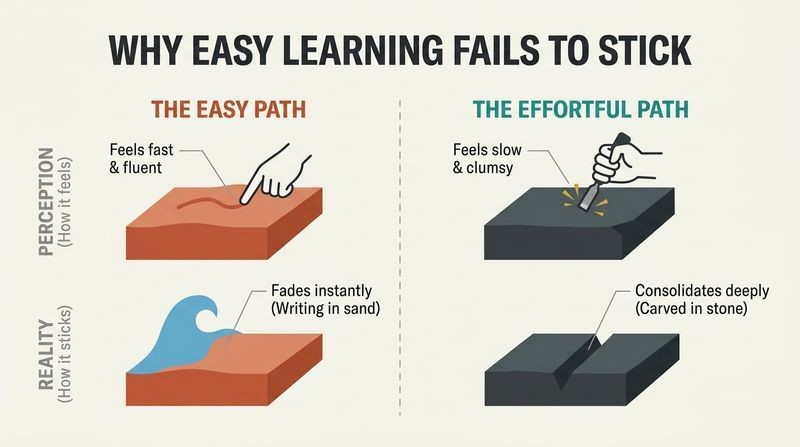
The book's central paradox: the study methods that feel most productive are usually the least durable, and the ones that feel frustrating build lasting mastery. Psychologists Elizabeth and Robert Bjork named these productive obstacles "desirable difficulties," short-term impediments that force the brain to work harder and, in doing so, encode learning more deeply.
Consider Mia Blundetto's military jump school. Recruits cannot take notes. They watch, rehearse, and execute under escalating difficulty until parachute reflexes hold under terror. Easy learning, the authors write, is like writing in sand. The catch is that effort is invisible to the learner: you feel slow and clumsy precisely when the deepest consolidation is happening. Struggle is not a sign of failure. It is the feeling of learning working.
This inverts the intuition that fluency equals competence, a bias cognitive science calls the fluency illusion. The claim aligns with Robert Bjork's distinction between "retrieval strength" (how easily something comes to mind now) and "storage strength" (how durably it is learned), which can move in opposite directions. A useful caveat: difficulty only helps when the learner can overcome it. Handing a beginner a Lithuanian textbook adds friction without learning. The skill is calibrating difficulty to the edge of ability, echoing Vygotsky's zone of proximal development and Csikszentmihalyi's flow, where challenge slightly exceeds current skill.
Rereading your notes tricks you into thinking you know it
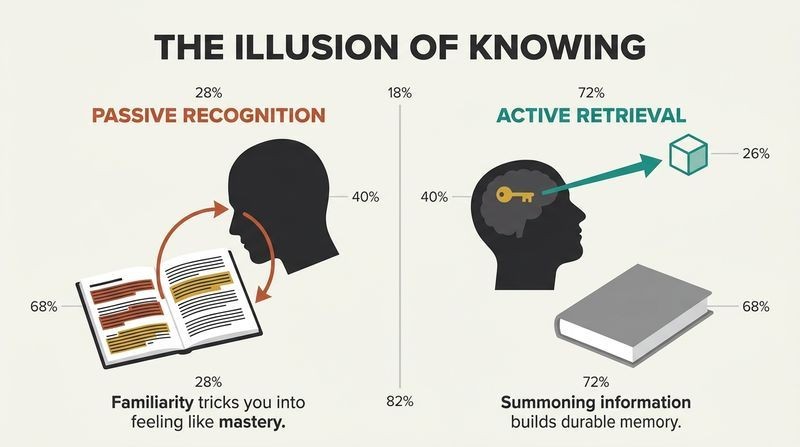
Rereading is the number one study method, used by over 80 percent of college students, and it is close to worthless after the first pass. In studies at Washington University, students who read a passage twice in a row did no better on delayed tests than students who read it once. The problem is subtle: growing familiarity with a text feels like mastery of its ideas.
The authors call this the illusion of knowing. A UCLA professor of 25 years could not locate the fire extinguisher inches from his office door despite passing it daily. A student who highlights notes in four colors and rereads them until fluent walks into the exam confident, then earns a D. Recognizing words on a page is not the same as being able to summon and apply their meaning.
The distinction between recognition and recall is the crux. Rereading trains recognition, which cheap familiarity mimics, while exams demand recall and transfer. This connects to the mere-exposure effect: repeated contact breeds a warm sense of knowing that is emotional, not epistemic. It also explains why propaganda's "big lie" works, as repeated claims feel true. The practical danger is metacognitive: poor studiers are the most overconfident, so the students most in need of changing tactics are the least likely to sense the need. The fix is not more time but a different act entirely.
Quiz yourself instead of reviewing; retrieval is the engine
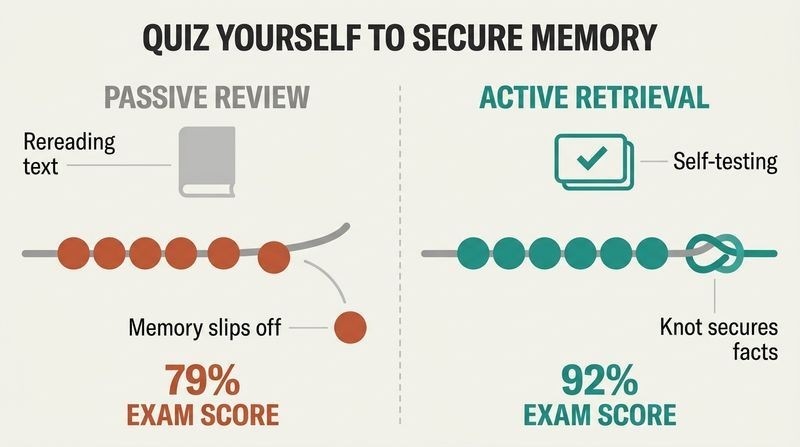
The most robust finding in the science of learning is the testing effect: pulling information out of memory strengthens it far more than putting it back in through review. In an eighth-grade science experiment in Columbia, Illinois, material that was quizzed scored an A-minus (92 percent) on later exams, while material merely restudied scored a C-plus (79 percent).
Retrieval does two things. It reveals what you actually know versus what you think you know, and it reconsolidates the memory, carving deeper neural paths so the knowledge returns faster next time. Flashcards, self-generated questions, and low-stakes quizzes all count. One quiz after reading beats several rereadings. Even failing to recall, then checking the answer, teaches more than passively rereading ever could. Retrieval, the authors say, ties the knot that keeps memory from slipping off the string.
This overturns testing's reputation as mere measurement, a "dipstick." The mechanism, memory reconsolidation, means retrieval is not neutral readout but active reconstruction that modifies the trace. A striking corollary from the research: harder retrieval, and slightly delayed retrieval, produce stronger gains, because effort is the active ingredient. One tension worth naming: high-stakes testing anxiety can consume working memory and hurt performance, so the benefit specifically attaches to frequent, low-stakes retrieval. Ironically, only about 11 percent of students self-test to learn, and most who do use it only to find gaps, missing that the act of retrieval itself is the learning.
Space out study sessions and let a little forgetting happen
Cramming resembles binge eating: a lot goes in and most comes right back out. Massed practice, the rapid-fire "practice-practice-practice" repetition most learners trust, produces fast visible gains that vanish just as fast. Spacing the same practice across days forces you to reconstruct fading knowledge, and that reconstruction is what strengthens it.
The evidence is vivid. Surgical residents learned to reattach tiny vessels in four lessons. Those who did all four in one day were outperformed on every measure a month later by those spaced a week apart, and 16 percent of the crammers botched the surgery on live tissue. The rule of thumb: leave enough time that practice is no longer mindless repetition, ideally at least a day so sleep can consolidate the memory. It will feel less productive. That feeling is the point.
Spacing is arguably the most cost-free upgrade available to any learner, requiring only rescheduling, not more hours. Its neuroscience rests on consolidation, the hours-to-days process by which labile memory traces stabilize and link to prior knowledge, with sleep playing a documented role. Spaced repetition software like Anki operationalizes this exact principle at scale. The deeper lesson is counterintuitive to institutions: intensive weekend workshops and bootcamps optimize for the feeling of progress, not retention. The surgical result should unsettle any field that crams professional training into single marathon sessions, since the visible confidence of the crammer is precisely the illusion the book warns against.
Mix problem types instead of drilling one at a time
Textbooks and coaches cluster practice by type: twenty problems of one kind, then twenty of the next. This blocked approach feels like mastery accruing. Interleaving, mixing different but related problems, feels worse but works better.
Two studies make it concrete. Eight-year-olds practiced tossing beanbags. The group that trained only on a three-foot target lost to the group that trained on two- and four-foot targets, even though the test used the three-foot distance. College students learning to compute volumes of solids scored 89 percent in blocked practice but crashed to 20 percent on a mixed test a week later, while interleavers scored 63 percent. Mixing builds the crucial skill real life demands: recognizing what kind of problem you face before choosing a solution. Studying birds or paintings interleaved sharpens the eye for what makes each type distinct.
Interleaving works by forcing discrimination, the act of noticing what distinguishes one category from another, which blocked practice hides because the answer type is already known. This maps onto how expertise actually operates: a physician's patient does not announce the disease, and a batter does not know the pitch is coming. The most telling detail is motivational: even after subjects saw their own interleaved scores beat their blocked scores, they still believed blocking helped more. That persistent metacognitive blindness suggests the barrier to better learning is not information but felt experience, which is why self-directed learners so reliably choose the inferior strategy.
Wrestle with a problem before you are shown the answer
Generation means attempting a solution before receiving instruction, and it primes the mind to absorb the answer when it arrives. Even trivial versions help: filling in a missing letter (foot-s e) locks a word into memory better than reading it whole.
Why does struggling first work? Trying and failing digs a channel in memory, exposing exactly where knowledge is missing, so when the solution appears it drops into fertile ground rather than sliding off a smooth surface. Bonnie Blodgett, the self-taught "Blundering Gardener," built national expertise by diving into projects before knowing how, then reflecting on the mess. Washington University's physics department now requires students to attempt problems before class despite student protest. It is better to solve a problem than to memorize a solution, and better to attempt and fail than never to attempt.
Generation reframes failure as preparation, a stance supported by research on "productive failure" (Manu Kapur), where students who flounder on problems before instruction outperform those taught first. The mechanism dovetails with predictive processing theories of cognition: the brain learns most from prediction error, the gap between what it expected and what occurred. This also reframes the flipped classroom and experiential learning as more than pedagogical fashion. A boundary condition matters, though. Generation requires corrective feedback; unresolved errors can entrench misconceptions. And in domains where errors are catastrophic, like landing a plane, pure trial and error is not an option, which is why simulation exists.
You are a terrible judge of what you actually know
Human judgment runs on two systems, borrowed from Daniel Kahneman: System 1 is fast, intuitive, and gut-level; System 2 is slow, analytical, and effortful. System 1 keeps us alive but falls for illusions, and we need System 2 to check it, the way pilots must trust instruments over their inner ear.
The cost of skipping that check is steep. China Airlines Flight 006 nearly crashed when the captain trusted his sensations over his gauges and let a jet roll into a dive. On the ground, the Dunning-Kruger effect shows the least competent are the most overconfident: students scoring in the 12th percentile on logic estimated they ranked near the 68th. The remedy is external gauges, quizzes, peer feedback, practice tests, that replace subjective confidence with objective calibration.
The pairing of aviation and Dunning-Kruger is clever because it shows the same failure at two scales: a trained expert overriding data under stress, and novices unable to see their own gaps. The unifying concept is metacognitive calibration, and the practical takeaway is that self-insight arrives through others and instruments, not introspection. This is a strong argument against pure student-directed and "unschooling" models, since the very learners who most need structure are the ones whose self-assessments are least reliable. Worth noting: Dunning-Kruger has faced statistical critiques (some patterns emerge from measurement artifacts), but the core practical warning, calibrate against reality, remains sound.
"Learning styles" are a myth with no scientific backing
The belief that each person learns best in a preferred mode, visual, auditory, or kinesthetic, is one of education's most entrenched ideas and one of its most wrong. When Harold Pashler and colleagues reviewed the evidence in 2008, they found almost no properly designed studies supporting it, and several contradicting it.
What actually matters is matching the mode to the material, not the person: diagrams for geometry, words for poetry. When the method fits the subject, everyone learns better regardless of preference. The danger of the styles myth is corrosive: one student concluded she was a "low auditory, kinesthetic learner" and therefore should not bother reading or listening. The productive move is the opposite, go wide, drawing on all your abilities rather than retreating into a supposed single channel.
This is one of the book's most valuable public-service debunkings, since surveys show the vast majority of teachers still believe in learning styles despite decades of null results. The persistence is itself instructive: the theory flatters our sense of individuality and gives a tidy story for struggle. The book's replacement framing, that abilities are multiple and worth deploying together, resonates with Sternberg's analytical, creative, and practical intelligences, which unlike styles has empirical support. The subtler point is ethical: labeling learners can become a self-fulfilling ceiling, whereas the evidence says effort and method, not fixed channel preference, drive outcomes.
Effortful learning physically rewires your brain, so adopt a growth mindset
The brain is not fixed hardware. Each time you learn, you form and strengthen neural connections, and expert practice thickens the myelin insulating relevant nerve fibers, which is why piano virtuosos show myelination changes specific to finger movement. Because ability is largely built, not born, how you interpret difficulty determines how far you go.
Carol Dweck's research draws the line. People with a fixed mindset see failure as proof of low ability and avoid challenge; those with a growth mindset see effort as the mechanism of getting smarter. In one study, students taught that struggle builds the brain became more aggressive learners. Praise matters too: children praised for effort chose harder puzzles, while 90 percent praised for being "smart" retreated to easy ones to protect their image. Expertise, per Anders Ericsson, comes from thousands of hours of deliberate practice, not genes.
The neuroplasticity framing gives Dweck's psychology a physical anchor, which strengthens its motivational force. Caution is warranted on two fronts. Growth-mindset interventions have shown smaller and more variable effects in large replications than early enthusiasm implied, working best for struggling students under supportive conditions rather than as a universal lever. And the "10,000 hours" popularization oversimplifies Ericsson, whose real emphasis was the quality of deliberate practice (goal-directed, feedback-rich, at the edge of ability), not raw time. Still, the core is defensible and liberating: framing intelligence as malleable changes the behaviors, risk-taking and persistence, that actually produce it.
Master material first, then use memory palaces to retrieve it
Mnemonic devices, from acronyms to the ancient "memory palace" (mentally placing vivid images along a familiar route or room), are not learning tools. They are retrieval and organization tools, filing cabinets for knowledge you have already understood.
Psychology students at Bellerbys College in Oxford built palaces in local cafes, populating a Pret-a-Manger with a man-eating plant to cue twelve paragraphs on dieting theory for their exams. Their teacher, James Paterson, a competitive memory athlete who can memorize a shuffled deck in under two minutes, insists he covers the concepts thoroughly in class before any palace is built. Paterson learned this the hard way: he first used mnemonics to ace exams without truly understanding, and discovered he had the mountaintops but not the mountain range. Mnemonics let mastered knowledge surface instantly under pressure.
The critical qualifier, master before you memorize, rescues mnemonics from their reputation as rote-learning parlor tricks. The technique's power comes from dual coding: pairing verbal information with vivid spatial imagery gives the brain two retrieval routes instead of one, and images are recalled more readily than abstract words. The method of loci exploits the hippocampus's evolved strength in spatial memory. What the book adds beyond Joshua Foer's popular account is the pedagogical boundary: a palace organizes comprehension for retrieval but cannot manufacture understanding. Used out of order, it produces confident recitation without knowledge, the same illusion the whole book warns against.
Explain new ideas in your own words and connect them to what you know
Elaboration is finding extra layers of meaning by relating new material to prior knowledge, translating it into your own words, or building a metaphor for it. To grasp heat conduction, picture warming your hands on a cocoa mug; for angular momentum, see a skater's spin speed up as her arms pull in. There is no known limit to how much you can learn if you elaborate, because each connection becomes another retrieval cue.
Reflection combines retrieval and elaboration: after a class or experience, ask what happened, what worked, and what you would do differently. Neurosurgeon Mike Ebersold invented a life-saving suturing technique by replaying difficult surgeries at home each night. Biology professor Mary Pat Wenderoth assigns weekly "learning paragraphs" and single-sheet visual summaries so students knit systems together rather than transcribing slides.
Elaboration is the connective tissue that turns isolated facts into a navigable structure, which is why the book links it to "structure building," the habit strong learners have of extracting central ideas and organizing them into a coherent mental model. This aligns with schema theory: knowledge organized into frameworks is more retrievable and more transferable than lists. Reflection also functions as spaced retrieval in disguise, which is why it compounds. The one demand it makes is honesty; elaboration only works when connections are accurate, so it pairs best with feedback. For self-learners, the "teach it to someone" test remains the cheapest, most exposing check on real comprehension.
Analysis
"Make It Stick" is a science-driven self-help hybrid built on an unusual collaboration: two eminent cognitive psychologists (Roediger and McDaniel) and a storyteller (Brown). Its structure enacts its own thesis, deliberately spacing and interleaving its core ideas rather than treating each once, so the reader experiences the effortful retrieval the book prescribes. The difficulty of summarizing it is that its value lives less in novel facts than in overturning intuitions the reader already trusts.
The book's intellectual center of gravity is a single robust finding, the testing effect, surrounded by a family of "desirable difficulties": spacing, interleaving, variation, and generation. What makes the argument persuasive is its refusal to rely on lab studies alone. It braids in field experiments (Columbia Middle School's grade-level gains) and vivid case studies (a pilot, a neurosurgeon, a Marine, a bankrupt-railroad investor) so that abstract mechanisms acquire narrative weight. This is Gladwellian in method but tethered to peer-reviewed evidence, a rare and welcome discipline.
The book's most durable contribution is metacognitive, not merely technical. Its deepest claim is that our felt sense of learning is systematically miscalibrated, that fluency, ease, and familiarity are precisely the sensations that betray us. This connects to a broader theme in behavioral science, from Kahneman's dual systems to the illusions of introspection: humans are unreliable narrators of their own minds.
Where the book is vulnerable is at the edges. Growth-mindset and working-memory-training claims have weathered replication challenges since 2014, and the "deliberate practice" literature has grown more contested about how much of expertise practice explains. But the core toolkit, retrieve, space, interleave, generate, elaborate, and calibrate against external feedback, has only strengthened with time. For any student, teacher, or lifelong learner, it offers the rarest thing in the genre: advice that is counterintuitive, cheap, and empirically true.
Review Summary
Make It Stick offers evidence-based strategies for effective learning, emphasizing retrieval practice, spaced repetition, and interleaving over traditional methods like rereading. The book challenges common misconceptions about learning and provides practical techniques for students, teachers, and lifelong learners. While some readers find the content repetitive or overly long, many praise its insights and applicability. The authors stress the importance of effortful learning, embracing difficulties, and developing a growth mindset. Overall, reviewers recommend the book for its valuable advice on improving memory retention and learning efficiency.
People Also Read





FAQ
What's Make It Stick: The Science of Successful Learning about?
- Focus on Learning Science: The book delves into the science of learning and memory, offering evidence-based strategies for effective learning.
- Counterintuitive Strategies: It presents strategies that may seem counterintuitive, like embracing difficulties and using retrieval practice, which lead to deeper learning.
- Real-Life Examples: Through stories and examples, the authors illustrate successful application of these principles in various fields.
Why should I read Make It Stick: The Science of Successful Learning?
- Improve Learning Effectiveness: The book helps you adopt effective learning strategies grounded in cognitive science for better retention.
- Debunking Myths: It challenges common beliefs about learning, such as the effectiveness of cramming and learning styles.
- Applicable to All Learners: Whether you're a student, teacher, or lifelong learner, the insights can enhance your learning processes.
What are the key takeaways of Make It Stick: The Science of Successful Learning?
- Effortful Learning is Better: Learning is deeper and more durable when it requires effort, as easy learning often leads to quick forgetting.
- Retrieval Practice is Crucial: Actively recalling information strengthens memory and interrupts forgetting, making testing a powerful tool.
- Spaced and Interleaved Practice: Spacing out practice and mixing topics leads to better retention and understanding.
What are the best quotes from Make It Stick: The Science of Successful Learning and what do they mean?
- "Mastery is a quest": True mastery requires effort and persistence, not just passive learning, encouraging readers to embrace challenges.
- "The harder it is to recall": Struggling with recall strengthens memory, suggesting that difficulties can lead to deeper understanding.
- "Knowledge is not knowhow": This underscores the difference between rote memorization and true understanding, encouraging focus on concepts.
What is retrieval practice, and why is it important in Make It Stick: The Science of Successful Learning?
- Definition of Retrieval Practice: It involves recalling information from memory, strengthening neural pathways associated with that information.
- Benefits of Retrieval: Engaging in retrieval practice reinforces learning and improves long-term retention.
- Practical Applications: Techniques like self-testing and flashcards are effective forms of retrieval practice.
How does spacing out practice improve learning according to Make It Stick: The Science of Successful Learning?
- Concept of Spaced Practice: It involves distributing learning sessions over time rather than cramming all at once.
- Long-Term Retention: Spacing out practice strengthens memory and improves retention over the long term.
- Real-World Examples: Examples like surgical residents performing better with spaced lessons demonstrate its effectiveness.
How does interleaved practice improve learning in Make It Stick: The Science of Successful Learning?
- Definition of Interleaved Practice: It involves mixing different topics or types of problems during study sessions.
- Benefits of Interleaving: This method enhances learning by forcing adaptation and better discrimination between concepts.
- Contrast with Massed Practice: Massed practice leads to quick gains but poor long-term retention, unlike interleaving.
What are "desirable difficulties" in Make It Stick: The Science of Successful Learning and how do they enhance learning?
- Definition of Desirable Difficulties: Challenges that make learning harder but lead to stronger retention and understanding.
- Examples of Desirable Difficulties: Techniques like spacing, interleaving, and retrieval practice create these beneficial challenges.
- Long-Term Benefits: Embracing these difficulties encourages deeper processing and more durable learning outcomes.
How do cognitive biases affect learning and self-assessment in Make It Stick: The Science of Successful Learning?
- Understanding Cognitive Biases: Biases can lead to overconfidence and misjudgments about what we know.
- Illusions of Mastery: Learners often mistake familiarity with material for true understanding, leading to poor self-assessment.
- Importance of Feedback: Seeking feedback and engaging in self-testing can counteract these biases and improve self-awareness.
What role does reflection play in the learning process according to Make It Stick: The Science of Successful Learning?
- Definition of Reflection: Involves reviewing and thinking critically about what has been learned to enhance understanding.
- Benefits of Reflective Practice: Helps connect new knowledge to prior experiences and solidify understanding.
- Practical Techniques: Writing summaries or discussing key concepts with peers can facilitate reflection and deepen learning.
How can I apply the principles from Make It Stick: The Science of Successful Learning in my own learning?
- Implement Retrieval Practice: Use self-testing techniques like flashcards to reinforce learning and improve retention.
- Incorporate Spacing and Interleaving: Space out study sessions and mix different subjects to enhance understanding.
- Embrace Challenges: View difficult material as opportunities for growth and deeper learning.
What is the difference between rule learners and example learners in Make It Stick: The Science of Successful Learning?
- Rule Learners: Focus on understanding underlying principles, better at applying knowledge to new situations.
- Example Learners: Tend to memorize specific examples without grasping broader rules, hindering problem-solving.
- Improving Example Learning: Comparing multiple examples helps identify commonalities and extract underlying rules.
Download PDF
Download EPUB
.epub digital book format is ideal for reading ebooks on phones, tablets, and e-readers.








