

Key Takeaways
Stop mistaking a school-shaped struggle for proof of a child's limits
A hidden difference. Phil Hanley spent five years failing at reading and spelling before doctors identified severe dyslexia, a learning difference that affects how a person processes written language. Before diagnosis, teachers treated his difficulty as a lack of ability or effort. He could solve math problems, yet lose marks because he could not read the question or spell the answer. School taught him to see himself as stupid, even though his kindergarten teacher had described an engaged, capable child.
Support kept him afloat. His mother, Joan, refused to let poor grades define him. She defended him at school, helped with homework, and reminded him that difficulty reading was not evidence of low intelligence. The book insists on both truths: dyslexia made daily life and school painfully difficult, and those difficulties never measured the whole person.
What's important here is the distinction between a skill deficit and a verdict on a person. When institutions treat performance on one narrow task as a proxy for intelligence, they can turn an access problem into an identity wound. A diagnosis can clarify why a task is hard, but it cannot by itself undo years of humiliation. Hanley's mother's steady faith matters because it supplies a competing interpretation before he can supply one himself.
Change the conditions of the test before judging the student's ability
Access changed the result. In his final year of high school, Hanley moved into advanced classes after his parents challenged the school's assumptions. A resource teacher, Mr. Armstrong, worked one-on-one with him. Teachers supplied notes, allowed extra time, and read exam questions aloud while Hanley dictated answers. The tests assessed what he knew rather than how quickly he could read and write.
Ability became visible. The work was exhausting, and Hanley sometimes needed an entire day for an exam. Still, he earned As, graduated with honors, and became an Ontario Scholar. His parents then worried that the effort had taken too much out of him to make college a wise next step. The achievement did not erase the cost. It showed how much a student's measured ability can depend on whether the format lets that ability appear.
This is a practical lesson in measurement: an assessment can measure knowledge, reading speed, memory, or some mixture of all three. Accommodations are not a lowered bar when they remove an irrelevant obstacle; they make the intended ability easier to observe. Hanley's results challenge the assumption that identical conditions are automatically fair. At the same time, the story exposes a hard limit: access to one supportive teacher briefly opened a door, but it did not redesign the educational path around him.
Follow the opening that gets you moving, not the plan you lack
A friend saw possibility. After high school, Hanley was living at home without a career plan and unable to manage many written tasks alone. His friend Shalom Harlow, already working as a model, suggested he try modeling. She helped connect him to a photographer, and the first shoot gave Hanley evidence that he might belong in that world. He went to Milan at nineteen, despite feeling physically and socially out of place among polished, competitive models.
Motion came before certainty. Modeling did not become his life's work, but it took him beyond Oshawa, exposed him to new people, and helped him discover what kind of work he wanted. Its value was not that it solved dyslexia or guaranteed success. It interrupted a stalled life and made another step imaginable. Sometimes a workable next move is more useful than a complete map.
Hanley's path resembles exploration more than career planning: an opportunity produces information that could not have been gathered from the starting point. That is especially valuable when a person has been told, explicitly or implicitly, that only conventional routes count. The story does not suggest that every invitation deserves a yes. Shalom offered a credible bridge into a new environment, and Hanley chose to test it. Movement is useful when it expands options, not when it becomes an excuse to ignore risk.
Let a bad fit reveal the market, not define your worth
One industry's ideal was another's mismatch. In Milan, Hanley was too thin for the clothes at Giorgio Armani's fitting, and the humiliating experience left him feeling that his body had failed a public test. Yet he was booked by Dolce & Gabbana, whose collection suited his angular, slender look. Later, fashion trends shifted toward pale, thin models, and his appearance became commercially desirable. The same body moved from liability to asset as the market changed.
Rejection had context. Modeling made that context unusually visible: designers evaluated bodies against a particular collection, season, and aesthetic. A casting decision could hurt without being a universal judgment about a person's value. Hanley still faced real rejection and shame, but he gradually learned that a poor fit with one gatekeeper did not prove he had nothing to offer.
The fashion world makes a general truth almost comically literal: evaluation often means fit with a local demand, not measurement of human worth. Seeing the standard change can loosen the grip of rejection. It also reveals the instability of praise. A person should not mistake a favorable trend for proof of permanent superiority any more than an unfavorable one proves inadequacy. The useful question is narrower: what does this setting reward, and is that a setting worth pursuing?
Choose support that enlarges your choices, not your dependence
Help made life possible. Hanley's mother, friends, and later colleagues often read, organized, or handled logistics he found difficult. In London, his friend Ronnie offered him a home and steady companionship. Hanley also depended on a romantic partner, Alison, to arrange travel, manage addresses, and help him prepare for daily tasks. That practical support made his life smoother, but the relationship grew controlling and unhappy. He recognized how hard it was to leave when he relied on her for basic organization.
Support needs boundaries. The memoir does not treat help as weakness. It shows how essential other people can be when systems assume everyone can handle written instructions, forms, and planning in the same way. But care becomes precarious when one person holds too much power over another's independence. The aim is not to do everything alone. It is to build support that preserves choice and dignity.
This distinction is useful well beyond disability: good support increases a person's capacity to act, while coercive support makes action conditional on pleasing the helper. The line can be difficult to see when practical assistance is genuinely needed. Hanley's story honors interdependence without romanticizing it. A stronger support network, including more than one trusted person and reliable external systems, can reduce the pressure placed on any single relationship.
Use meditation for steadiness, not as a substitute for OCD care
A practice brought relief. After returning to Vancouver, Hanley learned Transcendental Meditation, or TM, a practice in which a person silently repeats a personal mantra while allowing thoughts to arise without chasing them. He meditated twice daily and found that anxiety eased and unwanted thoughts felt less gripping. The practice helped him recognize how harshly he had judged himself.
Relief was not treatment. In New York, he developed severe checking rituals, sometimes taking nearly an hour to leave his apartment. He tried to control the problem by meditating more, until meditation itself became compulsive and all-consuming. A therapist eventually identified obsessive-compulsive disorder, or OCD. A silent retreat and spiritual discipline did not resolve it. Hanley's account distinguishes a personally meaningful practice from clinical care, and shows how a helpful tool can become harmful when used as the only answer.
The key distinction is between a practice that supports well-being and a treatment matched to a disorder. A calming routine may help someone feel more grounded without addressing the mechanisms driving compulsions. Hanley's experience also cautions against treating failure to improve as a failure of spiritual effort. When a coping strategy becomes rigid, burdensome, or fused with fear, its role deserves reassessment. A memoir can illuminate that distinction, though it cannot substitute for individualized clinical guidance.
Train the comic instinct school mistook for a distraction
Humor was already there. Hanley had made friends laugh for years, but school rewarded reading, writing, and test performance, not quick observations or comic timing. In England, an improv class gave him a first taste of making strangers laugh. His friend Nathan recognized the ability and encouraged him to try stand-up, a form that let Hanley speak in his own voice without relying on a team to show up.
A workable process mattered. Hanley built material through spoken ideas, handwritten notes, and later large visual surfaces that suited his way of thinking. He also wrote comedy for films, including the Air Buddies movies, dictating and drafting scenes despite the effort reading and writing required. Talent did not make the work easy. It gave him a reason to persist through a difficult process.
The contrast between school and comedy is not simply between a bad institution and a gifted student. Each environment asks for different capacities, and only one recognized Hanley's strengths. His story suggests that talent can remain invisible when the available measures are too narrow. Yet discovering a strength does not remove the need for craft, collaborators, and accommodations. The important shift is from asking whether someone is capable in general to asking what conditions let a particular capability develop.
Keep showing up until difficult rooms become usable material
Repetition built control. Hanley performed night after night in Vancouver, including music open mics, hostile bars, and awkward private events. At one show in the Cobalt, a rowdy audience threw wet toilet paper at him. A joke about his experience on the short bus turned the room toward him, and the heckler later apologized. These rooms were not glamorous training grounds, and some were genuinely unsafe.
The hard rooms taught a skill. Hanley kept a count of his performances and pushed toward five or more shows a week. Repetition helped him refine concise jokes and become nimble with audience interaction, known in comedy as crowd work. He eventually used audience members as recurring characters across a set. The lesson is not to seek abuse. It is that practice under varied conditions can build skills that a friendly, predictable room never tests.
Repeated performance gives a comic feedback that private writing cannot: a line either connects in the room or it does not. Hanley's rough gigs sharpened attention to timing, audience mood, and adaptation. That is a form of deliberate practice, but the account also draws a necessary boundary. Exposure to difficulty can build skill; danger and humiliation are not inherently educational. The strongest practice environment stretches ability while leaving enough safety for the performer to learn rather than merely endure.
Let pain become comedy without calling suffering a gift
A breakup became a scene. After his relationship with Danielle ended, Hanley replayed her breakup call and began imagining a different response, one in which he rejected her first. He shaped the imagined exchange into a comic bit, sometimes inviting a woman from the audience to read the other role. The performance gave him a way to turn a private humiliation into shared laughter, and audiences responded to the fantasy of revising a painful moment.
Pain was material, not a blessing. Hanley connects his comedy to what a therapist called the wound and the bow: using a painful experience as the source of a strength. The phrase does not mean the injury was good, necessary, or deserved. The comedy came from the work of reframing it, shaping it, and performing it. Humor offered agency and connection, not proof that suffering should be romanticized.
The bit demonstrates how comedy can create distance without denying what happened. Rehearsing an alternate ending gives the performer control over a scene that once felt uncontrollable, while the audience recognizes the shared wish to revise regret. That transformation is powerful, but not automatic: some pain remains pain, and public disclosure is a choice rather than an obligation. Hanley's strongest claim is about possibility, not prescription. A hard experience can become art without becoming worthwhile in retrospect.
Treat dyslexia shame as a systems failure, not a private defect
The pattern is bigger than one classroom. Hanley argues that schools often mistake dyslexia for laziness or low intelligence, damaging students' self-worth while failing to teach them effectively. He cites estimates that about 10 percent of people in the United States are dyslexic, and prison studies in Texas and Louisiana in which roughly 47 to 48 percent of inmates showed signs of dyslexia. In the Louisiana sample, he notes, 97 percent had received special education. These figures do not establish that dyslexia causes incarceration; they underscore the stakes of exclusion and inadequate support.
Change the message and the method. Speaking to dyslexic students, Hanley urges them to ask for help without shame and to value strengths that school overlooks. He also asks adults to protect students' self-esteem, recognize their abilities, and adapt instruction. His own progress depended on a mother who kept advocating and teachers who eventually changed how he could demonstrate what he knew.
The memoir's most consequential implication is institutional: resilience matters, but it should not be used to excuse preventable harm. The prison statistics are a warning signal, not proof of a simple causal chain. Their value lies in prompting questions about educational exclusion, special-education quality, and the consequences of labeling children as deficient. Individual success stories can inspire, but they can also obscure how uncommon such outcomes are. Hanley pairs his survival with a demand to change the conditions that produced shame.
Analysis
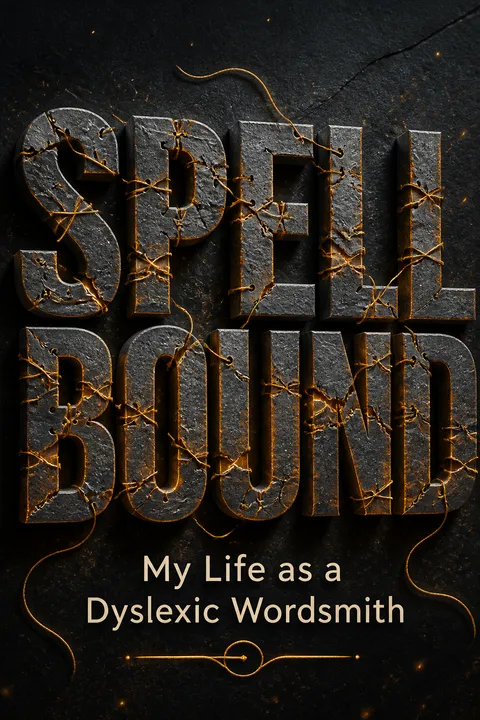
Spellbound is a memoir organized around a gradual change in interpretation. As a child, Hanley experiences dyslexia as personal failure because school repeatedly treats reading and writing as proof of intelligence, effort, and character. The first major counterforce is not a technique but a relationship: his mother insists that the institution's judgment is incomplete. Later, Mr. Armstrong makes that belief operational by changing how Hanley can demonstrate knowledge. The contrast between his years of failure and his final-year academic success makes the book's critique concrete.
The narrative then widens from school to work. Modeling offers escape without becoming a final answer. Its shifting standards expose the difference between rejection and a universal verdict, while the move into comedy gives Hanley a craft in which effort produces visible improvement. The path is not a simple triumph arc: he describes dependence, heartbreak, obsessive-compulsive symptoms, and psychiatric misdiagnosis. Meditation helps at one point, becomes burdensome when treated as a cure, and does not replace clinical care. That complication gives the memoir credibility and discourages a tidy moral about mindset solving everything.
The book's most distinctive argument is that a disability can shape strengths without being valuable because it causes suffering. Hanley's humor, crowd work, and unusual creative process are connected to his experience, but he does not need to claim that school mistreatment was beneficial. This distinction matters. Stories of exceptional achievement can accidentally imply that people must convert pain into success to justify receiving care. Hanley partly resists that implication through his advocacy for students and his account of the costs.
The result is both an individual story and a challenge to the systems around it. His career depended on supportive people, altered expectations, and environments that valued capacities school had missed. The memoir's hope is therefore not that every child will find an unlikely escape route. It is that fewer children should need one to discover their worth.
Glossary
Dyslexia
Different language processingA learning difference that affects how a person processes written language, often making reading, spelling, or writing unusually difficult. Hanley describes its effects as reaching beyond schoolwork into planning, organization, and confidence. In the memoir, dyslexia is not treated as a measure of intelligence, but as a difference that can be misunderstood when instruction and assessment assume one standard way of learning.
Transcendental Meditation
Mantra-based meditation practiceA meditation method Hanley learns in Vancouver. Practitioners silently repeat an individually assigned mantra while allowing thoughts to arise and pass without deliberately controlling them. Hanley initially meditates twice a day and finds the practice calming and clarifying. His experience also shows its limits: when he uses meditation compulsively to try to eliminate severe obsessive thoughts, the practice becomes burdensome rather than sufficient treatment.
Obsessive-compulsive disorder
Intrusive thoughts and compulsionsA mental health condition associated with intrusive, unwanted thoughts and repetitive behaviors performed in response to distress. Hanley describes repeatedly checking appliances, taps, and locks until leaving home can take a long time. A therapist identifies his symptoms as OCD after earlier explanations and treatment attempts fail to address them. His account distinguishes the disorder from ordinary worry and from dyslexia itself.
wound and the bow
Pain transformed into strengthA phrase Hanley's therapist uses for the process of drawing creative strength from a painful experience. Hanley applies it to turning school humiliation and other personal struggles into comedy. The metaphor describes what he makes from an experience, not a claim that the injury was beneficial, necessary, or deserved. Suffering can remain harmful even when someone later shapes it into art.
O-1 visa
U.S. extraordinary-ability work visaA U.S. work visa Hanley pursues to perform comedy in New York. His application requires evidence that he qualifies as an individual with extraordinary ability or achievement, including support letters and proof of professional recognition. The visa marks a practical threshold in his career: ambition alone is not enough to work legally in the United States, so he must document his accomplishments.
Download PDF
Download EPUB
.epub digital book format is ideal for reading ebooks on phones, tablets, and e-readers.








