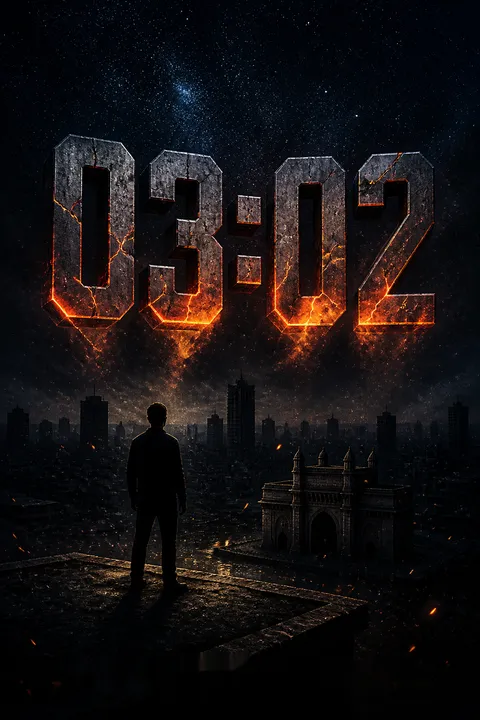


Plot Summary
Promotion Before Blackout
At thirty, Aaditya believes his promotion to vice president at Excel Ventures confirms the life he chose after abandoning his childhood ambition to join the Army. His father had forbidden that path after Aaditya's uncle died in combat, and business success later helped pay for his mother's cancer treatment.
At the celebration, mentor and friend Dhruv admits that corporate life has cost him too much for spreadsheets and titles. The warning follows Aaditya home, where he opens a box of sports and cadet medals before returning to plans for his career. At 03:02, a dull blast wakes him. Electricity, phones, cars, and the entire visible city have stopped working, though he assumes the failure will soon be repaired.
Aaditya's promotion initially gives him a legible measure of success: title, salary, and a future ladder to climb. The medals in his box complicate that confidence. They embody an abandoned self, but also the family history that made his sacrifice seem necessary. Dhruv's disillusionment introduces a question Aaditya has avoided by treating work as meaningful in itself. The blackout then removes the infrastructure that made his chosen identity feel secure. The exact time, 03:02, becomes a hinge between personal ambition and collective emergency. His old training has not vanished; it has merely been waiting outside the professional story he told about himself.
One Working Generator
By morning, Aaditya learns that the outage has disabled not only the grid but generators, vehicles, phones, and hospital equipment. He promises elderly neighbor Mr Guha help because his pacemaker has stopped, then discovers at Hiranandani Hospital that patients have died when the backup systems failed.
At a crowded society meeting, former electrical engineer Nitish bypasses the generator's circuits and restores power to the common areas. Aaditya urges residents to conserve fuel rather than illuminate every apartment, and the committee agrees to ration the generator.
When he and guard supervisor Pandey cycle out for diesel, they find the pumps useless and hear gunfire near R City Mall. Flames rising from the mall turn a technical failure into a threat to survival.
The restored generator offers practical relief, but it also exposes the limits of simply returning to routine. Electricity is not an abstract convenience here: it sustains pacemakers, hospital machines, and the social confidence that a repair crew can always be summoned. Nitish's improvised fix gives the residents a first experience of solving a problem together, while Aaditya's fuel question forces them to think beyond the evening. The burning mall punctures their optimism. Their sheltered residential complex is not separate from the city around it, and security cannot be assumed just because gates and guards existed yesterday.
The Hotel's Screams
With police abandoning their station and most building guards going home, Aaditya organizes rotating night watches with Pandey, Nitish, and a few young residents. Nitish rigs lamps into makeshift searchlights.
Five armed men in stolen police uniforms approach, but retreat when the residents illuminate the road and prepare to resist. At dawn, screams draw Aaditya to the Meluha Hotel. He finds two murdered hotel workers, two dead men who tried to defend the guests, and foreign survivors in handcuffs beside the murdered women.
The old couple, Dr Guenther and Marie, and two Turkish businessmen, Ismail and Akif, accept shelter in Aaditya's community. His guilt at failing to warn them sharpens his resolve to protect people outside his own apartment block.
The failed warning at the hotel becomes Aaditya's first painful recognition that vigilance directed only inward is not enough. The sentries succeed tactically, yet the nearby guests suffer because the community's attention stopped at its own walls. His guilt is not merely private remorse; it changes the scale of responsibility he believes he must accept. The rescue also introduces people whose skills and histories will matter later, turning hospitality into a reciprocal bond. By taking in strangers, the residents begin to define safety as a shared condition rather than a privilege maintained by locked gates.
The Hospital's Last Patient
The hospital doctor, Megha, refuses to abandon her remaining patients when a looter in a police uniform threatens her. Aaditya returns with Pandey and Nitish, knocks the attacker down, and kills him in the struggle. He takes Megha and two patients back to the society, then learns of a badly wounded Navy pilot hidden at the hospital.
The residents move the pilot to Dr Guenther for treatment. Aaditya is shaken to realize that he has killed a man, even though the attacker was about to assault Megha and harm patients. The pilot, Squadron Leader Sajid Iqbal, insists on explaining what happened before his condition worsens, making the survivors' immediate crisis part of a much larger one.
Aaditya's first lethal fight breaks the boundary between the competent professional he understands and the person circumstances demand. His action protects Megha and the patients, but necessity does not erase the psychological cost. Megha's refusal to leave her patients offers a moral counterpart to his violence: both accept danger for others, though in sharply different forms. The pilot's arrival widens the story's scale without yet resolving its mystery. The community can no longer treat each emergency as an isolated failure of local infrastructure; someone with military knowledge may explain why ordinary systems have collapsed everywhere.
The First Armed Stand
Iqbal explains that an enemy nuclear detonation high in the atmosphere produced an electromagnetic pulse, frying modern electronics across the region. He also describes an attempted terror attack and the armed men who shot him. As residents absorb the scale of the disaster, the gang leader arrives seeking revenge for the man Aaditya killed at the hospital.
Residents throw bottles to disrupt the attackers, while Aaditya uses General Lamba's small pistol to wound the gunman. When ammunition runs out, Pandey, Ismail, and Akif take the leader into the darkness and kill him. The attackers flee, leaving weapons behind. Aaditya survives the stand, but victory comes with a new burden: frightened neighbors now look to him for decisions.
The EMP revelation transforms confusion into an intelligible, if terrifying, cause, while also showing that explanation cannot restore the institutions the blast has disabled. The gang's attack tests whether the residents can convert fear into coordinated action. Bottles, a tiny pistol, and improvised courage are not an army, but their shared response denies the attackers an easy victory. The killing of the gang leader complicates that achievement. Violence protects the community and secures its weapons, yet it gives Aaditya authority through an act he cannot regard as clean. Leadership begins not as a title he claims but as a consequence others assign to his actions.
A Neighborhood Learns
Aaditya persuades neighboring societies to coordinate watches and block alleys with abandoned cars. Former Army officer General Lamba lends experience, while Nitish repairs generators and logistics director Kundu organizes supplies.
Rani, the Haiko worker who knows village survival, proposes drawing water from Powai Lake and planting food in the gardens. Residents begin collecting water, growing crops, and pooling labor; even domestic workers challenge employers who still expect old class privileges.
The diamond merchant Mr Sinha joins after Aaditya exposes armed guards who stole supermarket food and drives them away. Not everyone joins: when desperate families seek refuge, the committee turns them back, fearing shortages and hidden attackers. The decision leaves Aaditya and Mrs Khatri troubled.
The crisis redistributes competence. Kundu's corporate logistics and Nitish's technical knowledge still matter, but Rani's practical experience answers questions the affluent residents had never needed to ask. Social rank loses force when water must be carried by hand and food must be grown. Yet solidarity remains bounded. The refusal of refugees reveals that collective care can coexist with exclusion, especially when people fear that compassion will endanger dependents. Sinha's decision to join marks a change in his own outlook, but the unresolved refugee question shows that no single act of generosity can settle the community's moral limits.
Justice on the Balcony
When teenager Mangla arrives at the clinic beaten and raped, Megha identifies her attacker as Rakesh Khaitan, a wealthy young executive reputed to have escaped consequences before the blackout. The community debates how to investigate crimes without courts or police.
Aaditya leads a hearing process on paper, but when Khaitan refuses to attend and boasts that money and connections would protect him, Aaditya breaks his arm and throws him from his balcony. Pandey tells the community that Khaitan killed himself.
General Lamba privately understands what happened and urges Aaditya to accept the leadership he is already exercising. Megha comforts him, but Aaditya recognizes that protecting the vulnerable has begun to make him judge and executioner.
Khaitan's power rests on the old system's unequal distribution of credibility: Mangla's vulnerability once made her easy to dismiss, while his wealth could purchase silence and witnesses. The collapse of that system creates an opening for justice, but no legitimate procedure automatically fills it. Aaditya's attempt to establish hearings is overtaken by his own certainty and fury. His action stops a predator from exploiting the new disorder, yet it also makes private conviction the basis of punishment. Lamba's counsel recognizes that leadership entails power, but the scene leaves a crucial distinction unresolved: taking responsibility for protection does not guarantee that one's judgments remain just.
The Airport's Black Flag
After lights return at the international airport, expatriate residents decide to go there, hoping to contact their families. Aaditya, Mahadev, and Akif later travel out to find medicines and learn what happened.
Near the airport road they find the expatriates, including Don and several children, executed beside their bus. Two armed men are searching the bodies; one nearly kills Aaditya before Mahadev shoots him. The airport flies an ISIS flag, confirming that the attackers are organized terrorists, not merely local looters.
Aaditya returns injured and more frightened than before. The enemy has a base nearby, captured weapons, and hostages among the missing women. A conflict once limited to protecting a neighborhood has become part of a coordinated war.
The airport changes the meaning of distance. It is close enough to visit by rickshaw, yet its black flag marks a world of organized violence that local barricades cannot contain. The executed families make the danger concrete, especially because they had left seeking safety and connection. Mahadev's intervention shows that survival skills often come from people whom the previous social order undervalued. Aaditya's injury also punctures the legend beginning to form around him: courage cannot cancel the advantages of trained, armed opponents. The discovery obliges the community to prepare not just for breakdown, but for an enemy pursuing deliberate territorial control.
A School Becomes a Refuge
When Aaditya learns that terrorists are searching nearby neighborhoods for those who killed their men, he and Akif go to Nahar's school, where families have taken refuge. They warn the residents and help them evacuate toward the protected societies before a patrol arrives.
Aaditya and Akif ambush two terrorists at the school, take their weapons, and return with their radios. Back home, an ancient vacuum-tube television restored by Nitish receives a government broadcast urging citizens to hold together.
The national song that follows moves the assembled residents, who had felt stranded and forgotten. The message does not bring immediate rescue, but it confirms that India still has functioning leadership and turns the neighborhood's improvised resistance into a cause larger than self-preservation.
The school evacuation revises the earlier refusal of outsiders. Aaditya now risks his own small force to protect people beyond the alliance, because the threat has become shared and imminent. His decision does not solve the scarcity that motivated the earlier rejection, but it reveals how moral boundaries shift when the supposedly external danger reaches everyone. The restored television performs a different kind of repair from the generator: it reconnects residents to a national public. The broadcast gives meaning to local action without pretending that symbolic unity can substitute for food, medicine, or weapons.
IIT's Improvised Arsenal
Aaditya sends young fighters toward IIT Bombay, where they rescue more than fifty students sheltering in the canteen after looters attack. Mohit, whose research concerns electrical grids and electromagnetic pulses, joins Nitish in seeking workable technology.
His solar panels restore limited power, while Mahadev teaches a crew to bypass electronic systems in old buses and rickshaws. When Aaditya presses Mahadev about bullet holes in his vehicle, the driver admits that ISIS fighters forced him to transport them and that he escaped after helping them attack police.
Aaditya gives him a chance to serve the community by repairing transport. The new vehicles improve water delivery and patrols, while Mohit's work suggests that the residents may recover more than the ability to defend themselves.
The newcomers expand the community's capacity in distinct ways: the IIT students bring technical knowledge, while Mahadev brings intimate familiarity with vehicles and city routes. Their contributions expose the fragility of status based on education or income alone, but they also resist a simple reversal in which one kind of expertise replaces another. Mahadev's confession complicates the community's moral accounting. He assisted the enemy under coercion, yet his escape and practical usefulness make reintegration possible. His inclusion is a pragmatic choice and an ethical one: survival depends on judging what people can do now, not reducing them permanently to their worst constrained act.
The Sky Fights Back
A leaflet dropped from an unidentified plane announces that Indian forces are preparing to fight back. The residents raise the national flag, then watch two restored Alize aircraft attack the occupied airport. Both are shot down, and the enemy soon bombards Raheja Vihar with machine guns and rockets. Suri, terrified, tries to leave with a bus and community food; Aaditya lets him and his family depart rather than imprisoning them.
Soon afterward, a messenger delivers the terrorists' demand for supplies and girls in exchange for safety. Aaditya refuses, dressing for battle and rallying volunteers. He frames the choice as defense of home and family, not a promise of easy victory, and the community begins preparing for an assault.
The failed airstrike is a brutal lesson in the gap between national resolve and available capability. The old planes embody courage, but their destruction warns that symbolism and bravery alone cannot defeat superior weapons. Suri's departure tests whether Aaditya's leadership will become coercive; allowing him to leave preserves the voluntary principle even under pressure. The enemy's demand makes the stakes intimate and gendered, reducing people to resources for an occupying power. Aaditya's response channels fear toward defense, while refusing to pretend that every resident must fight. The community's consent matters because their resistance is built from civilians choosing what risks they will bear.
The Checkpoint Holds
General Lamba and engineering student Nasir prepare improvised explosives along the Ghatkopar approach while Akif and Ismail monitor captured radios. When an ISIS force advances in a Humvee and jeeps, the first bombs destroy vehicles, but a final device fails. Lamba is shot while trying to repair its wires.
Residents fire from behind their barricade; Yash and Mira are killed, and Aaditya is badly wounded. Two Indian Navy commandos, Ronald Ely and Shaikh, arrive during the fighting and help break the assault. The defenders capture weapons and vehicles, but Lamba's death and the young residents' losses end any illusion that their improvised army can fight without lasting cost.
The checkpoint battle marks the transition from improvised deterrence to sustained warfare. Nasir's bombs and the captured radios show how civilian ingenuity can exploit the enemy's confidence, but the failed device exposes the fragility of a plan dependent on makeshift materials. Lamba's choice to trigger the explosives himself is both an act of expertise and a sacrifice that cannot be separated from his age or grief. The deaths of young volunteers strip away the romance of patriotic action. Ronald and Shaikh bring professional skills, yet they do not erase the fact that the community has already paid in lives.
A Wedding Under Fire
After the battle, Ronald explains that nuclear electromagnetic attacks have blacked out major regions worldwide, while sleeper cells and reinforcements exploit the resulting chaos. The community captures two terrorists, and interrogation reveals that their leader, the self-proclaimed Caliph, is expected in Mumbai.
Aaditya contacts the national command, admits that his civilians cannot take the airport alone, and proposes combining them with trained personnel arriving from Goa. Before those forces arrive, Aaditya and Megha marry in a community celebration. Their private commitment forms amid the same losses and uncertainty that drive the military plan, giving them a future to imagine without suggesting that danger has passed.
The revelation of a global attack makes the neighborhood's experience one front in a coordinated political project, not an isolated catastrophe. Aaditya's honesty with the Army Chief is a maturation of leadership: he distinguishes what his force can do from what it cannot. The proposed coalition links local knowledge with military training instead of treating either as sufficient alone. His marriage to Megha does not function as an escape from war. It is a deliberate claim on ordinary life when ordinary life can no longer be assumed. Their choice gives emotional form to the resistance, but it also raises the stakes of every mission Aaditya accepts.
A Siege at Powai
The terrorists use night-vision snipers to kill exposed sentries, then fire mortars into the residential compounds, killing and wounding civilians. Residents move into underground parking areas, but the next morning an enemy Humvee blocks the route to Powai Lake, threatening the community's water supply. Aaditya and a small team approach it from behind, kill its crew, and drive the vehicle back before its absence raises alarm.
The captured Humvee brings a TOW missile launcher and new firepower, while Mohit and Nasir develop radio-triggered explosives and powerful spotlights to counter enemy night vision. Their defenses improve, but the siege makes clear that the enemy can attack families and necessities without risking a direct assault.
The shift from raids to siege targets the conditions that make collective life possible. Mortars punish residents in their homes, while the Humvee at the lake threatens water, a resource no amount of courage can replace. Aaditya's covert seizure of the vehicle restores a measure of agency, but it also confirms the community's dependence on surprise. The technical response by Mohit and Nasir is not simply inventive problem-solving; it is an attempt to alter who can see and strike whom. Light becomes both a defensive instrument and a vulnerability, forcing the community to treat visibility itself as a contested resource.
Heads Above the Lake
Aaditya's teams slip into the city to destroy a mortar crew before it can keep shelling their homes. The attack succeeds, but several raiders do not return. Reinforcements from Goa, including Major Shwetabh Mehta and military personnel, arrive and help defeat another enemy group. At dawn, the terrorists display the severed heads of six missing young fighters above the lake and dump their bodies in the water.
The atrocity devastates the residents and angers the fighters, while a mother blames Aaditya for inspiring her son to join the resistance. Aaditya accepts responsibility rather than blaming the dead youths. Their loss hardens his resolve, but also makes him fear that vengeance could destroy the judgment that kept them alive.
The enemy's mutilation of the dead is designed to turn grief into paralysis or indiscriminate retaliation. Instead, it makes the costs of leadership impossible for Aaditya to evade: his example has consequences even when he did not order the mission. His acceptance of blame is emotionally honest, though it cannot restore the young fighters or guarantee better decisions next time. The polluted lake joins bodily violence to material coercion, attacking both memory and survival. The arrival of trained reinforcements offers new capacity, but the community must still decide whether its anger will serve a plan or become another weapon used against itself.
The Airport Burns
After the Caliph's presence is confirmed, Aaditya sees that the airport is receiving aircraft and strengthening its defenses. He and Shwetabh drive a captured Humvee to a parking structure with a clear view across the city.
Shwetabh fires its TOW missile at a fuel tanker beside an incoming aircraft, igniting the plane and nearby terminal equipment; a second strike destroys a vehicle carrying anti-aircraft missiles. The explosions disrupt the enemy's air resupply and convince its fighters that the airport is under attack from forces they cannot locate.
Aaditya proposes exploiting their confusion with a coordinated assault: the Sea Hawks will draw fire, commandos will strike one approach, and his fighters will enter from the domestic terminal.
The missile strike reverses the geography of the siege. A weapon captured from the enemy becomes a way to reach beyond neighborhood barricades and threaten the logistical system sustaining the occupation. Aaditya's insight depends on collaboration: his knowledge of local buildings finds the sightline, while Shwetabh's training makes the shot possible. The attack does not defeat the airport force, but it creates uncertainty about the source and scale of resistance. That uncertainty is valuable because the enemy's superiority rests partly on its ability to dictate where a fight occurs. The shift from defense to coordinated assault is therefore strategic, not merely emotional.
03:02 at the Terminal
At 03:02, the Sea Hawks and commandos draw the airport guards toward the wrong entrances while Aaditya leads forty fighters through the domestic terminal. They fight through departure gates toward the occupied international side. Mahadev charges the Caliph's personal guard with explosives, killing many attackers and dying in the blast; Shaikh and Anagha also fall.
Aaditya recognizes Akif's ring on the masked commander and kills him. Shwetabh and Pandey arrive in Humvees, but the Caliph escapes toward a C-130. A damaged Sea Hawk collides with the departing plane, which explodes. Afterward, Aaditya gives rescued women weapons to decide the prisoners' fate, then broadcasts the airport's liberation and calls other Indians to resist.
The airport assault resolves the central conflict through coordination rather than a lone hero's strength. Its success depends on multiple kinds of labor: pilots draw fire, commandos exploit openings, civilians navigate and fight, and earlier technical improvisations make the approach possible. The cost is intimate and irreparable. Mahadev's sacrifice and the deaths of Shaikh and Anagha prevent victory from becoming uncomplicated triumph. Aaditya's decision to give the rescued women weapons transfers agency to people who had been treated as spoils of war, though it also shows how far the community's justice has moved beyond formal institutions. The broadcast turns a local victory into a public invitation.
Epilogue
In the weeks after the airport battle, Aaditya's group arms and trains nearby settlements while the wider war continues. The government eventually places Mumbai's security under the Azad Hind Fauj, but Aaditya refuses to govern every community and limits his authority to defense.
He and Megha live together in a city slowly restoring light, and she is pregnant. The school and clinic reopen, though weapons training remains part of daily life. Aaditya still dreams of the violence he has committed, and he has not learned whether his father survived in Delhi. The airport is free, but the country is not.
The ending offers recovery without pretending that victory repairs everything. Restored schools, clinics, and lights stand beside weapons training, nightmares, and uncertainty about Aaditya's father. His refusal to govern every settlement limits the authority his wartime role could easily accumulate, suggesting that emergency leadership must eventually make room for local self-rule. The pregnancy gives the future a body, but the child will inherit a world shaped by the violence meant to protect it. Aaditya's final condition is therefore neither triumph nor despair. He has helped create a safer community while remaining answerable to the moral damage of how it was defended.
Analysis
03:02 begins by separating modern life from the systems that quietly sustain it. Aaditya's career depends on networks, financial institutions, and a belief that expertise can be converted into control. When electronics fail, the same executive who once evaluated companies must ask who can repair a generator, carry water, or defend a gate. The novel's reversal of status is practical before it is ideological: Rani's farming knowledge and Mahadev's mechanical improvisation matter because they solve immediate problems, not because the story simply declares the old hierarchy unjust. Aaditya's transformation is driven by responsibility, but responsibility repeatedly shades into violence. He acts when formal authority disappears, first to protect individuals, then to organize a neighborhood, and eventually to wage war. His discomfort after killing is important because it distinguishes him from the enemies he opposes, yet it does not prevent him from becoming judge, executioner, and commander. The book therefore does not treat moral injury as a clean proof of goodness. It shows how emergency can make a person indispensable while also narrowing the safeguards that restrain him.
The community's moral development is similarly uneven. Residents learn to share food, labor, and risk, but initially refuse refugees; they resist religious prejudice, yet later punish captives outside ordinary law. Their solidarity is not a settled virtue but a series of decisions under pressure. The airport assault extends that tension: the civilians must become tactically inventive without mistaking courage for invulnerability. The people who survive do so through coordination across class, profession, nationality, age, and gender, while their dead prevent victory from becoming a simple celebration.
The ending offers a provisional political answer. Aaditya refuses to convert wartime command into total control, and the community's practical federation preserves local responsibility. Still, the child he and Megha expect will inherit a world where weapons training has entered ordinary schooling. The novel's hope is consequently demanding rather than consoling: people can rebuild institutions, but they must also remember what emergency power and survival have made them capable of doing.
Review Summary
03:02 is a thrilling novel set in Mumbai during a global blackout. Readers praise the unique premise, fast-paced action, and vivid descriptions of a world without technology. The protagonist, Aditya, emerges as an unlikely hero leading civilians against a terrorist threat. While some found parts repetitive or unrealistic, most enjoyed the patriotic themes and character development. The book explores human resilience, societal breakdown, and the potential for ordinary people to rise to extraordinary challenges. Overall, it's considered an engaging and thought-provoking read that keeps readers on the edge of their seats.
Characters
Aaditya
Reluctant neighborhood commanderAaditya, usually called Aadi, is a thirty-year-old private-equity executive whose career has displaced an early desire to join the Army. He is physically disciplined, observant, and quick to organize people, but his confidence in action is matched by a deep discomfort with the consequences of violence. His mother's illness and his father's fears shaped his decision to choose financial security over military service. The blackout puts his abandoned training back into use and forces him to test whether competence can become ethical leadership. His central tension is not whether he can take charge, but how to protect others without mistaking necessity for unlimited authority.
Megha
Doctor with a fighter's nerveMegha is the young doctor Aaditya meets while trying to save a hospital's patients. Raised in an Air Force family, she has lived with uncertainty and understands that courage is often a practical decision rather than a feeling. She stays with patients when danger arrives, treats injuries, and helps the community establish medical care. Her relationship with Aaditya grows through shared work and the rare moments when they can acknowledge fear or tenderness. Megha is neither a symbol of vulnerability nor merely a source of comfort for him. Her clear moral instincts challenge his tendency to shoulder every burden alone and remind him that care is also a form of resistance.
Dhruv Batra
Disillusioned career mentorDhruv is Aaditya's boss, mentor, and close friend at Excel Ventures. His career has made him a model for Aaditya, but a late crisis of conscience leads him to question what years of pursuing titles and financial returns have cost. His warning arrives just as Aaditya inherits his position, planting doubt in the young executive's celebration. Dhruv represents the professional life Aaditya once hoped to emulate, while also revealing its personal limits. His absence during the blackout leaves Aaditya without a reassuring answer about where Dhruv and his family are.
Pandey
Veteran building guardPandey supervises security at Aaditya's residential complex and is a retired Army infantryman with experience in dangerous postings. Before the blackout, his position makes him easy for residents to overlook. Once police and ordinary routines disappear, his practical knowledge of patrols, defenses, and weapons becomes indispensable. He is blunt, disciplined, and willing to challenge people who mistake social standing for authority. His trust in Aaditya is not based on a title; it grows from seeing him accept risk alongside everyone else. Pandey also understands the emotional burden of command and offers steadiness when Aaditya is unsure of himself.
Major General Lamba
Retired soldier and strategistGeneral Lamba is a retired Indian Army officer living in a neighboring residential complex. Age has reduced his mobility but not his strategic judgment or sense of duty. He helps organize defenses, advises Aaditya on the political danger of leadership, and understands how quickly a frightened population can surrender authority to someone who seems decisive. Lamba is also a father who has endured military loss, which gives his counsel a personal gravity. He believes leadership is earned through responsibility and sacrifice, not merely assigned by rank. His presence connects Aaditya's inherited military history to the difficult decisions unfolding in the present.
Mrs Khatri
Society committee chairMrs Khatri is the retired teacher who chairs Aaditya's residential society committee. She begins as a capable manager of ordinary building concerns, then finds herself responsible for neighbors facing risks no committee was designed to handle. Her maternal instincts make her attentive to children, elderly residents, and people in distress, but the refugee crisis forces her to weigh compassion against scarce supplies. She supports Aaditya while retaining her own moral doubts, particularly when collective security requires refusing desperate families entry. Her role shows the strain placed on civic caretaking when familiar institutions stop functioning.
Mr Sinha
Entrepreneur turned civic leaderMr Sinha is an elderly business magnate and former politician who lives behind the guarded gates of a wealthy residential complex. Reserved and accustomed to protecting what he built, he initially assumes his private security and resources can insulate him from the crisis. Aaditya's visit confronts him with the behavior of his armed guards and the possibility that wealth no longer commands obedience. Sinha's experience as a refugee after Partition informs his understanding of how communities rebuild after loss. He contributes judgment and organizing ability without insisting that leadership must come with a formal position.
Nitish
Resourceful electrical engineerNitish is an electrical engineer and IT analyst living in Aaditya's building. He restores the society generator by bypassing fried electronics, then helps residents assess which older machines can still function. His curiosity makes him alert to possible causes of the blackout, though early theories remain uncertain. Nitish is more comfortable solving tangible technical problems than commanding people, and his ingenuity becomes essential as the community repairs lights, vehicles, and communications. He represents expertise that seemed ordinary in the old world but becomes life-preserving when the service systems behind modern technology disappear.
Akif
Turkish ally and fighterAkif is a Turkish businessman stranded in Mumbai with his colleague Ismail. He has military experience from his youth and offers both combat knowledge and a willingness to defend the people who shelter him. His family history includes personal loss to political violence, giving his determination a grief-hardened edge. Akif helps Aaditya understand the enemy's methods and uses his knowledge of Arabic to interpret radio traffic. He is capable, loyal, and impatient with passive fear, though his readiness to fight can push the group toward risks. His bond with the community grows from reciprocal protection rather than citizenship or prior acquaintance.
Ismail
Radio and weapons specialistIsmail is Akif's Turkish business partner and another former military trainee. He supports the neighborhood's defense with firearms knowledge and, alongside Akif, helps interpret Arabic communications from the terrorists. Ismail is more reserved than his companion, but his skills make him a crucial link between captured equipment and actionable intelligence. He is also a reminder that the crisis has pulled people far from home into obligations they did not choose. His willingness to remain and help reflects gratitude, principle, and a practical understanding that safety cannot be secured alone.
Mahadev
Mechanic and fearless driverMahadev is an auto-rickshaw driver who knows Mumbai's streets and the quirks of older vehicles. His ability to bypass modern meters and electronic systems restores transport when newer cars will not start. He is thin, quick, irreverent, and more courageous than his modest social standing might suggest. His work links the community's supply system to its defenses, carrying people, water, and equipment through streets that have become dangerous. Mahadev's past actions under enemy coercion complicate how others assess him, but his loyalty and practical resourcefulness make him difficult to reduce to a single label.
Rani
Supermarket worker and growerRani is the elderly Haiko supermarket worker who is stranded at the store when its systems fail. Aaditya's group brings her back to the community, and she contributes both access to food stocks and knowledge of how to grow crops. Her rural experience supplies answers that the residents' education and professional status have not prepared them to find. Rani is modest in manner but firm in judgment, and she turns uncertainty into practical work by organizing planting and water use. Her presence challenges assumptions about whose knowledge counts as expertise.
Kundu
Logistics and supply organizerKundu is a supply-chain director whose planning skills become essential to the community's survival. He organizes the first supermarket convoy, later manages food storage and water schedules, and insists that supplies be tracked rather than distributed ad hoc. His humor helps relieve tension, but he is also willing to confront residents who waste water or expect others to carry the load. Kundu's professional background proves unexpectedly useful, though the crisis requires him to apply it to food, sanitation, and transport rather than commercial inventory.
Anil Suri
Defiant self-protection advocateSuri is a resident who repeatedly argues that families should keep their resources private and wait for normal systems to return. His resistance to shared supplies and neighborhood defense comes from fear as much as selfishness. He values the protection of his family and distrusts any authority that appears to take choices away from individuals. As the crisis worsens, he must confront the limits of isolation and the costs of acting alone. Suri gives voice to the community's recurring question of whether cooperation is a moral duty or a risk imposed on people with dependents.
Dr Guenther
Surgeon among the refugeesDr Guenther is a retired Swiss surgeon traveling in India with his wife, Marie. The blackout traps them far from home, and violence at their hotel leaves them traumatized. He uses his medical training to treat the wounded and becomes a central figure in the makeshift clinic. Guenther is calm without being detached; he understands that medicine can offer care even when advanced equipment and dependable supplies are gone. His presence gives the community a needed clinical resource and connects its local emergency to the experiences of stranded visitors.
Mohit
IIT electrical researcherMohit is an IIT student whose research concerns alternatives to vulnerable electrical grids. Direct, restless, and technically gifted, he recognizes the likely implications of the blackout earlier than most residents and proposes ways to restore power. He experiments with solar panels and old equipment, while working with others rather than presenting technology as a solitary solution. Mohit's confidence can make him seem impatient with people who lack his background, but his knowledge is valuable only because a broader community helps put it to use.
Nasir
Student explosives inventorNasir is a chemical engineering student who has experimented with explosives outside his formal studies. His technical interest becomes a critical resource when the residents need weapons that can compensate for their lack of training and heavy equipment. Nasir works with volunteers to make improvised devices, but he also encounters suspicion because he is Muslim in a moment when communal prejudice could fracture the alliance. Aaditya's firm response to that prejudice protects the fragile coalition. Nasir is inventive, energetic, and personally invested in proving that his skills serve the community rather than the stereotypes imposed on him.
Ronald Ely
MARCOS commandoRonald Ely is a Marine Commando in the Indian Navy who reaches Powai with his partner Shaikh. He brings professional combat training, field experience, and a warm manner that helps civilians work alongside soldiers. Ronald respects Aaditya's local leadership rather than assuming that military rank alone should determine command. He also carries information about the scale of the global attack and the limits facing India's conventional forces. His arrival gives the community expertise and a link to national operations, but he recognizes that the local fighters remain essential.
Shaikh
MARCOS sniper and interrogatorShaikh is Ronald's fellow MARCOS commando, a skilled marksman who supports the neighborhood's operations and gathers information from captured fighters. He is confident, sardonic, and accustomed to the demands of combat, but he asks Aaditya's approval before using harsher interrogation methods. That restraint acknowledges the authority the community has placed in its civilian leader. Shaikh's military competence helps transform improvised resistance into coordinated action, while his methods raise difficult questions about what a besieged community may do to obtain information.
Major Shwetabh Mehta
Army officer and tacticianShwetabh Mehta is an Army officer from the Armoured Corps who arrives with reinforcements from Goa. He knows military vehicles and anti-tank systems, but he recognizes that Aaditya understands the local terrain and civilian fighters better than he does. Their collaboration combines formal training with knowledge acquired through the neighborhood's repeated defenses. Shwetabh is disciplined, candid about risks, and willing to serve under a leader whose authority comes from action rather than rank.
Anagha
Young community defenderAnagha is a young resident who joins the neighborhood's defense and proves especially skilled at throwing improvised explosives. She is bold, direct, and determined to contribute rather than remain a protected bystander. Her participation challenges the assumption that combat roles belong only to men or trained soldiers. Aaditya recognizes her ability and gives her responsibility for training other throwers.
Yash
Karate student turned guardYash is a young karate student who knew Aaditya from the dojo before the blackout. Initially confident in familiar training, he must face the difference between sparring and armed conflict. He helps recruit other students and takes on neighborhood guard duties, bringing energy and physical courage to the defense. His presence reflects the younger generation's struggle to replace screen-based distance with direct responsibility.
Plot Devices
Electromagnetic pulse
Disables modern infrastructureA nuclear detonation high in the atmosphere produces an electromagnetic pulse that fries electronic circuits across vast regions. Cars, phones, computers, generators, hospital equipment, and much of the power network fail at once. The mechanism first appears as an unexplained citywide blackout, then becomes clear through the wounded Navy pilot and later military reports. It forces characters to distinguish older mechanical systems from electronics and makes repairs, transport, communication, and medicine central sources of conflict. The cause is a major revelation, so this device contains spoilers.
Residential alliance
Turns neighbors into infrastructureThe residents' societies gradually pool knowledge, labor, supplies, and security rather than relying on police or commercial services. They repair generators, establish watches, gather lake water, plant crops, organize a clinic, and create rules for distributing resources. The alliance is imperfect: some residents resist sharing, and the group turns away refugees before later expanding its sense of responsibility. This device makes the neighborhood itself the practical replacement for institutions that have vanished. It also gives the story a way to test solidarity against scarcity and fear.
Improvised technology
Makes scarcity tactically usefulResidents reuse whatever survives the blackout: Nitish bypasses generator circuits, Mahadev rewires old vehicles, Mohit deploys solar panels, and Nasir builds improvised explosives. Later, radios, spotlights, a tennis-ball launcher, and a captured missile system allow civilians to counter opponents with superior training and firepower. These inventions are not effortless solutions; failed wires, limited supplies, and inexperienced operators keep them dangerous. The device rewards collaboration between practical, technical, and military knowledge, and repeatedly turns discarded objects into tools for survival.
The tricolour signal
Marks resistance and gathers alliesThe Indian flag becomes a visible declaration that the residents refuse to submit to the occupiers. Raised above the neighborhood, it helps signal the community's position to aircraft and arriving forces, while also giving civilians a shared image around which to organize. The flag does not itself protect anyone, and displaying it risks drawing enemy attention. Its power lies in making local resistance legible to people who might otherwise assume they are alone. It links an improvised defense to a national struggle without erasing the neighborhood's particular losses.
Aaditya's abandoned training
Returns a rejected vocationAaditya's childhood athleticism, karate black belt, and years in the National Cadet Corps initially seem like relics of the life he gave up for business school. The crisis brings those skills back into use, helping him organize patrols and survive direct confrontations. His past does not make him a trained soldier, and the novel repeatedly shows the difference between personal fitness and combat experience. The device ties his present leadership to family history, especially the uncle whose death helped drive him away from military service.
Download PDF
Download EPUB
.epub digital book format is ideal for reading ebooks on phones, tablets, and e-readers.








