

Key Takeaways
Use calm counts to stop misbehavior, not to start long tasks
Separate the jobs. The 1-2-3 method is for behavior a child can stop quickly, such as whining, teasing, or arguing. Give a brief warning, pause about five seconds, and count again if the behavior continues. At the third count, use a short time-out, usually about one minute per year of the child’s age, or a reasonable alternative such as losing a privilege. Serious behavior can warrant an immediate consequence.
Keep the moment small. A necessary explanation comes first when a behavior is new or the child may not understand the rule. After that, calm counting replaces debate. The method is not meant for tasks like homework or getting dressed, which take sustained effort and need other forms of motivation.
The practical strength here is behavioral precision: a parent identifies the action to stop, responds consistently, and avoids turning a minor incident into a prolonged contest. That resembles a clear contingency in behavior analysis, where consequences are predictable rather than emotionally improvised. The method also protects the parent from escalating in the heat of the moment. Its effectiveness depends on consequences being safe, proportionate, and appropriate to the child’s development. A count should not become a reflexive response to fear, sadness, or disability-related behavior that calls for support rather than punishment.
Save explanations for calm moments; make limits clear during conflict
Words can fuel the argument. Phelan challenges the Little Adult Assumption, the belief that young children will reliably change their behavior if adults explain the reasons well enough. Repeated persuasion can slide into arguing, yelling, and sometimes physical punishment. Even accurate explanations may distract from the actual request and give a frustrated child more points to contest.
Be brief, then pause. If a child keeps demanding a snack after hearing no, repeating the reasons is unlikely to help. A clear limit followed by a quiet count leaves the responsibility for stopping with the child. The book does not rule out talking: explanations make sense when a rule is unfamiliar, an event is unusual, or safety requires clarity. The warning is against lecturing while enforcing a limit.
This approach treats attention as part of the interaction, not merely a channel for information. In a heated exchange, each new explanation can provide fresh material for disagreement, while a simple response reduces the number of openings for escalation. The discipline is not silence for its own sake; it is restraint that makes the boundary legible. Still, brevity should not erase a child’s perspective. Once everyone is calm, a conversation can clarify what happened, teach a skill, or repair a misunderstanding. A limit without later dialogue risks becoming control without learning.
Expect testing when limits change, and do not reward escalation
Frustration invites experiments. The book calls attempts to get one’s way, or retaliate when refused, testing and manipulation. It describes six common forms: repeated demands, temper, threats, guilt-inducing displays, flattering promises, and physical actions such as breaking things or running away. These are not automatically signs of a disorder; they can be ordinary attempts to influence a more powerful adult.
Expect a rough start. Some children cooperate quickly; others initially intensify the behavior or switch tactics when the old approach stops working. Phelan advises parents to stay consistent rather than giving in after a tantrum or becoming angry in response. If behavior involves violence, self-harm threats, or persistent severe distress, the book advises seeking professional evaluation rather than treating every case as routine testing.
A useful insight from learning theory is that behavior can persist when it has sometimes succeeded. If a child’s repeated demands occasionally change a no into a yes, repetition may become especially tenacious. Consistency can make the adult response easier to predict, but it is not a reason to dismiss the message beneath the behavior. Threats, aggression, or withdrawal may signal risk or unmet needs, not just a bargaining tactic. The book’s distinction between common testing and serious problems is important, provided caregivers take safety concerns seriously and seek qualified help when needed.
Use motivation tools for tasks that take longer than a few seconds
Starting is a different challenge. Phelan calls desired actions that a child is not doing Start behavior. Unlike stopping a whine, completing homework or getting ready for bed takes time, effort, and follow-through. The book offers several tools: praise, clear requests, kitchen timers, a system where the child pays when a parent completes an avoided task, natural consequences, charts, and a limited use of counting for very brief actions.
Choose the tool to fit the task. A timer can turn picking up into a race against a clock. A chart can track practice or chores, with praise or a modest reward for progress. If a child leaves laundry on the floor, the natural consequence might be that it does not get washed. The goal is to teach a routine, not to nag until the task is done.
The distinction between stopping and starting behavior is more than terminology. It recognizes that initiating and sustaining an effort draws on different capacities from inhibiting a brief action. Timers and visible records can make expectations concrete, while praise can help a child notice progress. External rewards are useful in some situations, but applying them to every routine can make family life feel like a constant transaction. A sensible progression is to establish the skill and routine, then use rewards selectively when a task is unusually difficult or motivation is clearly low.
Build routines around school, meals, and sleep instead of nagging daily
Predictability lowers friction. Morning preparation, homework, meals, and bedtime are recurring tasks, so the book recommends routines rather than fresh negotiations each day. For older children who dawdle before school, Phelan proposes letting natural consequences teach responsibility, such as experiencing the trouble caused by arriving late. For homework, a set time and place can help, and a parent can accept work that is mostly complete rather than demanding perfection late at night.
Make the routine visible. At bedtime, a timer can give a child a set period to wash, dress, and handle other preparations before a quiet parent-child moment. At meals, small portions and a time limit can reduce arguments with a picky eater. The parent avoids constant prompting, while clear expectations and follow-through make the routine easier to learn.
Routines function like external scaffolding: they reduce the number of decisions that a child and parent must remake under time pressure. That is especially valuable in the morning, when stress can turn simple tasks into conflict. Natural consequences can teach, but they should be calibrated to the child’s age and circumstances. A late arrival may be instructive for one child and overwhelming for another, especially when disability, anxiety, or transport problems are involved. The goal is not to let a child fail at any cost; it is to transfer manageable responsibility gradually.
Match serious misconduct with proportionate consequences and repair
Reserve stronger responses for stronger problems. For recurring serious conduct such as stealing, bullying, property damage, or repeated rule-breaking, the Major/Minor System sorts behavior into levels and sets consequences in advance. Possible responses include a grounding, repayment, household work, community service, or an educational assignment. A first-time incident may call for a direct response tied to the harm, such as having a child help pay for a broken window.
Do not turn questions into a trap. When a parent already knows what happened, cross-examining a child can create repeated opportunities to lie. Ask once when the facts are unclear, or calmly explain what is known and apply the agreed consequence. The point is correction, not revenge. Persistent serious behavior, family conflict, or a parent’s inability to remain calm are reasons to consult a qualified professional.
Pre-agreed consequences reduce impulsive punishment and make expectations more transparent. The strongest version of this idea also connects consequence to repair: replacing what was damaged or addressing the person harmed can teach responsibility more directly than an unrelated penalty. Yet a classification system can become rigid if it ignores context, intent, or the child’s developmental capacity. A consequence should be enforceable and proportionate, not so severe that it provokes a new conflict or teaches concealment. The book’s recommendation to seek professional guidance in persistent cases is a necessary safeguard.
Make one-on-one fun a regular part of parenting
Connection needs protected time. Phelan argues that family life can become dominated by instructions, chores, and correction. Shared enjoyment counteracts that pattern. He especially recommends each parent spending time alone with each child, doing something both enjoy: taking a walk, playing a game, visiting a museum, or sharing a meal. Without siblings competing for attention, conversation and affection can come more naturally.
Notice what is going right. Praise specific effort, cooperation, or skill, and make positive attention more frequent than correction. The book suggests that families can intentionally notice several positive actions for each negative one. Praise should suit the child: one may enjoy enthusiastic celebration, while another prefers a quieter acknowledgment. These moments support confidence and make discipline less likely to define the whole relationship.
The case for one-on-one time is relational as well as logistical: it removes sibling competition and gives a child undivided attention. In attachment terms, predictable moments of availability can help a child experience the relationship as more than a system of demands. Specific praise is most informative when it recognizes effort or a concrete contribution, rather than offering broad approval detached from what the child did. The approach does require flexibility. Some families have limited time or several children, so small, regular moments can matter more than elaborate outings.
Listen to the child’s story without confusing empathy with permission
Understand before responding. Active listening means trying to see a situation from the child’s point of view, then checking that understanding with open questions, reflections of feeling, or a brief summary. If a child storms in upset about an unfair classroom incident, a parent can ask what happened and acknowledge the embarrassment or anger before deciding what to do.
Feelings and actions differ. Listening is not the same as agreeing or surrendering a limit. A child may be angry about homework, and a parent can recognize that frustration while still expecting the work to begin. If the child’s complaint becomes an insult or an attack, the parent can enforce the boundary. This combination helps avoid treating ordinary distress as defiance, while preserving the adult’s responsibility to set limits.
Empathic listening can lower defensiveness because it demonstrates that the child’s account has been heard before judgment is made. It also helps distinguish emotion from conduct: anger can be accepted as an experience even when aggression is not accepted as an action. This distinction is central to effective emotional coaching. The parent’s task is not to mirror every statement mechanically, however. Genuine listening requires curiosity and an accurate response, and it may reveal that the adult’s first interpretation was incomplete. Empathy strengthens authority when it makes limits more understandable, not when it replaces them.
Let capable children learn safely instead of narrating every risk
Overparenting can undermine confidence. The book uses this term for unnecessary warnings or corrections when a child can manage the situation, could learn from experience, or is dealing with a trivial issue. Repeated cautions can irritate children and suggest that adults do not trust their abilities. Parents are encouraged to ask whether intervention is truly needed before stepping in.
Share authority as children mature. Young children need adults to set most rules; older children can gradually take more responsibility. Family meetings offer a structured way to discuss shared problems, hear each person’s view, and agree on a trial solution. Parents retain final responsibility when agreement is impossible, but involving children gives them practice in negotiation and ownership. The aim is a gradual shift toward independence, not a sudden withdrawal of guidance.
This is an autonomy-supportive view of parenting: competence grows when children have meaningful chances to act, make manageable mistakes, and adjust. The idea is particularly useful for parents whose anxiety turns every uncertainty into a warning. Still, restraint must be risk-sensitive. A child’s ability depends on the task, context, and maturity, and safety-critical guidance remains essential. Family meetings similarly work best when participation is real rather than ceremonial. Their value lies in giving children a voice while adults remain accountable for decisions that children are not yet equipped to make.
Analysis
The book’s central achievement is its division of parenting into distinct problems: stopping conduct, initiating constructive behavior, and sustaining a relationship. That separation gives caregivers a usable map at moments when frustration usually narrows judgment. A count is not a universal answer; a homework routine is not a punishment; empathy is not permission. The method’s simplicity is a feature because parents can recall it under pressure, and its recurring emphasis on calmness makes discipline partly a practice in adult self-regulation.
The text also has an important account of escalation. A child tests a limit, an adult answers with more words or emotion, and conflict becomes its own reward. Consistent, low-drama responses can interrupt that cycle. But consistency alone does not establish that a behavior is willful or that a consequence is appropriate. The book itself acknowledges health, developmental, and psychological concerns, including aggression, severe anxiety, and self-punitive behavior. Those cases require assessment, not merely better implementation of a home discipline technique.
Its strongest contemporary reading is therefore neither rigid compliance nor permissiveness. It is structured caregiving: boundaries are explicit, consequences are proportionate, and children receive room to learn. One-on-one attention and listening matter because a child is not reducible to the behavior being corrected. The book’s examples and professional experience make its advice vivid, but the supplied text does not present controlled comparisons that establish the method’s effectiveness against alternatives. Readers should treat it as a practical framework to adapt, not a clinical treatment or a promise of uniform results. The most transferable principle is the pairing of adult steadiness with developmentally realistic expectations. When a technique increases fear, danger, or conflict, the framework should yield to safety, professional judgment, and the needs of the particular child.
Review Summary
1-2-3 Magic by Thomas Phelan receives mixed reviews. Some parents find it highly effective, praising its simplicity and ability to reduce arguing. They report improved behavior and less parental frustration. However, critics argue it's too controlling, lacks empathy, and doesn't teach children proper coping skills. Some reviewers dislike the author's tone and view of children as manipulative. While many appreciate the concrete discipline strategy, others feel it's overly simplistic or dated. Overall, the book seems to work well for some families but is not universally embraced.
People Also Read





Glossary
1-2-3
Brief behavior-counting procedureA method for stopping disruptive behavior in which an adult gives brief warnings, usually separated by a short pause, then applies a predetermined consequence if the behavior continues. The consequence may be a short time-out or another reasonable loss or task. The method depends on calm, consistent delivery and is intended for behavior a child can stop quickly.
Stop behavior
Behavior a child should stopThe book’s label for actions a parent wants a child to cease, including whining, arguing, teasing, yelling, and tantrums. These behaviors are treated differently from tasks that require a child to begin and sustain effort. The author recommends using counting for Stop behavior because cooperation can often be demonstrated in a few seconds.
Start behavior
Desired behavior not yet begunThe book’s label for constructive actions a child is expected to begin or complete, such as homework, getting ready, chores, or going to bed. Because these tasks take sustained effort, the author recommends motivation strategies such as routines, praise, timers, charts, natural consequences, or a system in which the child pays for a parent’s help.
Little Adult Assumption
Treating children as small adultsThe belief that children are naturally reasonable and will change their behavior if given enough explanation. Phelan argues that young children often need clear limits and repeated practice, not extended persuasion. He warns that relying on discussion during conflict can turn a request into an argument and may increase frustration for both child and parent.
No-Talking and No-Emotion Rules
Stay brief and calmGuidelines for discipline moments: avoid unnecessary explanation, arguing, shouting, or visible anger while enforcing a limit. The point is not to prohibit all conversation or feeling, but to prevent emotional reactions from escalating conflict and obscuring the consequence. Explanations remain useful when behavior is new, unusual, serious, or unsafe.
Testing and Manipulation
Attempts to change a limitThe book’s term for behaviors a frustrated child may use to obtain a desired outcome or retaliate when an adult says no. It groups these behaviors into badgering, temper, threats, martyr-like displays, flattering promises, and physical tactics. The author presents such behavior as common, while distinguishing it from persistent or dangerous problems that warrant professional help.
Major/Minor System
Pre-set levels of consequencesA family plan for responding to more serious or repeated misconduct. Parents classify offenses by severity, then choose a consequence from the corresponding level, such as repayment, a grounding, chores, community service, or an educational assignment. The system is intended to make responses predictable and proportionate, rather than improvised in anger.
Docking System
Charge for completing an avoided taskA method for Start behavior in which a parent completes a task the child was responsible for, then deducts an agreed amount from the child’s allowance or other funds. For example, a child who does not feed a pet on time may pay the parent for doing it. The agreement and fee should be clear in advance.
PNP Method
Positive, negative, positive feedbackA sequence for responding to a child’s schoolwork: begin with a genuine positive observation, mention a correction only if needed, and end with another positive comment. The method is meant to make feedback more encouraging and keep a child willing to share work. It does not require pretending that poor or incomplete work is excellent.
Overparenting
Unnecessary correction or warningThe book’s term for intervening when a child can manage a situation, could learn safely through experience, or faces an unimportant issue. Repeated unnecessary warnings may irritate children and weaken their confidence in their own abilities. The concept does not argue against supervision where safety, age, or skill makes adult guidance necessary.
FAQ
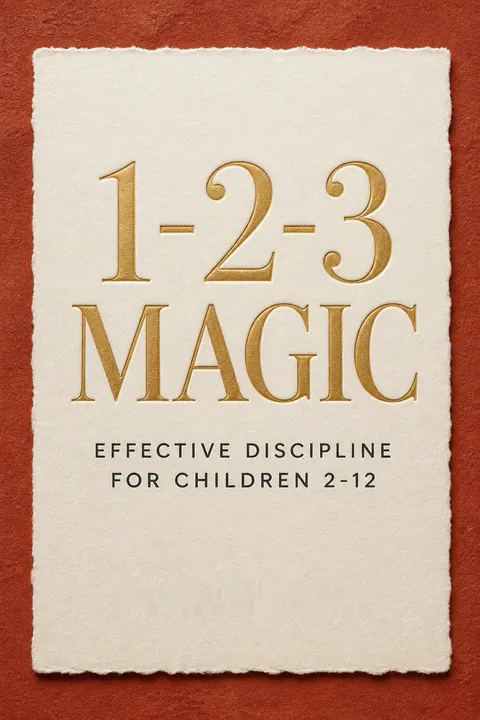
What's "1-2-3 Magic: Effective Discipline for Children 2-12" about?
- Discipline Strategy: The book by Thomas W. Phelan introduces a straightforward discipline strategy for managing children's behavior, focusing on children aged 2 to 12.
- Three-Step Approach: It outlines a three-step approach to parenting: controlling obnoxious behavior, encouraging good behavior, and strengthening the parent-child relationship.
- Behavior Management: The method emphasizes counting as a tool to manage difficult behavior without arguing, yelling, or spanking.
- Practical Guidance: It provides practical guidance for parents to implement these strategies effectively in everyday situations.
Why should I read "1-2-3 Magic: Effective Discipline for Children 2-12"?
- Proven Techniques: The book offers proven techniques that are easy to learn and implement, making it accessible for all parents.
- Immediate Results: Many parents report seeing immediate improvements in their children's behavior after applying the methods.
- Comprehensive Coverage: It covers a wide range of common parenting challenges, from tantrums to bedtime routines.
- Positive Parenting: The book promotes a positive parenting style that fosters a healthy relationship between parents and children.
What are the key takeaways of "1-2-3 Magic: Effective Discipline for Children 2-12"?
- No-Talking and No-Emotion Rules: These rules are crucial for the effectiveness of the counting method, helping parents remain calm and consistent.
- Start and Stop Behaviors: The book distinguishes between behaviors you want to start (like doing homework) and those you want to stop (like whining).
- Testing and Manipulation: It identifies six types of testing and manipulation children use and how to manage them.
- Building Relationships: Strengthening the parent-child relationship is as important as discipline, with strategies for affection, praise, and one-on-one fun.
How does the counting method work in "1-2-3 Magic"?
- Simple Process: The counting method involves giving children two chances to stop a behavior before a consequence is applied at the count of three.
- Calm and Consistent: Parents are encouraged to remain calm and avoid talking or showing emotion during the counting process.
- Consequences: Consequences can include time-outs or loss of privileges, and they should be reasonable and related to the behavior.
- Immediate Feedback: The method provides immediate feedback to children, helping them learn to take responsibility for their actions.
What are the "No-Talking and No-Emotion Rules" in "1-2-3 Magic"?
- Silence is Key: Parents are advised to avoid talking during discipline to prevent arguments and maintain authority.
- Emotional Control: Keeping emotions in check helps prevent escalation and keeps the focus on the child's behavior.
- Consistency: These rules ensure that the counting method is applied consistently, making it more effective.
- Focus on Behavior: By not talking or showing emotion, parents help children focus on their behavior rather than the parent's reaction.
How does "1-2-3 Magic" address sibling rivalry?
- Count Both Kids: The book suggests counting both children involved in a conflict, as both usually contribute to the problem.
- Avoid Stupid Questions: Parents are advised not to ask "Who started it?" as it often leads to more conflict.
- Consistent Rules: Applying the same rules to both children helps reduce rivalry and promotes fairness.
- Separate Time-Outs: If necessary, children should be sent to separate time-out areas to prevent further conflict.
What are the six types of testing and manipulation in "1-2-3 Magic"?
- Badgering: Repeatedly asking for something to wear the parent down.
- Temper: Using anger or tantrums to intimidate or get one's way.
- Threat: Making threats to get what they want or to retaliate.
- Martyrdom: Acting like a victim to induce guilt in the parent.
- Butter Up: Using flattery or promises to manipulate.
- Physical Tactics: Resorting to physical actions like hitting or breaking things.
How does "1-2-3 Magic" suggest handling bedtime and nighttime waking?
- Basic Bedtime Method: Establish a consistent bedtime routine with a set time for getting ready and going to bed.
- Use of Timers: A timer can help children manage their bedtime routine independently.
- Nighttime Waking: For nighttime waking, the book suggests minimal interaction and guiding the child back to bed without turning on lights.
- Consistency and Calmness: Consistent application of the bedtime routine helps children settle down and sleep through the night.
What is the "Major/Minor System" in "1-2-3 Magic"?
- Serious Offenses: The system is used for more serious offenses that are too significant for simple counting.
- Major and Minor Consequences: Offenses are categorized as major or minor, with corresponding consequences.
- Predefined Punishments: Having predefined consequences helps parents respond calmly and consistently.
- Focus on Prevention: The system aims to prevent more serious behavior problems by addressing them early.
How does "1-2-3 Magic" recommend using praise and affection?
- Positive Reinforcement: Praise should be used frequently to reinforce good behavior and build self-esteem.
- Tailored Praise: Praise should be tailored to each child's preferences, whether they like elaborate or simple recognition.
- Affection as a Tool: Affection is a powerful tool for strengthening the parent-child relationship.
- Balance: The book emphasizes balancing discipline with positive interactions to maintain a healthy relationship.
What are the best quotes from "1-2-3 Magic" and what do they mean?
- "Silence often speaks louder than words." This highlights the importance of the No-Talking Rule in effective discipline.
- "Good discipline makes for good times." It emphasizes that effective discipline leads to a more enjoyable family life.
- "Train the children or keep quiet!" This underscores the importance of using the book's methods rather than resorting to nagging.
- "To like your child you must have fun with her on a regular basis." It stresses the importance of shared fun in building a strong relationship.
How does "1-2-3 Magic" help with overparenting?
- Recognizing Overparenting: The book helps parents recognize when they are overparenting by giving unnecessary warnings or corrections.
- Encouraging Independence: It encourages parents to allow children to learn from experience and develop independence.
- Reducing Anxiety: By reducing overparenting, parents can decrease their own anxiety and improve their relationship with their child.
- Fostering Confidence: Allowing children to handle situations on their own fosters confidence and self-esteem.
About the Author
Other books by Thomas W. Phelan

Download PDF
Download EPUB
.epub digital book format is ideal for reading ebooks on phones, tablets, and e-readers.








