

Key Takeaways
Follow the chain from cheap credit to your job and savings.
A crisis travels. The book opens with the 2008-2009 collapse, when rising home prices and easy borrowing encouraged households to spend against apparent wealth. Banks and investors had bundled mortgages into securities, spreading exposure through the financial system. When housing prices fell and borrowers struggled, those securities lost value, banks tightened lending, businesses and households cut back, and job losses fed the downturn. What looked like a housing problem reached far beyond housing because credit, investment, spending, and employment are connected.
Use the chain as a map. Economic vocabulary matters because it helps readers trace how a distant market shock can affect household finances. The practical aim is not to predict every turn, but to recognize how one decision or disruption can travel through the system.
What's useful here is the systems view: a mortgage is not just a private contract when it is financed, repackaged, and held across institutions. Feedback loops help explain why a decline can accelerate: falling asset values weaken balance sheets, which can restrict credit and further depress activity. The account also cautions against monocausal stories. Cheap credit and rising prices mattered, but the chain ran through lending standards, investor incentives, and household choices. A useful question during any boom is not simply whether prices are rising, but who is carrying the risk if they stop.
Build your lifestyle on income, not paper gains in assets.
Paper wealth can vanish. The wealth effect occurs when people spend more because rising asset prices make them feel richer, even if their income has not increased. During the housing boom, some homeowners borrowed against rising home values to fund spending. Once prices fell, they had both less wealth and more debt, a painful combination that encouraged deleveraging, or rapid debt reduction. The book reports that U.S. personal saving fell below zero by 2005, then rose to about 5 percent during the 2009 downturn.
Save for resilience. Living below income leaves room to absorb job loss or falling asset prices. There is a broader tension: one household saving more may be prudent, while many households cutting spending at once can weaken demand across the economy. That tension does not make personal financial caution a public obligation.
The distinction between income and perceived wealth is a powerful behavioral safeguard. People often treat an increase in a home's market price as spendable cash, although selling or borrowing against it carries costs and risks. This resembles the difference between a paper gain and a realized gain in investing. The saving paradox adds a social dimension: prudent decisions can have different effects when made individually versus simultaneously by millions. Still, household security should not be sacrificed to sustain aggregate spending. The sharper lesson is to distinguish productive borrowing from borrowing that depends on an asset price continuing to rise.
Track jobs and real incomes, not GDP alone.
GDP is a useful total. Gross domestic product measures the value of final goods and services produced in a country. Its components include consumption, investment, government spending, and net exports. The book notes that U.S. personal consumption made up about 70 percent of GDP in 2008, and that U.S. GDP fell 6.3 percent in the final quarter of 2008. Such figures help show the scale and direction of economic activity.
Totals hide lived conditions. Unemployment, household income, and purchasing power add important context. The unemployment rate counts people without work who are available and actively looking, so it does not capture every form of labor-market hardship. Consumer confidence surveys can hint at future spending, while income adjusted for inflation shows whether people can actually buy more. GDP per person also misses factors such as health, safety, and leisure.
Economic indicators are instruments, not the economy itself. GDP is strong at measuring market production, but it cannot tell whether gains are widely shared or whether households feel secure. This is a measurement problem familiar across social science: what is easy to count can become a stand-in for what matters. Pairing output with employment, real income, and distribution gives a fuller picture. Forecasting requires humility too. Leading indicators offer clues, not certainty, and confidence surveys record expectations rather than future behavior. The practical discipline is to ask what each number measures, and what it leaves out.
Treat interest as money's price and inflation as its erosion.
Borrowing has a price. Interest is the cost of using someone else's money, and the rate reflects factors such as time, inflation expectations, default risk, and taxes. Central banks influence short-term rates and credit conditions to encourage or restrain activity. Inflation is a broad increase in prices that reduces what a unit of money can buy. The book describes moderate, predictable inflation as preferable to deflation, where falling prices can encourage households and businesses to postpone purchases and investment.
Watch the direction. A yield curve compares interest rates on debt with different maturities. Normally, longer-term borrowing costs more, but an inverted curve, where short-term rates exceed long-term ones, has often been treated as a warning that activity may slow. For households, the same forces affect mortgage costs, loan payments, and the real value of savings.
Thinking of interest as a price makes policy easier to understand: lowering it can encourage borrowing, while raising it can cool demand. But monetary policy is not a precise thermostat. Supply shocks, such as a sharp rise in energy costs, can raise prices while weakening activity, leaving policymakers with difficult tradeoffs. Inflation also redistributes: borrowers may repay fixed debts in money with less purchasing power, while savers can lose ground if their returns do not keep up. The yield curve is similarly informative but not a forecast with a guaranteed outcome. Indicators deserve attention, not obedience.
Recognize that bank leverage creates credit and magnifies panics.
Banks multiply lending. Fractional reserve banking is a system in which banks keep some deposits available and lend the rest. As loans are deposited and lent again, the banking system can support a much larger amount of credit than the original cash base. This helps fund households and businesses, but it also makes banks vulnerable if many depositors seek their money or borrowers stop paying.
Losses can feed on themselves. During the 2008 crisis, banks faced falling values in mortgage-related assets and pressure to preserve capital. Forced sales could push prices lower, weakening other balance sheets and prompting further sales. Loan loss reserves are intended to cover expected defaults, while Tier One capital helps absorb unexpected losses. Federal support, including TARP, was meant to stabilize institutions and restore lending, but also shifted some risk onto the public.
Leverage is not inherently reckless. It allows a bank to fund more activity with limited capital, just as it lets a business invest beyond its cash on hand. The danger is the asymmetry: gains can look steady during an expansion, while a relatively small decline in asset value can wipe out a thin equity cushion. This makes capital quality and risk management as important as headline profitability. A financial system also depends on confidence, which can disappear faster than assets can be sold. Understanding the multiplier effect helps explain why bank regulation and deposit guarantees are economic stabilizers, not merely administrative rules.
Ask whether policy treats weak demand, scarce money, or bad incentives.
Different diagnoses imply different remedies. Fiscal policy uses government spending and taxes to influence economic activity. Monetary policy uses money supply and interest rates, chiefly through a central bank. Keynesian thinking emphasizes supporting overall demand during a slump. Monetarists stress stable management of the money supply. The Austrian School warns that prolonged cheap credit can distort investment and that intervention may delay necessary corrections. Supply-side arguments focus on incentives to produce and invest, often through lower taxes.
Every tool has tradeoffs. Government spending can arrive slowly or reflect political priorities; lower rates can encourage borrowing but also create inflation risks. Tax rebates may be saved instead of spent, limiting their immediate stimulus. The book's central point is not that one school settles every argument, but that policy choices rest on competing explanations of what is wrong.
These schools are best understood as rival models of causation, not teams whose labels settle policy debates. The same recession can look like deficient demand, a monetary contraction, or a correction to investments made under distorted incentives. Each view highlights something important and can miss something else. A good policy discussion therefore asks what mechanism a proposal is meant to change, how quickly it can work, and who bears the cost if it fails. The book's useful restraint is its reminder that policy can smooth cycles but cannot make uncertainty disappear or replace sound household and institutional decisions.
Assume complex securities hide risks until proven otherwise.
Packaging changes who carries risk. An asset-backed security bundles loans, such as mortgages or car loans, into an investment whose payments come from those underlying debts. A collateralized debt obligation, or CDO, can divide a bundle into tranches with different priorities and risks. A credit default swap is a contract that pays out if a borrower defaults. These instruments can spread risk or help investors hedge, but they can also make exposures difficult to see and value.
Complexity amplified the crisis. Mortgage securities relied on assumptions about borrowers and housing prices that proved unreliable. CDO sales rose from $157 billion in 2004 to $521 billion in 2006, then fell to $56 billion in 2008. The book describes credit default swaps as a major factor in AIG's federal rescue, showing how contracts can create obligations beyond what a firm can safely cover.
Financial engineering can make small loans investable at scale, but moving risk is not the same as eliminating it. The key questions are who ultimately bears losses, whether that party can absorb them, and whether outsiders can verify the underlying assets. Complexity also creates a problem of accountability: originators may earn fees while buyers inherit risks they cannot easily evaluate. Ratings can help organize information, but they cannot substitute for transparent data or independent judgment. The broader principle applies beyond securities: whenever a product's safety depends on a long chain of assumptions, the chain itself deserves scrutiny.
Know what your account protects, and what it cannot protect.
Protections have boundaries. The book describes FDIC insurance as covering qualifying bank deposits up to $250,000 per depositor per bank at the time of writing. It distinguishes these deposits from money market mutual funds, which are investments. Securities Investor Protection Corporation coverage addresses a brokerage firm's failure, not losses caused by falling investment prices. Securities laws require disclosure and regulate parts of the market, but they cannot guarantee a profitable investment.
Prepare for income shocks. Unemployment benefits, COBRA continuation coverage, and bankruptcy procedures can provide limited options after job loss, health costs, or insolvency. Retirement accounts also require planning: defined contribution plans specify contributions, not a guaranteed retirement income. Social Security can help, but the book cautions that it may cover only part of a retiree's needs. These rules and dollar limits reflect the book's 2009-era snapshot and should not be treated as current guidance.
The distinction between protection from institutional failure and protection from market risk is essential. A guarantee can prevent one kind of loss while leaving investment value exposed to another. The same logic applies to employment and retirement benefits: they are safety nets with eligibility rules, limits, and gaps, not complete substitutes for planning. Knowing those boundaries can reduce panic and help people act sooner when circumstances change. Because laws and coverage limits are time-sensitive, a reference book can teach the categories while current decisions require checking present rules with the relevant institution or a qualified professional.
Compare investing services by cost, incentives, and freedom to take risk.
Convenience has a cost. Mutual funds pool investors' money and spread it across securities, giving smaller investors a way to diversify without choosing every holding themselves. The book gives typical annual management and marketing fees of 0.5 to 1.5 percent, charged even when the investment loses value. It contrasts these regulated funds with hedge funds, which can use short selling, derivatives, and borrowing, and are limited to eligible investors.
Ask who is being paid, and how. The book distinguishes registered investment advisers, who are expected to act in clients' interests, from broker-dealers, who commonly earn transaction commissions. Financial advisers may also receive fees or commissions from products they recommend. Credentials, disclosure documents, total costs, and conflicts of interest all matter. Leverage can magnify returns, but it can also force investors to sell at the worst moment.
An investment service should be judged by the problem it solves, not by prestige or promises of exceptional returns. Diversification can reduce dependence on any one company, but fees compound against the investor over time. Compensation structures also shape behavior: a transaction-based payment can reward trading, while asset-based fees can reward gathering more assets. Neither arrangement proves an adviser is unsuitable, but each deserves clear disclosure. The useful habit is to ask for the total cost, the source of the recommendation, and the downside scenario. Sophisticated strategies are not automatically better suited to an individual's goals or capacity for loss.
Welcome trade's efficiencies while preparing for local disruption.
Specialization connects economies. Comparative advantage means that a country or region can produce some goods or services relatively more efficiently than another. The book points to lower-cost manufacturing in China, technical support in India, and precision manufacturing in Japan as examples of how production can shift across borders. Consumers may benefit from lower prices, and firms can reach larger markets, but workers and communities can lose jobs when production moves.
Trade balances reveal a broader choice. A trade balance compares exports with imports, while the current account also includes financial flows. The book argues that persistent deficits can create longer-term concerns, particularly when a country relies on foreign financing. It also warns that protectionist tariffs can trigger retaliation and reduce trade, citing the Smoot-Hawley tariffs during the Great Depression. Efficiency gains are real, but so are concentrated costs.
Trade can enlarge the total pool of goods and opportunities while distributing its gains unevenly. That distinction matters: aggregate benefit does not automatically compensate a displaced worker or a town built around one industry. The case for open exchange is strongest when paired with serious attention to adjustment, retraining, and local resilience. Protectionism can shield particular producers temporarily, but retaliation may harm exporters and consumers elsewhere. The book's practical insight is to understand comparative advantage without treating every outcome as painless or inevitable. A lower price at the register and a lost job in a community can both be consequences of the same trade pattern.
Analysis
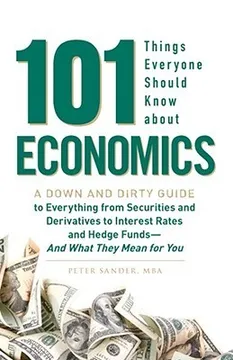
This book is a practical glossary arranged as a tour of the economic system. Its deepest contribution is not the definitions alone, but the connections between them: household borrowing supports spending, banks transform deposits into credit, financial markets distribute risk, and public policy tries to stabilize the resulting cycles. The 2008-2009 crisis gives the guide a narrative spine, turning abstractions such as securitization and deleveraging into parts of a chain with consequences for jobs, homes, and retirement plans.
The strongest reading strategy is to treat each statistic as a signal with a specific scope. GDP measures production, not overall welfare. Unemployment measures a defined group, not everyone experiencing insecure work. A housing median can move because of the mix of properties sold as well as changing prices. These distinctions make the book more useful than a list of headlines, since they teach readers to ask what a number includes and excludes.
The book also stages a genuine policy conflict. Keynesian approaches emphasize demand support, monetarism emphasizes the money supply, and Austrian arguments warn about credit distortions and delayed correction. Rather than resolving this dispute, the guide demonstrates why policy choices depend on causal theories and carry different risks. That is a strength, though the compressed format sometimes gives complicated debates the appearance of tidy competing camps.
Its numerical examples, institutional arrangements, and legal limits belong to a 2009 snapshot, not a current financial handbook. The concepts remain valuable, but readers should verify any present-day rates, program rules, or regulatory details. The most durable lesson is economic literacy as disciplined skepticism: trace incentives, ask who holds the risk, distinguish income from asset appreciation, and do not confuse a safety net with a guarantee of prosperity.
Glossary
Wealth effect
Spending from perceived wealthThe tendency for people to spend more when they feel wealthier because assets such as homes or stocks have risen in price, even if their income has not. The effect can be risky when people borrow against those assets, since falling prices can leave them with both less wealth and more debt.
Deleveraging
Reducing borrowed debtThe process of paying down debt or selling assets to reduce borrowing, often under pressure during a recession. If many borrowers and institutions sell assets at once, prices can fall, damaging balance sheets and prompting further sales. This feedback can deepen a downturn even when each seller is acting to reduce personal risk.
Paradox of Thrift
Individual saving, weaker demandThe idea that increased saving can be wise for an individual but, if many households save more at the same time during a downturn, their reduced spending lowers aggregate demand. Lower demand can then reduce business revenue and employment, worsening the conditions that prompted people to save. It describes a tension between household prudence and economy-wide effects.
Yield curve
Rates across debt maturitiesA graph or comparison of interest rates on debt securities with different maturity dates. A typical curve rises with maturity because investors expect compensation for waiting and taking on longer-term risks. A flat or inverted curve, where short-term rates approach or exceed longer-term rates, is watched as a possible sign of economic slowdown.
Fractional reserve banking
Banks lend part of depositsA banking system in which institutions retain a portion of deposits as reserves and lend the remainder. Loans can circulate back into banks and support further lending, expanding credit beyond the original cash deposited. The system helps fund economic activity, but it can be vulnerable when depositors withdraw funds or borrowers default at the same time.
Reflation
Stimulus to lift economic activityA set of government or central bank actions intended to revive an economy after recession, deflation, or falling asset prices. Measures may include low interest rates, lending support, public spending, or direct capital infusions. These actions can support demand and financial stability, but critics worry that excessive or prolonged stimulus may contribute to inflation or distort asset prices.
Asset-backed security
Investment backed by pooled loansA security created from a pool of assets, such as mortgages, car loans, or credit card balances. Payments made by borrowers provide income to investors, while the underlying assets provide collateral. Pooling can make many small loans easier to finance and trade, but investors need reliable information about the quality and risks of the underlying loans.
Collateralized debt obligation
Debt pool divided by riskA structured security backed by a collection of debt obligations or other securities. The pool may be divided into tranches, which receive payments in different orders and carry different levels of risk. Because the structure can be complex and the underlying assets difficult to assess, buyers may struggle to understand the losses they could face.
Credit default swap
Contract tied to borrower defaultA contract in which one party pays a fee for a potential payment if a specified borrower defaults or meets another agreed credit event. It can function like insurance on debt, but the buyer need not necessarily own the bond being covered. Large or poorly managed obligations can expose the seller to losses beyond its ability to pay.
Comparative advantage
Relative production efficiencyThe principle that a country, region, or producer can benefit by specializing in goods or services it can produce at a lower relative cost than alternatives, then trading for other goods. It helps explain why production moves across borders. The principle describes potential efficiency gains, but does not guarantee that the gains are evenly shared among workers or communities.
TARP
U.S. financial rescue programThe Troubled Asset Relief Program was a U.S. government initiative created during the 2008 financial crisis to support the financial sector. Its original design authorized purchases or insurance of troubled assets, especially mortgage-related securities. The program was later used to provide capital to institutions, with the aim of stabilizing balance sheets and restoring lending.
TALF
Support for loan-backed securitiesThe Term Asset-Backed Lending Facility was a Federal Reserve program created during the 2008 crisis to support lending markets. It provided financing to investors purchasing certain highly rated asset-backed securities tied to consumer and business loans. The goal was to help lenders regain access to funding when private markets had stopped buying those securities.
Download PDF
Download EPUB
.epub digital book format is ideal for reading ebooks on phones, tablets, and e-readers.








