Key Takeaways
1. England's Early History: A Series of Memorable Invasions
The Roman Conquest was, however, a Good Thing, since the Britons were only natives at that time.
Waves of invaders. English History began with a series of memorable invasions, starting with Julius Caesar in 55 B.C., who landed at Thanet and famously declared "Veni, Vidi, Vici" (misunderstood by Britons as "Weeny, Weedy, and Weaky"). The Romans, being top nation, introduced baths and straight roads, building Hadrian's Wall to keep out the savage Picts and Scots. This Roman Occupation was a Good Thing, as Britons were merely natives.
Saxon and Danish dominance. After the Romans left for Gibbon's Decline and Fall, Britain was subjected to waves of Picts, Angles, Saxons, and Jutes, who also landed at Thanet. The brutal Saxons drove the Britons into Wales, making them Welsh, and renamed the country England, which naturally became C. of E. This was followed by a Wave of Danes, led by Harold Falsetooth, who introduced the Danelaw and were eventually beaten by Nelson.
Conversion and Egg-Kings. The conversion of England was a result of Pope Gregory's memorable joke, "Non Angli, sed Angeli," leading to a Wave of Saints, including St. Neot (inventor of whisky). Soon, Egg-Kings like Eggberd and Eggfroth appeared, though none were particularly memorable beyond their names. The Danes, however, were eventually compelled to become English and C. of E. at the memorable Peace of Wedmore.
2. The Age of Kings: Good, Bad, and Unready Rulers
King Alfred was the first Good King, with the exception of Good King Wenceslas, who, though he looked 4th, really came first.
Alfred the Cake. King Alfred, the first truly Good King (excluding Wenceslas), was famous for not burning cakes and for inventing the British Navy by building longer ships than the Danes. His wife, Lady Windermere, was a Bad Queen who bathed with Sir Launcelot. The Anglo-Saxon Chronicle, the first English newspaper, reported on these events.
Unready and Experimental. Ethelread the Unready, the first Weak King, was never ready for the Danes, who fined him Danegeld repeatedly. He was succeeded by Canute, an Experimental King, who mistakenly believed he could sit on the sea without getting wet. After this, he became a Good King and C. of E., originating the proverb "Paddle your own Canute."
Confessor and Last English King. Edward the Confessor, a Weak King, was prone to confessing to all crimes, whether he committed them or not. He was the last English King, as subsequent rulers were Waves of Normans, Tudors, Stuarts, and Hanoverians, not forgetting the memorable Dutch King-Williamanmary.
3. Feudal Times: Barons, Piety, and the Magna Charter
Magna Charter was therefore the chief cause of Democracy in England, and thus a Good Thing for everyone (except the Common People).
Norman Conquest and Feudal System. William the Conqueror, in 1066, conquered England at the Battle of Senlac, establishing the Feutile System where everyone belonged to someone else, and all to the King. He created the Doomsday Book to inventory possessions and made strict forest laws, cutting off ears and legs of trespassers. His Curfew law, making everyone go to bed at eight, was a Good Thing, leading to Gray's Energy in the country churchyard.
Dreadful reigns and justice. Rufus, a Ruddy King, was shot by William Tell, leading to Sir Isaac Walton's Law of Gravity. Henry I, a Tragic King, died of a surfeit of palfreys. Stephen's reign was a dreadful confusion, with him and his Aunt Matilda (or Maud) escaping over snow in nightgowns while Barons built romantic castles and tortured people. Henry II, a Just King, reformed trials, making people plunge their heads into ploughshares after a jury decided their guilt, a much Better Thing.
Magna Charter and Awful John. King John, an Awful King, lost his temper, pulled Irish chiefs' beards, and tried to blind his nephew Little Arthur. The Pope put England under an Interdict, and sent a Bull to excommunicate John. The Barons, armed to the teeth on Ganymede, forced John to sign Magna Charter, which granted freedoms to everyone (except the Common People). John, known as "Lackshanks," eventually died of peaches and no cider.
4. Tudors: Wives, Reformation, and Beards Galore
Henry VIII was a strong King with a very strong sense of humour and VIII wives, memorable amongst whom were Katherine the Arrogant, Anne of Cloves, Lady Jane Austin, and Anne Hathaway.
Bluff King Hal. Henry VIII, a strong King with a strong sense of humor, had VIII wives and a red beard. He invented "Bluff King Hal," a game where ministers guessed his next wife. When the Pope refused his divorce from Katherine the Arrogant, Henry caused the Restoration by seceding from the Church of England. He then executed wives who didn't produce sons, except Anne of Cloves, whom he sent back.
Dissolution and Successors. Henry's strongest act was the Disillusion of the Monasteries, as monks thought it was still the Middle Ages and weren't married. His successors, Edward VI and Broody Mary, were small Tudors. Edward forced everyone to be Protestant so Mary could execute them for not being Roman Catholic, a Bad Thing. Mary's heart was found engraved with "callous" after her death.
Elizabethan Era. Queen Elizabeth, a memorable Queen (though a man), was known by affectionate nicknames like Auroraborealis. Her reign saw a Wave of Beards and the defeat of the Great Spanish Armadillo, after Captain F. Drake singed the King of Spain's beard. Mary Queen of Hearts, a Scottish nuisance with many husbands, was executed by Elizabeth for being too romantic.
5. Stuarts: Divine Rights, Roundheads, and Merry Monarchs
With the ascension of Charles I to the throne we come at last to the Central Period of English History (not to be confused with the Middle Ages, of course), consisting in the utterly memorable Struggle between the Cavaliers (Wrong but Wromantic) and the Roundheads (Right and Repulsive).
Tidy King and Gunpowder Plot. James I, a Tidy King, executed Sir Walter Raleigh for being left over and tried to sort out the Picts and Scots by planting Scots in Ulsters. His reign featured the Gunpowder Plot, a memorable plan by Sir Guyfawkes to blow up Parliament, which failed but is celebrated annually. The Early Fathers, persecuted for not learning Avoirduroi, sailed to America, causing America.
Civil War and Cromwell. Charles I, a Cavalier King, clashed with the Roundheads (Right and Repulsive) over his Divine Right of Kings. The Petition of Right challenged his methods, and Ship Money was a major cause. The war saw dashing Prince Rupert and many indecisive battles. Oliver Cromwell, with a round head and wart, led the New Moral Army (Ironclads) to victory.
Regicide and Commonwealth. Charles I was tried by the Rump Parliament and executed, famously walking and talking half an hour after his head was cut off. Cromwell, wielding his mace (Instrument of Government), declared "Blood and Ironclads" and divided the country into districts ruled by Serjeant-Majors, who tormented children with "Pride's Purge." This "Crommonwealth" was right but repulsive.
Merry Monarch. Charles II, a Merry Monarch, hid in oak trees during the Civil War and later descended to the throne. He kept many pets, including King Charles's Spaniards, and was fond of Elinor Gwyn. He invented the Reformation, a merry way of behaving, and passed witty Acts like the Act of Indemnity and Oblivion. The Great Plague and Fire of London were Good Things, leading to St. Paul's Cathedral and Sir Christopher Wren.
6. The Orange Rule and the Succession of Wars
WILLIAMANMARY for some reason was known as The Orange in their own country of Holland, and were popular as King of England because the people naturally believed it was descended from Nell Glyn.
Maddening King and Orange. James II, a Maddening King, irritated his subjects with arbitrary acts and Judge Jeffreys's "Bloody Asides." His attempts to repeal Habeas Corpus and confine his heir in a warming-pan drove the people mad, leading them to declare the answer was an Orange. James abdicated, and Williamanmary, known as The Orange, became King.
Scottish and Irish Questions. The Orange passed the Toleration Act but couldn't tolerate the Scots, who were in a "skirling uproar." After the Massacre of Glascoe, Scots were forbidden to curl, hoot, or wear kilts. The Orange's ingenious answer to the Irish Question involved the Battle of the Boyne, transporting Catholics to France, putting others to the sword, and planting Northern Ireland with fierce, industrial Blood-Orangemen, descendants of Nell Glyn.
National Debt and Succession. Williamanmary discovered the National Debt and built the Bank of England to put it in, a Good Thing to prevent Political Economy. The Orange was killed by a mole, succeeded by Queen Anne, a Dead Queen, known for her kind-hearted Occasional Conformity Act. The 18th century saw a Succession of Wars, like the Spanish Succession, fought over the French King L/XIV saying there were no more Pyrenese.
7. The Industrial Revelation and Victorian Amusements
The Industrial Revelation would never have occurred but for the wave of great mechanical Inventors, e.g. Arkwright, who invented the Spinning Jenny, or unmarried textile working girl.
Obstinate King and Global Conquests. George III, an Obstinate King, was largely insane but a Good Man, served by waves of Pitts. Britain "Muffled Through" by conquering Quebec, where General Wolfe defeated the French general Keep-calm. Indian History began with victorious wars against Sahibs and Rajahs, notably Robert Clive's revenge on the Black Whole of Calcutta at Cressey.
American Independence and French Revolution. George III's compulsory tea-party at Boston led to the Americans pouring tea into the harbor and becoming Independent, causing the United States. This was the only war England lost, but it was unfair as America had the Allies. The French Revolution, caused by Liberty, Fraternity, Equality, and Madame Tousseau, saw massacres and Napoleon's rise.
Industrial and Agricultural Revolutions. The Industrial Revelation discovered that women and children could work 25 hours a day without dying, changing the North of England. Inventors like Arkwright (Spinning Jenny) and Crompton (mules) drove this. The Agricultural Revelation, with turnips and "Trespassers would be Prosecuted," led to the Enclosure movement. Discontent led to the Blankester Massacre and the Six Acts, making massacres of blanket-wearers legal.
Victorian Era. Queen Victoria, a Good Queen, ascended the throne in her nightdress, determined to be good and plural but not amused. Ministers like Lord Melbourne and Mr. Rowland Hill tried to amuse her, but failed. The Chartists, with their enormous Chart, caused riots. Sir Robert Repeel invented Policemen and abolished Potato Duties in Ireland, allowing the Irish to eat bread.
8. The Great War: The End of All Memorable History
King Edward's new policy of peace was very successful and culminated in the Great War to End War.
Crimean and Indian Wars. The Crimean War, exceptionally inevitable, was fought against the Russians over Holy Places and Russia's size. Battles like Inkerman and Balaclava (Charge of the Fire Brigade) were fought, with Flora MacNightlight curing troops with deadly lampshade. The Indian Mutiny, caused by natives biting greasy cartileges, led to the relief of Lucknow and the Queen becoming Great Mohawk of India.
Justifiable Wars and Imperialism. Victoria's generals provided military diversions through a wave of Justifiable Wars: China (opium), Afghanistan (unfriendly kings), Sheikh War (huge Sheikhs), Burmese War, Abyssinia (King Theodore blown up with Magnesia), A Shantee (Coffee burnt), and Zulus (exterminated). Spheres of Interference were discovered in countries with natives, like Egypt, where Alibaba and other Pasha-Beziques were exterminated.
Disraeli, Gladstone, and Boer War. Disraeli "brought back Peace with Honour" from the Balkan Treaty of Berlin and bought the Panama Canal. Gladstone, the "G.P.O.," tried to please the Queen by chewing milk pudding and inventing an uncomfortable collar, but failed to solve the Irish Question. The Boerwoer, fought against tiresome Dutch Bores, was won by Mafeking and led to Boy Scouts and manly books.
Inventions and the Great War. Victoria's reign saw a Wave of Inventions: Darwin's Elocution (Origin of Speeches), the Oxford Movement (sinuflection towards Rome), Oscar Wilde's Art and Asceticism, and McCanical inventions like Bicycles and Roads. Edward VII, almost a Monarch, preferred peace. This culminated in the Great War to End War, fought between Germany and America in Belgium, caused by German Governesses and the Kaiser's telegrams. The Americans were 100% victorious, and the Peace to End Peace was signed at Versailles, marking the end of History.
Last updated:
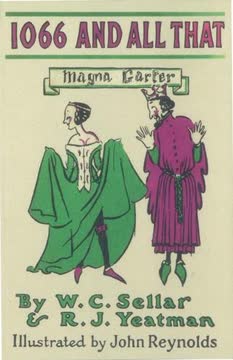
Review Summary
1066 and All That is a 1930 satirical parody of English history textbooks, presenting history as a series of memorable (and deliberately garbled) facts. Reviewers praise its dry British humor and clever wordplay, comparing it to Monty Python. The book works best for readers familiar with traditional English history education, as many jokes rely on historical knowledge. Common themes include jokes about "Top Nation" status, Good vs. Bad kings, and mock exam questions. While some find it brilliantly funny, others note it hasn't aged well, particularly regarding colonial attitudes. Most agree it's a quick, entertaining read requiring historical background for full appreciation.





