

Key Takeaways
Make mindset the engine; let skill turn ambition into results
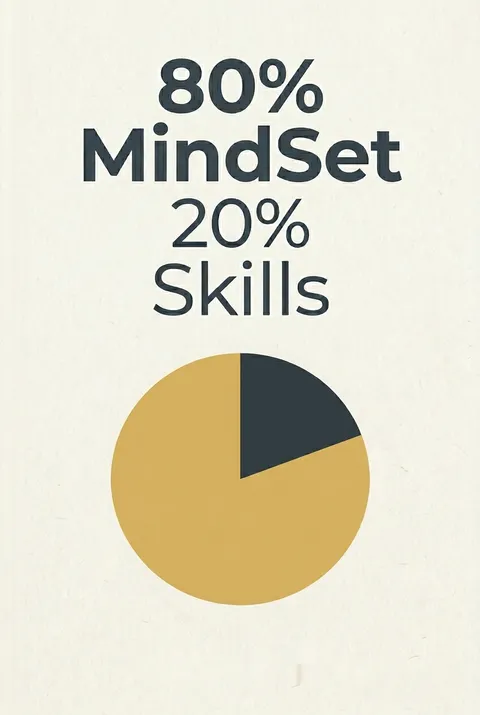
Mindset starts the work. Gadhvi’s central claim is that success depends more on how a person thinks than on the skills they currently possess. He frames this as 80% mindset and 20% skills: confidence, commitment, and persistence push someone to learn and practice the skills a goal requires. The ratio is a motivational rule of thumb, not a measured formula, and the book does not argue that skill can be skipped.
Ambition needs a craft. The author points to Sadhguru’s account of studying water purification after agreeing to attempt a project outside his expertise. An initial test failed; further study helped him succeed. The useful lesson is not that determination magically supplies expertise. It is that a learning-oriented mindset can keep a person engaged long enough to acquire it.
The strongest version of this claim is that mindset affects how people respond to difficulty: whether they seek feedback, keep practicing, and treat an initial failure as information. That makes it a practical starting point, not a guarantee of success. The percentage split is memorable, but it risks making psychological readiness sound more important than training, resources, or circumstance. The Sadhguru anecdote offers a better model: determination mattered because it led to study, revision, and another attempt.
Admire follow-through, not charisma, when choosing a role model
Two friends diverge. Moe and Joe begin with similar modest backgrounds and work together in Mumbai. Joe is witty, socially skilled, and a strong advocate for his team, qualities Moe admires. Years later, Moe has advanced professionally and built a family life he values, while Joe struggles with stagnant income, drinking, and regret. Moe offers help, including a possible job, but Joe never sends the requested résumé.
The missed step matters. The story illustrates the gap between wanting change and acting on an opening. Gadhvi uses Joe and Moe as inner characters: Joe voices caution and comfort, while Moe pushes toward growth. The distinction is not a fixed personality type. A person can recognize the cautious voice and still choose one concrete next action.
The contrast makes an abstract message visible: talent and charm do not replace repeated decisions. Joe’s missing résumé is more revealing than any speech about ambition. Still, the story should not be read as proof that mindset alone explains two people’s outcomes. Health, social support, opportunity, and circumstance also shape a life. Its most useful question is narrower: when help or an opportunity appears, what small action would demonstrate genuine readiness to change?
Find purpose by noticing what keeps drawing your effort
Look for recurring energy. Gadhvi urges readers to ask what they would choose if immediate income were not the only concern, what activities feel absorbing, and what others already value in their abilities. Purpose, in this account, is a reason to direct effort, not a grand title that must arrive in a flash of revelation. It can emerge through experience and reflection.
Build beside the day job. The author says he spent years in sales before recognizing that training, helping, and motivating people gave him lasting satisfaction. He does not insist that everyone quit paid work. The photography enthusiast in his example could develop a community, teach on weekends, or share lessons online while keeping a job. The practical move is to test a passion through useful work before betting everything on it.
Purpose is compelling here because it connects personal energy to contribution: an interest becomes more durable when it helps someone else. The gradual approach also avoids the myth that everyone has one hidden calling waiting to be uncovered. Interests change, and a passion may remain meaningful without becoming a profitable career. Small experiments can reveal both fit and demand. That is a more reliable guide than treating a dramatic leap as the only proof of commitment.
Choose goals that stretch your identity, then raise your effort
Use a bigger target. Gadhvi argues that modest goals can invite modest effort. He describes choosing a mission to help 10 million people, despite others considering it unrealistic, and recommends writing goals for work, health, and family in concrete terms. In his view, an ambitious target can make a person search for new skills, strategies, and opportunities instead of repeating familiar routines.
Do not confuse scale with a plan. The book suggests making goals visible, reviewing them regularly, and increasing the work when progress stalls rather than shrinking the ambition at the first obstacle. Its examples include a person whose weight-loss progress stopped short of the original target and the author pursuing a demanding fitness goal despite discouraging comments. A large destination still needs measurable steps and honest feedback.
A stretch goal can expand what someone considers possible, especially when the current benchmark is merely what feels safe. But a goal that is ambitious without milestones can become fantasy or a source of shame. The most useful interpretation is not that people should ignore feasibility, but that they should distinguish a bold direction from a realistic next experiment. Progress measures, available resources, and changing responsibilities should inform the route, even when the destination remains ambitious.
Turn realization into action, then build routines that sustain it
Change has a sequence. The book organizes transformation around recognizing a gap, acting on it, and keeping the change alive. Gadhvi says that recognizing his paycheck-to-paycheck habits and encountering Grant Cardone’s work helped him commit to a different path. But insight alone did not create the shift. He began making videos, learning sales, developing projects, and repeating those actions.
Start before confidence arrives. In one example, Gadhvi hesitates before his first live social media video, worrying about judgment and mistakes. He records it anyway, describing the act as a first step rather than a polished performance. The book’s broader advice is to take consistent, substantial action, while recognizing that persistence is built from ordinary repeated work. A useful starting point is to identify one neglected goal and schedule the next action for it.
The sequence helps separate three problems that are often blurred together: not seeing the need to change, not beginning, and not maintaining momentum. That is a useful diagnostic. The emphasis on substantial action can also challenge a habit of endless preparation. Its limit is that activity alone is not progress. Repeated effort needs feedback and adjustment, or a person may simply become more efficient at pursuing the wrong target.
Protect your first focused hours for the work that matters
Shape the day early. Gadhvi describes using a morning routine to keep his attention from immediately shifting to messages and other people’s demands. He draws on S.A.V.E.R.S., a routine from Hal Elrod’s book The Miracle Morning: silence, affirmations, visualization, exercise, reading, and writing. The elements are prompts, not mandatory steps. His own practices include reviewing goals, exercising, listening to audiobooks, and creating content.
Make focus practical. The book also recommends deciding the night before what to work on after waking, so the clearest hours are not spent on low-priority tasks. Gadhvi cites a claim that many workers are productive for fewer than three hours in an eight-hour day, but presents no supporting study details in the text. Treat the statistic cautiously; the sounder advice is to notice when focused work comes most easily and protect that time.
A morning ritual can reduce the daily cost of deciding what to do next. The value lies less in a universal schedule than in creating a protected block for important work before interruptions accumulate. The routine should fit the person: shift workers, caregivers, and people with health constraints may not have a conventional morning. The book’s specific productivity statistic is not sufficiently sourced here, so the personal experiment is more persuasive than the numerical claim.
Invest in skills and mentors that shorten the learning curve
Treat learning as productive work. Gadhvi says he spent years developing professionally without investing much in self-education. Later, he paid for sales training and other programs, read widely, and applied what he learned to workshops, books, and business projects. He presents these expenses as investments rather than status purchases, while also noting that free books, videos, and other resources can help someone begin.
Choose guidance with evidence. A mentor, in the book’s usage, is someone who has achieved the kind of result the learner wants and can teach relevant steps. Gadhvi names books, videos, and courses as ways to learn from people who may never meet the learner. The key is application: knowledge that is not practiced or tested remains potential, not capability.
The distinction between consuming advice and building competence is crucial. A course or mentor can compress trial and error, but payment alone does not ensure quality or results. The learner still needs to check whether the teacher has relevant experience, whether the methods suit the situation, and whether progress can be observed. The book’s strongest point is that learning deserves planned time and resources; its less secure implication is that every expensive program reliably pays for itself.
Shift from selling hours toward solving problems at scale
Income follows value. Gadhvi contrasts payment for time with payment for useful results. His mechanic example describes a worker who becomes faster and charges more because experience lets him solve the same problem efficiently. The value, in this framing, is the customer’s problem resolved, not the minutes spent doing the work.
Think beyond one paycheck. The book presents an Income Quadrant: employee, self-employed or small-business owner, owner of a larger systemized business, and investor. Each position describes a different relationship between labor, systems, and capital. Gadhvi encourages readers to build skills, serve customers, and develop additional income streams rather than relying on a single salary. He also warns that a small business can become another job if the owner must personally handle every task.
The value-versus-time distinction can help workers explain the outcomes they create, not merely the hours they attend. The quadrant is useful as a map of operating models, but not a universal ladder: employment can offer stability and meaning, while investing carries risks and requires capital. Multiple income streams are not automatically safer if they are poorly understood or highly correlated. The practical priority is to create real value and understand the trade-offs of each income source.
Give useful value publicly to build mastery and trust
Teach what you are learning. Gadhvi describes sharing lessons through videos, workshops, interviews, and a community called CareNation, including projects that support street vendors. In his experience, teaching pushed him to deepen his knowledge, while feedback from people helped him feel that the work mattered. He argues that contribution can motivate continued effort and create relationships that may support future opportunities.
Begin before expertise feels complete. The book encourages people to share experience honestly rather than pretend to know everything. Someone might offer a useful skill to a colleague, explain a lesson learned, or help a small group solve a problem. The aim is to serve, not to treat generosity as a guaranteed sales funnel. Paid work can follow when the service is genuinely useful and the exchange is clear.
Public teaching creates a productive loop: explaining an idea exposes gaps in understanding, and practical feedback shows whether the idea helps anyone. Contribution can also strengthen belonging, a powerful source of motivation. There is a boundary worth keeping clear: helping should not become covert marketing, and public visibility is not the only meaningful form of service. The book’s combination of learning and giving is most persuasive when usefulness comes first and recognition remains secondary.
Choose peers who stretch you, without treating people as disposable
Environment shapes standards. Gadhvi recounts friends whose reading, work habits, and ambition made him reconsider his own effort. He recommends spending time with people who encourage growth and paying attention to the content and conversations that fill daily life. His YouTube example makes the point personally: recommendations reflect, in part, what a person has chosen to watch.
Change the circle thoughtfully. The book sometimes advises readers to distance themselves from people who reinforce low ambition. That can be useful when relationships consistently undermine a serious goal. But it also recommends encouraging friends rather than simply labeling them. A practical approach is to seek peers, teachers, or communities with the habits one wants to develop, while preserving relationships that offer care, loyalty, and honest challenge.
Social environments make behavior feel normal: a group can either expand a person’s sense of possibility or quietly reinforce old defaults. That insight is stronger than the book’s claim that a handful of friends can predict someone’s income, which oversimplifies a complicated relationship. Ambition is not the only measure of a valuable friend. The key distinction is whether a relationship supports a person’s well-being and chosen commitments, not whether it resembles a business network.
Make ambition answer to health, family, and a durable pace
Success has several parts. Gadhvi defines a rich life as including money, health, and family, rather than wealth alone. He describes working on fitness with a coach, following a planned diet and exercise routine, and treating energy as an asset for sustained effort. He also acknowledges that his intense focus on his mission created friction at home when he gave too much attention to his phone and work.
Think in years, act each day. The book’s long-game advice is to judge progress across years while moving promptly on daily tasks. It encourages regular time with family, expressions of affection, and attention to what loved ones value. The message is not to abandon ambition, but to stop measuring success in a way that makes health and close relationships collateral damage.
This broader definition of success corrects a common distortion in achievement advice: visible output is easy to count, while health and emotional connection are easier to neglect. The author’s account of family friction makes the trade-off concrete. High effort can be meaningful, but relentless work is not automatically wise or sustainable. The useful test is whether ambition is improving the life it is meant to serve, including the lives of people close to the person pursuing it.
Analysis
The book is best understood as a motivational operating manual built around a personal transformation story. Its narrative contrast between Moe and Joe turns mindset into a memorable choice: one voice seeks comfort, the other accepts the discomfort of growth. The author then expands that choice across purpose, goals, learning, money, health, relationships, and service. This breadth gives the book energy, but also produces its central tension. It can sound as though ambition reliably produces wealth, as though people who remain in ordinary jobs have simply failed to think big enough, or as though more effort is always the answer. Those claims need qualification. Outcomes also depend on access, economic conditions, caregiving, health, discrimination, and luck. Mindset can shape a response to constraints, but it cannot abolish them.
The strongest practical ideas are more grounded than the grand promises: identify a meaningful direction, take a first visible step, practice relevant skills, seek guidance, and create routines that make follow-through more likely. These ideas align with a useful distinction in behavioral science between intention and implementation. A person can sincerely want change yet fail to act when the next step is vague, costly, or competing with immediate demands. Specific plans and feedback make intention more actionable. The book gestures toward this through goal writing, schedules, coaches, and repeated practice, though its rhetoric sometimes favors intensity over measurement.
Its financial advice is most useful when read as a set of questions, not universal laws: What problem does this work solve? Is income tied entirely to hours? Could a system or skill increase value? What risk accompanies another income source? Likewise, the social advice should encourage supportive environments without reducing human worth to productivity. The book’s lasting contribution is an insistence that a life should be deliberately designed across several domains. Its promise is not that a mindset guarantees extraordinary success, but that awareness and sustained action can expand the choices a person makes within real constraints.
Review Summary
"80% MindSet 20% Skills" receives mixed reviews, with an overall positive rating. Many readers find it motivational and practical, praising its simple language and relatable stories. The book emphasizes mindset transformation, action-taking, and breaking free from mediocrity. Some readers appreciate the author's personal journey and the book's focus on passion and goal-setting. However, critics note a lack of originality, repetitive content, and excessive self-promotion. Despite these drawbacks, many readers find value in the book's motivational aspects and its potential to inspire change.
People Also Read




Glossary
80% Mindset 20% Skills
Mindset-led skill buildingGadhvi’s shorthand for the idea that mindset is the larger driver of achievement, while skills provide the means to execute. He uses the ratio to emphasize commitment, persistence, and willingness to learn. It is presented as a guiding principle, not a research-derived measurement or a claim that technical ability is unimportant.
Average Joe
Voice of comfortable thinkingA character representing thoughts that favor safety, routine, and low effort, such as assuming there is no time to learn or no point in taking a risk. Gadhvi uses the figure to help readers notice self-limiting habits. It is a metaphor for a pattern of thinking, not a fixed kind of person.
Moe Mindset
Voice of growth and actionThe counterpart to Average Joe, representing ambition, openness to opportunity, and willingness to move beyond familiar limits. In the book, Moe symbolizes the choice to learn, take calculated risks, and pursue meaningful goals. The concept works as a motivational contrast rather than a complete account of why people succeed.
Realization, Transformation, and Sustentation
Three stages of changeThe book’s broad sequence for personal change. Realization means recognizing a gap between present circumstances and potential. Transformation means taking action, developing habits, learning, and building skills. Sustentation means maintaining progress through continued effort, supportive conditions, and long-term thinking. The sequence presents change as more than a brief burst of inspiration.
S.A.V.E.R.S
Morning routine componentsA routine described in Hal Elrod’s The Miracle Morning and adopted by Gadhvi. The letters refer to silence, affirmations, visualization, exercise, reading, and writing, which the book calls scribbling. These are suggested ways to begin the day intentionally; the text does not require every person to use every component or follow one schedule.
Income Quadrant
Four income modelsA framework, inspired by Robert Kiyosaki, that groups income by how it is generated: employment, self-employment or small business, ownership of a larger systemized business, and investment. Gadhvi uses it to contrast exchanging personal time for income with building systems or investing capital. It describes models, not a guaranteed progression or ranking of personal worth.
Passionpreneur
Entrepreneur built around passionGadhvi’s term for someone who develops a business around an interest, skill, or area of personal commitment. The idea is to combine work that feels meaningful with a service people value, potentially starting alongside existing employment. Passion alone does not establish a viable business; the concept also depends on solving a real problem and finding customers.
Corporate Zombies
Disengaged workplace employeesA vivid label Gadhvi applies to employees who feel aimless, resent their work, and discourage others from pursuing goals. He uses the term as a warning about workplace cultures that can dull ambition. It is rhetorical rather than diagnostic, and dissatisfaction at work may reflect real organizational problems, not simply a personal failure of mindset.
FAQ
What's "80% MindSet 20% Skills: Life Transformation in 9 Days!" about?
- Author's Background: Dev Gadhvi shares his journey from a humble background to transforming his life using millionaire secrets.
- Purpose of the Book: The book aims to help readers transform their lives by adopting a millionaire mindset.
- Structure: It provides a practical, step-by-step guide to change your mindset and life in just 9 days.
- Target Audience: It's crafted for those seeking a life-changing moment and wanting to understand the secrets of success.
Why should I read "80% MindSet 20% Skills: Life Transformation in 9 Days!"?
- Transformative Potential: The book promises to shift your mindset from mediocre to millionaire, impacting your life significantly.
- Practical Guidance: Unlike typical motivational books, it offers actionable steps to follow for real transformation.
- Author's Experience: Dev Gadhvi shares his personal experiences and insights from studying and interviewing successful people.
- Community Support: Reading the book connects you to a community of like-minded individuals striving for success.
What are the key takeaways of "80% MindSet 20% Skills: Life Transformation in 9 Days!"?
- Mindset Over Skills: Success is 80% mindset and 20% skills, emphasizing the importance of mental transformation.
- Realization and Action: Recognizing your potential and taking massive, consistent action are crucial for success.
- Sustaining Success: Long-term success requires maintaining momentum and continuously adding value to others.
- Importance of Environment: Surrounding yourself with ambitious, positive people is vital for personal growth.
What is the "Moe and Joe" story in "80% MindSet 20% Skills: Life Transformation in 9 Days!"?
- Two Paths: Moe and Joe start with similar backgrounds, but their mindsets lead them to different life outcomes.
- Moe's Success: Moe adopts a millionaire mindset, takes risks, and achieves significant success and happiness.
- Joe's Struggles: Joe remains in a mediocre mindset, leading to stagnation and dissatisfaction in life.
- Lesson: The story illustrates the impact of mindset on life trajectory and success.
How does "80% MindSet 20% Skills: Life Transformation in 9 Days!" define a millionaire mindset?
- Abundance Mentality: Believing in the abundance of opportunities and resources rather than scarcity.
- Big Goals: Setting ambitious, seemingly unrealistic goals to push yourself beyond average limits.
- Value Creation: Focusing on adding value to others as a path to personal and financial success.
- Continuous Learning: Investing in self-education and skill development as a lifelong commitment.
What are the steps to transformation in "80% MindSet 20% Skills: Life Transformation in 9 Days!"?
- Step 1 - Realization: Recognize the limitations of an average mindset and the potential for greatness.
- Step 2 - Transformation: Take consistent, massive action and develop habits that align with your goals.
- Step 3 - Sustentation: Maintain momentum by playing the long game and continuously adding value.
- Commitment: Stay committed to your goals and purpose, regardless of challenges.
What role does environment play in "80% MindSet 20% Skills: Life Transformation in 9 Days!"?
- Influence of Peers: The people you surround yourself with significantly impact your mindset and success.
- Positive Ecosystem: Create an environment that supports growth, ambition, and positive thinking.
- Avoid Negativity: Distance yourself from negative influences that can hinder your progress.
- Community Building: Engage with communities that share your goals and values for mutual support.
What are some of the best quotes from "80% MindSet 20% Skills: Life Transformation in 9 Days!" and what do they mean?
- "Kill the average disease before you are deceased." - Emphasizes the urgency of overcoming mediocrity to achieve greatness.
- "You cannot get rich thinking poor." - Highlights the importance of a wealth-oriented mindset for financial success.
- "Be so good that good feels great with you." - Encourages excellence and mastery in your field to stand out.
- "If you are not scared, then you are not growing." - Suggests that growth often involves stepping out of your comfort zone.
How does "80% MindSet 20% Skills: Life Transformation in 9 Days!" suggest maintaining motivation?
- Purpose-Driven: Align your actions with a larger purpose to sustain motivation over time.
- Obsession: Cultivate an obsession with your goals to keep the fire burning.
- Community Support: Engage with like-minded individuals who can inspire and motivate you.
- Regular Reflection: Continuously revisit your goals and progress to stay focused and driven.
What is the significance of the "unstoppable agreement" in "80% MindSet 20% Skills: Life Transformation in 9 Days!"?
- Commitment to Change: The agreement is a pledge to take control of your life and mindset.
- Mindset Shift: It reinforces the decision to adopt a millionaire mindset and reject mediocrity.
- Accountability: By signing the agreement, you hold yourself accountable for your transformation.
- Empowerment: It empowers you to take ownership of your actions and future success.
How does "80% MindSet 20% Skills: Life Transformation in 9 Days!" address financial freedom?
- Multiple Income Streams: Encourages building various sources of income for financial security.
- Investment in Self: Stresses the importance of investing in self-education for long-term wealth.
- Money Mindset: Advocates for a mindset that sees money as abundant and attainable.
- Ethical Duty: Views becoming financially successful as a responsibility to yourself and others.
What practical exercises does "80% MindSet 20% Skills: Life Transformation in 9 Days!" include?
- Daily Rituals: Establish morning routines that include affirmations, visualization, and goal setting.
- Mindset Exercises: Engage in activities that challenge and expand your current mindset.
- Goal Writing: Regularly write and review your goals to keep them at the forefront of your mind.
- Community Engagement: Participate in communities that support your growth and transformation.
Download PDF
Download EPUB
.epub digital book format is ideal for reading ebooks on phones, tablets, and e-readers.








