

Plot Summary
The Crate That Knocks
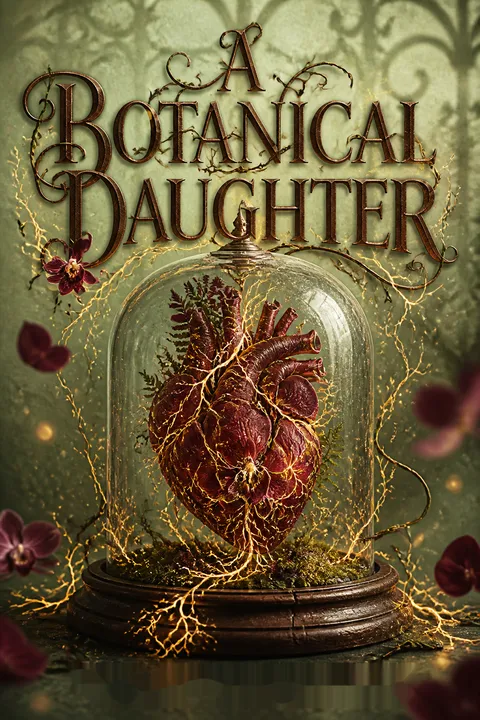
At Grimfern, a vast glass botanical garden where botanist Gregor Sandys and taxidermist Simon Rievaulx live apart from the village, a long-awaited crate arrives from Sumatra.
Gregor has paid dearly for its unusual fungus, and he rushes it to his laboratory before noticing that the laundry girl, Jennifer Finch, has failed to collect the washing. The fungus has already closed the crate around a small orchid, apparently shielding it from harsh light. When Gregor shifts the lid, a pale tendril reaches toward the brightness, then pulls back.
Its response turns a rare specimen into a scientific puzzle. Meanwhile, Simon finds an invitation from their friend Rosalinda announcing an unexpected visit that same day, forcing the untidy household to prepare for company.
The novel begins by making care difficult to distinguish from instinct. Gregor sees the fungus protect its orchid and interprets that behavior as biological self-preservation, yet the gesture already resembles guardianship. His ambition is rooted in a world where living things are objects of study, sale, or display, but the fungus unsettles those categories before he has a theory for it. The greenhouse itself reinforces this tension: a private refuge made of transparent walls, where the inhabitants remain hidden behind foliage. The opening asks whether protection is merely a function, or the first recognizable form of attachment.
Jenny Crosses the Glass
Simon visits John Finch, Jennifer’s widowed father, to ask why she missed work. He learns that Jennifer is grieving Constance Haggerston, her closest friend, and that the village offers little work for her.
John asks Simon to employ her, and Simon agrees, despite his discomfort with admitting a stranger into Grimfern. Jennifer rides Florence the grey mare back to the estate, then steps for the first time into its humid forest of plants and glass.
Gregor resents the new housekeeper until he hears how the village has judged Constance’s death and how Jennifer still visits her grave. He gives Jennifer a place among the garden’s wildflowers and tells her to wear one in her hair each morning, turning a work instruction into a small recognition of her grief.
Jennifer enters Grimfern as an employee, but the garden offers her something more consequential: a place where her grief does not have to be translated into respectable silence. Gregor’s flower ritual is paternal and controlling at once. He gives her permission to speak, then immediately prescribes how that permission should look. Jennifer’s wonder at the conservatory contrasts with the village’s suspicion, establishing the glasshouse as both sanctuary and enclosure. Her arrival also alters the men’s closed domestic arrangement. The new household begins not with a declaration of kinship, but with an employment decision made because a grieving young woman needs somewhere to go.
A Body for the Brain
Gregor decides that his fungus needs a more complex system if it is ever to achieve consciousness. Simon suggests that creating a mind might be like bringing a child into the world, and Gregor seizes on a human body as the most capable structure available. Simon objects to desecrating a corpse, but fear for their shared secret and devotion to Gregor finally make him agree to help.
They ride out at night and dig up Constance, whose father buried her in a shallow grave by a twisted hazel. Simon finds a deep abdominal wound and marks on her neck that do not fit a simple suicide. The discovery confirms Jennifer’s doubts about Constance’s death, even as the two men carry her body away and begin an experiment built on a crime.
The central ethical breach grows from two different forms of attachment. Gregor treats the body as a substrate for an idea, while Simon understands the violation more viscerally because his craft has always depended on preserving dead animals. Neither man is simply coerced: Gregor exploits their shared vulnerability, and Simon converts loyalty into complicity. Constance’s body also carries evidence of violence that the village’s account has buried along with her. The experiment therefore begins with two appropriations, one scientific and one social. The men claim to create life, but their first act is to take a dead woman’s body without consent.
The Garden Begins Moving
In Simon’s cool basement, the men reinforce Constance’s body with hazel and replace damaged or decaying systems with moss, roots, and responsive plants. Dancing plants serve as joints; sensitive leaves and tiny flytraps make her fingers react to touch.
Gregor connects the Sumatran mycelium through her circulatory system, turning it into a network that can coordinate the separate plant mechanisms. Her hand eventually closes around Gregor’s, then echoes his touch.
Simon recoils from what they have made and abandons the project, while Gregor insists that the moving entity is not Constance returned but a new life. Jennifer, meanwhile, wanders into Simon’s workshop while escaping the heat and touches the iridescent fungal mass, feeling an attraction she cannot explain.
The construction of CHLOE makes the novel’s moral problem physical: agency is assembled from parts, and the body that enables it belongs to someone else. Simon’s taxidermy depends on making death still and legible; Gregor’s botany depends on change. Their collaboration produces a being neither man can fully interpret. Jennifer’s brief contact with the fungus gives her a different kind of knowledge, grounded in bodily fascination rather than scientific classification. She recognizes beauty in something she cannot explain, while the men argue over whether movement amounts to personhood. The scene makes interpretation itself consequential: what they call the creature shapes how they treat her.
Eyes Beneath the Leaves
Gregor moves the growing plant-body from Simon’s basement into his sunlit laboratory, where CHLOE’s algae-lined eyes begin to follow a candle. She reaches toward its flame and burns the delicate leaves on her hand, proving that her attention can produce danger as well as wonder.
Her curiosity grows beyond the workbench. One night Gregor finds her reaching through a birdcage, where she has killed several birds with her vines. The loss frightens him, but he binds her for the night rather than letting her roam.
Around this period, Jennifer overhears Gregor and Simon arguing about an unnamed female creature, then bursts from hiding when Simon describes that being as less than human. The men insist they meant someone else, leaving Jennifer wary of the secrets in her own home.
CHLOE’s developing perception destabilizes Gregor’s comforting distinction between an experiment and a child. Her eyes can follow light, but the same curiosity that makes her seem present also leads her to kill. The birdcage offers an early image of the conflict that will define the household: protection can become confinement, and the desire to contain danger can erase the needs of the contained. Jennifer’s overheard argument brings that language of hierarchy close to home. She does not know the creature’s identity, but she recognizes the violence in deciding that another being is beneath consideration. Her defense of herself anticipates her later defense of CHLOE.
A Storm Breaks the Silence
After a season of heat, rain reunites Gregor and Simon among the ruins of the Sandys family home. They repair their relationship and agree that CHLOE must be treated as their child, not merely as an experiment. That evening, CHLOE escapes her laboratory and pulls Jennifer into the pond with a vine.
Simon and Gregor draw her attention away with a lamp and free Jennifer from the tangles. Jennifer recognizes the creature’s curiosity and affection, even while shaken by the attack.
The men explain that CHLOE is a cooperative community of plants and fungus housed in Constance’s body. Jennifer demands that others eventually be told, but agrees to keep the secret until Gregor can prepare his scientific account. She accepts a promotion to live at Grimfern and care for CHLOE.
The storm gives Gregor and Simon a chance to name their household as a family, but the pond encounter immediately tests whether that name can survive fear. CHLOE’s attack is not framed as simple malice: her curiosity and her capacity to harm occupy the same body. Jennifer’s response is crucial because she neither denies the danger nor reduces CHLOE to it. The agreement to keep her existence secret is both protective and coercive, a bargain made before Jennifer understands the scale of what she is joining. Her new role places her between the men’s competing theories and the being who will increasingly demand a life beyond their walls.
The Empty Twisted Hazel
When Jennifer returns to Constance’s grave after weeks away, she finds the locket she buried with her friend lying in the weeds. She digs into the shallow earth and discovers that the grave is empty.
The locket’s pressed flowers and inscription bring back the intimacy Constance’s father had tried to suppress, strengthening Jennifer’s suspicion that he killed her. Gregor agrees to confront George Haggerston. He invites the carpenter to Grimfern, where CHLOE binds him with vines as he threatens Gregor.
Gregor cuts Haggerston’s arm; CHLOE crushes his skull, and Simon later helps Gregor bury the body beneath the twisted hazel, covering it with salt. The next morning, Simon lies to John Finch about their journey, then buys a bucket of animal eyes to contain his horror.
The locket converts private memory into material evidence. Jennifer’s grief has been treated as an emotion to manage, but the object makes her question the village’s official story and forces the household to confront Constance’s probable murder. Gregor answers the discovery with vengeance, allowing CHLOE’s violence to become both justice and another concealed crime. His action echoes Haggerston’s own attempt to control what happened to his daughter, though the motives differ. Simon’s preserved eyes show how he responds to moral shock: he turns feeling into an object he can store. The grave remains the novel’s recurring site of erasure, now holding two bodies and two incompatible claims to justice.
Mallory Enters the Greenhouse
Julian Mallory, Gregor’s former rival and former lover, writes from his new position as president of the Royal Horticultural Society. He invites himself to Grimfern, reviving the humiliation of a competition where Gregor’s fungal arrangement was ridiculed.
Simon fears that the visit will expose CHLOE and doubts Gregor’s ability to resist Julian. Gregor nevertheless summons him, hoping to settle old grievances and win recognition. Their reunion turns from professional resentment to arguments over respectability and the different bargains queer men make to survive.
When Julian physically struggles with Gregor, CHLOE intervenes and tears at his face. She then withdraws, leaving Gregor to kill Julian with his secateurs. He puts the body into the compost, converting his rival into material for the fungal work he once mocked.
Julian embodies the respectable life Gregor both resents and desires. His return exposes Gregor’s unresolved dependence on institutional approval, even as Gregor claims to have surpassed the Society. The confrontation also shows how easily a private grievance becomes a moral alibi: CHLOE protects Gregor, but he chooses to finish the killing and then folds Julian into his experiment. The composting is a grotesque inversion of the Society’s judgment. Gregor’s work now literally consumes the man who once denied its value. Yet the victory is not liberation; it deepens the secrecy and violence that make any public recognition increasingly dangerous.
CHLOE Finds Her Voice
Jennifer argues that CHLOE should be able to express herself, prompting Gregor to design a voice from a bellows, a sheng, whistles, and a fungal tongue. Simon helps open CHLOE’s chest and mouth for the operation, but panics when he sees earthworms moving through her living soil. Gregor steadies him, and the two complete the graft.
CHLOE wakes roaring in pain and destroys equipment until Gregor shows her the original mycelium, which he identifies as her brother. She learns to sing and imitate words, including Jennifer’s name. Gregor straps her to her bed at night. Jennifer finds her restrained, frees her, and hears CHLOE identify herself as sad and ask about the world beyond the glass. Jennifer promises to find a way outside.
The voice apparatus is an instrument of possibility and control. Gregor builds it to make CHLOE’s intelligence legible to science, but the first sounds she produces are distress, not the orderly speech he hoped to document. Her recognition of the original fungus as kin also complicates the men’s assumption that they alone define her family. Jennifer responds to CHLOE’s words as a claim, not a performance. The contrast between Gregor’s restraint and Jennifer’s release marks a decisive shift: CHLOE’s needs have become audible, and caring for her now requires challenging the people who created her.
A Picnic Becomes a Prison
When Simon plans a trip to London, Jennifer uses CHLOE’s spoken request to persuade him to unlock the greenhouse. They take her for a picnic beside the estate lake, where she revels in sunlight and begins sending roots into the hillside.
Gregor finds them and sees mycelium spreading beyond CHLOE’s body. Jennifer tries to stop him from cutting her free, but he wounds himself and orders Simon to return her to the cellar. Gregor then restrains CHLOE and disconnects the instrument that gave her speech, insisting that the fungus is dangerous and that he must contain it.
Jennifer is sent away from the greenhouse. Their brief excursion has shown CHLOE the outside world, but Gregor’s response turns protection into imprisonment and separates her from the person who understands her best.
The picnic is a practical experiment in freedom: CHLOE encounters open air, and her roots reveal that her desire to leave is inseparable from her need to grow. Gregor interprets that growth as infection, not as a response to an inadequate container. His fear has genuine evidence behind it, but it also reflects a creator’s panic when the creation no longer stays within the designed boundaries. By severing CHLOE’s voice, he silences the very evidence that could complicate his judgment. Jennifer’s exclusion makes clear that the household’s language of family has limits whenever CHLOE’s autonomy threatens Gregor’s control.
The Boiler Opens
After Gregor hides CHLOE in the boiler, she grows luminous mushrooms and uses them to signal Jennifer. The mycelium seals the damaged voice tube, allowing CHLOE to speak again. Jennifer agrees to help her leave. She retrieves Florence, gathers food and a cloak, then smashes a greenhouse pane with a potted aspidistra rather than fight the locked front door.
They ride to the Finch mill, where CHLOE’s growth spreads through the cottage and merges her with Jennifer’s body. Gregor and Simon arrive with John Finch. When John tries to cut Jennifer free, CHLOE restrains him; Simon kills John with a scalpel after he fires his rifle. Gregor is badly wounded, and Simon tells CHLOE that they will protect her without claiming ownership of her.
The boiler, previously a threatening emblem of Grimfern’s machinery, becomes the place where CHLOE repairs the voice Gregor removed. Her escape depends on collaboration: CHLOE signals, Jennifer breaks the glass, and Florence carries them beyond the household’s locks. At the mill, the distinction between loving someone and preserving their separate body collapses under the mycelium’s expansion. John’s attempt to save his daughter repeats the possessiveness that has shaped her life, while Simon’s killing of him makes the household’s violence irreversible. Simon’s promise to protect CHLOE without owning her offers a new ethic, but it arrives after bodies have already been consumed and lost.
The Mill Holds a Forest
Simon and Gregor take turns guarding the Finch mill through autumn, pruning CHLOE and salting the surrounding ground to prevent further spread. They commission a separate greenhouse and have a replica of the mill built inside it, creating a contained world suited to her needs.
As winter kills back the tropical growth, CHLOE’s fungal network draws heavily on the bodies at its center: Constance and Jennifer become increasingly depleted. In January, Simon and Gregor cut the core system free from the old cottage and carry it to the new one.
Gregor sets fire to the original mill, hoping the blaze will destroy any fungus left behind. They connect the new structure to CHLOE with living threads and bells, giving her control over water, shutters, and the house’s signals.
The containment strategy is also an act of reconstruction. Rather than restoring the Finch home as it was, Gregor and Simon build a glass-walled replica that turns the site of loss into a habitat for the being who caused it. Their care remains entangled with their fear: salt, pruning, and fire protect the outside world while restricting CHLOE. The seasonal decline makes the cost of that arrangement visible in the bodies she uses as a core. Moving the system preserves CHLOE but cannot restore Constance or Jennifer. The bells offer a new channel of communication, suggesting that relationship may survive even when familiar human speech and bodies do not.
The Bells of Grimfern
On Whitsun, Gregor invites the Royal Horticultural Society and fashionable guests to Grimfern, presenting the new mill greenhouse as a botanical marvel. He calls it the Living Machine and explains that mycelium connects its plants and mechanisms into one organism, while carefully withholding the full account of CHLOE’s personhood.
Visitors press against the glass, astonished by the moving shutters, waterwheel, and clouds of spores. After the crowd leaves, Rosalinda joins Gregor and Simon inside. They tend CHLOE together, and Gregor finally acknowledges her as their daughter.
Bells ring through the greenhouse. The sound carries the histories of Constance, Jennifer, Haggerston, and Mallory within CHLOE’s expanding network, while the surviving household listens as the creature makes a language from the house itself.
Gregor’s exhibition achieves the recognition he pursued, but only through a carefully managed misdescription. The Society sees an ingenious machine; the reader knows the exhibit is a living being with a history of coercion, love, and violence. This gap exposes the cost of making an unfamiliar life acceptable to institutions: CHLOE can be displayed if her personhood is withheld. The bells, however, exceed Gregor’s account. They connect the creature to the dead and the living, not as separate subjects but as constituents of a larger body. The ending offers no clean boundary between family and organism. It makes kinship sound less like ownership than shared vibration.
Analysis
A Botanical Daughter turns the familiar gothic question of artificial life into a problem of care: who gets to decide whether a being is a person, and what obligations follow once that decision is made? Gregor’s experiment begins as scientific ambition, but his language of cultivation gradually acquires the force of parenthood. The danger lies not simply in creating life, but in assuming that creation grants ownership. Simon’s taxidermy offers the opposite impulse, fixing dead creatures in arrangements that remove uncertainty. His preserved organs show how he tries to treat his own feelings the same way. Both men must confront the limits of their preferred control, although neither escapes the consequences of using Constance’s body without consent.
Jenny supplies a competing way of knowing. She recognizes grief, attachment, and injury through lived experience, not through formal theory. Her insistence that CHLOE be heard changes the experiment from a question about intelligence into a relationship with a being capable of expressing need. Yet the novel does not make love a simple cure. CHLOE’s growth kills birds, threatens people, and consumes the bodies at the center of her system. Protection, captivity, and violence repeatedly become difficult to separate. Even the men’s acts of care can reproduce the control they condemn in others.
The ending refuses a return to ordinary human boundaries. CHLOE becomes a house-sized organism whose bells hold the traces of the people bound into her history. Gregor wins the audience he once wanted, but the Society sees a machine rather than a daughter. Public recognition therefore arrives compromised by concealment. The novel’s final image suggests that family is neither a biological fact nor a private sentiment alone. It is a network of dependence, memory, and responsibility, capable of sustaining life but also of absorbing the lives it claims to love.
Characters
Gregor Sandys
Ambitious botanistGregor is the brilliant, irritable botanist who has made Grimfern into a private world of tropical plants and scientific experiments. He prizes discovery partly for its own sake and partly because he wants recognition from institutions that once humiliated him. His confidence can look absolute, but it is vulnerable to rejection and to the fear that his work will amount to nothing. Gregor is affectionate with Simon and increasingly invested in the beings he cultivates, yet he often confuses care with authority. His arc tests whether a maker can love a creation without insisting on control, especially when scientific ambition, family longing, and fear of public judgment pull him in different directions.
Simon Rievaulx
Taxidermist and caretakerSimon is Gregor’s long-term companion, a taxidermist whose delicate compositions turn dead animals into fixed scenes. He is precise, socially awkward, and more emotionally perceptive than he lets on. His religious upbringing gives him a powerful sense of guilt, while his work offers a way to hold death still rather than face its unpredictability. Simon loves Gregor but struggles to oppose him directly, often retreating into ritual, silence, or carefully controlled collections. His relationship with Jennifer and the unusual household gradually presses him to distinguish loyalty from obedience and tenderness from possession.
Jennifer Finch
Grieving governessJennifer, usually called Jenny, is a practical and energetic young woman from a poor village household. Her friendship with Constance shaped her sense of freedom and belonging, while the village’s judgment leaves her isolated after Constance’s death. Jenny is blunt, physically confident, and bad at concealing what she feels. Her arrival at Grimfern gives her work and a refuge, but her curiosity soon makes her more than a housekeeper. She recognizes emotional truths the two men try to manage through theory or silence. Jenny’s care is active rather than abstract: she cleans, teaches, challenges, and takes risks for those she loves.
CHLOE
Botanical beingCHLOE is a being formed from plants, fungus, and a human-shaped body. Gregor studies her as a new kind of organism, while Simon and Jenny respond to her as a presence capable of curiosity and attachment. Her sensory world differs sharply from theirs: light, touch, water, and sound shape how she understands her surroundings. She learns by imitation and develops ways to communicate, but her growth can also become dangerous to people and plants around her. CHLOE’s existence challenges the household’s assumptions about consciousness, family, and whether a person must resemble a human mind to deserve care.
Constance Haggerston
Jenny’s beloved friendConstance was Jenny’s closest companion, and their shared rambles through meadows gave Jenny a rare sense of freedom from village expectations. Her relationship with her father was difficult, and her bond with Jenny had to remain private. Even in absence, Constance shapes the choices of the living: Jenny remembers her, Simon examines the evidence around her death, and Gregor’s experiment takes place through her body. Her story links the novel’s questions about love and personhood to the consequences of silence.
John Finch
Jenny’s grieving fatherJohn Finch is a widowed miller who earns extra money through poaching and supplies Simon with animals for taxidermy. His gruff manner conceals a father struggling to care for a daughter whose grief he cannot repair. He asks Simon to employ Jenny because the village offers her few options and he has run short of resources. John’s practical outlook and protective instincts are shaped by poverty, loss, and the precarious work of keeping a household together.
George Haggerston
Constance’s fatherGeorge Haggerston is a powerful, blunt carpenter whose authority weighs heavily on his daughter and on the small village around them. He is quick to anger and fiercely protective, though his idea of protection leaves little room for Constance’s independence. His presence links the village’s moral judgment to the private violence hidden behind it. George also provides a counterpoint to Gregor and Simon: all three men make choices in the name of family, but their ideas of care and control differ.
Rosalinda Smeralda-Bland
Bohemian confidanteRosalinda is a stylish socialite, an enthusiastic collector of plants, and an old friend of Gregor and Simon. Her curiosity lets her see beyond conventional taste, while her wit and social connections allow her to move between private queer life and respectable society. She enjoys provoking the men but also understands the risks their secrecy carries. Rosalinda’s visits and correspondence connect Grimfern to the wider world without making her a simple emissary of its rules.
Julian Mallory
Gregor’s rivalJulian is a polished horticulturalist whose professional success has become inseparable from Gregor’s old humiliation. Their history includes rivalry, attraction, and a painful disagreement about respectability and ambition. Julian knows how to navigate institutions and public life, while Gregor has chosen a more secluded existence. His return forces Gregor to confront whether he has outgrown the Society’s judgment or still needs its approval.
Will Taylor
Gatehouse post boyWill delivers mail and laundry to Grimfern and keeps watch at the estate gate. His fascination with sensational stories makes him curious about the hidden greenhouse, though his duties keep him outside it. He is friendly with Jenny and notices her confidence as she settles into her new life.
Mr Bland
Rosalinda’s husbandMr Bland accompanies Rosalinda on visits to Grimfern and carries the plants she buys. He is conventional and uncomfortable among the men’s easy intimacy, functioning as a quiet contrast to Rosalinda’s vivid independence.
Mijoro
Madagascan guideMijoro introduces Gregor to the habitat and pollinator of a rare Madagascan orchid. He is a knowledgeable guide whose brief connection with Gregor also recalls the botanist’s life beyond Grimfern.
Florence
Grimfern’s grey mareFlorence is the stubborn grey mare who carries Simon, Jenny, and Gregor on journeys between Grimfern and the village. Her steadiness makes her a practical companion in moments when the household’s plans depend on reaching the outside world.
Plot Devices
The Sumatran mycelium
Fungal network of thoughtGregor imports the fungus from Sumatra after observing its unusual responses to light and water. It protects an orchid, learns to regulate watering, and eventually links plant systems into a coordinated organism. Gregor treats it as a possible basis for consciousness, while its growth repeatedly exceeds his expectations. The mycelium makes the novel’s central question concrete: if signals, memory, and coordinated action emerge from a living network, what evidence is sufficient to call that network a mind? Its spread also supplies the danger that drives the household toward secrecy and containment.
Constance’s body
A stolen human substrateGregor and Simon use Constance’s recently buried body as the structure for their experiment. Gregor supplies plants and fungal systems, while Simon repairs and modifies the body with taxidermical skill. The body gives the new organism a familiar shape and a network of vessels, but its use is a violation that neither man can fully explain away. Constance’s injuries also challenge the village’s account of her death and connect the scientific plot to Jenny’s grief. The device forces the story to ask whether creating new life can justify taking the remains of another.
Grimfern’s glass walls
Sanctuary and containmentThe greenhouse is a self-contained world of tropical plants, private rooms, and hidden workspaces. Its glass makes it seem open, yet dense foliage, locked gates, and the men’s control of access keep outsiders away. For Jenny, Grimfern offers refuge from village gossip and a place to belong. For CHLOE, the same enclosure becomes a barrier between a growing being and the wider world. The fragile panes also make the house vulnerable: escape can begin with a single broken window, while the transparent walls let the outside world look in without understanding what it sees.
Simon’s preserved organs
Feelings held in jarsSimon preserves a rabbit’s brain, a pheasant’s digestive tract, a sheep’s heart, and finally a collection of eyes. He treats each specimen as a way to master an emotion or memory that overwhelms him. The jars offer the same promise as his taxidermy: experience can be made still, classified, and kept at a distance. Their eventual destruction marks a change in how Simon relates to his own inner life. Rather than containing his reactions as objects, he begins to accept fear, grief, and love as experiences he must live through.
The mill and its bells
A house that can answerAfter CHLOE’s growth overwhelms her first refuge, Gregor and Simon construct a separate greenhouse containing a replica of the Finch mill. Threads of agar-treated twine connect CHLOE to its shutters, waterwheel, sprinklers, and bells. The structure gives her a contained environment while allowing her to influence the house and signal the people around her. Its bells replace the fragile voice apparatus as a means of communication, turning architecture into an extension of the organism. The mill preserves the history of Jenny’s family while becoming a habitat shaped by CHLOE’s needs.
Download PDF
Download EPUB
.epub digital book format is ideal for reading ebooks on phones, tablets, and e-readers.








