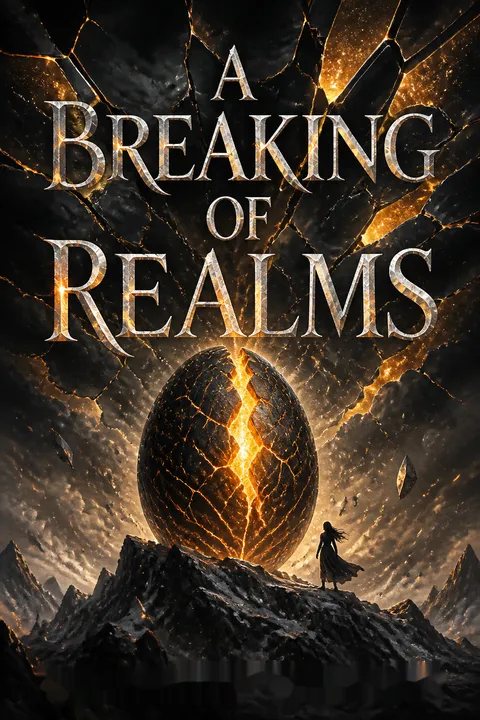


Plot Summary
Rotten Ice, Long Fall
A plea for help haunts Skálda Branwright, a hard-edged hunter from the impoverished Skonkauld islands, as she joins ritefest for a chance to win a dragon egg. She chooses a shield instead of a weapon, then climbs Hrafenfjall at her own steady pace while wealthier contestants waste strength sprinting. Her rivals Kjetil and Ottar stay ahead, and skáldwolves move unseen through the forest.
Near the summit, Skálda glimpses enormous symbols cut into the distant ice and hears the same plea from her dreams. She forces herself onward to catch Kjetil, but rotten ice gives way beneath her. The fall tears her from the trail and leaves the egg, her only imagined escape from poverty, beyond reach.
The ritefest makes Skálda’s ambition physical: success requires endurance, not the inherited advantages displayed by richer competitors. Her choice of a shield signals a defensive intelligence that later becomes moral as well as tactical. The fall interrupts her private contest with poverty and social exclusion, but her attention to the strange ice marks another scale of danger entering her life. The dream’s plea links personal longing to an external summons before she understands either.
The Shield Becomes a Sled
Skálda hears Ylva Solveig screaming in the woods and abandons her attempt to regain the lead. She faces five skáldwolves with Ylva’s flail and her shield, keeping silent until the pack retreats. Though exhausted and injured, she helps Ylva finish the climb, then turns the shield into a makeshift sled and races down Hrafenfjall. She reaches the final post ahead of Kjetil and wins.
At the ceremony, Jofreid Anders presents the green eld egg, but it remains cold beneath her hands. Skálda tries the two neglected pica eggs in Skoll Post’s hatchery as well, without success. Kael comforts her after the public humiliation, while the contrast between his tenderness and her guardedness exposes feelings she refuses to name.
Skálda’s victory comes through improvisation and choosing another person over a prize, although she still claims the prize by refusing to surrender. The episode complicates her reputation as an unemotional hunter: she acts compassionately without needing to perform warmth. The unresponsive eggs then make her achievement feel conditional. The Order offers a route out of poverty, yet its central ritual seems to reject her, reinforcing the fear that skill alone cannot make her eligible for a different life.
The Ivarion Comes Home
Far from the Skonkauld, Lord Eyrekvald Ivarion celebrates the campaign that has brought Teralynn close to becoming the first new realm under the Enterprise. He announces that his powerful rider Rowenna Amanoor has reached Dragonlord rank, and reveals his betrothal to Crown Princess Vhalentae.
Their triumph is shadowed by reports of northern fighters wearing skáldwolf fur and by the necklace of a faith Eyrek’s campaigns have treated as heretical. At Skálda’s ritefest, a Great Dragon lands beside the feast and its rider identifies himself as Eyrek, the brother who left home twelve solstices earlier. His appearance transforms the villagers’ view of Skálda and reunites her with the family she thought had vanished from her life.
The intercut celebration establishes the distance between Eyrek’s political world and Skálda’s precarious island life, then collapses that distance through kinship. His success embodies the Enterprise’s promise that birth need not dictate rank, but the signs of religious and military conflict trouble its triumphant public story. Skálda’s surprise at his return is inseparable from resentment: the brother who escaped has become a legend, while she has remained responsible for their mother. Their reunion therefore offers hope without immediately repairing abandonment.
An Egg That Will Not Hatch
Eyrek gives Skálda a rare Great Dragon egg descended from the legendary Vallyrath, but it too refuses to hatch. He does not punish her for the failure. Instead, the siblings spend the night at a tavern, where he explains that his first dragon died in battle and shows her the scar left by the Were King. He also reveals that their mother hid his letters and money, then warned him away from home.
He has learned that their father died in a plague-stricken village. Before leaving at dawn, Eyrek gives Skálda a finely forged axe, money for her mother and Anders, and a promise that her future lies beyond the islands. Soon after he flies away, an impact shakes the Skonkauld and fire streaks from the sky.
The failed egg prevents Eyrek’s affection from becoming a simple solution to Skálda’s life. His wealth can supply tools and food, but it cannot undo the years of silence caused by their mother’s manipulation or Skálda’s belief that he chose to abandon her. The axe is more meaningful than the egg because it grants her agency without promising instant transformation. The skyfall that follows his departure shifts the story from family repair toward a crisis neither sibling can control.
The Hatchling in the Burn
Skálda crosses the forests to investigate the scorchfall and finds a black hatchling lying in a glowing sphere of strange energy. She mistakes him for dead, then binds him when he wakes. As she carries him back to Skoll Post, he sends the same urgent plea that has filled her dreams. Anders reports the wild creature to Dragonsteel, whose law requires unregistered dragons to be killed.
Skálda secretly takes the hatchling to her barn to give him water, but he escapes through the roof and flies east. Meanwhile, Kael has already been sent to the Arcaenum after his magical affinity is discovered. At the Atheneum, an enigmatic elvish hunter named Aesir warns Skálda that the hatchling may be a Bael, a legendary Realm-Breaker.
The hatchling turns Skálda’s dream from private disturbance into a relationship demanding action. She first handles him as a dangerous animal, tying him down and attempting to manage him through force. His helpless appeal makes that method harder to sustain. The Order’s rule gives her a rational reason to surrender him, while the Arcaenum news reveals how institutions control anyone whose abilities exceed their categories. Aesir’s warning enlarges the danger, but it does not settle whether obedience or protection is the more ethical choice.
Skoll Post Is Broken
When Imperial Rangers arrive, Skálda finds the hatchling in a blizzard and hides him from their search. Her mother, Sigrede, unexpectedly recognizes how to feed him and warns Skálda to leave the Longcold, though she will not explain why. The Judge Rystendal Vacerys reaches Skoll Post with an icescourge dragon, kills the young rider Egil, annuls the post, and has Anders brutally whipped.
He destroys Skoll’s stored eggs and imprisons Mat, Anders, and the surviving riders. Aesir helps Skálda flee with the hatchling, later revealed as Bale, while she tries to reach the Cumbria waygate. Rystendal’s forces pursue them toward the melting Isendal River, making the escape a race across failing ice.
Rystendal converts a disputed legal breach into collective punishment, showing how a distant institution can make the poor pay for the vulnerability of its own laws. Skálda’s guilt is intensified because her choice to protect Bale coincides with the destruction of her home, even though the Judge chooses the scale of that violence. Her mother’s partial knowledge suggests the crisis reaches into family history. Aesir’s aid gives Skálda a route forward, but he remains an uneasy ally rather than a trustworthy rescuer.
Across the Breaking Ice
At the Derefter Wall, Bale struggles to climb the ice shelf while Crixalas closes in. Skálda instinctively casts a spell that suspends the icescourge long enough for Bale to cross, then lures the pursuing Rangers onto the weakened Isendal River. The ice collapses beneath them, and Skálda and Aesir reach the old gate as Crixalas’s fire breaks the glacier apart behind them.
Beyond the Wall, Skálda discovers fertile forest and begins searching for Bale. Aesir teaches her to recognize dragonscripts and explains that Bale has no legal Binding, despite their growing mental connection. When Bale returns, he gives her his true name, Baelaeryx, and accepts the shorter name Bale.
Crossing the Wall is both a geographical escape and a breach of the identity assigned to Skálda. Her spell reveals an affinity she did not know she possessed, but she uses it under immediate pressure rather than from ambition or study. The melting ice also makes the skyfall’s physical consequences visible. Bale’s self-naming deepens their bond beyond law and inheritance, while Aesir’s insistence that they are not truly rider and dragon exposes the difference between lived attachment and official recognition.
Tera Beren Burns
Three days after receiving an urgent transmission, Eyrek reaches Tera Beren and finds the capital destroyed, its gates marked with his name and its leaders’ severed heads displayed above them. The assault came through hidden tunnels beneath the walls, and most of his riders are dead. At the Republic’s Conclave, the rulers argue over the Wereguild’s return and whether to declare war.
High Queen Lhyestrae Morghûl uses Eyrek’s absence during the attack to block his coronation, and the High Eldari’s vote strips him of his claim to kingship. She still assigns him the defense of the northern border, since the Republic refuses to commit its forces. Eyrek accepts the mission, though grief turns his duty toward vengeance.
Eyrek’s collapse demonstrates the vulnerability concealed by his public stature. He has built a realm through effort, but cannot be present everywhere, and the attack turns that limit into a political weapon. The Conclave treats catastrophe as an opportunity to settle factional disputes, while Lhyestrae’s intervention mixes statecraft with personal hostility. Eyrek remains committed to service, yet the denied crown changes the emotional meaning of that service: protection and revenge begin to occupy the same ground.
A King Without a Crown
Eyrek gathers his surviving allies and leads them into the Deep North to reach Haverley, where four inexperienced riders remain surrounded. Dragon-slaying bolts kill riders during the march, and Vigardian warriors ambush the army in the Cauldwood. Eyrek rallies his forces, invokes the strength of his Great Dragon, and keeps fighting despite severe losses.
His troops reach Haverley and rescue the young riders, then uncover the hidden family of Isgardia’s king in a fortified church. Eyrek uses the heir to negotiate with his father and later confronts King Leondran Astoraine, demanding that Fjorland take responsibility for Isgardia. Eyrek’s military victory saves survivors, but his expanding campaign also increases his political danger.
The campaign tests whether Eyrek can act as a leader after the institution that promised him a crown withdraws its recognition. His decision to rescue low-ranked riders, rather than protect only powerful assets, preserves his governing ethic amid revenge. Yet his methods grow harsher as he gains leverage over Isgardia and confronts Leondran. The novel refuses to treat battlefield competence as moral innocence: Eyrek’s willingness to sacrifice and command others makes him effective, but also makes his judgment increasingly consequential.
The Bond Takes Shape
As Skálda and Aesir travel east, Bale learns to hunt, advances his chapters, and returns after running away when Skálda hurts him with a careless accusation. He remembers fragments of the dark realm from which he fell and admits he wants only to stay with her. Their journey reveals a hidden tree-root tunnel built by the Wereguild.
They find Vigardians preparing to kill a captured dragon and free it, but the encounter leaves Skálda badly hurt. Soon after, Rangers attack the village of Wyre, kill its inhabitants, and beat Aesir for sheltering them. Skálda heals Aesir by drawing on Bale’s growing power. The act confirms a profound connection between her and Bale, although it still has no place in Dragonsteel’s laws.
The relationship changes through repeated tests of trust rather than a formal ceremony. Bale’s flight after Skálda wounds him gives emotional consequence to her habit of treating care as an obligation she can later resent. His return and her healing of Aesir show that dependence can be reciprocal, not a hierarchy in which she alone protects everyone. The murdered villagers sharpen the cost of secrecy, while Skálda’s spontaneous magic suggests her capacity exceeds the sanctioned paths available to her.
The Wereguild Beneath
Aesir reveals that he is an Imperial Ranger who has never belonged comfortably among elves, and that he wants a cause less compromised than the Enterprise. He and Skálda reach the Álfvindor Alps, where Bale has grown large enough to bring down a moose. Near Dellfast, they find a Vigardian camp and see a captive rider threatened with the death of her dragon.
Skálda uses magic to stop the execution and helps free the creature. Bale’s chapters rise only slowly through ordinary hunting, so she begins to understand the scale of the journey ahead. Aesir’s knowledge of the tunnels and the Wereguild’s movements gives them urgent reason to warn Dellfast before the hidden army arrives.
The route toward Dellfast forces Skálda to revise her idea of power. A dragon’s growth is not a quick reward for courage; it depends on accumulated experience, care, and danger. Aesir’s disclosure also complicates the easy division between lawful elf and rogue human. He serves the ruling order while questioning what it has become. When Skálda intervenes for a stranger’s dragon, her protective impulse begins to widen beyond Bale, despite the risk of drawing more enemies.
Dellfast's Hidden Siege
Eyrek’s parallel campaign ends in victory at Haverley, but the cost is severe. He takes Isgardia’s young heir into his custody, threatens Leondran with the consequences of resisting him, and returns to the Lord Prince Vharyn Morghûl.
Vharyn secretly orders Eyrek to travel alone to Dellfast, use a ward to conceal his presence, and leave no witnesses if the Wereguild attack creates the chance. Meanwhile, Skálda enters Dellfast during the Dragonflight Regionals.
Recruiter Brennwald offers her a place in the prosperous post, but she discovers Feorya and Nornsir imprisoned and injured. When the Ranger Xandria Kirylith spots her, Skálda flees through the city and takes refuge with Leondran, who promises protection and learns that the Wereguild is approaching.
The split storyline places Skálda’s search for safety beside Eyrek’s increasingly secretive political mission. The contrast is unsettling: the same Enterprise that once offered him a path from poverty now asks him to conceal an act of mass violence. Skálda, by contrast, finds that lawful sanctuary depends on a king willing to recognize her as a subject rather than a criminal. Her discovery of the injured picas makes her private escape impossible; loyalty to her old community pulls her back into danger.
Fjella's Last Charge
The Wereguild’s tunnels crack Dellfast’s streets and swallow the arena as the attack begins. Skálda leaves Leondran’s protection and fights her way toward the keep, where Bale rejoins her.
Vigardian warriors led by shieldmaiden Fjella Wulfgar surround the captured riders, while dragon-slaying bolts bring dragons out of the sky. Bale’s fear threatens to overwhelm their mental bond, but Skálda steadies him and they fight together. Fjella nearly kills Skálda before Bale tears her away, allowing Skálda to strike the shieldmaiden down.
A child named Asveig touches Bale and calls the Wereguild fighters away from the courtyard. Their retreat gives the surviving riders time to regroup, and Skálda uses Bale’s power to heal the wounded eld Incendra.
The battle brings Skálda’s private emotional discipline into public action. She cannot command Bale by law or force; she must help him manage fear while admitting her own. Fjella’s final question about why Skálda fights for elves unsettles the victory, because the opponent sees a political allegiance that Skálda herself has not chosen consciously. Asveig’s intervention suggests Bale’s influence may reach beyond combat, but the immediate relief does not resolve the violence or the city’s structural vulnerability.
A Door Left Open
After the Vigardians withdraw, Faelan recognizes that Skálda helped save the post and its dragons. Primarch Alarek Tamarath knows the Order will pursue her if it learns what Bale is, but he also understands why she refuses to surrender him. Skálda tells the leaders that she intends to take Bale to the neutral Order of Traust, where mages may be able to return him to his own realm.
Rather than expose him, Alarek permits Skálda to leave with Aesir and Bale, and Faelan releases Mat and the badly injured Anders from the keep’s prison. Feorya and Nornsir join them. As the group prepares to escape, the ground begins breaking again beneath the city.
Alarek’s decision is a small but consequential refusal to let institutional obedience erase moral judgment. He does not claim certainty about Skálda’s plan; he grants her agency despite the risk to his own post. Faelan’s release of the prisoners extends that choice into action. The reunion offers Skálda a moment of belonging she has lacked since the Skonkauld fell. Yet the ground’s renewed movement makes clear that personal mercy cannot stop the larger forces already at work.
Dellfast Turns to Ash
As the survivors reach the gate, the earth splits open and swallows King Leondran and his carriage. A vast dragon appears behind a shimmering ward, seals Dellfast’s exits with fire, and begins destroying the city. Skálda thinks Rystendal has returned, but the immense creature is far larger than Crixalas, and the reader knows Eyrek has been sent on a concealed mission to Dellfast.
The dragon’s flames kill citizens and burn the city’s dragons from the sky. Alarek and his silver eld Asulf make one desperate attack and die in the blaze. With no route out, Skálda stands beside Bale, Aesir, Mat, Feorya, and Anders as the fire closes in.
The destruction collapses the distinction between the official enemy and the lawful protectors of the Republic. Skálda interprets the attack through her recent experience of Rystendal’s cruelty, while the preceding account of Eyrek’s covert order creates a more disturbing possibility. The uncertainty itself matters: power operates behind wards and competing explanations, while ordinary people receive only its consequences. The deaths of Leondran and Alarek also remove the political protections that briefly seemed capable of restraining Dragonsteel.
The Wolf Chooses Love
With the flames almost upon them, Skálda finally tells Bale plainly that she loves him, and he returns the feeling in the only way he can. She embraces Aesir, while Mat holds Feorya and Anders clings to Nornsir. Skálda understands that the Order’s labels have never made her bond with Bale less real, and she refuses to separate from him even if the choice costs her life.
At the last instant, the ground opens beneath the group and drops them into a tree-root tunnel. The fire passes over the place where they stood. The novel ends with Skálda committed to raising Bale in their world and challenging the order that has defined them as enemies.
The ending makes emotional speech an action with consequences: Skálda names a love she has long guarded, and the admission reorganizes her understanding of herself. Her former identity as a hunter rested on emotional distance and the treatment of animals as livelihood. Bale has made that distance untenable. The sudden fall saves the group without resolving their peril, preserving the novel’s central tension between intimate loyalty and institutions capable of rewriting whole realms. Skálda’s choice is not yet a victory, but it is no longer provisional.
Analysis
A Breaking of Realms treats social mobility as a genuine hope and a dangerous promise. The Realm-Building Enterprise allows a poor island girl like Skálda to imagine a future beyond hunger, while Eyrek’s rise gives that promise a public face. Yet the Order controls the eggs, ranks, land, and definitions of lawful life. Its offer of freedom is conditional on obedience, and its officials can erase a settlement when a human defies them.
Skálda’s growth is therefore not a simple ascent through rank. She learns to distrust the categories that once organized her ambitions: rider and rogue, dragon and monster, protector and criminal. Her bond with Bale begins in fear and caretaking, then becomes reciprocal. He does not merely need her; he protects her, helps her heal others, and becomes the relationship through which she can finally express affection without retreating behind work or sarcasm. Her refusal to surrender him is personal, but the consequences make it political.
Eyrek offers a contrasting version of the same dilemma. His achievements prove that the system can elevate the excluded, yet his loyalty to its leaders gradually entangles him in secret violence. His grief for Tera Beren and frustration at losing the crown do not excuse the covert order to destroy witnesses. The parallel makes the novel’s moral problem sharper: a liberating institution can reproduce domination when leaders believe a greater future licenses present sacrifice.
The book’s landscape carries this conflict. Ice melts, runes appear, root tunnels fracture cities, and dragons turn settlements into ash. These are not merely signs of approaching catastrophe. They show that political structures built on stable borders and official maps cannot contain the forces they have ignored. Skálda ends not with victory but with a chosen allegiance. She loves Bale, rejects the Order’s definition of their bond, and falls into the earth still committed to changing the world that named them enemies.
Review Summary
Characters
Skálda Branwright
Skonkauld wolf hunterSkálda is a resourceful young hunter raised amid poverty, cold, and her mother’s instability. She trusts practical skill more than affection, and her bluntness protects her from rejection as much as it keeps others at a distance. Her ambitions are shaped by the possibility of joining the Dragonsteel Order, but her sense of responsibility repeatedly pulls her toward vulnerable people and creatures. She is fiercely independent, suspicious of authority, and more capable of tenderness than she believes. Her attention to terrain, animal behavior, and danger makes her an alert survivor, while her reluctance to admit emotional need complicates her relationships with Kael, Eyrek, and Bale.
Eyrekvald Ivarion
Legendary realm-builderEyrek is a celebrated Dragonlord whose rise from an ordinary upbringing has made him the public model of the Realm-Building Enterprise. Charismatic and disciplined, he knows how to turn a crowd’s despair into collective purpose. His commitment to building posts and strengthening the Republic is sincere, but it can also make him impatient with limits and vulnerable to treating people as pieces in a larger campaign. He values loyalty, remembers the life he left behind, and carries the burden of leadership as both vocation and identity. His bond with his Great Dragon is central to his sense of worth.
Baelaeryx, called Bale
Fallen black hatchlingBale is a newly hatched, black-scaled creature who begins the story frightened, hungry, and unable to communicate beyond a few urgent thoughts. He attaches himself to Skálda because she offers protection without understanding what he is. Curious and playful, he can also be impulsive and dangerous when he feels trapped. His memories are fragmented, and his emotional connection with Skálda grows faster than either can explain. Bale’s dependence is not simply childish: he offers comfort, acts to protect Skálda, and gradually develops a will of his own. His origin and potential make him a source of both intimacy and profound danger.
Aesir Luthonder
Imperial Ranger outsiderAesir is an experienced Imperial Ranger who enters Skálda’s life while pursuing the strange events in the north. He is observant, skilled, sardonic, and practiced at concealing what he knows. His service to the Morghûl court gives him access to power, but his mixed heritage leaves him poorly accepted by both the human and elvish worlds. Aesir longs for a cause that can unite rather than dominate, although he doubts that such a cause exists. His relationship with Skálda develops through argument, mutual dependence, and hard-won trust, while his knowledge of magic and the Order makes him both guide and threat.
Matleif Brynhild
Skálda’s loyal friendMat is Skálda’s warm, talkative childhood friend and a rider at Skoll Post. His humor softens the isolation of island life, but beneath it lies a strong sense of duty to his post and family. He often tries to draw Skálda into the community she resists, and he is willing to act even when frightened. His loyalty is practical as well as affectionate: he shows up, helps with difficult work, and expects his friends to do the same.
Kael
Skálda’s closest confidantKael is a thoughtful student and Skálda’s longtime friend. His patience, intellectual curiosity, and understated warmth make him one of the few people able to reach past her defensive manner. He encourages her ambition without mocking her limitations, although their closeness carries feelings neither has fully clarified. Kael’s future is shaped by a rare talent that makes his bond with Skálda both intimate and fragile.
Sigrede Branwright
Skálda’s troubled motherSigrede is frail, mentally unstable, and difficult for Skálda to care for. Her hoarding and evasions have made their home a place of scarcity and mistrust. Yet she has knowledge that exceeds her apparent helplessness, especially concerning dragons and the dangers surrounding the family. Skálda’s anger toward her is knotted with obligation, grief, and a wish for the mother she cannot remember clearly.
Jofreid Anders
Skoll Post’s aging leaderAnders is the Ealdorman responsible for Skoll Post, a once-ambitious leader whose small, underfunded outpost has stagnated. He cares for his riders and islanders with the familiarity of a parent, sometimes so much that he neglects the authority his role requires. His dream of advancing the post has not died, but years of failure have made him cautious. Skálda sees both his kindness and the cost of his reluctance.
Vharyn Morghûl
Lord Prince of DragonsteelVharyn is the supreme rider and leader of Dragonsteel, a visionary who helped shape the Realm-Building Enterprise. He and Eyrek share a deep political and personal bond, but Vharyn’s authority rests on a system that can turn people into instruments of continental security. His grief and deterioration have altered the strength of his leadership. He remains formidable, yet his private reliance on Eyrek complicates the public certainty surrounding his rule.
Lhyestrae Morghûl
High Queen and political forceLhyestrae is the High Queen of Rhaennöria, a politically powerful ruler whose composure conceals old grief and continuing fear of war. She treats diplomacy as a form of control, weighing personal loyalties against the danger of another continental conflict. Her relationship with Eyrek is openly antagonistic, while her private ties to the High Eldari reveal how much she risks to steer the Republic’s decisions. She trusts few people and shows tenderness only behind guarded walls.
King Leondran Astoraine
Traditionalist king of FjorlandLeondran leads Fjorland and heads the Old Faction in the Republic’s ruling council. He values political tradition, public duty, and the protection of his people, though his opposition to Dragonsteel can make him appear more certain than circumstances justify. His grief over family losses informs his protectiveness toward his surviving heir. In dealings with Skálda, he shows that authority can also mean accepting responsibility for subjects whom others would dismiss.
Rystendal Vacerys
Dragonsteel’s brutal JudgeRystendal is a high-ranking Judge who enforces Order law through fear and spectacle. He commands a powerful icescourge and treats punishment as an extension of his personal authority. His hostility toward humans is shaped by the devastation of the War of Treason, though he uses that history to justify cruelty against people who pose no comparable threat. He embodies the danger of a legal system with immense force and little meaningful oversight.
Xandria Kirylith
Relentless Ranger hunterKirylith is a swift, capable Ranger who assists Rystendal in hunting fugitives. She enjoys the power her position grants her and treats pursuit as both duty and sport. Her confidence makes her dangerous in close combat, while her contempt for humans reflects the hierarchy she serves. She is especially determined to capture Skálda and the escaped creature.
Mat's dragon, Feorya
Proud young picaFeorya is Mat’s spirited pica dragon, fierce toward threats and accustomed to the attention of children and villagers. Her attachment to Mat makes her a source of warmth in the modest Skoll Post community. Though smaller and less formidable than the great dragons, she has courage and a distinct will of her own.
Rowenna Amanoor
Accomplished DragonlordRowenna is an elite rider whose battlefield success helps Teralynn approach realm status. She is married to Leofraen Amanoor and commands respect for her skill, not merely her title. Her advancement makes her a public emblem of the Enterprise’s promise that disciplined service can alter one’s rank.
Leofraen Amanoor
Teralynn’s ambitious DukeLeofraen is a powerful rider and Rowenna’s husband, celebrated for helping build Teralynn into a new realm. His charm and political ambition coexist with genuine affection for his allies. He wants his wife and post leader to reach the ranks their work has earned, and he sees the Enterprise as a route to a stronger future.
Draughammr, the Were King
Vigardian war leaderThe Were King commands the resurgent Vigardians beyond the Republic’s northern frontier. He is a disciplined strategist and a formidable fighter whose campaign targets Dragonsteel’s posts. His motives are tied to old wounds between the northern peoples and the Order, but his methods put civilians and riders alike in danger. He treats Skálda as both a potential enemy and a figure whose significance he cannot easily dismiss.
Fjella Wulfgar
Vigardian shieldmaidenFjella is a fierce warrior and a leading fighter in the Wereguild. Her confidence in battle is matched by a history of personal loss and hostility toward the dragon riders who displaced her people. She fights with a heavy axe and sees the conflict through the long memory of the Deep North.
Faelan Pranathor
Dellfast’s capable post secondFaelan is the second-in-command at Dellfast, a skilled rider who takes his responsibility toward the post and its dragons seriously. He respects order, but his experience of battle forces him to weigh rules against the people those rules are meant to protect. His relationship with the missing rider Livana is a private source of worry.
Alarek Tamarath
Builder of thriving DellfastAlarek is Dellfast’s Primarch, a successful Builder whose post has grown into a wealthy center for dragon trade and training. He admires Eyrek’s leadership and has built his own authority around service to his riders. Alarek is loyal to Dragonsteel, but he understands that loyalty can come into conflict with conscience.
Ylva Solveig
Ritefest survivorYlva is a young islander who struggles through ritefest and is nearly killed by skáldwolves. She is more vulnerable and openly emotional than Skálda, but she shows gratitude and courage once she recovers. Her interest in Kael makes her an early point of tension for Skálda.
Kjetil Asger
Skálda’s spiteful rivalKjetil is a wealthy competitor from Breck who expects ritefest to reward strength and preparation. He bullies weaker contestants and resents Skálda’s unconventional victory. His entitlement contrasts with her hard-earned knowledge of the terrain.
Egil Frode
Skoll’s youngest riderEgil is Skoll Post’s young scout and rider. Eager to be included in the adults’ work, he brings urgency and enthusiasm to a post where few people believe change is still possible.
Brennwald Matheson
Dellfast’s hopeful recruiterBrennwald is an ambitious young rider who approaches strangers during the Regionals to recruit new Builders. He is earnest about his post and proud of its prosperity, but his confidence in Dellfast’s safety has not been tested by the threats gathering nearby.
Plot Devices
Realm-Building Enterprise
Power through dragon serviceThe Enterprise is the Order’s system for recruiting riders, advancing dragons, and building posts across Elondria. Riders gain standing as their dragons unlock chapters, while higher ranks bring stronger Dragonspells and authority to develop larger settlements. The system offers a path out of poverty, as Eyrek’s career demonstrates, and supplies the novel’s central promise of self-made destiny. Its rules also define dragons as property of Dragonsteel and punish anyone who refuses the Order’s decisions. The device therefore functions as both opportunity and coercive structure: it opens social mobility while concentrating power in the institution that decides who may build, ride, or remain free.
Dragonscripts and chapters
Measure growth and strengthA dragon’s soul is understood as a living story, measured by chapters that can be unlocked through hunting and battle. Chapter totals determine rank and the power a rider can draw through a Binding. The system gives characters a measurable language for growth, but it also encourages competition and reduces living beings to military capacity. Bale advances through experience, while Skálda learns to read his script and draw on his power despite lacking a sanctioned rider’s status. This device ties emotional development to physical progression without making the two identical: Bale’s trust in Skálda matters as much as the numbers recorded by the Order.
The mind-bond
Share fear and trustSkálda and Bale communicate through an unusual mental connection that carries emotion as well as simple words. At first, his repeated plea for help overwhelms her, and his fear can become indistinguishable from her own. As they grow closer, the connection lets Skálda calm him, sense danger, and draw on his power to heal others. Their bond resembles the Order’s Soul-Binding but does not fit its legal categories. This mechanism gives the relationship direct consequences: trust can steady Bale in danger, while hurt and mistrust can close him off from Skálda. It makes intimacy an essential survival skill rather than a decorative sentiment.
Faolrún and root tunnels
Hide an invasion undergroundEnormous symbols in the ice and scorched marks in the earth signal that something beyond ordinary warfare is changing the landscape. The Wereguild’s hidden tree-root tunnels, formed through the work of the Thomdrim, allow an army to undermine fortified cities without approaching their gates. Their construction accounts for the concealed attack on Tera Beren and the collapse of Dellfast. The tunnels turn terrain itself into a weapon and connect Skálda’s first mysterious visions to the political and military crises that follow. They also suggest that events in the sky and earth are part of a broader rupture, not merely a border war.
Waygates and wards
Control travel and visibilityWaygates connect distant dragonposts and make rapid travel possible for riders who control them. Their strategic value is clear when Skálda tries to reach Cumbria and when Eyrek moves between the High Post and his campaigns. Wards, by contrast, conceal or protect a person, place, or dragon through older magic. Aesir uses them to evade pursuit, while Vharyn directs Eyrek to conceal his presence on a covert mission. These devices make distance politically manipulable: the powerful can arrive unseen or cut off escape, while fugitives such as Skálda must rely on terrain, patience, and risk.
Download PDF
Download EPUB
.epub digital book format is ideal for reading ebooks on phones, tablets, and e-readers.








