

Plot Summary
The Practical in Darkness
Mercy Whitaker,2 a gifted medical student with two dead fingers she hides beneath enchanted gloves, completes a dangerous severance operation under Dr. Horn’s12 watch. She cuts a patient’s kinship thread cleanly, proving her precision despite instructors who have doubted her ability.
Horn12 then assigns her a final field practical: investigate a mystery illness in Running Hills and earn her fellowship. Her assigned protector is Devlin Albright,6 the paladin who once dated her for three years6 before abruptly ending their relationship.
Mercy2 cannot refuse without risking the career she has fought to secure. The two travel north together, each carrying unfinished history into a village where the first patients are already showing bruises, thirst, exhaustion, and an unsettling echo in their heartbeats.
Mercy’s opening test makes competence both her refuge and her claim to belonging. Her gloves conceal a bodily difference, but they are also the instrument through which she demonstrates extraordinary control. The fellowship depends on being assessed by institutions that once excluded her, so her professional ambition is inseparable from an old wound. Devlin’s appointment folds private rejection into public duty: she must work beside a man whose approval once mattered too much, while trying to trust her own judgment. The mysterious heartbeat shifts the story from a career trial toward a medical and political investigation.
Running Hills Runs Red
Mercy2 examines farmhands whose bruises, inner burning, thirst, confusion, and abnormal heartbeats appear too uniformly to be ordinary contagion. She traces the shared exposure to the town’s water system and goes with Devlin6 to its treatment plant.
Inside, they find a mutilated woman held motionless in the current, her wounds leaking the same strange substance associated with dragon18 remains. Holt,19 the unsettling farmhand who has delivered water to the sick, attacks them and knocks Devlin6 into the channel.
Devlin6 kills Holt,19 but a poisoned knife wounds him. Mercy2 retrieves her medical kit from the rapids and escapes by way candle, carrying Devlin6 with her as best she can. She arrives at Safe Harbor alone, bleeding, and unable to understand why he did not travel with her.
The investigation turns medical pattern recognition into moral alarm. Mercy notices that the cases do not behave like a chain of ordinary infection, then follows the evidence to the common water supply. Devlin supplies the crucial shift from diagnosis to intent: the body is not simply a source of disease, but a placed weapon. Mercy’s leap into the rapids makes her expertise physical and costly, while her escape without Devlin fractures her confidence. The episode also establishes that a healer’s duty can demand exposure to danger, but that courage cannot guarantee a clean return.
The New Broods' Bargain
Ren Monroe1 and Theo Brood3 inherit House Brood’s rule after Theo’s father,3 Landwin, dies, only to discover that governing means contracts, taxes, and disputed farms rather than swift justice. At a meeting with Viceroy Martin Gray,11 Ren1 presses him to restore displaced farm tenants and release promised soldiers.
Theo3 then raises the city defense contract, which gives the Broods control of profitable public facilities, including water systems. Gray11 offers to let those assets return to government hands, forcing Ren1 and Theo3 to confront whether keeping them would make their reforming house resemble the old one.
Theo3 arranges a private spell practice for Ren,1 and their long-suppressed attraction finally becomes physical. Soon after, Ren’s1 old neighbor Aunt Sloan asks her to find Lana Dawson,20 a missing woman linked to Ren’s mother’s5 support group.
Ren and Theo discover that inherited power is not only a weapon but an administrative habit. Their instinct to retain the defense contract is practical: it could fund reform and prevent rival houses from taking the assets. Yet that calculation risks making House Brood the permanent beneficiary of the very structures it claims to change. Ren notices Theo’s skill at authority, while he makes space for her magic and ambition. Their intimacy arrives amid governance, not apart from it. Aunt Sloan’s request then tests whether Ren’s new position can remain connected to the Lower Quarter rather than becoming a protected world above it.
The Child and the Map
Nevelyn Tin’Vori4 searches Kathor’s archives for weaknesses in the great houses and discovers that the Brood defense contract has expired. She also learns that Ren Monroe1 has borrowed books about the city’s infrastructure, a clue she follows to Ren’s mother,5 Agnes.5 Before Nevelyn4 can make sense of Agnes’s5 research, a boy named Josey9 arrives at the Tin’Vori home with a portrait drawn by his dead brother, Garth.22
Josey9 has been turned out of his lodging and taken to an orphanage, so Nevelyn4 brings him inside and feeds him. The next day, she secretly enters Agnes’s5 apartment and finds detailed notes on the Broods. Agnes5 catches her, resists Nevelyn’s4 concealment magic, and urges her to prepare for a coming choice that will change Kathor.
Nevelyn’s research and Josey’s arrival reveal two forms of vulnerability: a city’s neglected systems and a child’s lack of shelter. Her instinct is to understand power by locating its structural cracks, but the portrait forces her to respond to grief without turning it into a puzzle. She gives Josey a home before she knows what his arrival will mean for her. Agnes, meanwhile, unsettles Nevelyn by resisting a spell that normally lets her disappear. The scene suggests that secrecy is not simply protection. It can also be a form of power, and Nevelyn is beginning to encounter people whose plans exceed her ability to observe them.
Four Bodies Beneath Kathor
Ren1 uses a forbidden mimicry spell on Lana Dawson’s20 shoes to follow the missing woman’s steps. The trail leads to a water treatment plant and four mutilated bodies suspended in separate tanks, including Lana.20 Ren1 fears the remaining corpse may be her mother,5 but recognizes it as another woman. Before she and Theo3 can investigate further, masked attackers strike.
Ren1 identifies the houses behind the ambush, including her former mentor Seminar Shiverian16 and Theo’s sister15 Tessa,15 who intends to remove Ren1 from the political equation. Dr. Horn,12 a specialist in magical severance, confirms that a flaw in Ren1 and Theo’s3 bond could be cut. He begins the procedure while Theo3 is unconscious, hoping to leave Theo3 in power but erase Ren1 from his life.
The bodies make the missing-person investigation impossible to keep private or emotionally tidy. Ren’s fear for her mother arrives before the relief of finding someone else, and that relief is immediately complicated by evidence of Agnes’s possible involvement. The ambush reveals that the old houses can cooperate when their interests align, even after a public transfer of power. Their plan is chillingly selective: preserve Theo’s usefulness while removing Ren’s influence. Magical severance turns political exclusion into literal surgery. Ren’s bond is both a source of intimacy and a point of access, showing how the structures that make people powerful can also make them vulnerable.
The City Forgets Its Magic
Mercy2 wakes in Safe Harbor after more than twenty days of intermittent delirium. Her parents and the paladins insist there was no body at the treatment plant, no Devlin,6 and no Nance Forester,13 while Mercy2 is treated as a suspect because she arrived covered in blood.
She remembers the waterborne disease and predicts that Kathor’s facilities are being targeted. Dr. Horn12 eventually confirms that patients with her symptoms are flooding the hospital and that the city’s water system has been compromised.
Mercy2 takes charge of triage, creates an isolation ward, and organizes staff despite her earlier confinement. In the morgue, she links the patients’ strange heartbeats to an absence of magic: the disease is burning magic out of its victims. Her mentor, Dr. Horn,12 later dies among the plague’s casualties.
Mercy’s enforced uncertainty is not just a private crisis; it delays the city’s ability to respond. Her parents interpret disrupted memory as proof that the story is false, while the institution treats her as a danger rather than a witness. Once the epidemic confirms her account, she does not spend long enjoying vindication. She converts it into triage procedures and a ward for the sick. Her discovery that magic itself is being removed gives the illness a civic scale: it threatens the infrastructure and identity of Kathor, not only individual bodies. Horn’s death brings the crisis into her professional family.
Red Scarves, Borrowed Conviction
After escaping captivity with Theo,3 Ren1 visits Agnes5 and learns that the Makers intend to overturn the great houses by destroying the magic that sustains them. Agnes5 admits that volunteers helped test the disease and that she has permanently lost her own magic.
She argues that the plague can erase the old hierarchy, while Ren1 fears that ordinary people will bear most of its cost. Agnes’s5 red scarf draws Ren1 into a moment of emotional vulnerability, and Ren1 returns to Theo3 under the influence of a chain manipulation spell woven into the fabric.
Theo3 recognizes that her thoughts have been altered and burns the scarf, breaking its hold. Nevelyn4 watches the Makers distribute food and recruit support, while the city’s exhausted residents prepare to vote on removing the ruling houses.
Agnes’s argument is powerful because it grows from a real injustice, not a fabricated grievance. Ren cannot dismiss the Makers’ demand for change without confronting the advantage she has gained from the same system. But the scarf converts agreement into coercion: the campaign does not merely persuade people, it uses their existing convictions to push them past their moral limits. Theo’s response matters because he recognizes that Ren’s consent has been compromised without treating her as foolish or disloyal. The distinction between belief and manipulation becomes the story’s central political problem.
Beacon House Turns Battlefield
The viceroy11 summons the few people who have kept their magic, including Ren,1 Theo,3 Nevelyn,4 and Mercy,2 to Beacon House. Mercy2 notices Nance13 disguised as a paladin and attacks before he can reach an exit.
Viceroy Gray11 proves to be the hidden organizer of the gathering’s violence, commanding former guards against the wizards. Ren,1 Theo,3 and Avid Shiverian10 fight him while Dahvid7 joins the defense; the room fills with fallen paladins and wounded survivors.
Gray11 escapes and broadcasts that the great houses caused the plague, then falsely claims the immune are attacking the city. The surviving group captures him, but an attempt to use Gemma Graylantian’s manipulation skills to break the chain spell fails when an unseen force takes control of Gray11 and burns him alive.
Beacon House collapses the distinction between emergency governance and political theater. The summons appears to recognize the immune as necessary helpers, but it places them where the authorities can disarm or destroy them. Mercy’s recognition of Nance turns her earlier disbelief into action, while the coordinated attack shows how badly the city’s institutions have failed. Gray’s broadcast weaponizes the truth that magic remains concentrated among a small group, redirecting public fear toward the people who might protect the city. His death also reveals the limits of human explanation: the spell directing the Makers has a source more powerful than the viceroy.
A Dragon Under the Hills
At Safe Harbor, Mercy2 studies the bodies and hires a houndmaster to trace the substance leaking from them. Josey9 recognizes the marked location on the tracking map as the burial site of Arakyl,18 a dragon whose name survives in old stories.
Ren1 and Mercy2 connect the dragonlike wounds, the extraordinary manipulation spell, and the hounds’ trail; they conclude that a dead dragon18 is driving the attack. Able Ockley gathers the remaining wizards at Balmerick, while Avid10 reveals Meredream, a hidden Shiverian settlement with food, housing, and a reserve of magic.
The group sends a team, including Theo3 and Mercy,2 toward Arakyl’s18 chamber and prepares to move everyone else. Theo3 and Ren1 part with a renewed bond, each aware the other is walking into danger.
The source of the crisis becomes visible through unlikely forms of knowledge: Mercy’s clinical observations, Josey’s accumulated reading, and Ren’s command of historical patterns. No single expertise is sufficient. The dragon hypothesis is frightening precisely because the houses have treated the burial site as someone else’s responsibility, leaving a gap in oversight for an ancient force to exploit. Meredream offers survival, but it is not a return to the old order; the wizards must decide what they are willing to preserve and what they can leave behind. Theo and Ren’s separation gives that strategic choice an intimate cost.
Meredream's Door Is Breached
The search party reaches the scarred hillside above Arakyl’s18 chamber and finds the entrance concealed beneath fabric. Elsewhere, fire spreads through the Heights, forcing the remaining wizards to abandon Balmerick.
Ren1 discovers that Theodore Crane,17 a young Brood cousin, has been bound and hidden by Elison Proctor, who has sold the settlement’s location to the Makers. Ren1 races back, but Proctor extinguishes the portal candle as the group prepares to travel. Most of the survivors are pulled through the waxways before she can stop the sabotage.
They arrive near Meredream to find an army waiting beyond the gates. Able Ockley is struck by arrows, and the wizards form a defensive shield while soldiers press in. Ren1 and Crane17 remain stranded at Balmerick, with the portal spell disabled.
The escape plan fails through the convergence of practical scarcity and personal betrayal. Way candles are already difficult to replace, so one extinguished flame can strand an entire population. Proctor’s treachery is not a spontaneous reversal: his access to the group’s plans turns trust into a route for military intelligence. The fire at Balmerick removes the safest fallback just as the settlement becomes exposed. For Ren, being left behind means she must choose between preserving herself and returning to people who may already be lost. The scene makes refuge conditional: a safe place can become a trap when its location is known.
The Dragon Calls Ren
As the battle tightens around Meredream, Theo3 reaches Ren1 through their repaired bond and pulls her into the waxways. There she encounters Arakyl,18 who claims that Ren’s1 fury over her father’s murder first awakened him. The dragon18 offers to turn that rage into a force capable of destroying every great house, naming the wish Ren1 has tried to bury.
Ren1 resists and asks Theo3 to sever the bronze thread binding her anger to Arakyl,18 then send her back. The portal spell catches her at the wrong instant and deposits her behind the Makers’ lines. Seeing Winnie Fletcher21 beside a dying child, Ren1 attacks the soldiers with a ferocity that horrifies her. Nevelyn4 realizes the battle cannot be won by force alone and steps away from the retreating group.
Arakyl’s appeal works because it does not invent Ren’s anger. He reframes a real history of violence as permission for limitless retaliation, promising that destruction can complete the justice her original mission could not. Ren’s refusal is therefore not the absence of rage but an effort to prevent rage from becoming her only moral language. Yet when she sees a child dying, the same emotion returns as action, and she must face how easily protection can resemble vengeance. Nevelyn’s decision to remain behind begins in the same crisis: she sees that survival may require someone to draw attention away from the vulnerable.
Death Becomes the Price
In the burial chamber, Arakyl’s18 hounds and purple fire overwhelm the wizards; Theo,3 Dahvid,7 and the others fall. Mercy2 hides in a narrow burrow until the dragon18 turns away, then returns to the bodies and uses her secret power to restore them, sacrificing her hair, tooth, leg muscle, and sight.
With Mercy’s spell revealing the thousands of magical threads linking Arakyl18 to the Makers, Dahvid7 and the others sever the yellow threads while Theo3 cuts the bronze one connecting Ren’s1 rage to the dragon.18
Freed from the dragon’s18 influence, the Makers’ army falters. On the hillside, Ren1 and Avid10 lead the survivors toward Meredream, but Nevelyn4 draws the soldiers’ attention with her beholding magic, giving the children and wounded time to reach safety. Her choice costs her life.
The climax rejects victory as a clean triumph. Mercy’s necromancy restores the fighters, but every life she returns is paid for by a part of her own body. The group’s success depends on both clinical precision and collective labor: she identifies the threads, while the others cut them under fire. Ren’s rage is not simply condemned; Theo’s severing of its link to Arakyl makes it possible for her to choose what to do with it. Nevelyn’s final act completes the same ethical movement. She uses the power that once let her disappear to make herself impossible to ignore, protecting others at terrible personal cost.
A City Learns to Share
The surviving wizards reach Meredream, where they bury their dead and begin deciding how to live beside former Makers. Ren’s mother,5 freed from Arakyl’s18 influence, joins the survivors, and Ren1 slowly accepts that loving her does not erase the harm she helped cause.
Mercy2 returns from the chamber blind, bald, and unable to walk unaided; her companions confirm that Arakyl’s18 threads have been severed. After the fighters return, Mercy2 uses her remaining power to revive Nevelyn, suffering an additional, uncertain cost.
Dahvid,7 Ava,8 and Josey9 mourn Nevelyn,4 while Ava8 asks Ren1 to teach Josey9 as a way of settling an old debt. Kathor and Meredream reach a tentative peace, and the remaining great houses agree to surrender wealth and influence rather than force a war.
The aftermath treats political reconstruction as slower and less satisfying than defeating an enemy. Ren cannot undo her mother’s choices, nor can she make grief disappear by forgiving her. She can, however, choose continued relationship without pretending the damage is small. Mercy’s revival of Nevelyn extends her costly gift beyond the battle, while leaving its final price uncertain. The Tin’Voris’ grief gives the settlement a human measure: survival is not enough if the people who remain cannot imagine a future together. The peace with Kathor likewise depends on relinquishing inherited privilege rather than simply changing who holds it.
Epilogue
Five years later, Ren1 teaches magic at Meredream and leads a cautious exchange with Kathor. The city below needs wizards to repair passive spells that have begun to fail, so five volunteers travel there while five young artisans come to Meredream to learn and work. Ren1 and Theo3 welcome them together, wearing paired wedding bracelets.
At the lake, Ren1 demonstrates a bridge of sunlight, and the recruits cross it one by one. Nearby, statues honor Timmons, Avy, Cora, and Clyde, while a statue of Mercy2 commemorates the doctor who saved the survivors.2 The new arrangement remains fragile, but it replaces a guarded border with a practical promise: knowledge and labor can move in both directions.
The epilogue measures political change through repeated, ordinary acts rather than a declaration that the past has been repaired. Kathor needs magic, but Meredream sends people under an agreement of mutual work instead of taking control. The exchange of young artisans for wizards makes learning reciprocal, challenging the old assumption that knowledge flows only from an elite to its dependents. Ren’s sunlight bridge reprises a moment of wonder as a form of teaching, not conquest. The memorial statues prevent optimism from becoming amnesia: the new society is built by people who remember exactly what its earlier choices cost.
Analysis
The novel’s central conflict is not simply whether magic should survive, but who gets to define its costs and distribute its benefits. The great houses have made magic the basis of public infrastructure and inherited authority. The Makers correctly identify that monopoly, yet their campaign turns a legitimate grievance into coercion and mass harm. Agnes’s5 convictions remain rooted in lived injustice, while Arakyl’s18 manipulation exploits those convictions rather than replacing them. That distinction prevents the story from reducing political radicalism to madness or villainy: people can be right about the wound and wrong about the cure.
The two principal forms of power, magic and medicine, are both shown as forms of access. Magic builds water systems, shields bodies, and carries people across distance, but it can also manipulate minds and sever relationships. Medicine studies bodies with care, yet Mercy’s2 hidden necromancy would make her vulnerable to exploitation if the powerful controlled it. Her work repeatedly depends on noticing what others dismiss: a faint heartbeat anomaly, an inconsistent infection pattern, a patient’s suffering. The novel treats attentive care as a form of intelligence that political leaders often lack.
Ren’s1 development gives the conflict its emotional center. Her revenge begins as a response to real violence, but Arakyl18 turns her anger into a possible engine for further violence. Theo’s3 willingness to know her fully, including the truths she fears, offers a model of intimacy that does not require innocence. Nevelyn’s4 protection of Josey9 and Mercy’s2 sacrifices broaden the idea of responsibility beyond inherited power or personal guilt. The ending does not repair every loss or promise a stable utopia. Instead, it imagines a fragile peace maintained through teaching, shared labor, restored infrastructure, and a continuing willingness to choose the next useful act over the most satisfying punishment.
Review Summary
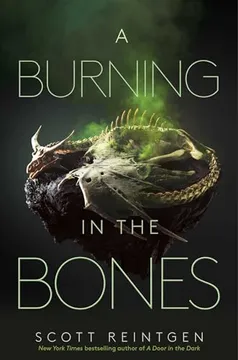
A Burning in the Bones receives strong praise as a satisfying conclusion to the Waxways trilogy, averaging 4.33 stars. Readers celebrate its fast-paced plot, compelling character development—particularly Ren Monroe's growth—and the welcome addition of new POV character Mercy. Many compare it favorably to Harry Potter and the Scholomance series. Critics note some predictability and pacing issues early on, and a few felt the story relied on familiar fantasy tropes. Overall, most agree it's the trilogy's strongest installment.
Characters
Ren Monroe
Revenge-born reformerRen is a brilliant wizard from Kathor’s Lower Quarter whose father’s murder shapes her early understanding of justice. She studies systems with unusual intensity, notices how contracts and institutions hide power, and often assumes that careful planning can keep grief contained. Her bond with Theo3 complicates the independence she has built around herself: intimacy asks her to trust someone with truths she would rather manage alone. Ren’s anger is not a flaw she can simply discard, because it has helped her resist oppression and act decisively. Her deeper challenge is learning to distinguish action that protects people from action that merely gives pain a target, then finding purpose in teaching and rebuilding.
Mercy Whitaker
Healer with hidden powerMercy is a precise young doctor whose ambition has been sharpened by disability, institutional skepticism, and a painful breakup. Her leather gloves conceal her damaged fingers and serve as the vessel for her medical magic, joining privacy to professional competence. She trusts evidence and procedure because both offer a way to act when emotion threatens to overwhelm her. Mercy’s deepest conflict is between the healer’s impulse to save every patient and the knowledge that her rare gift demands a personal sacrifice. Her relationship with Devlin6 tests whether she can hold affection without surrendering judgment, while the plague forces her to become a leader before she feels fully accepted as one.
Theo Brood
Heir choosing another wayTheo inherits a powerful house burdened by a long record of cruelty, but he is neither naïve about that history nor willing to treat it as destiny. He understands negotiation, defense, and the practical mechanics of authority, often seeing consequences before Ren1 has finished voicing her doubts. His calm can steady her, though it can also conceal how much responsibility he has absorbed. Theo’s bond with Ren1 is built on mutual recognition rather than rescue: he believes she can be both formidable and fallible. His central tension is how to use inherited power without allowing its habits to define the future he and Ren1 are trying to build.
Nevelyn Tin’Vori
Watcher turned protectorNevelyn is a guarded researcher shaped by poverty, displacement, and the loss of people she loved. She looks for vulnerabilities in powerful institutions and prefers to observe before revealing what she knows. Her concealment magic suits that instinct, but it also risks keeping her isolated from people who need her. Nevelyn’s return to a restored family home does not erase the habits formed while fleeing danger. Josey’s9 arrival draws out a more openly protective side, while her relationships with Ava8 and Dahvid7 remain marked by affection, grief, and old disagreements. She is perceptive without being sentimental, yet her reserve is not indifference; it is a method of deciding where her care can matter.
Agnes Monroe
Ren's mother and organizerAgnes is a Lower Quarter dockworker and the mother of Ren1, a woman whose private convictions reach far beyond the modest life she appears to lead. She has spent years among people who have little access to the city’s power, and she sees magic as a source of entrenched inequality rather than an unquestioned good. Agnes loves Ren1, but their shared commitment to justice does not guarantee agreement about methods. Her history with Ren’s father1 and her membership in the Makers give her choices a generational dimension. She is resourceful and persuasive, yet her certainty can make it difficult to recognize when a cause has begun to demand more than its members can morally bear.
Devlin Albright
Paladin and former loverDevlin is a disciplined Brightsword paladin assigned to protect Mercy2 during her field practical. He is physically capable and proud of his service, but his history with Mercy2 makes professional duty emotionally complicated. During their relationship, his gestures of care could leave Mercy2 feeling indebted rather than understood, a pattern she is now determined to examine for herself. He remains skilled at combat and protective magic, and his presence gives Mercy2 both practical support and an unwanted reminder of the person she used to be with him.
Dahvid Tin’Vori
Warrior with living tattoosDahvid is Nevelyn4 and Ava’s8 brother, a formidable fighter whose magical tattoos let him summon weapons and defensive power. He is direct, physically confident, and more comfortable acting than discussing pain. Grief has drawn him toward training and combat, sometimes leaving his sisters to carry the family’s emotional and practical burdens. His bond with Nevelyn4 is affectionate but strained by their different ways of coping. Beneath his martial discipline is a strong sense of loyalty, especially toward the family and the vulnerable people who have found shelter with them.
Ava Tin’Vori
Survivor with a bladeAva is Nevelyn4 and Dahvid’s7 sister, a resourceful young woman who has endured years of concealment and displacement. She values independence and resists being treated as fragile, even by the family members trying to protect her. Her quickness and practical intelligence make her a useful scout, while her impatience surfaces when Nevelyn4 assumes responsibility for everyone else. Ava’s return to her siblings restores an important family bond, but the years apart have left her determined to make her own decisions.
Josey
Boy carrying a portraitJosey is the younger brother of Garth22, a child who has been left without a stable home after his brother’s death. He arrives at the Tin’Vori house carrying a portrait that connects him to Nevelyn’s4 past. Hungry, curious, and sometimes cheeky, he is more accustomed to household responsibility than adults expect from a child his age. His limited magical education distinguishes his experience from the Tin’Voris’, whose upbringing included regular training. Josey’s presence gives Nevelyn4 a concrete person to protect and a reason to imagine a life beyond survival.
Avid Shiverian
Young strategist and spellmakerAvid is a young heir of House Shiverian, trained in a family culture that treats magic as a subject for study and refinement. She is composed in public and quick to assess strategic problems, including the risks of preserving the great houses’ power. Her age does not prevent her from taking responsibility for children, refugees, and the future of magical education. Avid believes in preparation, yet she is capable of recognizing when a once-defensible position has become untenable. She provides a counterweight to older leaders whose attachment to status makes compromise difficult.
Martin Gray
Viceroy between housesMartin Gray is Kathor’s popular viceroy, formally responsible for the Brightsword Legion and for mediating among the great houses. His public image rests on the idea that ability and hard work can overcome class, though his own background includes considerable privilege. Gray is politically observant and knows how little independent power his office truly holds. He often presents himself as a practical servant of the city, making it difficult for others to distinguish his genuine limits from his private aims.
Dr. Horn
Mercy's exacting mentorDr. Horn is a respected Safe Harbor physician who developed a difficult severance procedure and demands careful balance from his students. His standards are exacting, and his praise can carry a sting when he frames a student’s achievement as proof that another person was wrong. He recognizes Mercy’s2 precision but does not always see how his reminders of her narrow path into the profession affect her. His work places him at the intersection of medical innovation and the dangerous power to alter human bonds.
Nance Forester
Running Hills' public contactNance is the chair of the local farming union who welcomes Mercy2 and Devlin6 to Running Hills. He presents himself as a tired civic organizer trying to protect harvest work while disease spreads through the farms. His concern for the town appears sincere, and he is practiced at keeping conversations moving. Nance’s authority comes not from magic or aristocratic lineage but from his knowledge of the region’s workers and needs.
Zel Carrowynd
Warden of living stoneZel Carrowynd is Kathor’s warden and the commander of its livestone guardians. She is decisive, protective, and accustomed to following threats beyond the city’s official boundaries. Her bond with the statues is both practical and deeply personal, so their risks matter to her as more than lost equipment. Zel’s independent approach gives her room to act when the houses and city institutions are distracted or compromised.
Tessa Brood
Ambitious Brood heiressTessa is Theo’s sister3 and a sharp political thinker with a clear understanding of the city’s old conflicts. She is proud, calculating, and comfortable using knowledge of history as leverage. Tessa’s intelligence makes her more dangerous than a merely impulsive rival, because she understands how to make a change in leadership appear orderly. Her relationship to Theo3 is shaped by family history and competing ideas about who should direct House Brood.
Seminar Shiverian
Ren's former mentorSeminar is a senior Shiverian who once taught Ren1 and remains closely tied to her family’s political interests. She combines genuine respect for talent with a sharp sense of hierarchy. Her regret at Ren’s1 refusal to join her house suggests that mentorship can be sincere even when it is also a form of recruitment. Seminar prizes order and reputation, qualities that shape how she responds to the upheaval in Kathor.
Theodore Crane
Young Brood animatorTheodore Crane is a thirteen-year-old Brood cousin named after Theo3, and an animator trained to work with livestone. He is eager to be useful and visibly proud of his family connection, though his youth makes him easy for adults to underestimate. His father helped create Vega, giving the boy a personal link to the living statues and to House Brood’s craft tradition. Theodore’s earnestness and courage offer a different kind of strength from the polished confidence of the city’s heirs.
Arakyl
Dragon of old historiesArakyl is a dragon whose burial site and surviving stories become central to the characters’ investigation. The historical record portrays him as unusually patient and dangerous, though dragon lore is fragmented and often shaped by the people who tell it. His presence tests the limits of what Kathor’s scholars believe about death, magic, and time. The characters must decide how much weight to give old accounts when the present supplies evidence that exceeds their established theories.
Holt
Farmhand under suspicionHolt is a large, hired worker in Running Hills who delivers water to the sick farmhands. His silent manner and repeated attention make Mercy2 uneasy, though Nance13 describes him as a useful local repairman. He knows the farms and their routines, giving him access to places an outsider would struggle to enter.
Lana Dawson
Missing Maker recruitLana is the daughter-in-law Aunt Sloan asks Ren1 to find. After losing her job, she becomes involved with the Makers, a group that promises solidarity and a new social order. Her disappearance concerns her husband and draws Ren1 into a trail that reaches far beyond one family’s distress.
Winnie Fletcher
Young spell studentWinnie is a young student with a white braid who approaches magic with determination despite her fear. Ren1 notices her persistence as she practices foundational spells. Winnie’s presence reminds Ren1 that the future of magic belongs to children who deserve instruction and safety, not merely protection as political symbols.
Garth
Josey's artistic brotherGarth is Josey’s9 older brother and Nevelyn’s4 lost companion. His portrait of Nevelyn4 reveals an observant, affectionate artistic side that she had not known about. His care for Josey9 continues to shape the boy’s memories and helps explain why he seeks Nevelyn4 out.
Plot Devices
Waxways and way candles
Travel through darknessA traveler focuses on a destination and uses a burning way candle to pass through the waxways, a magical route connecting distant places. The method lets Mercy2 reach Running Hills and later lets Ren1 and the survivors move between Kathor, Balmerick, and Meredream. Candles must burn long enough for the intended distance, and supplies are finite. That limitation makes them more than convenient transport: missing candles can strand a person, while extinguishing one at the crucial moment can redirect an entire group into danger.
Threads of connection
Make bonds visibleMedical severance spells reveal colored threads representing a person’s relationships and connections. A surgeon can identify a target thread and cut it, but a mistake can permanently alter a patient’s attachments. The device first establishes Mercy’s2 discipline as a doctor, then becomes the means of exposing the magical links behind the Makers’ movement. Its imagery makes social influence tangible: a bond can be intimate, chosen, manipulated, or used as a channel for power.
The waterborne plague
Turn infrastructure into a weaponMutilated corpses placed in treatment facilities release a substance into Kathor’s shared water supply. The resulting illness causes bruising, thirst, confusion, and a strange echo in the heartbeat, then permanently removes ordinary magic from its victims. The threat scales from a handful of farms to a dense city because the water system carries it for the attackers. Mercy’s2 medical investigation links the symptoms to a loss of magic and gives the survivors a way to understand both the disease and its political purpose.
Red scarf chain spell
Turn belief into compulsionThe Makers’ red scarves carry a chain manipulation spell that can pass from person to person. It does not create new beliefs from nothing; instead, it pushes existing grievances and political convictions beyond the wearer’s ordinary limits. The spell helps explain how a movement built around real inequality can be driven toward extreme actions without every member recognizing the coercion. Ren1 detects the spell’s influence on herself, and the investigation later traces its source through the people connected to the Makers.
Mercy's life exchange
Return life at personal costMercy2 can restore someone who has died, but the magic takes something from her in exchange. The cost is unpredictable and may damage her body, making each use a choice rather than a limitless cure. She has hidden the ability because public knowledge would make her a resource controlled by powerful families. Its eventual use changes the battle’s outcome, but the bodily price forces the story to ask whether a healer can remain responsible for every life she might save.
Download PDF
Download EPUB
.epub digital book format is ideal for reading ebooks on phones, tablets, and e-readers.








