

Key Takeaways
Reserve the CEO’s attention for Culture, People, and Numbers
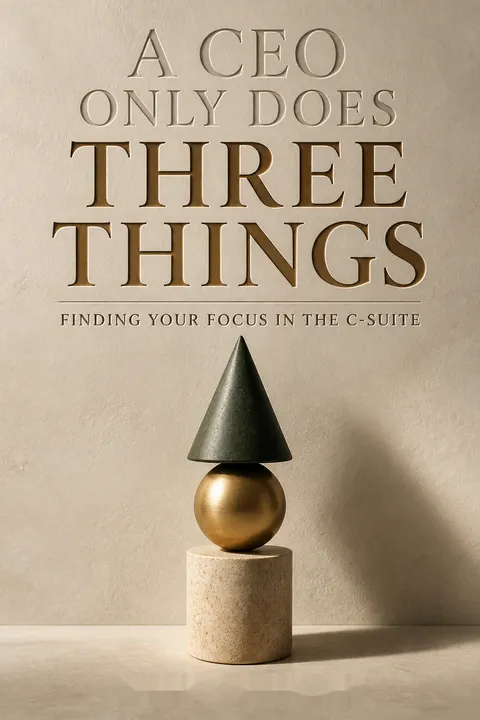
The job is narrower. Trey Taylor was preparing to join AOL’s effort to sell assets when his father died and he took over the family business in rural Georgia. Years of learning to lead shaped his answer to a basic executive question: the CEO’s core work is culture, people, and numbers. The CEO remains accountable for the organization, but that does not mean personally doing every task. Decisions close to the work should usually stay with the people who understand it best.
Delegate the rest. The CEO sets direction and communicates it, builds and keeps the team, and ensures the business has enough cash. When a decision in these areas reaches an impasse, the CEO steps in. The three priorities act as a filter for competing demands, protecting time for decisions that can change the company’s trajectory.
This is a useful antidote to executive busyness masquerading as responsibility. Organizational design research often finds that decisions improve when authority sits near relevant information, while senior leaders concentrate on tradeoffs spanning the whole system. The distinction between accountability and execution is crucial: delegation does not absolve the CEO, it makes ownership clearer. The framework is intentionally spare, though small firms may face genuine role overlap. The practical test is not whether a task touches culture, people, or money in some indirect way, but whether the CEO has a unique contribution to make.
Inspect the beliefs steering your decisions before correcting visible behavior
Behavior has roots. Taylor describes three linked dimensions of human behavior: “I Think,” the conscious, intellectual part; “I Feel,” the emotional part; and “I Am,” the deeper layer of identity, values, and beliefs. He argues that the last dimension shapes how people interpret events, which then influences emotion and action. A leader who wants different results must look beyond the visible mistake to the beliefs and assumptions producing it.
Study your own patterns. The book cites organizational psychologist Tasha Eurich’s finding that while most people consider themselves self-aware, only a small minority meet a more objective standard. Peter Drucker’s feedback analysis offers a practical discipline: write down what a decision is expected to produce, then compare the prediction with results months later. The gap can reveal strengths, blind spots, and recurring motives.
The model’s strength is its reminder that information alone rarely changes conduct. Behavioral science distinguishes knowing what to do from having the motivation and context to do it; identity and emotion help explain that gap. A decision log adds useful calibration by confronting leaders with outcomes rather than self-narratives. One caution: the three dimensions are a coaching lens, not a complete scientific map of the brain. Used as prompts for inquiry rather than fixed psychological categories, they can help leaders ask better questions about causes.
Treat culture as the company’s invisible operating system, not office decoration
Culture directs choices. Taylor defines company culture as the shared beliefs, norms, and practices that shape how people treat one another and make decisions. It exists whether leaders name it or not. If the CEO does not deliberately tend it, the everyday choices of employees create an accidental culture, often shaped by whoever has the most local influence. A healthy, intentional culture can help attract strong people and support execution; a neglected one can undermine both.
Look for evidence. The book cites a Deloitte survey in which 82 percent of respondents saw culture as a possible competitive advantage, while only 19 percent believed their own company had the right culture. Taylor recommends observing actual behavior, then asking employees what the organization reliably does. He suggests rating each proposed value: scores above 85 percent describe values already widely practiced, while lower scores may reveal aspirations rather than reality.
Calling culture an operating system captures how informal norms guide thousands of small decisions without a manager present. It also helps explain why slogans cannot compensate for incentives that reward contradictory behavior. The value-rating exercise usefully distinguishes lived practice from corporate wish lists. Still, consensus is not automatically virtue: a close-knit culture can normalize exclusion or silence dissent. Leaders should ask not only whether a value is shared, but whose experience it serves and whether people can challenge its interpretation.
Turn values into repeatable rituals people can practice without you
Make principles tangible. Values gain force when they are translated into actions people can repeat. Taylor calls a company’s rules, norms, and routines a cultural operating system. Ritz-Carlton’s brief daily team gatherings, for example, revisit one service value so employees can connect the principle to the day’s work. In Taylor’s firm, a weekly message highlights a value through a colleague’s example.
Design rituals deliberately. The book describes a ritual as a repeated activity with a purpose: introducing or reinforcing a shared value. It should be practical enough to sustain. A ritual can be a short meeting, a recognition practice, or a recurring way to welcome new employees. Taylor warns against forcing routines that feel hollow. If people only perform the motions, the ritual can weaken trust rather than strengthen culture. Start small, observe whether it resonates, and adjust.
Ritual links abstract norms to embodied memory. Anthropology and social psychology both examine how repeated group practices create belonging and make expectations legible, especially for newcomers. A short, consistent practice can therefore do more than a polished values document. Its quality depends on whether the behavior it celebrates matches actual power and rewards. Rituals can also become performative, so employee feedback matters. The strongest test is whether the practice helps people make a better decision when no leader is watching.
Recruit for four kinds of fit, not likability alone
Use four separate tests. Taylor’s 4Cs are Culture, Capabilities, Compensation, and Commitment. Instead of relying on one interview or a résumé, the process examines each area in turn. First, candidates learn the company’s values and decide whether they want to work there. Next, the employer explains the job and assesses relevant skills with objective tests, behavioral questions, and references. Compensation is discussed openly, and the final conversation makes expectations on both sides explicit.
Let candidates opt in. After each stage, Taylor gives candidates time to reflect and asks interested people to recontact the company. This can screen out candidates who do not want the role or culture, before either side invests further. The approach is demanding, but the book argues that replacing an employee can cost about one-fifth of annual pay. A careful process can be an investment in retention, not merely a slower route to filling a vacancy.
Separating cultural alignment from job capability reduces a common hiring error: treating charm as evidence of competence. Structured interviews and work-relevant assessments also make comparisons more consistent and less vulnerable to snap judgments. Candidate choice is valuable because hiring is reciprocal, not just employer selection. Yet “culture fit” can become a cover for hiring people who resemble existing staff. A stronger interpretation is contribution fit: can the candidate uphold essential principles while bringing different experience, perspective, or working style?
Match people’s time horizons to the work they must own
Fit the role to the person. Organizational psychologist Elliot Jaques argued that jobs differ in the length and complexity of work people must manage without close supervision. Taylor presents five broad levels, from daily execution to leading the company across multiple years. The right match matters: a role requiring long-range planning can frustrate someone who thrives on immediate tasks, while routine work can constrain someone ready to manage systems and strategy.
Separate person from position. Taylor recounts hiring Robert for sales and client service, a role with short-cycle demands. Robert’s strengths pointed toward longer-term process building. When the company created a client-success function, Robert became its director and helped build the new team. The lesson is to assess both the work’s time horizon and the employee’s capacity, rather than treating poor performance as proof of poor talent. The book cites Jaques’s estimate that many employees occupy mismatched roles.
This model directs attention from personality labels toward the structure of the work itself. Role design is often an overlooked cause of both underperformance and burnout: people may struggle because the job demands a different planning horizon, not because they lack commitment. Robert’s move illustrates the value of listening for how someone thinks about work. The framework should not be used as a rigid ranking of human worth. Time horizon is a hypothesis to test through assignments, support, and observed results.
Correct mistakes without humiliation, and make specific praise routine
Model the culture yourself. Taylor draws on quality expert W. Edwards Deming’s warning that a flawed system can defeat a capable person. When an employee made a harsh, unhelpful complaint to a vendor, Taylor acknowledged the employee’s commitment to high standards, then explained how the message violated the firm’s values. The employee responded by recognizing the mistake. The goal was correction, not shame.
Notice good work. Taylor urges leaders to praise specific contributions in private and in public. A CEO he knows interrupted a conversation to tell a young adviser that a task was well done and that the performance showed promise. Praise can recognize both the work and the person’s developing capability. Taylor also describes recognizing employees’ families when exceptional work requires sacrifice. Praise should remain sincere; empty compliments risk making recognition feel like another management tactic.
This approach combines accountability with psychological safety, the sense that people can admit problems or offer ideas without expecting humiliation. Research on learning climates suggests that this combination supports correction and improvement better than fear alone. Specific praise is most useful when it identifies an observable behavior and its effect, so people know what to repeat. Leaders should avoid turning praise into surveillance or favoritism. Recognition works best when access to it is fair and when employees can still hear candid feedback.
Track leading and lagging measures so teams can steer, not just score
Choose the right numbers. Key performance indicators, or KPIs, are measures selected because they help assess the health and direction of a business. The CEO should decide which ones matter, even when finance staff handle reporting. Lagging indicators show results already achieved, such as profit. Leading indicators track activities or conditions that can signal future results. Watching only lagging measures is like trying to navigate using only a rear-view mirror.
Connect data to action. Taylor describes Pixable, a digital publisher that aimed to raise advertising revenue without producing more content. Data revealed that readers spent longer with its material and shared it widely. The company used those findings to support sales, adjust pricing, and guide content decisions. The example shows why metrics should be chosen for their ability to change a decision, not simply because they are easy to count.
The distinction between leading and lagging measures mirrors the difference between a warning signal and an outcome report. A balanced dashboard supports earlier intervention without pretending that every future result is predictable. Pixable’s example also shows that measurement can reveal value customers recognize but a firm has not yet communicated. Metrics can distort behavior when treated as targets in isolation. Leaders should pair each indicator with a clear question: what action would change if this number moves?
Share relevant numbers so employees can improve the business
Make contribution visible. At Bethlehem Steel, executive Charles Schwab wrote the day shift’s production total where the night shift could see it. The next shift beat the score, and the day crew responded by raising its own output. Taylor reports that production rose 66 percent in a day. The important change was not a complicated incentive plan; workers could see a result and act on it.
Invite people into problem-solving. Taylor’s own team was asked to find $100,000 in cost savings without layoffs. Employees identified $200,000 in possible cuts, and those who contributed shared a portion of the savings. In another company, line workers exposed an obsolete cooldown rule that had limited production. Such insights often sit with people closest to the work. Share enough context for employees to understand the goal, then make it safe and worthwhile to offer solutions.
Transparent measures can turn employees from recipients of instructions into interpreters of the system. This aligns with participatory management: people closest to a process often see waste or obstacles that senior leaders cannot observe. Schwab’s chalkboard also shows that feedback and comparison can motivate without elaborate controls. But competition is not universally helpful, and raw numbers can invite gaming or blame. The measure must be fair, understandable, and paired with authority to improve the conditions it reveals.
Build reserves and share gains to preserve choices under pressure
Cash buys options. Taylor argues that profit is not only a reward; it can fund resilience and future growth. His company carried enough reserves to endure two years of sharply reduced sales during the financial crisis. He recommends building toward a year of operating expenses in cash, so a downturn does not immediately force layoffs or insolvency. Reserves can also let a company act when an opportunity appears.
Share the harvest. Taylor advocates rewarding people for value they create beyond routine duties, including ideas that improve systems rather than just individual output. He also recommends using some profits for causes that genuinely connect to the company and its people. These uses are presented as investments in retention, trust, and reputation, not as substitutes for a sound business. The CEO’s financial task is to balance current needs, future options, and fair recognition of contributors.
The emphasis on reserves treats liquidity as strategic freedom, not idle money. Corporate finance recognizes the value of flexibility: cash can protect a firm when credit tightens and support investment when competitors are constrained. Sharing gains can reinforce cooperation when rewards reflect genuine contribution and are distributed transparently. There is a real tradeoff, however. Excess reserves can become complacent hoarding, while poorly designed incentives distort priorities. A disciplined policy should specify what cash protects, what counts as value created, and how benefits are shared.
Analysis
The book’s most useful move is to redefine executive focus as a question of role boundaries. The CEO is accountable for the whole organization, but should not become its universal problem-solver. Culture, People, and Numbers form a compact test for deciding where executive judgment is uniquely valuable and where authority belongs closer to the work. This makes the book less a time-management manual than an argument about organizational design.
Its strongest through-line is alignment. Values should shape routines, hiring should select and develop people who can thrive within those routines, and metrics should make shared goals visible enough for employees to act on them. The stories make this architecture memorable: Robert’s move from sales into building client success shows how role design can recover talent; Schwab’s production score shows how information can alter behavior without elaborate oversight. In each case, leadership changes the conditions around work rather than merely demanding more effort.
The framework also carries risks worth keeping in view. Culture can become conformity if “fit” means similarity. Values can turn into branding if leaders are exempt from them. Metrics can narrow attention if measurable output displaces unmeasured quality. And the idea that CEOs should personally own hiring and culture requires adaptation in large, complex organizations, where distributed leadership is unavoidable. The book’s own logic suggests a safeguard: delegate execution, make decision rights clear, and retain accountability for the system.
The humanistic language of belief, purpose, and care is most persuasive when converted into observable practice: candid feedback, fair assessment, clear measures, real employee voice, and financial resilience. Its central proposition is therefore practical rather than mystical. A CEO creates leverage by shaping the environment in which other people make thousands of consequential decisions, then protects enough attention to keep that environment aligned with the company’s purpose and survival.
Review Summary
A CEO Only Does Three Things receives mostly positive reviews, with readers praising its concise and practical approach to leadership. Many appreciate the book's focus on three key areas: culture, people, and numbers. Reviewers find the insights valuable for CEOs and leaders at all levels. Some highlight the book's actionable advice and clear articulation of the CEO's role. While most reviews are enthusiastic, a few readers find some sections generic or note missing elements like product focus and strategy. Overall, the book is praised for its clarity and usefulness in navigating leadership challenges.
People Also Read










Glossary
Trinity
CEO’s three prioritiesTaylor’s name for the CEO’s core responsibilities: Culture, People, and Numbers. The CEO shapes the organization’s shared values and direction, recruits and retains talent, and ensures the company has the financial resources to operate and grow. Other work should generally be delegated unless it reaches an impasse or requires uniquely executive judgment.
Three Dimensions of Human Behavior
Thought, feeling, and identityA model that separates human experience into “I Think,” the conscious intellectual dimension; “I Feel,” the emotional dimension; and “I Am,” the deeper sense of identity, values, and beliefs. Taylor uses it to explain why behavior is shaped by more than knowledge, and to encourage leaders to understand themselves and employees as whole people.
Cultural operating system
Rules that guide behaviorA company’s articulated values, behavioral expectations, and recurring practices that help people make decisions without needing constant executive direction. Taylor argues that it should be built from values employees actually share, explained with enough context to guide action, and reinforced through leadership behavior and rituals.
4Cs
Four stages of hiringTaylor’s structured talent acquisition process: Culture, Capabilities, Compensation, and Commitment. Candidates first assess whether the company’s culture suits them, then demonstrate relevant skills and work fit. Compensation is discussed openly, and the final stage clarifies reciprocal expectations. The sequence is intended to make hiring more deliberate and improve the likelihood of a lasting match.
Levels of work
Increasing work complexityAn organizational framework associated with Elliot Jaques that distinguishes roles by the complexity and span of responsibility they require. Taylor presents levels ranging from doing daily work to leading a company across years. The idea is to classify the position itself, then assess whether a person’s capabilities and preferred time horizon fit its demands.
Time horizons
Span of independent workThe length of time a person can plan and work effectively without direct supervision, as used in Jaques’s approach to role design. A role may require daily execution, monthly coordination, or longer-range planning. Taylor recommends comparing the position’s required horizon with the employee’s capacity to identify mismatches that may limit performance or cause frustration.
Ownership thinking
Acting like a business ownerA mindset in which employees understand how their work affects the company and take initiative to improve results. Taylor links it to transparent, relevant numbers, opportunities to contribute ideas, and recognition for value created. It is not simply working harder or receiving a bonus; it means engaging critically with how the business operates.
Preception
Seeing potential earlyTaylor’s term for noticing a person’s undeveloped capacity before it is obvious to others. It is the act of recognizing a strength that may not yet appear in performance or self-understanding. The book’s closing story describes a teacher who identified a young student’s sense of responsibility and gave him meaningful work that made the strength visible to him.
Evocation
Calling potential into actionTaylor’s term for helping another person recognize and express a capacity they may not yet see in themselves. A leader evokes potential by naming a strength and giving the person a consequential opportunity to use it. In the book’s closing example, a teacher’s confidence in a student’s judgment encouraged him to accept responsibilities he initially wanted to avoid.
FAQ
What's "A CEO Only Does Three Things" about?
- Core Focus: The book by Trey Taylor emphasizes that a CEO should focus on three primary areas: Culture, People, and Numbers. These are the pillars that drive a company's success.
- Interdisciplinary Approach: It combines insights from neuroscience, anthropology, psychology, and business to address challenges faced by corporate leaders.
- Practical Guidance: The book provides tools and mindsets for CEOs to unlock value from the top of the organization down, focusing on what only they can do.
Why should I read "A CEO Only Does Three Things"?
- Leadership Clarity: It offers a clear framework for CEOs to focus on their most impactful responsibilities, reducing overwhelm and increasing effectiveness.
- Actionable Insights: The book provides immediately actionable insights that can be implemented to improve company culture, talent management, and financial oversight.
- Broad Applicability: Whether you're a new CEO or a seasoned leader, the book's principles are applicable across various industries and organizational sizes.
What are the key takeaways of "A CEO Only Does Three Things"?
- Focus on Three Areas: CEOs should concentrate on Culture, People, and Numbers to drive organizational success.
- Intentional Leadership: Leaders must act with intent, focusing on decisions that have a significant impact on the company's long-term success.
- Empowerment and Delegation: CEOs should delegate tasks that do not align with these three areas to empower their teams and focus on strategic leadership.
What are the best quotes from "A CEO Only Does Three Things" and what do they mean?
- "A CEO only does three things." This quote encapsulates the book's central thesis that a CEO's role is to focus on Culture, People, and Numbers.
- "Culture eats strategy for breakfast." This Peter Drucker quote, highlighted in the book, underscores the importance of a strong company culture in achieving strategic goals.
- "If you don’t know your numbers, you don’t know your business." This emphasizes the critical role of financial literacy and data-driven decision-making in effective leadership.
How does Trey Taylor define the role of a CEO in "A CEO Only Does Three Things"?
- Vision and Strategy: The CEO sets the overall vision and strategy of the company and communicates it to all stakeholders.
- Talent Management: The CEO is responsible for recruiting, hiring, and retaining the best talent for the company.
- Financial Oversight: Ensuring there is always enough cash in the bank is a key responsibility of the CEO.
What is the significance of Culture in "A CEO Only Does Three Things"?
- Competitive Advantage: Culture is described as the most important competitive advantage a company can have.
- Intentional Development: CEOs must intentionally develop and nurture a company culture that aligns with shared values and drives success.
- Behavioral Influence: A strong culture influences employee behavior and decision-making, often more than policies or procedures.
How does "A CEO Only Does Three Things" address People management?
- Whole-Person Management: The book emphasizes understanding employees as whole individuals, considering their intellectual, emotional, and creative dimensions.
- Talent Acquisition: It advocates for a structured, multi-step hiring process focused on cultural fit, capabilities, compensation, and commitment.
- Retention Strategies: The book provides strategies for retaining talent by fostering a supportive and engaging work environment.
What role do Numbers play in "A CEO Only Does Three Things"?
- Data-Driven Decisions: Numbers are crucial for making informed decisions and understanding the health of the business.
- Key Performance Indicators (KPIs): The book stresses the importance of identifying and tracking KPIs to guide strategic planning and execution.
- Financial Literacy: CEOs must be financially literate to effectively oversee the company's financial health and ensure sustainable growth.
How does Trey Taylor suggest CEOs handle decision-making in "A CEO Only Does Three Things"?
- Focus and Intent: CEOs should focus on decisions that align with the company's core areas of Culture, People, and Numbers.
- Avoiding Overchoice: The book warns against decision fatigue and suggests making fewer, more impactful choices.
- Empowerment through Delegation: By delegating non-core tasks, CEOs can concentrate on strategic decisions that drive long-term success.
What is the "4Cs" model in "A CEO Only Does Three Things"?
- Culture Fit: The first step in the hiring process is ensuring candidates align with the company's culture.
- Capabilities Assessment: Evaluating a candidate's skills and abilities to perform the job effectively.
- Compensation Alignment: Discussing and agreeing on a compensation package that reflects the candidate's value to the company.
- Commitment Confirmation: Ensuring the candidate is committed to the company's mission and values before finalizing the hire.
How does "A CEO Only Does Three Things" propose CEOs should handle company growth?
- Sustainable Growth: The book emphasizes the importance of sustainable growth through strategic planning and resource management.
- Reinvestment: Profits should be reinvested into the business to fuel further growth and stability.
- Cash Reserves: Maintaining cash reserves is crucial for weathering economic downturns and seizing growth opportunities.
What is the overall impact of following the principles in "A CEO Only Does Three Things"?
- Enhanced Leadership: CEOs who focus on Culture, People, and Numbers can lead more effectively and drive organizational success.
- Improved Company Performance: By aligning the company's operations with these three areas, businesses can achieve better performance and growth.
- Long-Term Success: The book provides a framework for sustainable success by focusing on the core responsibilities of a CEO.
Download PDF
Download EPUB
.epub digital book format is ideal for reading ebooks on phones, tablets, and e-readers.








