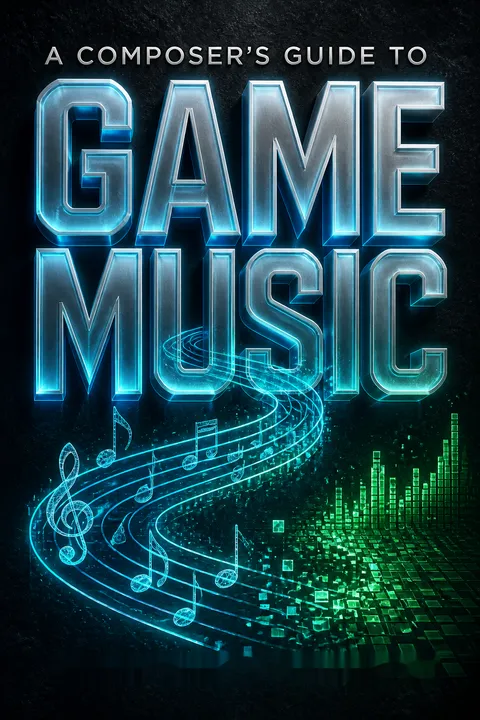


Key Takeaways
Write music for the player's changing experience, not just the screen.
The medium changes the brief. Game music must serve a player whose actions can change what happens, when it happens, and how long a situation lasts. A composer may need to anticipate exploration, combat, sudden danger, and repeated listening, while still creating music that works as music. This is not simply film scoring with different pictures: the composition may need to loop, shift, or respond to gameplay conditions.
Art and technology meet. Phillips's career began with a realization while playing Tomb Raider: game music could be a profession. She argues that technical fluency matters, but the first responsibility remains making music that strengthens the game. Interactivity is a design constraint, not a substitute for artistic judgment.
The central challenge is to compose for both a work and an experience that changes in real time. That makes the composer part artist, part systems thinker: a musical idea must survive variation without losing its emotional identity. The distinction is useful beyond games wherever media responds to an audience. The tension is real, though. If technical demands dominate the brief, music can become a clever mechanism with little expressive force. Phillips's insistence on musical quality provides a needed standard: implementation should enable the composition, not become its reason for existing.
Train your ears broadly, then let tools serve musical judgment.
Build musical range. Phillips recommends learning through formal study, private instruction, or self-directed work. None guarantees success, but each can develop theory, musicianship, and the ability to hear how a piece is constructed. Nobuo Uematsu, who learned without formal music training, illustrates that the self-taught route is possible, though it demands persistence and close listening.
Listen beneath the surface. Study arrangement, rhythm, structure, and tone color, the quality that lets one sound stand apart from another. That skill is useful when a composition must be divided into parts that still work independently. Keyboard ability, a second instrument, and working knowledge of music technology also widen the composer's options. Tools reshape creative habits, so learning them is part of learning how to compose with them.
The strongest version of this advice treats listening as a form of analysis, not passive exposure. A composer who can identify what an unfamiliar style is doing has more choices than one who merely likes or dislikes it. That capacity also makes collaboration easier because musical references become interpretable rather than mysterious. The caution is that technical competence can be mistaken for artistic development. Software proficiency expands the available palette, but it cannot decide which sound belongs in a scene. Deliberate listening and compositional practice keep the equipment in its proper role.
Use music to guide attention, emotion, and the player's sense of time.
Immersion has stages. Phillips draws on a model that describes engagement, engrossment, and total immersion. Engagement is the willingness to invest attention and effort. Engrossment adds emotional involvement and reduced self-awareness. Total immersion occurs when attention and empathy combine so fully that the game world feels compelling. Flow is a related state in which a person becomes absorbed and actions feel almost automatic.
Music can help at each stage. A calmer opening may reassure a newcomer facing unfamiliar controls. A change in music can distinguish combat from exploration, while silence or a brief motif can gently point toward a place worth investigating. Studies discussed in the book suggest that music can affect time perception, visual interpretation, task enjoyment, and how viewers understand a story. These effects are possibilities to test, not guarantees.
Music's power here is informational as well as emotional. A shift in texture can tell a player that the rules of the moment have changed before a written prompt appears. That makes score part of interface design, with the advantage of communicating through mood rather than instruction. The research examples are suggestive, but their results should not be treated as universal laws. A minor key or a faster tempo does not produce the same response in every listener or context. The practical lesson is to use psychological findings as hypotheses, then judge their effect inside the actual game.
Give stories musical memory, but build themes that can keep changing.
Themes can carry meaning. A leitmotif is a recurring musical idea associated with a character, place, object, or situation. Once players learn the association, a theme can recall an absent character or add subtext to a new scene. Phillips distinguishes this from an idée fixe, a central theme tied to a persistent, often abstract idea rather than only one literal story element.
Variation keeps meaning alive. In Assassin's Creed III: Liberation, Phillips used a recurring musical idea for the search for truth. It appeared quietly in the main theme, then returned with greater force around revelations. She also describes altering themes through new instrumentation, tempo, mode, or fragments. In Resident Evil 2, changing the instruments carrying a creature's theme accompanied its escalating transformation. Variation preserves recognition while preventing a theme from becoming an irritating repeated signal.
A recurring theme works like a learned symbol: each appearance draws on the listener's memory of earlier ones. Games can make that association especially personal because the player encounters it while acting, not only while watching. The distinction between a character theme and a theme for an idea is also valuable. It gives composers a way to connect separate plot events without claiming they concern the same person. But symbols can become too explicit. If every recurrence announces exactly what the player should feel, the score risks narrowing interpretation instead of enriching it.
Treat genre conventions as audience clues, not creative handcuffs.
Know whom the game serves. Phillips presents DGD1, a model grouping players as Conquerors, Managers, Wanderers, and Participants. Broadly, they seek challenge, mastery, exploration, and social or emotional involvement. The model also distinguishes hardcore and casual players. The book connects these preferences with game genres and with research on musical taste, then uses familiar patterns to explain why shooters often combine rock and orchestral weight, while life simulations tend toward friendlier, varied styles.
Use conventions intelligently. Nintendo's shift from the aggressive music used to promote its Revolution concept to the more welcoming sound of Wii advertising signaled a broader intended audience. Phillips's Speed Racer audition likewise succeeded by combining racing-game energy with the project's unusual retro-futuristic and story-driven qualities. Genre history can help a composer meet expectations, but research and precedent should inform choices rather than dictate them.
Genre conventions are a form of communication between creators and audiences. Familiar sounds can establish a game's identity quickly, especially when the player has little context. The book's player categories offer a practical prompt: consider whether the experience emphasizes mastery, discovery, or relationships. Their weakness is the risk of turning broad tendencies into fixed stereotypes. The model's correlations cannot tell a composer what every player wants, and game audiences are not uniform. The most useful approach is to combine genre knowledge with the specific game's design, audience testing, and creative purpose.
Choose music by the job it must perform in gameplay.
Music does more than set mood. Phillips describes it as a way to create a player's mental state, build the credibility of a world, and sustain the pace of action. For SimAnimals, a simulation about caring for animals and their habitat, she moved away from a conventional cinematic approach and used post-minimalist patterns to echo the player's need to monitor many changing details. Research for a setting can also shape instrumentation and atmosphere, as Phillips's study of religious music informed her score for The Da Vinci Code game.
Music can respond to performance. A brief stinger can signal victory, defeat, a transition, a hint, or a discovered prize. Longer tracks can comment on the player's fortunes, as in SimAnimals, where music reflected the health of the game world. Music can also serve branding or deliberately distinguish a minigame from the rest of the score.
Thinking in functions turns a vague request for something exciting or atmospheric into a design question: what should the player notice, feel, or understand? That question encourages closer collaboration among composers, designers, and sound teams. It also helps explain why a musical choice that sounds effective alone may fail in play. A soundtrack has to share space with controls, effects, speech, and player attention. Functional categories are therefore best treated as a checklist, not a formula. One passage may build a world and set a pace at once, while another may need to stay out of the way.
Ask for the game's raw materials before composing a note.
Prepare with evidence. Phillips urges composers to request gameplay captures, design documents, dialogue scripts, concept art, storyboards, a music asset list, cinematics, and playable builds when available. Each reveals a different part of the project: gameplay video shows movement and rhythm, concept art communicates visual atmosphere, and a script clarifies character and story. The music asset list estimates what tracks are needed, where they play, and what they should do. Because plans change, it should be detailed and kept current.
Join the team early. Phillips recalls a creative briefing for SimAnimals in which a developer described the many possible outcomes of a bear and a rabbit encountering each other. Her involuntary concern for the rabbit made the game feel more real to her. The episode captures why team conversations matter: they give the composer emotional access to a project that documents alone may not provide.
The request for materials is really a request for context. A composer cannot make informed decisions about pacing or thematic meaning if the only input is a short verbal description. A shared asset list also turns assumptions into questions that collaborators can resolve before they become expensive revisions. This is especially important when a project develops iteratively and its plan changes. The counterpoint is that documentation can lag behind the game itself. Materials are a starting map, not ground truth, so regular communication and firsthand exposure to gameplay remain essential.
Make linear loops feel alive without advertising their return.
A loop must conceal its seam. Linear music follows a fixed form, even when gameplay around it is unpredictable. A linear loop repeats, so its ending must connect naturally to its beginning. Phillips offers several ways to avoid an obvious musical landmark: develop themes continuously, use small moving events, present a succession of variations, build around a repeating figure, or let slow textures change gradually. Longer, varied tracks can help reduce repetition fatigue.
Plan the join. A loop point is the transition from the end of a track back to its start. Composers can disguise it with a repeated vamp, split a question-and-answer phrase across the seam, or divide a chord progression between the ending and opening. Editing also matters: a reverb tail must not vanish unnaturally, and audio should be trimmed near a zero crossing point to avoid clicks. Stingers and one-shot tracks serve other fixed purposes, such as signaling an event or scoring a cinematic.
The loop problem reveals how playback conditions can become compositional material. A phrase that feels satisfying once may become unbearable after repeated exposure, while a subtle transformation can make recurrence feel like continuity. The book's practical editing details are valuable because a musically sound design can still fail at the audio boundary. There is also a tradeoff: hiding repetition too completely can make a score bland or forgettable. The aim is not to erase identity, but to balance recognition with enough change that the player can remain inside the experience.
Design interactive music as modular composition, not afterthought engineering.
Rendered music can still react. Horizontal re-sequencing rearranges recorded segments along the timeline, while vertical layering combines or removes synchronized musical layers. In Speed Racer, a high-energy zone-mode segment could replace part of a regular racing track and then return smoothly to it. For The Maw, Phillips wrote three additive layers that could play alone or together as the action changed. Each layer needed to work independently and fit with the others.
Data offers different freedoms. MIDI stores musical performance instructions rather than one finished recording, allowing a game to alter notes, tempo, instruments, or dynamics. Generative music uses rules, probability, or chance to produce changing sequences. These systems can reduce obvious repetition, but they also create constraints and can yield uninspired results if the composition and rules are weak. Whether using recorded audio or data, interactivity should serve the musical experience rather than overshadow it.
Modular composition asks a composer to think about how musical parts behave when separated, recombined, or triggered in unfamiliar sequences. That is a distinctive craft, not merely a programming task. The examples show why planning matters: layers need enough independence to remain clear, yet enough compatibility to form a coherent whole. The same principle applies to any system assembled from reusable components. More possible combinations do not automatically mean more expressive music. A smaller set of carefully designed transitions can feel more responsive than a sprawling system whose parts have no meaningful relationship.
Build a composing career with the habits of a small business.
Talent needs a route to work. Phillips describes composing as a business that includes writing concise pitches, maintaining a professional website, researching studios, keeping contact records, meeting people, and following up politely. Her own first break came after three game projects she had worked on were cancelled. She sent a brief letter to Sony, met a music supervisor at E3, then submitted audition music and followed up. The opportunity led to work on God of War and Charlie and the Chocolate Factory.
Expect uncertainty. Contract composers may invest unpaid time in auditions, pay for equipment, and work without predictable income or benefits. A project can change direction, criticism can trigger revisions, and a strong composition alone may not secure the next job. Phillips's practical standard is to pair excellent music with reliable communication, respect for the team, and persistence that is courteous rather than relentless.
The career advice is unusually concrete because it treats self-promotion as part of the craft rather than an embarrassing distraction from it. A clear portfolio and sustained professional relationships make creative work discoverable, while follow-up converts a fleeting introduction into a possible collaboration. The story also shows the role of timing: skill and effort helped, but neither guaranteed the outcome. The book is candid about the costs of contract work, yet its optimism should not obscure the need for boundaries. Persistence is valuable; normalizing unpaid labor or chronic overwork is not a sustainable business plan.
Analysis
The book's deepest contribution is its insistence that game music is composed for conditions, not merely images. A player can linger, rush, fail, explore, or trigger events in an order the composer cannot predict. The composer must therefore make music that remains expressive while adapting to uncertainty. This reframes technical implementation as an artistic problem: a loop needs form without a destination, a theme must survive rearrangement, and a musical layer may need to stand alone without losing its place in the whole.
Phillips supports this argument with a useful progression from the inner skills of listening and composition to immersion, thematic meaning, genre, production workflow, implementation, and career management. Her project stories make abstract challenges tangible. The example of the truth motif in Assassin's Creed III: Liberation shows how a recurring idea can unify separate events, while The Maw illustrates the compositional discipline required for interchangeable layers. Her account of three cancelled early projects followed by a carefully pursued opportunity makes the business advice more than generic networking counsel.
The book's strongest caution is implicit in its own examples: a system can be technically elegant and still produce weak music. Interactivity, demographic models, and psychological findings are tools for making hypotheses, not authorities that replace listening. DGD1's player categories can prompt useful questions, but should not be treated as a precise map of every audience. Likewise, evidence about mood or time perception does not guarantee a predictable response in a particular game.
Some product references and platform-specific instructions reflect the technology landscape of 2014, so they are less durable than the design principles. The lasting lesson is to gather context early, understand the team's goals, compose for the player's actual activity, and keep artistic quality as the measure of whether the technical solution works. The guide is most valuable as a working method for balancing musical intention, player agency, and production reality.
Review Summary
A Composer's Guide to Game Music receives mostly positive reviews for its comprehensive overview of game music composition. Readers appreciate the author's industry experience and practical advice. Some find the writing style dry or basic, questioning the target audience. The book is praised for covering business aspects, technical details, and creative approaches. It's considered valuable for aspiring game composers, though some desire more advanced content. Critics note redundancy and a lack of audio examples. Overall, it's seen as a solid introduction to the field, despite some limitations.
People Also Read
Glossary
Immersion
Absorption in a gameA state in which players become absorbed in a game's world and activity, with reduced awareness of the screen, controls, or themselves as separate from play. Phillips describes a progression from engagement, to engrossment, to total immersion, in which attention and empathy help make the fictional experience feel compelling.
Flow
Absorbed, automatic activityA psychological state associated with deep involvement in an activity. In the book's account, players in flow become so focused that actions feel spontaneous and self-awareness recedes. Flow helps explain why clear gameplay cues and music that supports concentration can strengthen a player's involvement.
DGD1
Four player profilesDemographic Game Design 1 is a model developed by Chris Bateman and Richard Boon that groups players as Conquerors, Managers, Wanderers, and Participants. The categories describe broad motivations such as overcoming challenges, mastering systems, exploring environments, and connecting socially or emotionally. The model also distinguishes hardcore and casual play styles.
Leitmotif
Recurring symbolic themeA musical idea repeatedly associated with a character, place, object, or dramatic situation. Once the association is established, a composer can use the theme to recall that element, signal its importance, or add subtext even when it is not directly present. Variations can preserve recognition while changing the emotional meaning.
Idée fixe
Persistent central musical ideaPhillips uses the term for a singular, recurring theme that represents a persistent idea, emotion, belief, or goal within a work. Unlike a theme tied narrowly to one character or location, it can remain relevant across different story situations. The book's example is a motif for the search for truth in Assassin's Creed III: Liberation.
Linear loop
Repeating fixed-form musicA piece of recorded game music with a predetermined structure that repeats while gameplay continues. Its ending must connect smoothly to its beginning, and its internal landmarks should not make recurrence irritatingly obvious. Composers use development, variation, repeating figures, and slow textures to maintain interest across repetitions.
Horizontal re-sequencing
Reordered music segmentsAn interactive music method that divides a composition into recorded segments and changes their order or selection as gameplay changes. Carefully chosen transition points allow the score to shift between segments while continuing in time. The segments must be composed to connect smoothly, often within compatible tempos and harmonic structures.
Vertical layering
Synchronized musical layersAn interactive method in which separate recordings play together in synchronization, with the game adding, removing, or adjusting layers as gameplay changes. In an additive arrangement, layers should work both independently and in combination. Phillips's example from The Maw uses three layers to alter musical activity and intensity.
Generative music
Rule-driven changing musicMusic produced through rules that select or alter musical material using probability, chance, gameplay conditions, or combinations of these. A composer supplies the materials and defines how they may behave, while the system produces changing sequences. The method can reduce obvious repetition, but its results still depend on strong musical content and well-designed rules.
Music asset list
Game music requirements documentA project document estimating the music needed for a game, commonly organized by track with information about length, style, and placement. It helps the composer and development team understand the scope of work and avoid confusion. Because game design can change, the list may need revision and should be supported by ongoing communication.
FAQ
What's A Composer's Guide to Game Music about?
- Focus on Game Music: The book delves into the unique aspects of composing music for video games, distinguishing it from traditional music composition for film and television.
- Creative and Technical Insights: It offers insights into the artistic and technical skills needed for game music, such as immersion and thematic development.
- Personal Experiences: Author Winifred Phillips shares her career experiences, providing relatable and informative content for aspiring composers.
Why should I read A Composer's Guide to Game Music?
- Comprehensive Overview: The book serves as a valuable resource for both beginners and experienced composers, offering a thorough exploration of the game music industry.
- Inspiration and Guidance: Phillips provides practical advice and encouragement, aiming to inspire creativity while addressing challenges faced by game composers.
- Industry Insights: Readers gain insights into the business side of game music, including finding work and collaborating within development teams.
What are the key takeaways of A Composer's Guide to Game Music?
- Understanding Immersion: Emphasizes the importance of immersion in gaming and how music can enhance the player's experience.
- Role of Themes: Discusses the significance of musical themes in creating emotional connections and enhancing storytelling within games.
- Technical Skills Required: Outlines the technical skills necessary for game composers, such as familiarity with software and interactive music systems.
What are the best quotes from A Composer's Guide to Game Music and what do they mean?
- "Music has the ability to yield unexpected results": Encourages composers to explore diverse influences and the creative potential of music research.
- "We should try to arrange our workflow so that it allows us to create in the most conducive environment": Stresses the importance of a productive workflow that fosters creativity.
- "As game composers, we’ll need to remind ourselves frequently that we are members of the team": Highlights the collaborative nature of game development and the composer's role within the team.
How does A Composer's Guide to Game Music define immersion?
- Active Engagement: Describes immersion as the state where players lose awareness of game mechanics and become fully absorbed in the experience.
- Suspension of Disbelief: Connects immersion to the suspension of disbelief, where players accept the game’s reality and become emotionally invested.
- Music’s Role: Music enhances immersion by enriching the atmosphere and emotional weight of gameplay, guiding players through their experiences.
What is the importance of themes in game music as discussed in A Composer's Guide to Game Music?
- Emotional Connection: Themes help establish emotional connections between players and characters, enhancing the narrative experience.
- Leitmotifs and Idées Fixes: Explains how these concepts represent characters or ideas, providing a musical language for deeper meanings.
- Variability and Adaptation: Encourages creating theme variations to avoid repetition fatigue, keeping music engaging throughout gameplay.
What are the different roles and functions of music in games according to A Composer's Guide to Game Music?
- State of Mind: Music sets the mental state for different game genres, such as tension in horror or excitement in action games.
- World Building: Contributes to creating immersive worlds, enhancing the player’s experience by reflecting the game’s culture and environment.
- Pacing and Audience: Influences gameplay pacing and acts as an audience, responding to player actions and providing feedback.
What is the significance of the technical skillset for game composers as outlined in A Composer's Guide to Game Music?
- Mastering Technology: Composers must be proficient with software and tools used in game music production, as the industry is highly technical.
- Interactive Music Systems: Understanding how to create interactive music that responds to gameplay is crucial for modern game composers.
- Business Acumen: Highlights the importance of treating oneself as a business, including networking and finding work in a competitive industry.
How does A Composer's Guide to Game Music address the relationship between music genres and game genres?
- Target Demographics: Explains how different game genres appeal to specific player demographics, influencing the musical style chosen.
- Musical Traditions: Discusses the historical context of music in various game genres, helping composers understand prevalent styles.
- Player Preferences: Connects player personality types to musical preferences, guiding composers in their creative choices.
What are some examples of effective musical themes in video games mentioned in A Composer's Guide to Game Music?
- Final Fantasy Series: Highlights Nobuo Uematsu’s use of leitmotifs, where each major character and event has a recognizable theme.
- Assassin’s Creed III: Liberation: Phillips shares her experience using an idée fixe to represent the quest for truth, unifying the score.
- Resident Evil 2: Cites the transformation theme as an example of how variations in instrumentation can alter a melody's impact.
What advice does A Composer's Guide to Game Music offer for aspiring game composers?
- Develop a Love for Games: Emphasizes the importance of passion for video games, as it fuels creativity and motivation.
- Continuous Learning: Encourages seeking education through formal institutions, private lessons, or self-directed learning.
- Networking and Business Skills: Advises treating careers as a business, focusing on networking, marketing, and understanding the industry.
How does Winifred Phillips suggest composers should handle feedback and criticism in A Composer's Guide to Game Music?
- Thick Skin Development: Composers should view criticism as part of the creative process, not a personal attack.
- Objective Perspective: Important to evaluate feedback objectively, allowing for growth and improvement in compositions.
- Collaboration Mindset: Understanding that feedback often stems from collaboration can help composers remain open to revisions.
Download PDF
Download EPUB
.epub digital book format is ideal for reading ebooks on phones, tablets, and e-readers.








