

Plot Summary
The Body Beneath David
Near dawn, Cesare Aldo,1 a seasoned constable on Florence’s curfew patrol, follows a hooded stranger9 through the rain with his younger partner, Benedetto.16 When the stranger9 bolts, Aldo1 pursues alone into a cramped courtyard and wounds the man9 with his stiletto, but the fugitive9 escapes. Blood washed away by the storm, the patrol follows the likely route and finds a corpse6 beneath the statue of David in Piazza della Signoria.
The dead man6 has been strangled, his arms spread and feet crossed as if arranged on a cross. Aldo1 spots the wounded fugitive9 again, but refuses to chase him. A murder now matters more than a curfew violation, and the corpse6 becomes the investigation that may free Aldo1 from night patrol.
The opening makes Aldo’s competence inseparable from his limits. His chase ends in failure, yet he recognizes that the fugitive and the corpse demand different kinds of attention. That choice establishes his instinct to rank consequences rather than merely obey procedure. The body’s staged pose turns public space into a message, but Aldo does not yet know how to read it. Florence’s strict curfew sharpens the danger: whoever moves freely at night either has privilege or is willing to risk punishment. Aldo is trapped in that system professionally, while his decision to prioritize the murder hints that his real loyalty lies with solving harm, not enforcing rules for their own sake.
Saul Names the Dead
Aldo1 summons Saul Orvieto,7 a Jewish physician and his secret lover, to examine the corpse6 in a disused stable. Saul7 identifies him as Niccolò Zamora,6 a wool merchant he once treated, and finds that he was garrotted from behind without resisting.
Aldo’s1 relief that Saul’s7 former relationship with Zamora6 predates their own does not entirely hide his jealousy. At the Palazzo del Podestà, the court secretary, Massimo Bindi,13 refuses to restore Aldo’s1 rank and assigns the case to Carlo Strocchi,2 a younger officer and Aldo’s1 former protégé.
Strocchi2 asks Aldo1 to assist, but insists on leading. He sends Aldo1 to investigate Zamora’s6 business and goes to tell the dead man’s6 family. Their unequal partnership begins under pressure from Bindi13 and distrust between the two investigators.
The case immediately pulls private and public loyalties into the same room. Aldo’s summons gives him professional access to Saul, but the discovery that Saul knew Zamora exposes how easily intimacy becomes suspicion. His response is reassuring on the surface and possessive underneath. Bindi’s assignment then reverses Aldo and Strocchi’s old hierarchy: the mentor must assist the man he once trained. Strocchi’s insistence on evidence challenges Aldo’s habit of leaping ahead, while Aldo accepts the arrangement because the investigation offers a route out of punishment. Their cooperation is useful but not yet generous. Both men must learn whether trust can survive when rank, ambition, and affection pull them in different directions.
A Family's Old Exorcism
At Palazzo Zamora, Strocchi2 tells Niccolò’s6 widowed sister,10 Tullia Juvara,10 that her brother6 has been murdered. Her collapse convinces him that she is grieving, not concealing a crime.
The household’s steward, Querini,22 explains the earlier wound beneath her shock: Tullia’s10 son,11 Marsilio,11 was subjected to an exorcism at San Felice and was believed to have died by suicide soon afterward. Father Camillo Negri,5 the exorcist, refused Marsilio11 a burial in the family crypt, and Niccolò6 blamed the Church.
Aldo1 questions a dressmaker and a young street thief9 about violence against men who love men; neither knows of a new wave of attacks. That weakens Aldo’s1 first theory. Saul’s7 examination adds ash, a ruined Latin page, and a split tongue to the case.
The investigation shifts from the victim’s private life to the consequences of institutional power. Zamora’s family has already endured bereavement and clerical rejection, so his murder is not an isolated rupture. Negri’s exorcism has left a second family injury, and the Church’s refusal to bury Marsilio deepens it. Strocchi sees the personal cost in Tullia’s grief; Aldo tests the more dangerous possibility that Zamora was targeted for his sexuality, then relinquishes it when evidence fails to support it. The physical clues resist easy interpretation. Ash, a damaged religious text, and a mutilated tongue look like an argument made through a corpse, but the investigators do not yet know whose beliefs the message serves.
Freccia Joins the Dead
The next morning, Strocchi2 finds a young man9 garrotted outside Santo Spirito, his body posed like Zamora’s. The victim is Freccia,9 a thief Aldo1 questioned the day before. Ash spells a Latin word on his forehead, and Saul’s7 student, Rebecca Levi,18 confirms that Freccia’s9 tongue was cut in two and that the marks on his neck resemble Zamora’s.
A page from an exorcist’s handbook is found among his clothes. Freccia’s9 pregnant wife,23 Fiora,23 says he feared a hooded follower and had recently received unexplained money. Their landlord reports hearing Freccia9 argue with a priest in a black robe.5 The second murder turns a strange tableau into a pattern, while the stolen page and priestly visitor point the investigation toward San Felice.
Freccia’s death transforms symbolic detail into investigative evidence. The repeated arrangement, the cut tongue, and the page from an exorcism handbook establish deliberate continuity, while the different condition of his body suggests the killer had less control over this attack. His life complicates the case’s moral categories: he is a thief, a former sex worker, a husband, and soon-to-be father. None of those facts explains why he was killed, but they make it harder to reduce him to the label others use. Fiora’s account of the shadow following him offers a motive-shaped gap rather than an answer. The priest in the room links the murders to religious authority, where asking questions may be as dangerous as accusing the wrong man.
San Felice Closes Ranks
At San Felice, Strocchi2 questions Father Pagolo Zati,4 Negri’s5 troubled assistant, about the page found on Freccia. Zati4 identifies it as Negri’s5 writing, but Negri5 arrives, takes the evidence, and warns that the Otto has no authority inside church property.
Zati4 later tells Aldo1 that the Gheradinis sought an exorcism for their daughter, Cara, after discovering she loved another woman; Negri5 treated her difference as demonic and threatened her parents when they withdrew her.
Aldo1 finds that Freccia9 had argued with a priest whose appearance matches Negri’s,5 and suspects the thief9 was extorting him. Strocchi2 learns that Dea Vanni,8 a tannery worker, blames Negri5 for her brother Cecco’s death after an exorcism. Negri5 now has enemies on several sides.
San Felice protects its authority by controlling access to evidence and defining who is entitled to ask questions. Negri’s jurisdictional claim is not merely legal maneuvering; it shields a practice that treats nonconformity as disease and coercion as spiritual care. Zati’s account of Cara reveals the human stakes of that theology, while his visible discomfort suggests he is not at ease with the work he assists. Aldo’s theory about Freccia’s extortion makes Negri look culpable, but Strocchi still needs proof rather than resemblance and rumor. Vanni’s grief adds another possible motive, one that could easily be mistaken for evidence. The investigators confront a system where the powerful can prevent scrutiny, even when the vulnerable have nowhere else to turn.
Aldo Enters the Spy Game
Duke Cosimo12 summons Aldo1 and assigns him a second, secret duty: approach Contessa Valentine Coltello,3 Florence’s suspected Venetian spymaster, and learn why she abruptly tried to recruit court official Federico Dandolo.
Aldo1 tells the contessa3 enough truth about his demotion to earn an audience, then offers to pass information between her and Cosimo.12 She reveals that Venice has appointed Tito Grossolano,19 an arrogant new envoy, to replace her.
Grossolano19 arrives at her palazzo, insults her and demands her sources, while she refuses to surrender the network she built. Aldo’s1 covert assignment now runs alongside the murders. The contessa3 has her own contest for survival, and Aldo1 must decide what to reveal without losing the confidence of either ruler.
The spy plot mirrors the murder inquiry: both depend on reading what people conceal, but their standards of proof differ. Aldo’s candor is itself a tactic, allowing him to build trust by exposing a real grievance while keeping his larger purpose hidden. The contessa understands the performance and meets it with one of her own. Grossolano’s appointment threatens not only her status but the intelligence network she cultivated in a world that discounts women’s expertise. His crudity makes him easy to despise, but his official role gives that contempt political consequences. By placing Aldo between Cosimo and the contessa, the novel tests whether loyalty can be divided without becoming treachery, and whether skill can survive inside institutions built to deny it.
Grossolano's Staged Death
Grossolano19 disappears after drinking at the contessa’s3 palazzo and leaving during curfew. The following morning, Strocchi2 and Aldo1 find his body hidden beneath a blanket in an alley near Santa Maria Magdalena. He has been garrotted and arranged like the earlier victims, but his tongue is untouched and the cord marks differ.
Rebecca’s18 examination confirms that another hand likely killed him, then copied only the visible parts of the earlier murders. The contessa3 tells Aldo1 that Grossolano19 was missing and points suspicion toward Gonzalo Zilio,20 a Venetian official who has already left Florence.
Aldo1 recognizes the political convenience of her story. Cosimo12 orders Zilio20 convicted in absentia, closing the envoy’s19 case and protecting the contessa’s3 position, while the original murders remain unsolved.
Grossolano’s death creates a second crime that imitates the first, forcing the investigators to distinguish evidence from staging. The missing tongue and altered garrote marks reveal that resemblance can be manufactured, a principle that also governs the political subplot. The contessa offers a suspect who is both plausible and conveniently beyond reach; Aldo sees the manipulation but also accepts the advantage it gives Cosimo. The duke’s order converts uncertainty into an official conclusion, demonstrating that a court’s verdict may serve diplomacy more than truth. For Strocchi, this is a warning about how quickly a case can be declared finished when powerful interests prefer an ending. The genuine killer still moves freely, while the state closes its books on a convenient substitute.
The Son Returns Alive
On All Saints’ morning, a messenger brings news that Father Edoardo Visconti21 has been attacked in his church. Strocchi2 and Aldo1 find him alive but unconscious, with a garrote mark and the word Filii written in ash on his forehead. A young witness identifies himself as Marsilio Juvara,11 Tullia’s10 son,11 long presumed dead after his exorcism.
Marsilio11 explains that he escaped Florence with a friend, whose death by fire was mistaken for his own. He returned after hearing Niccolò6 had been murdered and came to Visconti21 for counsel. His arrival interrupted the attacker, whom he saw using a heavy beaded cord. Visconti21 later identifies the assailant as Zati.4 The apparent link between Negri5 and the murders now has a witness who points elsewhere.
Marsilio’s return overturns a death that had shaped the investigation and his family’s grief. The Church’s account of his fate proved wrong because it rested on clothes and a ring, while his survival depended on leaving Florence and building a life outside its judgment. His rescue of Visconti is not planned heroism; it results from seeking help after years of harm. The word on Visconti’s forehead extends the killer’s religious sequence, but the surviving witness changes the central question from symbolism to identity. Zati, previously seen as anxious and constrained by Negri, now stands in the shadow of a violent act. The plot’s most powerful reversal is also a moral one: the person presumed lost returns, while the trusted priest may be the real danger.
Vanni Confesses Her Grief
Before curfew, Aldo1 and Strocchi2 arrange for anonymous notes to bring their suspects to Santa Maria Magdalena. Dea Vanni8 arrives first. She admits that she followed her brother Cecco during an argument and believes herself responsible for his accidental fall, though she also blames Negri5 and the Church for what followed. She has submitted an accusation to the diocese and hopes it will finally act.
Aldo1 asks how she read his note; Vanni8 explains that someone read it aloud because she cannot read or write. That fact rules her out as the killer4 who wrote Latin words in ash. Her fury and strength had made her an alarming suspect, but her confession reveals a grieving woman seeking a hearing, not the author of the murders.
Vanni’s confession separates guilt from criminal responsibility. She carries remorse for pursuing Cecco during their final argument, but that grief had been mistaken for proof that she killed others. Her illiteracy is the decisive clue, not a sudden display of innocence: the method of the murders requires a skill she does not possess. The revelation also exposes how investigators can turn a person’s anger into a convenient explanation when institutions have ignored her for months. Vanni’s written complaint gives her a formal voice, but only because another person put her words on paper. Aldo’s response matters because he does not punish her for being difficult or mistake suffering for malice. The case narrows, while the cost of being unheard remains visible.
The Priest Comes at Midnight
After Vanni8 leaves, Father Zati4 enters the dark church. Aldo1 reveals that Visconti21 recognized him as the attacker, and Zati4 admits attempting to garrotte the priest.21 He insists Negri5 ordered the assault and blames the exorcist5 for the other murders. Zati4 says Negri5 gave him ash, a page from his handbook, and the beaded cord, but that he could not finish the attack because Marsilio11 arrived.
Before the investigators can press him further, Negri5 enters. Aldo1 accuses him of killing Zamora6 and Freccia;9 Negri5 attacks Aldo,1 and Strocchi2 knocks him down with the wooden cross. The officers bind Negri5 and arrest both priests. Each now accuses the other, and the case reaches its most dangerous impasse.
The midnight meeting makes confession a tactical act before it becomes a moral one. Zati admits the assault only after Aldo names Visconti as a witness, then redirects blame toward Negri. Negri’s violent response confirms his capacity for harm but does not prove the murders, a distinction the investigators must preserve. Strocchi’s use of the altar cross to stop the attack is especially charged: an object of devotion becomes a means of immediate protection. The scene places both priests under suspicion, but their unequal authority still matters. Negri has institutional standing; Zati has cultivated a reputation for weakness. Neither appearance can be trusted. The arrest buys the investigators a hearing, but the truth will depend on evidence the Church may prefer to suppress.
The Cross Becomes a Weapon
At the Podestà, Aldo1 persuades Strocchi2 to present Tullia’s sealed statement before Bindi13 and Monsignor Testardo. Tullia10 reveals that she was once Negri’s5 lover and that they were together on the night Niccolò6 was killed, giving the exorcist an alibi. She also confirms that Negri5 fathered a child9 she gave up, though she does not know that child9 became Freccia.9
Negri5 admits the affair and says he paid Freccia9 to keep their connection secret. Strocchi2 turns to Zati,4 the remaining suspect. Zati4 abandons his familiar, troubled manner and calmly admits killing Zamora6 and Freccia,9 as well as attacking Visconti.21 His confession settles the killer’s identity, even as the court and the Church prepare to dispute who may punish him.
Tullia’s statement changes the case through intimate knowledge that formal investigation could not obtain. Her private history simultaneously clears Negri of one murder and exposes the hidden family ties around Freccia. The revelation is painful not because past love is shameful, but because secrecy allowed a son’s life to unfold without either parent knowing the whole truth. Zati’s confession then turns the apparent weakness that protected him into a discarded disguise. His composure is more disturbing than a boast because it treats murder as a settled fact, not an emotional rupture. The hearing reaches a factual resolution, but not a just one: Bindi and Testardo control the room, and their institutions will decide what consequences the truth is allowed to have.
The Church Claims the Killer
In private questioning, Zati4 explains that he chose Zamora6 and Freccia9 because both had grievances with Negri,5 making the exorcist an easy suspect. He arranged their bodies as religious signs, split their tongues as a personal mark, and planned to kill Negri5 next. His attack on Visconti21 was designed to implicate the exorcist and draw the Otto into intervening.
Zati4 had killed before, and the convent incident had emboldened him to trust his own sense of superiority. The diocese removes him from the court’s reach and plans to banish him rather than permit a public trial. Negri5 loses his exorcism duties and must face church discipline. Tullia10 welcomes Freccia’s9 pregnant widow, Fiora,23 and the child she carries into the family home.
Zati’s explanation reveals a killer who uses religious imagery not as sincere devotion but as an instrument for directing attention and rehearsing superiority. The public signs point toward Negri because Zati understands the investigators’ assumptions and the Church’s vulnerabilities. His earlier killings, dismissed as practice, expose how institutions can mistake repeated warning signs for inconvenient rumor. Yet the decisive injustice comes after the confession: the diocese controls the outcome and protects itself by limiting public knowledge. Negri is culpable in coercive exorcisms and violence, but not the murders; his punishment is institutional, not criminal. Tullia’s welcome to Fiora and her unborn child supplies a human counterweight to that failure, converting a trail of deception into a chance at family repair.
Aldo Chooses the Open Road
The murders solved, Strocchi2 returns to Tomasia14 unsettled by the Church’s intervention. She reminds him that the priests were fallible men, not proof that his own faith must collapse; he must decide whether the Otto can still serve his idea of justice. Aldo1 tells the contessa3 what happened and warns that Zati4 may go to Venice.
She offers to arrange a fatal accident if he does, and Aldo1 accepts the obligation as a way to deepen her trust. He reports the arrangement to Cosimo,12 who approves his initiative. Bindi13 offers Aldo1 reinstatement as an officer, but Aldo1 refuses and resigns, leaving the Podestà for a new role as the duke’s12 agent. Strocchi2 remains with the court, now clearer about the difference between law and justice.
The ending resolves the opening’s professional trap without pretending that institutions have become just. Aldo wins the opportunity he wanted, yet declines the rank that once defined his ambition. His departure is not a clean escape: he accepts Cosimo’s service and becomes further entangled in political violence. Strocchi’s choice is less dramatic but more difficult. He stays, carrying his disillusionment into continued work rather than treating faith as a guarantee that authorities will behave well. Tomasia helps him distinguish belief from institutional obedience. The contessa, meanwhile, turns Zati’s possible exile into another intelligence bargain. Each character chooses a different form of compromise, and the novel ends with freedom as movement, not purity.
Analysis
A Divine Fury builds its mystery around the difference between a sign and its meaning. The killer’s ash, Latin words, split tongues, and cruciform poses appear to express religious conviction, but they also manipulate investigators into reading the wrong person as the author. The crime scene is both evidence and performance. Aldo’s1 central skill is interpretation, yet his confidence repeatedly risks becoming another form of projection. Strocchi’s2 demand for proof checks that impulse, while Tomasia’s14 practical intelligence helps him see connections beyond the court’s narrow procedures.
The novel’s institutions make truth difficult to convert into justice. Bindi13 uses rank to discipline investigators, Cosimo12 uses them to protect the state, and the diocese shields its authority by controlling the fate of a murderous priest.4 Even after Zati4 confesses, ecclesiastical jurisdiction prevents a public trial. This is not simply a critique of corrupt individuals. It shows how organizations preserve themselves through ordinary decisions: withholding access, moving a suspect elsewhere, or deciding that reputational damage matters more than open judgment.
The victims and suspects are also defined by forms of exclusion. Zamora’s6 private life and Freccia’s9 survival strategies leave them vulnerable to moral condemnation. Marsilio11 is subjected to an exorcism because he does not fit the life others demand of him. Vanni’s8 grief is repeatedly dismissed because she lacks education and social standing. The story refuses to let these people be reduced to a single label, even when Florence’s institutions do exactly that.
Aldo1 and Strocchi2 respond differently to compromised authority. Aldo1 assumes institutions will fail and acts through improvisation, sometimes at personal risk. Strocchi2 wants the law to embody justice, then learns that faith in God does not require faith in every priest or court. Their partnership suggests that ethical work depends on both skepticism and accountability. The ending offers no clean restoration: one investigator1 leaves, another2 stays, and political bargains continue. What survives is a more difficult kind of loyalty, directed toward people rather than institutions.
Review Summary
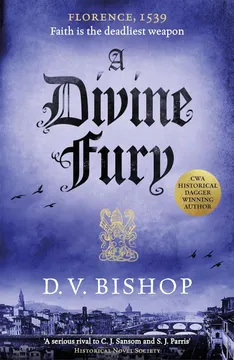
A Divine Fury is the fourth installment in the Cesare Aldo series, receiving an overall rating of 4.32/5. Set in 1539 Florence, the novel follows demoted officer Aldo investigating ritualistic murders while navigating political intrigue involving the Medici family and a Venetian spy. Reviewers praised the atmospheric historical setting, complex mystery, and character development, particularly the dynamic between Aldo and Strocchi. The introduction of Contessa Coltello was widely celebrated. Some noted predictability and a limited suspect pool as minor drawbacks.
Characters
Cesare Aldo
Restless court investigatorAldo is a perceptive Florentine investigator whose mercenary past has left him physically marked and difficult to intimidate. He reads people through small choices, listens for what they avoid, and trusts evidence more than official rank. His wit and appetite for risk can make him reckless, especially when a case offers a chance to reclaim his former standing. Beneath his guarded manner is a fierce concern for people whom the city’s institutions disregard. He loves Saul7, a relationship they must conceal in a society that punishes men like them. Aldo’s loyalty is real but rarely simple: he can serve the court, the duke12, or a private purpose, while keeping part of himself beyond anyone else’s command.
Carlo Strocchi
Conscientious young officerStrocchi is an officer of the Otto, younger than Aldo1 and once his constable. He is a careful investigator who tries to keep suspicion tethered to proof, even when pressure from Bindi13 makes that difficult. His moral instincts are shaped by faith, family, and a belief that public service should protect ordinary people. He is devoted to his wife Tomasia14 and daughter Bianca15, with another child on the way, and he worries that a professional mistake could cost them stability. Aldo’s1 influence draws him toward bolder methods, while Tomasia14 helps him recognize when patience has become fear. Strocchi’s decency is not naivety; it is a discipline he must repeatedly choose.
Valentine Coltello
Venetian intelligence operativeThe contessa is a Florentine-born widow who gathers intelligence for Venice while navigating a court that assumes women lack political skill. She studies appearance, appetite, vanity, and fear, then uses those observations to shape conversations in her favor. Her flirtation is often a working instrument, not a surrender of control, and she has little patience for men who mistake access to her attention for authority over her. Valentine is proud of the network she has built and protective of the sources who sustain it. Beneath her theatrical ease lies a disciplined survivor who recognizes that loyalty and self-preservation can overlap, but never assumes they are the same.
Pagolo Zati
Troubled exorcist's assistantZati is a young priest whose public manner appears gentle, anxious, and uncertain. He has been shaped by a church career that has narrowed rather than steadied his sense of purpose, and he feels alienated from fellow priests after joining Negri’s5 work. He seeks counsel from older clergy but struggles to act when belief, obedience, and fear collide. His concern for those subjected to exorcism appears sincere, though he is not always able to separate compassion from self-protection. Zati’s central tension is between the priest he believes he ought to be and the private judgments he keeps hidden. He is a figure whose apparent fragility makes others underestimate how much he may conceal.
Father Camillo Negri
Severe church exorcistNegri is a disciplined priest who treats exorcism as both sacred duty and an exacting test of moral purity. He fasts, scourges himself, and expects submission from the people who seek his help. His certainty gives him formidable authority, but it also leaves little room for doubt, context, or the possibility that he has harmed someone. He defends San Felice against outside scrutiny and invokes the Church’s jurisdiction when questioned. Negri is not simply a villainous caricature of religious power: he believes deeply in the work he performs, and that conviction makes his coercive choices more consequential. He embodies the danger of confusing personal certainty with divine approval.
Niccolò Zamora
Discreet wool merchantZamora is a wool merchant known for fairness in a guild reputed for hard dealing. He shares his home with his widowed sister Tullia10 and her children, and his quiet generosity makes him valued by staff and business associates. Private about his intimate life, he does not seek political advancement or public attention. The loss of his nephew Marsilio’s11 faith and safety leaves him distrustful of the Church, especially of the exorcist at San Felice5. Zamora’s restraint is not passivity: when someone he loves is harmed, he is willing to challenge institutions that would prefer his silence.
Saul Orvieto
Jewish physician and teacherSaul is a skilled physician who serves Florence’s Jewish community and teaches Rebecca18. He approaches death with professional calm, treating a body as evidence while remembering the person it once carried. His relationship with Aldo1 is intimate, affectionate, and necessarily cautious in a city where discovery could bring severe punishment. Saul understands the cost of secrecy without mistaking it for a lack of love. He offers care to people outside his own community and models a kind of ethical attention that Aldo1 and Strocchi2 need in their work.
Dea Vanni
Grieving tannery workerVanni is a strong, blunt woman who works with animal hides and carries the physical evidence of a hard trade. Her brother’s illness and treatment at San Felice have left her furious at the priesthood and desperate to make someone answer for what happened. She confronts priests in public, not because she enjoys spectacle, but because private appeals have failed her. Her anger makes others wary, yet she is also capable of deep attachment and grief. Vanni’s story exposes how easily people without education or influence can be dismissed until their pain becomes impossible to ignore.
Freccia
Thief and occasional informantFreccia is a quick-handed young thief who has also survived by selling intimacy. He knows Aldo1 from earlier arrests and moves through Florence’s marginal spaces with a mixture of caution and bravado. His marriage to Fiora23 and the child they expect complicate the city’s easy judgments about him. He is trying to secure enough money to provide for the future, while keeping the means of his income secret from his wife23. Freccia’s life illustrates how survival choices can become labels that conceal a person’s attachments and fears.
Tullia Juvara
Widowed keeper of the householdTullia is Zamora’s6 kind, capable sister, a widow raising three children in her brother’s6 palazzo. She has already endured bereavement and the frightening events surrounding her son11 Marsilio11, yet she remains attentive to the needs of her family. Her relationship with Niccolò6 is grounded in gratitude and affection, and his home gives her children security. Tullia is not a public or political figure, but her private choices connect several lives across the story. She embodies the burden of family secrets carried in the name of protection.
Marsilio Juvara
Survivor of an exorcismMarsilio is Tullia’s10 eldest child, a young man who has experienced the Church’s attempt to reshape him through exorcism. He is thoughtful and wary, unsure how to return to a family that believes it has already mourned him. His friendship with another young man helped him leave Florence and seek a life beyond the judgment imposed at San Felice. Marsilio’s hesitation is not a lack of love for his family; it reflects the fear of reopening grief and exposing the truth of his past.
Duke Cosimo de' Medici
Strategic ruler of FlorenceCosimo is a young duke who treats information as a form of protection for the city and for his own rule. He is attentive to reports, alert to rival states, and willing to use capable people regardless of their formal rank. His manner is less theatrical than that of his predecessor, but his decisions remain firmly shaped by political necessity. Cosimo values initiative when it serves his interests, while keeping the personal risks of covert work at a distance.
Massimo Bindi
Vindictive court secretaryBindi manages the Otto’s daily machinery and uses delay, silence, and public reprimand to remind officers of his authority. He is quick to threaten demotion and reluctant to praise, especially when Aldo’s1 independence challenges his control. Bindi is not a master investigator, but he understands how careers and livelihoods can be controlled through rank. His treatment of Strocchi2 and Aldo1 makes the court’s hierarchy a source of pressure throughout the case.
Tomasia Strocchi
Strocchi's perceptive partnerTomasia is Strocchi’s2 wife, mother to Bianca15, and expecting another child. Her difficult pregnancy limits what she can do physically, but not the clarity with which she sees a problem. She listens closely to Carlo’s2 accounts and spots connections he has missed, then pushes him to act according to his values rather than his fear of losing his position. Tomasia’s practical intelligence and affection give Strocchi2 a place to return to when the court’s demands threaten to consume his sense of self.
Bianca Strocchi
Strocchi's young daughterBianca is Strocchi2 and Tomasia’s14 two-year-old daughter. Her noisy affection and delight in her family remind Strocchi2 what his work is meant to protect, while her presence makes the financial risk of his position immediate.
Benedetto
Discontented night constableBenedetto is a younger constable whose enthusiasm for the Otto has curdled into resentment. He complains about night patrol and lacks Aldo’s1 habit of anticipating danger, but he still follows instructions and reports what he sees.
Manuffi
Steady, helpful constableManuffi is a large, gentle constable who accepts difficult assignments without competing for rank. He is not naturally suspicious, but his straightforward questions often reveal what others overlook. His fear of San Felice comes from a painful family memory, and his willingness to face that fear makes him a dependable colleague.
Rebecca Levi
Physician in trainingRebecca is Saul’s7 student and a future physician to the Jewish community. She is observant, steady around the dead, and willing to draw conclusions from the condition of a body without pretending to know more than she does. Her careful examination helps the Otto distinguish a copied murder scene from the original pattern.
Tito Grossolano
Boastful Venetian envoyGrossolano arrives in Florence with a new intelligence assignment and an inflated sense of his own importance. He speaks carelessly, treats servants and hosts with contempt, and mistakes bluster for authority. His behavior quickly makes him a source of friction in the contessa’s3 household.
Gonzalo Zilio
Venetian intelligence officialZilio serves as a traveling representative for Venice’s Council of Ten, gathering information and overseeing its agents. His visits to Florence are shaped by institutional rivalries and shifting political appointments. He is an important link between the contessa’s3 work and the changing structure of Venetian intelligence.
Father Edoardo Visconti
Compassionate parish priestVisconti is an elderly priest who offers counsel without the political sharpness of the diocesan leadership. He remembers Zati4 as a younger man and tries to guide him through spiritual uncertainty. His kindness makes him a trusted presence for those who fear harsher forms of religious authority.
Querini
Zamora household stewardQuerini has managed Zamora’s6 household for many years and remains loyal to Tullia10 and her children. He is careful with private information, but his memories of the family’s troubles help Strocchi2 understand the dead merchant’s6 history.
Fiora
Freccia's pregnant wifeFiora works at a tannery and is expecting a child. She and Freccia9 built their life from precarious beginnings, and she has endured his thefts and secrecy while trying to secure a home for their baby. She is wary of investigators and quick to defend herself, but grief and uncertainty sit close beneath that hard surface.
Tessa Robustelli
Bordello keeper and hostRobustelli runs the bordello where Aldo1 lives, offering him practical shelter while refusing to let him pass without questions. She is shrewd, warm, and attentive to the comings and goings of the city’s less respectable residents.
Pozzo
Contessa's trusted stewardPozzo is the contessa’s3 maggiordomo, a discreet manager who handles visitors, messages, and household business. He is alert to her preferences and helps preserve the orderly surface behind which her political work takes place.
Plot Devices
The ritualized crime scenes
A message written on bodiesThe killer4 garrottes victims with a heavy beaded cord, arranges their bodies in a cruciform pose, marks their foreheads with ash, and leaves pages from an exorcism handbook in their clothes. Each element looks religious, but the investigators initially cannot tell whether the signs identify a motive, a target, or a person being framed. Rain destroys part of the first message, and the repetition on later victims makes the pattern clearer. The practice also gives the killer4 a way to steer suspicion toward San Felice. A later attack extends the Latin sequence, while a copied version of the scene exposes how easily a visible signature can be imitated.
The Otto's jurisdiction
A court boxed out by powerThe Otto di Guardia e Balia investigates crimes in Florence, but its authority stops at the boundaries claimed by the Church. Negri5 uses that limit to refuse questions and seize evidence, while Bindi’s13 concern for political appearances makes the court reluctant to challenge the diocese. Aldo1 and Strocchi2 can identify suspects and obtain admissions, yet a clerical hearing ultimately controls the punishment of a priest. This device puts a distinction between discovering the truth and enforcing the law at the center of the plot. It also explains why the investigators must rely on persuasion, witnesses, and maneuvering rather than simply arresting everyone they suspect.
The Venetian spy network
Secrets traded for survivalThe contessa’s3 network supplies intelligence to Venice, while Cosimo12 maintains his own sources inside Florence and abroad. Aldo1 is asked to approach the contessa3 as a potential informant, allowing him to serve the duke12 while appearing useful to her. Grossolano’s19 appointment threatens the contessa’s3 position, and the rivalry makes the spy plot intersect with the murder inquiry. Information is never neutral: a true detail can support a lie, a suspected source can become a political scapegoat, and a report can be shaped to protect the person who supplies it. The network gives the novel a second arena where observation and deception determine who remains safe and influential.
The anonymous invitations
Suspects lured into one churchAldo1 sends unsigned notes to Vanni8 and San Felice, inviting each to Santa Maria Magdalena at a different hour and claiming the investigators know what happened. The notes exploit different fears: Vanni8 worries about the diocese ignoring her accusation, while the priests face exposure and possible punishment. The staggered appointments let Aldo1 test which suspect appears and keep the investigators nearby to intervene. Vanni’s8 arrival clears her through a fact she volunteers about her inability to read or write. The later arrival of a priest creates the confrontation that leads to the arrest and the final disclosures. The trap works because its targets cannot know what the investigators actually know.
Tullia's sworn statement
A private history becomes evidenceAldo1 asks Tullia10 to provide a sealed account of her past with Negri5 and of their relationship on the night Zamora6 was killed. She does not know every fact connected to Freccia9, but her testimony establishes an alibi that challenges the case against Negri5. Read aloud before Bindi13 and Monsignor Testardo, the statement also exposes how intimate histories can shape the investigation in ways that official records cannot. Tullia’s10 testimony does not by itself identify the killer4, but it removes the most powerful alternative suspect and leaves Zati4 exposed. The statement turns a private relationship, long protected by shame and silence, into evidence that can redirect a public inquiry.
Download PDF
Download EPUB
.epub digital book format is ideal for reading ebooks on phones, tablets, and e-readers.








