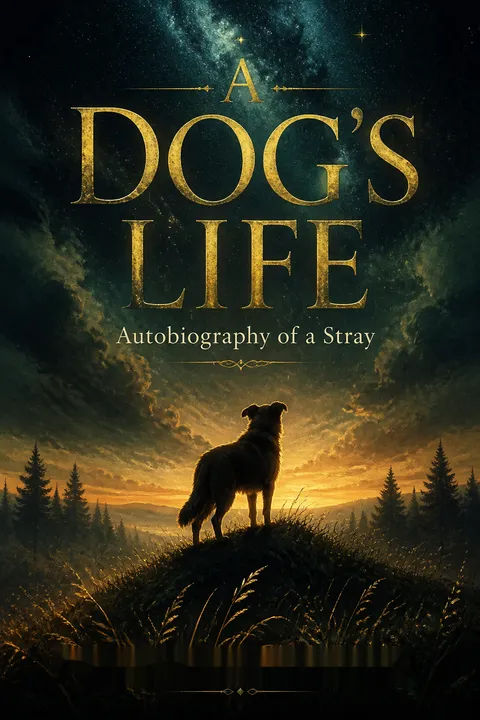


Plot Summary
Prologue
An old dog rests beside a fire in the home she shares with Susan, a woman who has given her warmth and a bed. From this shelter, she looks back across a life spent in woods, barns, garages, and town streets, remembering the mother, brother, and companions she lost.
The narrator is Squirrel, though the people who later care for her give her other names. Her memories begin with a puppy's world: a shed, a wheelbarrow, and the steady presence of her mother.
The frame establishes safety before recounting its cost. Squirrel's warm bed is not simply a happy ending placed in advance; it gives each later shelter a measure of what it can and cannot provide. Her retrospective voice also holds two kinds of knowledge together: the immediate instincts of a dog surviving from day to day, and the older animal's understanding that tenderness can arrive from more than one source. By beginning with gratitude rather than danger, the book makes survival feel less like a triumph over hardship than a gradual accumulation of bonds.
Two Puppies in a Wheelbarrow
Before Squirrel and her brother Bone are born, their mother, a stray named Stream, searches the Merrions' country property for a dry hiding place. She settles in an abandoned garden shed, choosing a straw-filled wheelbarrow away from the cats nesting in old chicken boxes. Five puppies are born there, but only Squirrel and Bone survive.
Their mother names them after things that matter to her and teaches them the rules of the shed: cats hunt mice, humans are dangerous, and the fox called Mine should be watched carefully. The puppies grow within a close animal neighborhood, protected by their mother's body and her knowledge of the land. Their small, familiar world depends on her presence.
The wheelbarrow is the first of many provisional homes, safe not because it belongs to anyone but because Stream has judged its risks. Squirrel's earliest education is ecological rather than moral: she learns where food moves, which creatures threaten one another, and how caution keeps a family alive. Naming the puppies through the mother's own priorities makes kinship concrete and animal-centered. The scene also gives the book its governing tension: shelter can be found, but it is never guaranteed, and a young creature's security rests on knowledge it cannot yet use alone.
The Rifle in the Garden
When the Merrions arrive for the summer, Squirrel and Bone must play quietly and keep away from the house. Their mother grows alarmed when Mine the fox wanders openly through the yard, and her fear proves justified: after the fox frightens the Merrion girl, a gardener shoots her. The fox's kits leave their den, and the next morning Stream walks away from the shed.
She never returns. The puppies wait, then accept that they must find food and water themselves, using the hunting lessons she taught them and raiding the garbage heap. With the fox gone, the property feels safer, but Squirrel and Bone have lost the creature who made it a home. They survive together, still too young to understand why she is gone.
The shooting exposes how differently the same landscape is read by its human and animal residents. To the Merrions, Mine is a nuisance to remove; to Stream, she is a danger whose reckless behavior could bring human violence down on every hidden creature nearby. Yet the apparent restoration of safety coincides with the puppies' deeper loss. The narrative refuses a neat explanation for Stream's disappearance, preserving the uncertainty that a young stray would actually experience. Squirrel and Bone respond not with reflection but with practiced survival, showing how attachment and practical adaptation can coexist without canceling each other.
Chicken for the Secret Puppies
Matthias, the quieter Merrion boy, discovers the puppies while reading outside and keeps them secret from his family. He returns to the shed with chicken, waits while they eat, and gradually earns their trust through patience and gentle touch. Squirrel begins to expect him each morning. Then a rifle blast unsettles Bone, who has grown wary even of the Merrions, and he slips away from the shed before dawn.
Squirrel follows because her brother is still her closest bond. Beyond the familiar fields, the pair reach a highway and spot discarded chicken across the traffic. Before they can cross, George and Marcy stop their car, scoop up the puppies, and carry them toward a home Squirrel has not chosen.
Matthias offers a rare relationship in which human power is restrained rather than imposed. He does not demand trust; he creates a repeated, low-pressure encounter that lets the puppies approach at their own pace. Bone's departure reverses that lesson. Squirrel follows him not because she has assessed the road or planned a new life, but because separation from her brother is more frightening than the unknown beyond the property. Her loyalty carries her into danger, while the chicken that once built trust with Matthias now draws the siblings toward a highway and a human rescue they cannot control.
Thrown From the Car
George and Marcy's house overwhelms the puppies with unfamiliar rules. Squirrel soils the floor, Bone overturns a garbage pail, and George grows angry; Marcy tries to be gentler but cannot settle them. After Bone bites her, George drives the pair to a mall and throws them from the car. Squirrel lands badly and injures her shoulder.
Two women find the puppies, but one takes only Bone, leaving Squirrel alone on the hot pavement. She hides beneath a tree, drinks from a puddle, and searches the parking lot for scraps. When a growling animal drives her from the garbage, she crosses a quieter road into a small wood. She has lost her brother again, this time without even knowing where he has gone.
The episode distinguishes rescue from care. George and Marcy initially take the puppies off a dangerous highway, but their household treats normal feral behavior as defiance, and the arrangement collapses before trust can form. The mall scene makes abandonment brutally selective: Bone is judged cuter and carried off, while Squirrel is deemed someone else's problem. Her injury narrows her choices, yet she still moves toward water, food, and cover. The story's repeated separations are not interchangeable losses; this one leaves Squirrel without family, a known territory, or even a companion to follow.
Moon Joins the Woods
Squirrel spends her first winter alone in a wood near the mall, hunting small animals and raiding the garbage behind nearby houses. She survives snow and hunger, but loneliness shapes every safe discovery; she even misses the shed cat Yellow Man. In spring, desperate for food, she returns to the busy road and meets a small female dog whose coloring reminds her of Bone.
The dog is Moon. Squirrel first approaches suspiciously, then accepts Moon's friendly signals and leads her to food. Moon stays beside Squirrel in her leaf shelter. When Moon later starts walking away from the woods, Squirrel follows by choice. She is no longer fleeing after her brother. She has learned that she can survive alone, and that she may still choose company.
Moon's arrival marks a shift from dependence to chosen attachment. Squirrel's decision to follow Bone had been an instinctive refusal to be separated from the last family she knew; following Moon comes after a winter in which she has tested her own competence. That distinction matters. Companionship is no longer the condition for survival, even though it makes survival less desolate. The resemblance between Moon and Bone initially stirs recognition, but Squirrel does not mistake one dog for the other for long. She accepts a new relationship without making it a substitute for the missing one.
Claremont's Food Plates
Traveling together, Squirrel and Moon raid a highway rest stop, where a starving pack attacks them over the food. They escape with bites and cuts, then spend days licking each other's wounds until they can move again. By winter they settle near Claremont, surviving on town garbage and learning its rhythms from hidden spots.
Local women begin leaving food for the strays in the supermarket parking lot, giving Squirrel and Moon regular meals. The kindness draws more dogs, but it also makes them easier to catch. One morning, men arrive in a dark van with looped poles and trap two dogs as they eat. When the van returns, Squirrel and Moon flee through the woods, leaving the food behind before they can be caught.
Claremont offers a fragile form of collective care. The volunteers recognize that the dogs' hunger is not a moral failing, and their food makes winter survivable; the same predictable routine, however, creates a point of exposure for animal control. The book avoids reducing either human response to a simple category. Food can sustain, while capture may be intended as protection, but Squirrel experiences the van through the history of being seized and discarded. The rest-stop fight supplies the reason she distrusts other dogs, while the parking-lot feeding shows that human generosity can help without erasing the structural danger of stray life.
Moon on the Mountain Road
After leaving Claremont, Squirrel and Moon keep moving between towns, farms, and wooded edges, avoiding people who might capture them. In the town of Republic, children throw rocks at them, while a shopkeeper quietly leaves food at the back of his grocery store. The next morning, the dogs chase chipmunks across a mountain road.
A truck strikes Moon and clips Squirrel's already injured shoulder. A family stops, carries both dogs to a veterinarian, and learns that Moon is dead and Squirrel has a broken leg. Dr. Roth repairs the fracture and spays Squirrel. The family returns to visit with their children, Margery and Donald, and, after learning that no owner has claimed her, decides to give her a home.
The collision compresses the precariousness of Squirrel's life into one ordinary mistake: two hungry dogs pursue prey, and the road turns that instinct fatal. The family who stops cannot undo Moon's death, but their choice to take Squirrel to the vet prevents the accident from becoming another abandonment. Medical care is especially significant because it repairs not only the new fracture but a life already marked by untreated injury. Still, the rescue begins a complicated new phase. Squirrel is safe from the road, yet the meaning of home will depend on whether the people who claim her accept responsibility beyond the moment of pity.
Daisy in the Garage
The Beckers name Squirrel Daisy and settle her in their garage, where she gets table scraps and plays with Margery and Donald in the yard. The children gradually spend less time with her, and their parents leave her to roam outside. As autumn nears, the family packs its belongings for the city.
Daisy has already learned to hunt when her food is forgotten, so the empty bowls do not immediately alarm her. But after the cars depart and the house remains closed, she understands no one is coming back. She sleeps beneath a bush, then moves on alone. The summer home has repeated the pattern of earlier shelters: comfort was real, but it depended on people whose care did not last.
The Beckers' failure is quieter than George's violence, which makes it no less consequential. They feed and play with Daisy, but they never bring her into the household, and the children's fading attention becomes the first sign that affection has no durable structure behind it. Because Squirrel can hunt, she survives the missed meals, yet her competence risks disguising the neglect: the animal's ability to endure does not make abandonment harmless. The family's seasonal departure also echoes the book's changing weather, turning a familiar rhythm into a human betrayal that Squirrel can only answer by leaving.
Winter Farms, Empty Trails
After leaving the Beckers, Squirrel develops a pattern: she wanders through warmer months and seeks farms for winter shelter and food. At one farm, Hal and Jean's barns, animals, and compost heap keep her through the cold; when spring comes, she moves on again. During a later journey through Lindenfield, familiar smells lead her back to the mall where George separated her from Bone.
She searches nearby neighborhoods, garages, and country properties, but never finds her brother. The search ends without reunion, and years pass as Squirrel repeats her seasonal travels. She grows old, her fur pales, her hearing weakens, and old injuries ache. In a bitter winter, she struggles through hunger and ice, searching for shelter she can still reach.
The farm pattern gives Squirrel a form of stability that does not require surrendering her independence. Hal and Jean's animals and provisions create a dependable winter refuge, but she still leaves when the season changes. Her return to the mall transforms scent into a map of memory: the place holds the last traceable point in her bond with Bone, even though it cannot lead her to him. The unsuccessful search resists the comforting convention of reunion. Instead, the passage of years makes endurance visible in Squirrel's aging body, reminding readers that surviving is not the same as remaining untouched.
Susan Opens the Door
After days of cold and hunger, Squirrel finds a house where an elderly woman named Susan leaves food and water on the stoop. Squirrel eats outside for several days, retreating whenever Susan approaches, until the freezing weather leaves her too weak to keep running. She crosses the doorway and Susan gives her blankets beside the fire, calls her Addie, and arranges veterinary care.
Susan's neighbor, Mrs. Oliver, questions whether she can manage an old dog, but Susan refuses to give her up. One night Squirrel climbs the stairs to Susan's bedroom and cannot jump onto the high bed. Susan helps her up, and the two sleep together. At last, Squirrel's life of wandering ends in a home built on mutual companionship.
The final threshold is crossed by Squirrel, not imposed by Susan. Earlier human kindness often came with capture, rules, or a fragile promise, so accepting indoor shelter requires more than hunger; it requires Squirrel to judge that this particular person is safe. Susan's age creates an unexpected symmetry. Neither woman is invulnerable, and each offers the other a kind of company the outside world cannot provide. Mrs. Oliver's doubts make care sound like a test of capacity, but Susan answers through commitment. The shared bed resolves the book's opening image of warmth by making safety relational, not merely physical.
Analysis
The novel's central structure is a sequence of attachments and separations. Squirrel loses her mother, is divided from Bone, chooses Moon, loses Moon, and eventually finds a different kind of companionship with Susan. The pattern could have made each new bond feel like compensation for the previous one. Instead, Squirrel's memories remain distinct: Moon is not Bone, and Susan does not erase the life that came before her. The book treats attachment as renewable without pretending that loss is reversible.
Squirrel's survival depends on skills that humans often mistake for evidence that she does not need help. She can hunt, find water, recognize a safe barn, and adapt to winter, but these abilities are responses to abandonment, not proof that abandonment has done no harm. The Beckers' summer care is especially revealing because it is affectionate in daily gestures yet fails as a lasting obligation. The story distinguishes good intentions from sustained responsibility without making every person cruel. Matthias, the volunteers, veterinarians, and Susan show forms of care shaped by patience, practical effort, and respect for an animal's needs.
The animal point of view also changes the scale of meaning. A shed is a social world; a garbage heap is a resource; a familiar odor can be more informative than a human name. Squirrel does not interpret events through abstract judgments, but readers can see the consequences of human choices in her hunger, injuries, and movement. Her life therefore becomes an ethical measure of the ordinary: who notices a stray, who turns away, who leaves food, and who accepts responsibility beyond the first impulse to help.
The ending does not reward Squirrel with the recovery of everything she lost. It offers something quieter and more credible: an old dog and an old woman make room for one another. The fire answers the opening need for warmth, while the shared bed transforms shelter into reciprocal belonging.
Review Summary
A Dog's Life receives mostly positive reviews for its touching portrayal of a stray dog's journey. Readers praise Martin's writing style and emotional storytelling, though some find it depressing. Many appreciate the dog's perspective and the book's ability to raise awareness about animal welfare. Critics note the simplistic prose and occasional unrealistic elements. Overall, reviewers recommend it for animal lovers and younger readers, highlighting its potential to inspire empathy and teach responsibility.
People Also Read


Characters
Squirrel
The wandering survivorSquirrel is a mixed-breed stray whose keen nose and careful attention help her read a world organized around food, shelter, and danger. She begins life sheltered by her mother and deeply attached to Bone, then learns to hunt and travel when those bonds are lost. Her intelligence is practical rather than humanlike: she notices routines, remembers places through scent, and adjusts to what each season permits. Squirrel does not become hardened beyond affection. She mistrusts people and other dogs after repeated harm, yet can recognize patience and gentleness when she encounters them. Her story explores the difference between being capable of surviving alone and no longer needing companionship.
Bone
Squirrel's bold brotherBone is Squirrel's littermate and first companion. More adventurous and wary of people than his sister, he often leads their early explorations and helps shape her understanding of the world. Their bond is formed before either puppy can manage alone, so Squirrel's instinct to follow him becomes a defining feature of her early life. Bone's caution also reflects what their mother has taught them: human attention can be dangerous even when it appears curious or kind. He represents family as Squirrel first knows it, and the enduring pull of a connection formed in the safety of their first home.
Mother, also called Stream
The stray motherStream, whom her puppies know only as Mother, is an observant stray who chooses the Merrions' neglected shed as a birth shelter. She studies the property before settling there, judging its predators, human traffic, and hiding places with the care of an experienced animal. Her lessons are concrete: where to find food, when to hide, how to avoid danger, and how to care for wounds. She is protective without being sentimental, because survival requires decisions made quickly and without explanation. For Squirrel, Mother is both a source of warmth and the first teacher whose knowledge must eventually be carried into a world without her.
Moon
The chosen companionMoon is a small, brave stray whose coloring briefly reminds Squirrel of Bone. She is bold around people and unusually willing to investigate garbage, but she is less skilled at hunting, so the dogs learn to depend on one another in different ways. Moon's courage helps draw Squirrel beyond the woods where she survived alone. She is not a replacement for Squirrel's lost family; their bond grows from shared travel, meals, danger, and rest. Through Moon, the story gives Squirrel a companionship she actively chooses, one that emerges after she has learned she can manage without anyone.
Susan McGrath
The elder who offers shelterSusan is an independent older woman who lives alone and takes pride in managing her own household. She is warm but not instantly sentimental, and she speaks to the dog who appears at her home as if companionship can begin before trust is complete. Her care is practical: food, warmth, veterinary attention, and an effort to understand what an unfamiliar dog needs. Susan also bristles when others treat age as proof of helplessness. That stubbornness grows from a desire to remain the author of her own life, not from denial that her body has limits. Her connection with Squirrel rests on mutual presence rather than rescue alone.
Matthias Merrion
The patient boyMatthias is the quiet Merrion child who prefers reading beneath a tree to joining his noisier siblings. When he discovers the puppies, he keeps them hidden and earns their trust by bringing chicken without forcing contact. His gentleness is expressed through patience and restraint, qualities Squirrel can recognize even though she does not understand his private feelings. He offers an early example of human care that respects an animal's fear instead of treating it as disobedience.
Mine
The bold foxMine is a fox raising four kits beneath a nearby shed. She moves openly across the Merrions' property, disregarding the danger that Stream carefully monitors. Squirrel first knows her through her mother's wary attention, then witnesses the human response to her presence. Mine's boldness makes her vivid in the puppies' young world, where every animal's habits can affect the safety of others.
Yellow Man
The shed's friendly catYellow Man is one of the cats living in the Merrions' shed. He eventually greets Squirrel with a familiar nuzzle, giving her a small friendship beyond her immediate family. His quiet daily presence becomes one more detail of the home Squirrel leaves behind.
George
The impatient rescuerGeorge is the man who stops for Squirrel and Bone on the highway with Marcy. He initially sees the puppies as a problem to manage, and their fearful, untrained behavior quickly frustrates him. His impatience leads him to respond with anger rather than curiosity, exposing the gap between taking an animal in and understanding what it needs.
Marcy
The hopeful adopterMarcy is George's partner and the more hopeful of the two when they find the puppies. She tries to welcome them and argues for giving them another chance, but she has little experience with animals that have never lived in a house. Her intentions are kinder than George's, though kindness alone cannot overcome the household's lack of preparation.
The Becker family
The summer householdThe Beckers include the parents and their children, Margery and Donald. They name Squirrel Daisy and give her a garage bed, food, and playtime during their summer stay. The adults set limits on where she can go, while the children bring her lively but inconsistent attention. As a family, they reveal how an affectionate beginning can be weakened when an animal is treated as a seasonal presence rather than a lasting responsibility.
Dr. Roth
The country veterinarianDr. Roth treats Squirrel after the mountain-road collision. She examines the stray carefully, recognizes the severity of her injuries, and helps arrange surgery despite the cost. Her manner is gentle even when treatment hurts, and she sees Squirrel as an animal with a future rather than an inconvenience. Her work turns the family's brief act of stopping into a chance for recovery.
Rachael
The veterinary caregiverRachael works at Dr. Roth's veterinary practice and helps Squirrel through recovery. She encourages the injured dog to walk, offers treats, and makes the clinic feel safer through steady, gentle handling.
Dr. Thompson, called Skip
Susan's trusted veterinarianDr. Thompson is the veterinarian Susan remembers from caring for her previous dog. He examines Squirrel when Susan brings her in and explains her condition and age. His professional judgment helps Susan understand what care the dog needs, while their familiarity gives the visit a reassuring tone.
Jean
The farm's caretakerJean lives on a small farm with Hal and cares for the animals there. Squirrel watches her from hiding and benefits from the farm's shelter and discarded food. Jean's household offers a model of quiet, routine attention to animals, without requiring Squirrel to become an indoor pet.
Hal
The farmerHal shares the farm with Jean and tends its animals through changing seasons. Squirrel studies his movements from the barns and pasture, learning that his presence is not a threat. His household becomes one of the places where she can find winter shelter while keeping her distance.
Mrs. Oliver
Susan's worried neighborMrs. Oliver is Susan's neighbor, younger than Susan but quick to assume that age limits what Susan can manage. She questions the decision to keep an old stray and voices concerns about the work ahead. Her concern may be sincere, but it becomes patronizing when she treats Susan's independence as something she can overrule.
Plot Devices
Scent and remembered places
A nose-led mapSquirrel understands places chiefly through smell. Food odors guide her to garbage and shelter, while familiar scents carry her back toward earlier parts of her life. This sensory logic gives the novel a distinct way to connect present action with memory: the mall is not merely a setting but a place whose smells revive the separation from Bone. Scent also grounds the animal perspective in practical perception rather than human explanations.
The changing seasons
A survival calendarWeather governs the shape of Squirrel's life. Warm months make travel and hunting easier, while snow, ice, and shortening days force her to seek sturdier shelter and dependable food. The cycle allows the story to move across years without losing physical continuity: Squirrel's repeated search for a winter refuge becomes a measure of both her experience and her aging body.
Temporary shelters
Home without ownershipThe shed, woods, garage, barns, and Susan's house form a sequence of places where Squirrel can rest. Each offers a different degree of safety, but many remain temporary because people leave, animals face danger, or Squirrel must keep moving. These shelters make home a lived condition rather than a building: protection depends on food, warmth, and whether another creature allows her to remain.
Food left behind
A trail of human choicesDiscarded scraps, garbage cans, and food intentionally set out for strays keep Squirrel alive and repeatedly bring her into contact with people. Food can invite trust, as when Matthias feeds the puppies, or create danger, as when predictable meals expose dogs to capture. By making hunger the immediate force behind many decisions, the story shows how human waste and human generosity both shape the lives of animals living outside.
FAQ
0. Synopsis & Basic Details
What is A Dog's Life: Autobiography of a Stray about?
- A Stray's Epic Journey: The novel chronicles the life of Squirrel (Addie/Daisy), a stray dog, from her birth in a garden shed with her brother Bone, through a series of challenging encounters with humans and the wild, as she navigates loss, abandonment, and the constant search for food and shelter.
- Survival and Companionship: It's a poignant tale of resilience, detailing Squirrel (Addie/Daisy)'s struggle to survive alone and with temporary companions like Moon, learning the harsh realities of life on the streets and the fleeting nature of safety.
- The Quest for Home: Ultimately, the story follows Squirrel (Addie/Daisy)'s lifelong, often heartbreaking, quest for a permanent home and unconditional love, culminating in an unexpected bond in her old age.
Why should I read A Dog's Life: Autobiography of a Stray?
- Deep Empathy for Animals: This book offers a unique, First-Person Canine Perspective that fosters profound empathy for stray animals, allowing readers to experience their world of sensory details, instinctual drives, and emotional complexities.
- Lessons in Resilience: Squirrel (Addie/Daisy)'s unwavering determination to survive despite repeated losses and betrayals provides a powerful narrative about resilience, adaptation, and the enduring hope for connection, even in the face of adversity.
- Exploration of Human-Animal Bonds: It subtly explores the spectrum of human interaction with animals, from casual cruelty and neglect to profound kindness and mutual companionship, prompting reflection on responsibility and the meaning of love.
What is the background of A Dog's Life: Autobiography of a Stray?
- Author's Personal Inspiration: Ann M. Martin was inspired by her own rescue dog, Sadie, whose mother was a stray found along a highway, prompting Martin to wonder about the lives of animals born in the wild. This personal connection lends authenticity to Squirrel (Addie/Daisy)'s journey.
- Research into Canine Experience: Martin conducted research on dog anatomy and behavior, and observed her own dog, Sadie, to ensure Squirrel (Addie/Daisy)'s story was believable, even making corrections like removing color references when she remembered dogs are partially colorblind.
- Reflecting Real-World Issues: The narrative draws from real-life experiences of rescued animals, including the traumatic event of puppies being thrown from a car, highlighting common issues like pet abandonment and the "summer dog" phenomenon.
What are the most memorable quotes in A Dog's Life: Autobiography of a Stray?
- "I've known all these dogs, and I've been all these dogs.": This opening line powerfully establishes Squirrel (Addie/Daisy)'s universal experience as a stray, encapsulating the diverse hardships and fleeting comforts she will encounter throughout her life, setting the stage for her autobiography.
- "Without Mother, Bone was my world. I could not be separated from him.": This quote underscores the profound, instinctual bond Squirrel (Addie/Daisy) shares with her brother, highlighting the devastating impact of their eventual separation and her deep-seated need for companionship.
- "It turned out that there was room in my heart for a human after all.": This concluding reflection reveals Squirrel (Addie/Daisy)'s ultimate emotional journey, signifying her healing from past betrayals and her capacity for love, finding a complete sense of belonging with Susan.
What writing style, narrative choices, and literary techniques does Ann M. Martin use?
- Sensory-Rich First-Person Canine Perspective: Martin employs a highly sensory, first-person canine perspective, immersing readers in Squirrel (Addie/Daisy)'s world through smells, sounds, and tactile experiences, making her internal monologue feel authentic and immediate.
- Simple, Direct Prose: The language is clear and unadorned, reflecting a dog's straightforward perception of the world, yet it carries significant emotional weight, allowing complex themes to resonate without being overly explicit.
- Episodic Structure: The narrative unfolds in distinct episodes, often mirroring the cyclical nature of seasons and the recurring patterns of finding and losing companionship, emphasizing the transient nature of a stray's life until her final home.
1. Hidden Details & Subtle Connections
What are some minor details that add significant meaning?
- Merrions' Hidden Animal World: Despite Mrs. Merrion's aversion to "germs and hair," the house is teeming with a "secret in-the-Merrions'-house neighborhood" of mice, squirrels, possums, snakes, and toads. This detail subtly highlights human ignorance of the natural world thriving around them and the animals' ability to adapt and coexist unseen.
- Matthias's Quiet Observation: Mrs. Merrion's exasperated comment, "Matthias, please, take your nose out of that book and get some exercise," reveals Matthias's introverted and observant nature. This quiet disposition is precisely what allows him to discover and patiently befriend Bone and Squirrel (Addie/Daisy), contrasting with his louder siblings and foreshadowing his gentle approach.
- The Wheelbarrow's Enduring Presence: The wheelbarrow, Squirrel (Addie/Daisy)'s first nest, reappears in her old age as an "upended wheelbarrow" offering temporary shelter during a harsh winter. This callback symbolizes the cyclical nature of her life, the constant search for basic needs, and the enduring memory of her origins, even as her body fails her.
What are some subtle foreshadowing and callbacks?
- Mine's Reckless Behavior: Mother's fear of Mine, the fox, is not just due to her being a predator, but because "Mine had no sense... she didn't even have the sense to steer clear of the Merrions." This foreshadows Mine's eventual violent death at the hands of the gardener, illustrating the fatal consequences of not understanding human dangers, a lesson Squirrel (Addie/Daisy) will learn repeatedly.
- Bone's Growing Restlessness: Early in their time with Matthias, Squirrel (Addie/Daisy) notes, "My brother was becoming restless... he was becoming suspicious." This subtle shift in Bone's demeanor foreshadows his eventual decision to leave the Merrions' property, driven by an instinctual need for change and a deeper wariness of their semi-domesticated life.
- Squirrel (Addie/Daisy)'s Re-injured Shoulder: The initial injury to Squirrel (Addie/Daisy)'s shoulder when George throws her from the car is later re-injured when she is clipped by the truck that kills Moon. This recurring injury serves as a physical callback to past trauma and symbolizes the lasting scars of abandonment and violence that mark her journey.
What are some unexpected character connections?
- Matthias as a Precursor to Susan: Matthias, the gentle Merrion boy, is Squirrel (Addie/Daisy)'s first positive human connection, offering food and quiet affection. His patience and non-threatening presence subtly prepare Squirrel (Addie/Daisy) for the deep trust she eventually places in Susan, who also approaches her with gentleness and understanding, creating a thematic link between these two pivotal human figures.
- Yellow Man and Moon as Transient Companions: Yellow Man, the shed cat, is Squirrel (Addie/Daisy)'s first non-family animal friend, offering a simple, consistent presence. His eventual disappearance, and Squirrel (Addie/Daisy)'s later longing for him, mirrors her relationship with Moon, highlighting a pattern of finding and losing cherished companions before her final, stable bond with Susan.
- Mrs. Oliver as a Societal Mirror: Susan's neighbor, Mrs. Oliver, who questions Susan's ability to care for an old stray, serves as a subtle connection to the broader societal indifference and judgment that strays like Squirrel (Addie/Daisy) face. Her skepticism underscores the unique, compassionate choice Susan makes, contrasting with the casual neglect Squirrel (Addie/Daisy) has experienced from others.
Who are the most significant supporting characters?
- Mine (the Fox): Mine is significant not just as a predator, but as a catalyst for Mother's survival lessons and a tragic example of human-animal conflict. Her reckless behavior and subsequent death directly lead to Mother's disappearance, forcing Squirrel (Addie/Daisy) and Bone into independence and highlighting the dangers of the human world.
- Yellow Man (the Cat): This shed cat represents the early, non-familial animal community and the simple, non-judgmental companionship Squirrel (Addie/Daisy) finds. His consistent presence and Squirrel (Addie/Daisy)'s later memory of him waiting for her emphasize the importance of these early, foundational connections in her development.
- Dr. Roth and Rachael: These veterinary professionals represent the organized, compassionate side of human intervention. Their gentle care, medical treatment, and efforts to find Squirrel (Addie/Daisy) a home (even if temporary with the Beckers) provide a crucial bridge from trauma to potential safety, contrasting sharply with the cruelty Squirrel (Addie/Daisy) often faces.
2. Psychological, Emotional, & Relational Analysis
What are some unspoken motivations of the characters?
- Bone's Instinctive Drive for Freedom: While Squirrel (Addie/Daisy) initially follows Bone out of loyalty, his "restless" and "suspicious" nature suggests an unspoken, instinctual drive to escape perceived dangers and seek a more truly wild existence, even if it means leaving the comfort of Matthias's kindness.
- Susan's Need for Companionship: Beyond pure altruism, Susan's decision to take in Addie is subtly motivated by her own loneliness and aging. Her conversations with Mrs. Oliver, and her comment "I do need you," reveal a deep, unspoken need for purpose and companionship that Addie fulfills, making their bond mutually beneficial.
- Marcy and George's Superficiality: Their motivation to "rescue" the puppies from the highway seems driven by a fleeting desire for "cute" pets, rather than a deep understanding of commitment. Their quick frustration and abandonment reveal a lack of foresight and emotional depth, treating animals as disposable commodities.
What psychological complexities do the characters exhibit?
- Squirrel (Addie/Daisy)'s Evolving Trust and Wariness: Squirrel (Addie/Daisy)'s psychological journey is marked by a complex interplay of innate fear (taught by Mother), cautious trust (with Matthias), profound betrayal (Marcy and George, the Beckers), and finally, earned, deep trust with Susan. This evolution shows her capacity for both resilience and vulnerability, shaped by a lifetime of varied human interactions.
- The Nature of "Home" as a Psychological Anchor: For Squirrel (Addie/Daisy), "home" is not merely a physical shelter but a psychological state of safety, warmth, and belonging. Her repeated losses and temporary refuges highlight how the absence of a stable home creates deep-seated anxiety and a constant, underlying search for security.
- Grief and Adaptation in Animals: Squirrel (Addie/Daisy) experiences profound loss (Mother, Bone, Moon), but her processing of grief is shown through adaptation and continued survival rather than human-like sadness. Her ability to move on, while remembering, demonstrates an instinctual resilience that allows her to endure trauma without being consumed by it.
What are the major emotional turning points?
- The Loss of Mother: This is Squirrel (Addie/Daisy)'s first major emotional turning point, abruptly ending her protected puppyhood. The realization that "she was not going to come back at all" marks the shift from innocent dependence to the harsh reality of self-reliance and the beginning of her profound loneliness.
- Separation from Bone at the Mall: Being thrown from the car and then watching Bone taken by another woman is a devastating emotional blow. This moment solidifies her distrust of humans and forces her into true solitude, marking the deepest point of abandonment and the beginning of her "Squirrel Alone" phase.
- Stepping into Susan's House: After a lifetime of wariness, the decision to enter Susan's home is a monumental emotional turning point. It represents a surrender of her fiercely guarded independence and a leap of faith into the unknown, driven by extreme cold and hunger, but ultimately leading to warmth and acceptance.
How do relationship dynamics evolve?
- From Instinctual Family to Chosen Companionship: Squirrel (Addie/Daisy)'s earliest bond with Mother and Bone is instinctual and protective. After their loss, her relationship with Moon evolves into a chosen partnership based on mutual aid and shared vulnerability, a "team" against the world, demonstrating the formation of family beyond blood.
- Human-Animal Relationships: From Utility to Reciprocity: Her interactions with humans shift from being a hidden observer (Merrions), to a recipient of secret kindness (Matthias), to a victim of casual ownership (Marcy and George, the Beckers), and finally to a reciprocal, deeply loving bond with Susan, where both "old ladies" find mutual comfort and purpose.
- The Cycle of Trust and Betrayal: Squirrel (Addie/Daisy)'s relationships with humans follow a pattern: initial hope, followed by betrayal or neglect, leading to renewed wariness. This cycle is broken only by Susan, whose consistent, gentle care allows Squirrel (Addie/Daisy) to finally overcome her ingrained distrust and form a lasting, secure attachment.
4. Interpretation & Debate
Which parts of the story remain ambiguous or open-ended?
- Bone's Ultimate Fate: The narrative explicitly states that Squirrel (Addie/Daisy) never finds Bone again, leaving his ultimate fate unknown. This ambiguity emphasizes the harsh reality of separation for strays and the finality of lost connections, rather than offering a tidy, unrealistic reunion.
- Mother's Exact Demise: Squirrel (Addie/Daisy)'s mother "never came back" after Mine's death, leaving her fate open to interpretation. This lack of explicit detail highlights the sudden, often unseen dangers that strays face, and how their disappearances are often a mystery to their offspring.
- Squirrel (Addie/Daisy)'s Canine Consciousness and Language: While the story is told from Squirrel (Addie/Daisy)'s first-person perspective, granting her human-like understanding and language, the author's note clarifies this as a literary liberty. This invites readers to debate the extent of animal sentience and the imaginative boundaries of anthropomorphism in fiction.
What are some debatable, controversial scenes or moments in A Dog's Life: Autobiography of a Stray?
- The Abandonment at the Mall: George and Marcy's deliberate act of throwing the puppies out of their car at a busy mall is a stark and controversial depiction of human cruelty and irresponsibility. It forces readers to confront the harsh reality of pet abandonment and the casual disregard some people have for animal welfare.
- The "Summer Dog" Phenomenon with the Beckers: The Beckers' adoption of Daisy (Squirrel (Addie/Daisy)) for the summer, only to neglect and then abandon her when they return to the city, is a subtle yet deeply problematic portrayal of pet ownership. It sparks debate about the ethics of temporary pet adoption and the long-term commitment required for animal care.
- The Animal Control Van in Claremont: The scene where animal control officers use poles to capture strays, from the dogs' perspective, is presented as a terrifying "trap." While necessary for public safety, it raises questions about the methods used and the ultimate fate of captured animals, highlighting the fear and uncertainty strays experience.
A Dog's Life: Autobiography of a Stray Ending Explained: How It Ends & What It Means
- Redefining "Home" and Belonging: The ending of A Dog's Life sees Squirrel (Addie/Daisy), now named Addie, finally finding a permanent home with Susan. This signifies that "home" is not necessarily a return to her origins or a reunion with lost family (like Bone), but rather a place of unconditional love, warmth, and acceptance, fulfilling her lifelong search for belonging.
- Mutual Rescue and Intergenerational Companionship: The story concludes with Addie and Susan, two "old ladies," finding profound companionship in each other. Susan explicitly states, "I do need you, and I'm glad you're here," emphasizing that their relationship is a mutual rescue, where each
Download PDF
Download EPUB
.epub digital book format is ideal for reading ebooks on phones, tablets, and e-readers.








