


Plot Summary
Fire She Cannot Hide
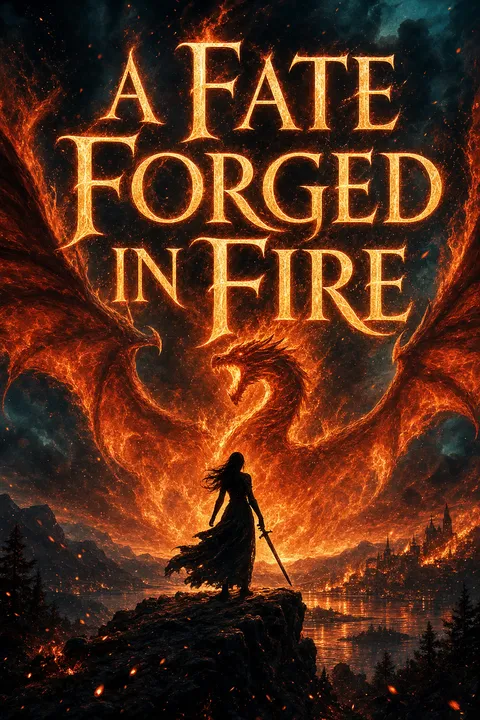
Crouched over a laboring mother in the slums of Àird Lasair, Aemyra1 loses control and conjures a flame far stronger than any common Dùileach should command. Her twin brother Adarian4 scolds her: their whole life depends on secrecy.
Beneath her headscarf lies auburn hair and forest-green eyes, the unmistakable markings of Clan Daercathian, the dragon-riding royal line. Raised by adoptive parents Orlagh5 and Pàdraig,14 Aemyra1 has waited ten years in this festering city for a birthright that may never come.
King Haedren rules with his golden dragon Kolreath, his mind rumored to be fracturing, while zealot priests of the True Religion desecrate Goddess shrines. Aemyra1 grinds her teeth and dreams of the crown, certain the mad king must die eventually.
McBride opens by fusing intimate domestic labor (midwifery) with concealed political dynamite, establishing Aemyra's central tension: a woman whose very body is a secret weapon. The forge becomes a metaphor for suppressed identity, heat contained until it warps the vessel. The dedication (to girls told to put their fires out) frames fire as feminine defiance against patriarchal erasure. Adarian functions as the superego to Aemyra's id, control versus combustion. The looming Chosen priests introduce the ideological antagonist: a misogynist theocracy that treats female power as demonic. The chapter seeds every payoff to come, hidden bloodline, dragon hunger, religious persecution, while grounding stakes in one struggling mother and one dangerous spark.
The Sword With The Garnet
Prince Fiorean,2 dragon rider of the cobalt Aervor, arrives to collect a claymore Adarian4 forged for his birthday. Aemyra1 cannot resist mocking the gaudy garnet weighting the blade, insulting the prince to his face while refusing to give her name.
His elder brother, crown prince Evander,7 arrives drunk and paws at her chin like she is livestock, until Fiorean2 pulls him off. Later, Fiorean2 returns alone seeking a horseshoe and lingers, unsettling her with his cold confidence.
That night, Aemyra1 and Adarian4 brawl with Chosen priests in Sorcha's11 tavern after the men belittle the working women. A treasonous street performance follows, invoking her exiled father,3 and Sir Nairn,9 captain of the guard, beats the elderly storyteller bloody in the square.
This section triangulates Aemyra's antagonists and her future lover through the language of craftsmanship. Her contempt for the top-heavy jeweled sword is a thesis statement: beauty without function, ornament masking uselessness, the same critique she levels at the ruling princes. Evander's violation and Fiorean's intervention establish a moral gradient between the brothers that the whole romance will exploit. The tavern brawl reveals Aemyra as protector of ordinary women, her politics visceral rather than abstract. The theocracy's creeping menace, priests preaching a womb-bound destiny for women, sharpens into physical violence with Nairn's assault, signaling that Tìr Teine's matriarchal faith is being strangled by imported patriarchal zealotry.
Oathed In Blood
Ambushed in a dark alley, Aemyra1 nearly incinerates her attacker before recognizing him: Draevan Daercathian,3 her true father, the exiled prince who fathered her on a commoner and hid her with loyal servants to protect her from the king. He has sailed from Penryth with fifty Dùileach soldiers and General Maeve.15
At Brigid's temple, high priestess Kenna13 and the priestesses formally claim Aemyra1 as the rightful queen, the first female Daercathian born in a century. Draevan3 kneels, anoints his brow with her blood, and swears fealty. Aemyra1 realizes her father loves power as much as he loves her, and that she is his key to it. Still, she vows to Brigid to protect her people and burn the Chosen from the territory.
The oathing ceremony crystallizes the book's most complex relationship: Draevan as father, tutor, and manipulator fused into one ambivalent figure. McBride refuses the comforting fantasy of paternal devotion, Aemyra understands she is simultaneously beloved daughter and political instrument. The blood ritual literalizes inheritance as sacrifice, foreshadowing the many blood vows to come. By routing legitimacy through the priestesses and the Goddess rather than through male primogeniture, the narrative stakes its feminist claim: sacred authority flows matrilineally. Yet the scarcity of soldiers (fifty against a royal guard of hundreds) plants dread. This is a coup built more on faith and bloodline than force, a fragility that will prove catastrophic.
Walking Through The Fire
When King Haedren dies and the bells toll, Aemyra1 bids a wrenching farewell to Orlagh,5 Pàdraig,14 and little Lachlann,14 gifting her mother the family necklaces and warning her lover Sorcha11 to flee.
At the king's funeral rites, Aemyra1 parts the temple's eternal fire with her magic and strides out unburned, dressed in queenly gold, declaring herself heir before the assembled nobility. Dowager Queen Katherine6 erupts, calling it treason and branding Aemyra1 a bastard, but Kenna13 invokes the ancient law: Goddess-blessed inheritance passes regardless of birth or sex.
Cornered by fifty Dùileach ringing the temple, Katherine6 grudgingly declares a truce, promising a council vote after the burning. Fiorean,2 seething, warns Aemyra1 it is a long way down from where she is climbing.
The theatrical entrance, a woman emerging unscathed from sacred flame, weaponizes spectacle as political theology. Aemyra understands that legitimacy is performed, not merely inherited, and stages her body as living proof of divine favor. Katherine emerges as the true adversary: a queen without magic whose power is rhetorical, capable of reframing Aemyra's miracle as treason. The forced truce is a false victory that reveals the coup's amateurism against seasoned court cunning. Fiorean's parting threat carries the sting of foresight, the higher Aemyra rises on borrowed conviction, the further she has to fall. The scene marries triumph with dread, the emotional signature of the entire book.
The Dragon Chooses Another
Slipping toward the mountain nests to Bond the golden Kolreath, Aemyra1 stumbles on Fiorean2 dragging his drunk brother7 up the same path. The grieving dragon rejects both of them and flies off. That night Kenna13 is shot through the back by an arrow on the temple steps: the Covenanters, the True Religion's army, have infiltrated the caisteal. Draevan3 orders retreat.
Fleeing to the harbor, the twins incinerate a dozen mounted Covenanters. Fiorean2 duels Aemyra1 on the docks; she cracks his skull against the cobblestones and steals his prized garnet, but Evander7 has claimed Kolreath, dooming her hope of a dragon. Aemyra1 dives into the loch and is hauled aboard her father's ship. Her adoptive family never reaches the harbor.
This is the hinge where ambition meets consequence. The dragon's rejection strips Aemyra of the symbolic weapon she believed guaranteed her destiny, forcing her to reckon with a throne she cannot simply claim by spectacle. Kenna's assassination converts abstract political danger into visceral grief and exposes Katherine's long game: Covenanters were hidden and waiting. The harbor duel establishes the erotic-antagonistic charge between Aemyra and Fiorean, violence as intimacy, while the stolen garnet becomes a talisman of vendetta. The missing family injects a thread of dread that the narrative will later exploit devastatingly. Aemyra flees having declared herself queen yet possessing neither crown, dragon, nor certainty her loved ones survived.
The Terror Is Female
On the Sunset Isle, sidelined in war councils by her domineering father,3 Aemyra1 rides with Adarian4 to Ballan, a village burned to ash. A dying Covenanter gasps of black scales, and Aemyra1 realizes The Terror,10 the wild obsidian dragon believed extinct for decades, defended her people. She climbs Beinn Deataiche alone and is nearly killed by the beast, dodging fire and claws across the peaks.
In the moment she surrenders, dropping her dagger, she recognizes the creature's four-clawed tail and double-fluted crest: the dragon is female, the last she-dragon alive. Their touch ignites a Bond that floods her with ancient magic. She names her Terrea10 and takes her first flight, returning to Penryth as a true dragon-rider at last.
The reveal that the fearsome Terror is female recasts the entire mythology: the dying of the dragons was tied to the death of queens, and here the last she-dragon waits for the last royal woman. Bonding, in McBride's world, requires surrender rather than conquest, so Aemyra can only claim Terrea by abandoning her sword and ego, a pointed inversion of masculine dominance fantasies. The scene rewards patience over force and reframes power as mutual chosen partnership. Emotionally it is Aemyra's apotheosis, the childhood dream realized, but the private knowledge of Terrea's sex becomes a dangerous secret: a fertile queen and a fertile dragon could resurrect a dynasty others would kill to control.
Three Graves, One Vendetta
At the Strathaven war camp, Draevan3 brings the news that shatters her: Orlagh,5 Pàdraig,14 and Lachlann14 were captured and executed in the caisteal courtyard, and Fiorean2 gave the order for his dragon to burn them.
Aemyra's1 grief explodes into wildfire that incinerates the beach camp before Draevan3 restrains her. Consumed by guilt for sparing Fiorean2 at the harbor, she resolves to kill him. Defying her father and abandoning her army, she flies Terrea10 across the territory toward Fiorean's2 last reported location, an inn deep in the Silent Forest.
Disguising herself, she extracts his whereabouts, only to discover too late that the sighting was bait. Fiorean2 traps her with smoke and Covenanters, slams her head against the ground, and knocks her unconscious.
Grief here becomes literally combustive, Aemyra's magic mirroring her psychological state as uncontained devastation. The false belief that Fiorean murdered her family is the engine of the middle act, a tragic misattribution that will later complicate the romance's ethics. Her solo revenge flight exposes her fatal flaw: impulsivity untempered by strategy, the very thing Draevan trained her against. McBride stages the capture as a hunter becoming prey, dramatizing how vengeance blinds. The section also interrogates culpability, whether ordering an act, performing it, or failing to prevent it carries equal weight, a question the narrative deliberately leaves raw before its eventual reframing. Aemyra ends the arc powerless, captured by the man she came to slay.
Married To The Enemy
Aemyra1 wakes a prisoner in Caisteal Lasair, her magic muted by a binding tonic administered by Katherine6 and Athair Alfred,8 leader of the Chosen. Evander,7 increasingly unhinged, accuses her of poisoning his children after his son Fergys dies, and nearly beheads her before Fiorean2 intervenes.
Katherine's6 solution: Aemyra1 will marry Fiorean,2 binding her, and by extension her father's3 dragon, to the crown. Forced through a Savior's tower wedding and a humiliating public bedding ceremony, Aemyra1 braces to kill her husband.
But Fiorean2 refuses to touch her, faking consummation by cutting his own hand for blood on the sheets. Living in forced proximity, she meets Maggie,12 a kind Ùir-born princess, and begins plotting to dismantle the regime from within.
The forced marriage weaponizes the very institution the Chosen sanctify, exposing patriarchal theology's core transaction: women as instruments of alliance and leverage. Fiorean's refusal to consummate introduces moral ambiguity that fractures Aemyra's certainty about his villainy, his restraint a quiet rebellion against his court's brutality. The binding agent literalizes disempowerment, forcing Aemyra to rely on wit rather than fire, which paradoxically sharpens her as a political actor. Maggie humanizes the Ùir women Aemyra dismissed as complicit, complicating the novel's feminism into something more intersectional. The section transforms the antagonist's stronghold into a chessboard where survival demands the patience Aemyra has always lacked, forcing her growth under maximum constraint.
Her Mother's Throat
When Aemyra1 starves herself until the tonic wears off and her magic flickers back, Sir Nairn9 subdues her with a magic-binding powder, and Fiorean2 deduces she has Bonded a dragon. Dragged to the loch's edge, Aemyra1 finds Orlagh,5 believed dead, alive and bound alongside Sorcha.11 Alfred8 demands she tether her dragon to Evander's7 cause.
Orlagh,5 whose firebird Solas has already perished, prays and tells her daughter she is the light, before Sir Nairn9 cuts her throat. Terrea10 descends in fury, revealed as the colossal Terror, but Aemyra1 sends her away to spare Sorcha,11 taking a knife wound to the chest from Nairn.9 Grief and rage nearly break her as her mother's body is carried skyward for a final burning.
The cruelest turn in the book, restoring Orlagh only to murder her, weaponizes hope as torment, a signature of the Chosen's psychological warfare. Orlagh's final blessing (you are the light) becomes Aemyra's spiritual inheritance, a mantra that will anchor her through later degradation. The scene brutally clarifies the stakes: this theocracy executes mothers to control daughters' wombs and dragons. Aemyra's choice to send Terrea away rather than unleash slaughter marks her divergence from Draevan's scorched-earth ethos, she will not trade innocent lives for vengeance. The revelation of Terrea's true scale to her captors sets a countdown, for now they believe her dragon is a small hatchling, a misapprehension that buys precious time.
The Dragon, Not The Man
Tending her wound, Fiorean2 confesses the truth: he did not kill Lachlann.14 His dragon Aervor loosed fire at Pàdraig's14 corpse during the execution without Fiorean2 sensing it, because he has never truly felt his Bond. When Aemyra1 presses her hand to his chest and finds no connection there, she understands his guilt is one of negligence, not murder.
As she nurses the poisoned royal children, diagnosing bitterberries and saving young Edwyn, an uneasy alliance thaws into attraction. On his birthday, Fiorean2 returns her stolen garnet reset as a necklace; when a laird assaults her at the cèilidh, Fiorean2 severs the man's hand. Introducing her to Aervor, Aemyra1 teaches him to open himself to his dragon, and he weeps at the Bond he never knew.
This is the romance's ethical pivot: culpability is reframed from intent to inattention, allowing Aemyra to forgive without erasing responsibility. Fiorean's inability to feel his Bond mirrors his emotional armoring, the ice he later confesses to, and Aemyra's lesson in vulnerability heals both the dragon relationship and the man. McBride threads the political and the intimate: the poisoning mystery keeps courtly danger alive even as tenderness grows. The returned garnet transforms a token of vendetta into one of devotion, symbolizing the alchemy of enemies into lovers. The severed hand signals that Fiorean's protectiveness has teeth. Beneath the slow-burn romance runs a thesis: connection requires the surrender of self-protective pretense, the same surrender that Bonds dragons.
The Instrument And The Blade
After Aemyra1 and Fiorean2 consummate their marriage and confess their feelings, learning his facial scars came from his abusive father and that Kolreath's Bond drives its riders mad, Alfred8 springs his cruelest trap. Cornering Aemyra1 with Sir Nairn9 and priests, he binds her magic anew and pins her to a table to cut out her womb, ensuring she can never bear Goddess-blessed heirs.
Fiorean2 bursts in and slaughters the priests, boiling one man's throat with magic. Enraged and violated, Aemyra1 hunts Sir Nairn9 to the courtyard and duels him, then castrates and beheads him with Fiorean's2 blessing, avenging Orlagh5 at last. Shattered afterward, she weeps in the bath while Fiorean2 cleanses the blood away and names her his queen.
The attempted forced sterilization is the theocracy's ideology made surgical: female power reduced to reproductive control, magic treated as a hereditary contagion to be excised. It is the book's darkest expression of bodily autonomy denied. Aemyra's vengeance on Nairn, ritualized and precise, reclaims agency through violence, yet McBride refuses triumphalism, the aftermath is trembling collapse, not catharsis. Fiorean's bathing of her enacts a radical reversal: a man of this court tending rather than possessing a woman's body. The revelation of his own paternal abuse and Katherine's suffering deepens the cycle-of-violence theme, everyone here is both victim and perpetrator of the same brutal machine. Survival, Orlagh's mantra insists, is itself the victory.
Forged Anew, Reunited
Fiorean2 helps Aemyra1 escape, freeing Sorcha11 from the dungeons and returning her magic-forged sword, which she names Fearsolais, Lightbringer. They part with a plan: he stays behind to open the city's gates when her army arrives. Reaching the war camp, Aemyra1 reunites with Adarian4 and reveals her marriage, provoking Draevan's3 fury; he vows to kill Fiorean2 or disown her.
Yet on a windswept cliff, Draevan3 breaks down and confesses he was the first hands to hold her at birth, that he failed her as a father by only ever being her tutor. Aemyra1 apologizes as his queen and daughter both. She takes command of her army, ordering Clan Leuthanach's forces spared, determined to win Àird Lasair with minimal bloodshed.
Naming the sword marks Aemyra's transformation from reactive victim to self-authored ruler, Lightbringer fulfilling Orlagh's dying benediction. The escape shifts the romance into a partnership across enemy lines, trust extended despite unresolved danger. Draevan's cliffside confession is the emotional detonation the whole father-daughter arc built toward: the man who weaponized his child reveals the wound beneath his coldness, love expressed only through instruction. It humanizes without absolving him. Crucially, Aemyra asserts merciful command against her father's bloodlust, defining her queenship in explicit opposition to his, she will spare enemies he would slaughter. The section gathers every thread for the climax while granting fragile reconciliation, the calm before catastrophe.
The Throne Was A Trap
The siege of Àird Lasair goes wrong from the sky. Draevan,3 defying Aemyra's1 orders, has already massacred the Leuthanach army. In a brutal aerial duel, his dragon Gealach kills Kolreath, and Draevan3 beheads the mad Evander.7
But when Aemyra1 breaches the throne room, she finds Fiorean2 seated on her throne beside Alfred8 and Katherine,6 his magic never truly bound. He denounces her as her father's puppet, blames her for the poisoned children, and reveals his true aim: the crown for himself, her exile, Draevan's3 execution.
Alfred8 unleashes a new weapon, a liquid that makes Dùileach magic agonizing. Terrea10 smashes through the wall to rescue Aemyra,1 Adarian,4 and Draevan,3 while Aervor covers their retreat. Bleeding, Aemyra1 swears a blood death-vow to kill Fiorean2 as the city burns.
The climactic betrayal detonates the romance the reader was seduced into trusting, mirroring Aemyra's own devastation and implicating our investment in Fiorean's redemption. McBride leaves his sincerity deliberately ambiguous, was the tenderness performance, coercion, or a genuine self buried beneath dynastic duty? Draevan's insubordination confirms his tragic flaw: the power-hunger that undermines the daughter he loves. The new anti-magic weapon escalates the theocracy from persecution to systematic disempowerment, echoing real-world technologies of oppression. The blood death-vow binds Aemyra and Fiorean across the coming sequel, transforming a love story into a curse. The closing image, a queen rising from a burning city she helped destroy, indicts the cost of ambition while promising resurrection: forged in fire, reborn from ash.
Analysis
A Fate Forged in Fire fuses Scottish Gaelic-inflected worldbuilding with a romantasy engine to interrogate how women wield, and are denied, power. Its dedication, to girls told to put their fires out, announces the governing metaphor: fire as feminine agency that patriarchal and theocratic forces relentlessly try to extinguish. The Chosen's ideology, treating female magic as demonic contamination and women as wombs to be controlled, culminates in the attempted forced sterilization, the book's most harrowing literalization of bodily autonomy denied. Against this, Aemyra's1 arc reframes power itself. Her father Draevan3 models domination: scheming, scorched-earth, treating even his beloved daughter as an instrument. The Bonding mythology offers the counter-model, power as mutual chosen partnership requiring surrender rather than conquest, which is why Aemyra1 can only claim the last she-dragon10 by dropping her weapon and ego. McBride repeatedly stages the lesson that vulnerability, not armor, unlocks true strength, most poignantly when Aemyra1 teaches the ice-encased Fiorean2 to feel the dragon Bond he has neglected his whole life. The romance functions as ethical laboratory, complicating culpability (intent versus negligence versus complicity) and refusing easy heroes: everyone in this court is both victim and perpetrator of the same brutal machinery, from the abused Katherine6 to the scarred Fiorean.2 The novel is unafraid of ambivalence, its father-daughter reconciliation coexists with paternal betrayal, its central romance detonates into a blood-vow of vengeance. Grief is rendered as literal combustion, and survival, per Orlagh's5 benediction, is itself framed as victory rather than triumphalism. If the book has a thesis, it is that ruling justly means defining oneself against the cruelty that made you, choosing to be the light in a world that profits from darkness, even when you have helped burn a city to claim it.
Review Summary
A Fate Forged in Fire received mixed reviews, with ratings ranging from 1 to 5 stars. Readers praised the world-building, dragon lore, and political intrigue, while some found the characters underdeveloped or unlikable. The enemies-to-lovers romance garnered both praise and criticism. Many compared it to Game of Thrones and House of the Dragon. Some readers felt the Scottish Gaelic terminology was confusing. The book's feminist themes and matriarchal society were generally well-received. The cliffhanger ending left many eager for the sequel, despite mixed feelings about the overall story.
Characters
Aemyra
Hidden dragon-blooded heirThe novel's fierce protagonist: a blacksmith-raised healer secretly born the first female Daercathian royal in a century, hiding auburn hair and green eyes beneath a headscarf. Blessed with fire magic that dwarfs any un-Bonded Dùileach, she has spent a decade suffocating her power to stay alive. Aemyra is impulsive, sharp-tongued, protective of working women and the vulnerable, and hungry for a throne she believes will let her heal her territory. She loves fiercely, her twin4, her adoptive family, her lover Sorcha11, yet struggles with a temper that combusts as literal wildfire. Torn between her father's3 ruthless pragmatism and her mother's5 ethic that fire cleanses as well as destroys, she must learn that surrender, not domination, is the truest power.
Fiorean
Cold prince, reluctant husbandThe second Daercathian prince, dragon rider of the cobalt Aervor, and the most powerful Dùileach in the royal family. Angular, guarded, and precise with a blade, he hides facial scars and an even more carefully hidden interior beneath a curtain of auburn hair. Fiorean cultivates an impenetrable, glacial facade as armor against a court that shaped him through cruelty. He believes his volatile brother7 could become a fair king and that duty means enduring rather than rebelling. Beneath the ice runs guilt, loyalty to a suffering mother6, and a longing for connection he cannot voice. His slow thaw around Aemyra1 reveals a man who has never learned to burn, and fears what happens when he does.
Draevan
Exiled, power-hungry fatherAemyra's1 biological father, the exiled Prince of Penryth, dragon rider of the emerald Gealach, and architect of a decades-long plot to place his daughter on the throne. Ruthless, brilliant, and quick-tempered, he raised Aemyra1 in secret as a tutor rather than a parent, molding her into a queen with blade, language, and politics while withholding warmth. Draevan craves power to redeem his dishonored branch of the clan, and Aemyra1 is both his beloved child and his instrument. He wields the legendary black blade Dorchadas and thrives in wartime. His love is real but tangled with ambition, a knot that makes him as dangerous to his allies as to his enemies.
Adarian
Devoted, grounded twin brotherAemyra's1 twin, raised as a blacksmith's son, bearing their mother Elsie's blue eyes rather than the Daercathian green. Where Aemyra1 is fire, Adarian is control: a skilled metalworker and warrior who mastered his lesser magic through discipline. Broad-shouldered and steady, he shoulders the burden of secrecy without resentment and serves as his sister's1 conscience, moral anchor, and fiercest protector. He carries a burn scar from her childhood loss of control, yet never blames her. Content with the love of his adoptive parents in a way Aemyra1 never quite was, Adarian grounds her recklessness and grieves their shared family with a quieter, more forgiving heart.
Orlagh
Adoptive mother, master healerAemyra's1 adoptive mother, a Bonded Dùileach healer of umber skin partnered to the firebird Solas. Gentle but no-nonsense, she raised the twins with warmth, taught Aemyra1 midwifery and the healing arts inherited from a Beaton great-grandmother, and patiently helped her control her dangerous magic. Orlagh represents the maternal, restorative face of fire, cleansing rather than consuming. Her devotion and quiet courage make her the emotional heart Aemyra1 returns to, and her mantra about being the light shapes her daughter's spirit.
Katherine
Scheming dowager queenThe widowed dowager queen, an Ùir-born devout believer in the True Religion whose power lies entirely in words rather than magic. Cold, controlled, and formidable, she manipulates the succession to protect her sons and her faith. Katherine is a product of the tyranny she endured in Tìr Ùir, hardened into someone who will stop at nothing to shield her family, even as her allegiance to the priest Alfred8 blurs the line between protector and persecutor. Her true depths remain unsettlingly ambiguous.
Evander
Unstable crown princeThe eldest Daercathian prince and heir, a drunken, entitled brute who paws at women and squanders his days in pleasure dens. After Bonding the ancient golden dragon Kolreath and losing his father and eldest son, he descends into violent, paranoid madness. Evander embodies the corruption of inherited male power, weak, cruel, and increasingly unhinged, a mirror of the mad king before him and a warning about the toll of Kolreath's fracturing Bond.
Athair Alfred
Fanatical theocratic mastermindLeader of the Chosen, the priests of the True Religion, and Katherine's6 closest companion. Bald, potbellied, and sanctimonious, Alfred despises Dùileach magic as demonic and women's power as a contagion to be excised. He wields prayer, binding tonics, and Covenanter soldiers as weapons, orchestrating the theocracy's infiltration of Tìr Teine. Utterly convinced of his righteousness, he is the novel's most ideologically pure and chilling villain, treating cruelty as salvation.
Sir Rolynd Nairn
Cruel captain of the guardThe arrogant, blond captain of Àird Lasair's guard, an orphan rescued from a fire and raised to hate Dùileach, protected by a magic-repelling Savior's pendant. Loyal to Alfred8 and Katherine6, he enforces harsh punishments and carries out the theocracy's ugliest orders. Nairn embodies the resentful, magicless man who converts to a faith that lets him exert control over the powerful, especially powerful women.
Terrea (The Terror)
Last female dragonThe legendary obsidian dragon long believed dead, in truth the last living she-dragon, older perhaps than Kolreath, with amethyst eyes and a four-clawed tail. Fierce, ancient, and wild, she nested alone on the Sunset Isle for decades, having never Bonded. When she finally chooses Aemyra1, their partnership floods both with immense magic. Terrea is ferocious yet tender, instantly fond of Adarian4, and symbolizes the resurrection of the matriarchy and the dragons alike.
Sorcha
Tavern owner, former loverA curvaceous former dragon-dancer turned successful tavern owner in Àird Lasair, and Aemyra's1 on-and-off lover for years. Sharp, warm, and fiercely independent, she built her business from nothing. Kept ignorant of Aemyra's1 royal identity, she feels profoundly betrayed when the truth emerges, and her imprisonment and grief test the bond between them.
Maggie
Kind Ùir-born princessNael's pregnant wife, a gentle Ùir-born princess sent to Tìr Teine as a marriage alliance. Appointed Aemyra's1 chaperone, she becomes an unlikely friend, quietly intelligent and diplomatic. Maggie complicates Aemyra's1 assumptions about the Ùir women, revealing depth and dormant strength beneath her demure exterior, and shares a nostalgic longing for a simpler life.
Kenna
High priestess of BrigidThe high priestess of Brigid's temple, wearer of a ruby headdress and longtime confidante of the royal family. She oaths Aemyra1 as true queen and serves as crucial liaison, using her relationship with Katherine6 to smooth the transition.
Pàdraig and Lachlann
Adoptive father and brotherPàdraig is the twins' adoptive father, a warm, formidable master blacksmith who molded them into skilled metalworkers. Lachlann is their beloved ten-year-old brother, a fire Dùileach who dreams of an egg ceremony and a dragon of his own. Together they represent the ordinary family life Aemyra1 fights to honor.
Maeve
Draevan's hardened generalDraevan's3 frosty, battle-scarred general and strategist, a veteran of his earlier coup. Skilled in warfare and blunt to the point of insolence, she becomes a grudging fixture of Aemyra's1 war council and offers unexpected insight into Draevan's3 character.
Plot Devices
The Bond
Sacred dragon-rider partnershipBonding links a Dùileach to a beathach (dragon, firebird, or other magical creature), amplifying magic and merging consciousness. McBride makes it explicitly consensual and mutual: a dragon searches a soul and chooses, and no Dùileach can truly control its beast. Bonding tethers a rider to their territory forever. The device structures the entire mythology, the dragons died as queens died, and drives Aemyra's1 lifelong yearning. It pays off when she Bonds the last she-dragon10 by surrendering rather than dominating, and again when she teaches Fiorean2 to feel his neglected Bond with Aervor. The contrast between chosen partnership and coercive extraction (the theocracy's view of Bonding as theft) encodes the book's central ethical argument about power.
The Binding Agent
Magic-suppressing weaponA tonic and later a powder and liquid developed by the Chosen through experiments in Tìr Uisge, capable of severing a Dùileach from their magic and their Bond. Administered through food, drink, or inhaled powder, it renders Aemyra1 ordinary and vulnerable, forcing her to survive by wit and blade rather than fire. The device physicalizes the theocracy's project of disempowering magic-users and, symbolically, of controlling women's bodies. It escalates across the book, from a covert tonic slipped into meals, to a powder tossed in her face, to a battlefield liquid that makes casting magic agonizing, mirroring the Chosen's growing boldness and turning the final battle against Aemyra's1 greatest advantage.
The Garnet
Talisman of shifting meaningThe oversized garnet embedded in the gaudy sword Adarian4 forged for Fiorean2, which Aemyra1 mocks as top-heavy and useless. She steals it after cracking Fiorean's2 skull at the harbor, and it becomes her private reminder of failed vengeance, of the family she believes he murdered, and of the crown she is owed. She rolls it between her fingers through her darkest days. Its meaning transforms when Fiorean2 resets it into a necklace ringed with black diamonds and returns it to her, converting a token of hatred into one of devotion. The garnet tracks the enemies-to-lovers arc in miniature, an object whose journey from insult to intimacy mirrors the relationship itself.
The Blood Death-Vow
Binding sworn oath of killingIn this world, vows and oaths are sworn in blood and carry magical weight, from the fealty oaths made to Aemyra1 to the marriage vows spoken in the Savior's tower. The most potent is the death promise: Aemyra1 slices her palm and swears by the Goddess to kill a specific person, and both parties feel the vow settle behind the navel like a tether. Introduced through the temple oathing early on, the device pays off catastrophically at the climax when Aemyra1 swears a blood death-vow against Fiorean2, binding their fates together across whatever comes next and transforming the romance into an inescapable curse of mutual reckoning.
Fearsolais
Self-forged symbolic bladeAemyra's1 own sword, forged with her sweat, blood, and magic, unadorned save for hand-carved runes, the deliberate opposite of the jeweled decorative weapons she scorns. It represents function, authenticity, and self-made worth against inherited ornament. Separated from it when she flees Àird Lasair, she is reunited with the blade when Fiorean2 returns it during her escape. At that moment, having survived violation and grief, she finally names it Fearsolais, Lightbringer, echoing her mother Orlagh's5 dying words that Aemyra1 is the light. The naming marks her transformation from reactive victim into self-authored queen, the weapon becoming an extension of an identity forged rather than granted.
Download PDF
Download EPUB
.epub digital book format is ideal for reading ebooks on phones, tablets, and e-readers.








