

Key Takeaways
Choose a lifelong direction over spiritual experiences designed for quick consumption.
Discipleship takes time. Peterson contrasts the tourist, who seeks a fresh religious experience, with the pilgrim, who keeps moving toward God through ordinary life. A disciple is not merely collecting information about faith, but learning how to live it. The book develops this idea through the Songs of Ascents, Psalms 120 to 134, traditionally associated with pilgrims traveling to Jerusalem. That connection is plausible, Peterson notes, but not certain. The songs form a spiritual itinerary, addressing repentance, trust, worship, service, and other practices of the journey.
Practice beats novelty. Peterson’s central argument is that Christian maturity grows through sustained attention and repeated obedience, not a stream of new experiences. The journey is not a shortcut to a religious high. It is a way of life.
The distinction between tourist and pilgrim offers a sharp diagnosis of attention shaped by novelty: spiritual consumers can confuse intensity with depth. Repetition, by contrast, gives practice time to become character, much as musical skill develops through exercises that rarely feel dramatic. The analogy has a limit: persistence alone does not make a practice wise. A long commitment can reinforce error or abuse. Peterson’s emphasis on a direction, rather than mere endurance, matters: the practice must remain answerable to a moral and spiritual purpose.
Let disillusionment become a turn toward God, not another excuse to withdraw.
Name what is false. In the first Song of Ascents, the speaker is exhausted by deception and conflict. Peterson reads this distress as the beginning of repentance: not simply feeling guilty, but changing direction and entrusting one’s life to God. In his account, some falsehoods are made of accurate facts arranged to leave out the deeper questions of human origin, responsibility, and purpose. The biblical place names Meshech and Kedar stand for a world experienced as strange and hostile.
Turn, rather than brood. The complaint becomes a decision to leave the old assumptions behind and seek a different way. Peterson compares the choice to seeing a road during a flash of lightning: the illumination matters because it shows where to step.
This account gives disillusionment a constructive role. In psychology, a shattered expectation can prompt either defensive cynicism or a revision of one’s model of the world. Peterson argues for the second response, though his Christian interpretation is not the only possible one: people can reject unjust conditions without adopting a religious explanation. The useful test is whether a new commitment leads toward greater honesty, responsibility, and peace, rather than simply replacing one unquestioned story with another.
Trust God's presence through danger, without mistaking protection for immunity.
Faith does not prevent trouble. Peterson rejects the idea that Christians should be spared illness, accidents, anxiety, or conflict. Psalm 121, in his reading, promises not a life without injury but God’s continuing presence and care. The danger is assuming that hardship means God has lost interest or that faith has failed.
Look to the Creator. The psalm’s traveler looks toward the hills for help, where local shrines promised protection from dangers such as heat or misfortune. Peterson contrasts those offers with trust in the God who made the natural world. He illustrates misplaced effort with a lawnmower bolt he could not loosen until a neighbor pointed out that its threads turned the opposite way. The lesson is not to try harder at the wrong source of help.
This distinction between protection and immunity is crucial in any theology of suffering. It avoids treating tragedy as proof of weak faith, a conclusion that can compound pain with shame. The idea also resembles psychological resilience: security can mean retaining a sense of connection and purpose under stress, not avoiding stress altogether. Still, spiritual reassurance cannot replace practical help. Illness needs care, danger may require intervention, and trust should never be used to discourage people from seeking either.
Let gathered worship shape the week, even when your feelings lag.
Worship gives life a frame. Peterson reads Psalm 122 as a song about gathering to praise God. Worship, in this account, helps bring scattered experience into a larger story and reminds people that they belong to a community. Its repeated words, prayers, music, and shared reading also direct attention toward what God has done and what the community should value.
Act before you feel ready. Peterson argues that praise need not wait for a particular mood. Worship is voluntary, but it is not necessarily spontaneous: acting with gratitude can help form the feeling. He compares the practice to sharpening a tool during a busy day. The pause does not waste time; it prepares someone to return to work with clearer purpose.
Worship functions here as a social and psychological practice, not simply as private expression. Repeated rituals can stabilize attention, transmit shared memory, and help a group interpret events together. The claim that action can influence emotion also fits a broad insight from behavioral approaches to mood: waiting to feel motivated can preserve avoidance. Yet ritual can become empty or coercive. Its value depends partly on whether it helps participants attend honestly to reality and treat others with greater care.
Use freedom to serve a better master through ordinary, concrete work.
Service starts with attention. Peterson describes Christian service as learning to respond to God rather than treating God as a personal assistant who must fulfill one’s plans. Psalm 123 pictures a servant waiting attentively for direction and asking for mercy. In this view, serving God is not a vague spiritual intention. It becomes practical care for other people in ordinary life.
Freedom needs a purpose. Peterson warns that escaping one form of control can lead to another, including compulsive work or consumption. He connects the psalm’s posture of service with Jesus washing his disciples’ feet: authority becomes a model for serving, not a license to dominate. Freedom is not simply doing whatever one wants. It is the capacity to give oneself to love and useful work.
The chapter’s strongest insight is that freedom is not merely the absence of constraint. It also concerns what a person is free to do, and whether that action serves worthwhile ends. This resembles the distinction between negative liberty, freedom from interference, and positive liberty, the capacity to pursue meaningful aims. The language of obedience can be misused to sanctify abusive authority, however. Service is most credible when it is reciprocal, protects the vulnerable, and does not demand silence about harm.
Measure work by the life it builds, not the effort it consumes.
Work can become anxious. Psalm 127 warns against labor that tries to secure everything through human effort alone. Peterson uses the Tower of Babel as a picture of immense organized work that produces confusion, and contrasts it with Christians who used religious belief as an excuse to avoid working at all. Neither frantic activity nor passivity is the point.
Join work to care. Peterson’s alternative begins with the conviction that God works, and that human work can participate in care, justice, healing, and creation. He emphasizes relationships over the accumulation of possessions or status. The psalm’s image of children as a gift illustrates a life that grows through relationship, though Peterson extends the idea beyond parenthood to nurturing people in many settings.
This framework challenges the tendency to equate visible busyness with contribution. It also resists the opposite mistake of treating dependence as an excuse to withdraw. A useful contemporary extension is to ask what work produces beyond its measurable output: does it sustain relationships, build competence, or repair something that matters? Peterson’s emphasis on relationships is powerful, though not all valuable work is intimate or immediately visible. Infrastructure, research, and maintenance can serve people at a distance.
Anchor joy in remembered grace and expected renewal, not painless circumstances.
Joy has a history. Psalm 126 recalls exiles returning home and finding their relief almost unbelievable. Peterson sees that memory as a source of present joy: people remember what they have survived and what they believe God has done. The psalm also looks forward, using images of drought relieved by rain and seeds eventually yielding a harvest.
Sorrow can remain. Joy is not presented as a requirement to feel cheerful or as proof that suffering has disappeared. It is a consequence of living in hope, and can coexist with grief. Psalm 128 adds a picture of happiness that grows through shared life rather than private wealth. Peterson’s account of blessing describes God’s generous life shared with people, answered by gratitude and generosity.
This is a more durable account of joy than pleasure as a passing sensation. Memory and expectation give present emotion a narrative context, a connection explored in research on autobiographical memory and future-oriented thinking. The argument also avoids demanding cheerfulness from people in pain. Its theological confidence should not be confused with a guarantee that every loss will be visibly repaired in this life. Hope can sustain action without making grief illegitimate or promising a tidy outcome.
Keep going because faithfulness rests on God's grip, not your perfect record.
Endurance is not self-reliance. Psalm 129 remembers repeated oppression but insists that its damage did not have the final word. Peterson’s image is of a plow whose harness has been cut: the persecutors keep moving, but their work no longer determines the future. Perseverance, in this account, is not flawless performance or passive acceptance. It is continuing along the path despite setbacks.
Hope means waiting attentively. Psalm 130 gives that endurance a practice: waiting and watching for God, like a night watchman expecting dawn. The watchman does not control the sunrise, but remains alert and carries out assigned tasks. Peterson grounds perseverance in God’s faithfulness rather than in a person’s changing confidence or mood.
The shift from self-discipline to dependable relationship can relieve the burden of treating every lapse as a verdict on one’s identity. It also resembles a feature of secure attachment: confidence in a reliable bond can make exploration and recovery possible. The metaphor of the watchman makes waiting active rather than inert. Still, patience is not always the right response to oppression. Endurance should not become a demand that injured people remain in preventable danger.
Prune both grandiosity and helplessness into calm, teachable trust.
Humility is not self-erasure. Psalm 131 rejects the urge to control everything, claim every achievement, or become the center of other people’s lives. Peterson calls this a kind of pruning: removing ambitions that pull a person away from their roots in God. But he also rejects the opposite response, becoming passive or allowing others to walk over you.
Trust can mature. The psalm’s image is a child resting beside a mother after being weaned. Peterson interprets this as a shift from treating God mainly as a source of immediate comfort toward valuing relationship itself. Faith can begin in desperation, but it need not stay dependent on dramatic reassurance. Mature trust remains willing to learn and receive, without demanding constant proof.
The pairing of grandiosity with helplessness is unusually perceptive: both can avoid the vulnerability of being a finite person among others. The image of a weaned child offers a developmental account of trust, where security permits independence rather than abolishing it. This model needs careful handling in unequal relationships. A person seeking humility should not confuse healthy boundaries with pride, or accept mistreatment as evidence of spiritual maturity.
Let obedience remember God's past and move toward promises not yet seen.
Memory steadies action. Psalm 132 recalls David bringing the ark, a sacred chest that symbolized God’s presence among Israel. Peterson stresses that the ark was a sign, not an object people could use to control God. Remembering its history helps pilgrims distinguish faithful worship from superstition and interpret their present experience with more than a few recent impressions.
Hope gives direction. The psalm also looks ahead to blessings still promised. Peterson connects obedience to both memory and expectation: the past provides grounding, while hope prevents faith from shrinking into routine. A hospital story in which a frightened young man asked a pastor to pray, then ignored him when the crisis passed, illustrates the difference between seeking help only in emergencies and living faith through ordinary days.
This union of memory and hope resembles how communities preserve institutional knowledge while still revising their aims. Memory guards against repeating old failures; future commitments keep tradition from becoming mere nostalgia. Peterson’s insistence that the ark cannot be manipulated is especially important: religious symbols can support shared meaning, but they can also be mistaken for mechanisms of control. The chapter’s account works best when inherited stories are examined honestly, rather than treated as automatic proof of present claims.
Treat fellow believers as family to encounter, not problems to manage.
Community is part of faith. Psalm 133 celebrates people living together in harmony, while Peterson is frank that churches contain irritating, flawed people. He argues that Christian faith is never simply a private relationship with God. The community is not an optional social accessory, even when its members are difficult.
Resist two evasions. One is to treat people as personal problems to solve and remove them from their relationships. The other is to turn a church into an institution that values people mainly as units serving its goals. Peterson explains the psalm’s images of oil and dew as warmth and freshness: members should see one another as people formed by God and still capable of growth.
The chapter offers a useful critique of two familiar forms of social distance: clinical detachment and bureaucratic abstraction. Community becomes real through repeated encounters in which people are more than cases or roles. This connects with social psychology’s emphasis on belonging and mutual recognition, but belonging can also suppress dissent or exclude outsiders. The test of a healthy community is not harmony at any cost. It is whether disagreement can occur without reducing people to enemies or disposable assets.
Read Scripture slowly enough to answer God with prayer and action.
Reading is a relationship. In the epilogue, Peterson explains that Scripture and prayer belong together: Scripture is understood as God addressing people, and prayer as their honest response. The aim is not merely to collect information or extract a quick rule, but to let the biblical story reshape how life is seen and lived.
Read with attention. Peterson recommends reading slowly, imaginatively, prayerfully, and obediently. Imagination brings the reader into the lives and situations in Scripture; prayer turns reading into dialogue; obedience tests that response in daily life. He describes pastoral work as helping people attend to Scripture and pray, rather than trying to manufacture spiritual growth through shortcuts.
This method counters a style of reading that treats every text as a container of immediately usable advice. Slow, situated reading can reveal tensions and human motives that disappear in slogan-making. The communal dimension is important: readers benefit from hearing interpretations beyond their own preferences. At the same time, obedience requires discernment, not mechanical application. A text’s historical setting, literary form, and effects on vulnerable people all matter when deciding what faithful response looks like.
Analysis
Peterson’s book is both a devotional reading of fifteen biblical poems and an argument about the pace of spiritual formation. Its structure follows a pilgrim’s imagined ascent: dissatisfaction prompts a turn, trust and worship shape daily life, and the journey opens into community and praise. The sequence gives the book narrative momentum, while its repeated return to the Psalms keeps the argument grounded in prayer rather than abstract rules.
Its central contrast, quick religious experience versus lasting apprenticeship, remains persuasive because it names a real confusion between excitement and maturity. Peterson also makes the discipline humane: suffering is voiced rather than denied, doubt does not automatically disqualify the believer, and joy is allowed to coexist with grief. His strongest recurring move is to replace self-monitoring with attention to a larger story of divine faithfulness.
The method is explicitly Christian and should be read as pastoral theology, not neutral proof of its claims about God. Peterson acknowledges that the pilgrimage use of the Songs of Ascents is conjectural. More broadly, images of divine protection, obedience, and community can be misread if separated from his cautions against immunity, passivity, and coercion. Religious communities can harm people, and perseverance can become a rationale for enduring preventable abuse. The book is most compelling when its spiritual practices deepen honesty, responsibility, and care, rather than when its assurances are treated as guarantees.
The epilogue clarifies the practical engine beneath the whole project: Scripture read as address, prayer as response, and obedience as lived answer. This makes the book less a productivity system for faith than an invitation to sustained attention. Its challenge is not to become more intense, but to keep returning to a direction with memory, hope, and companions.
Review Summary
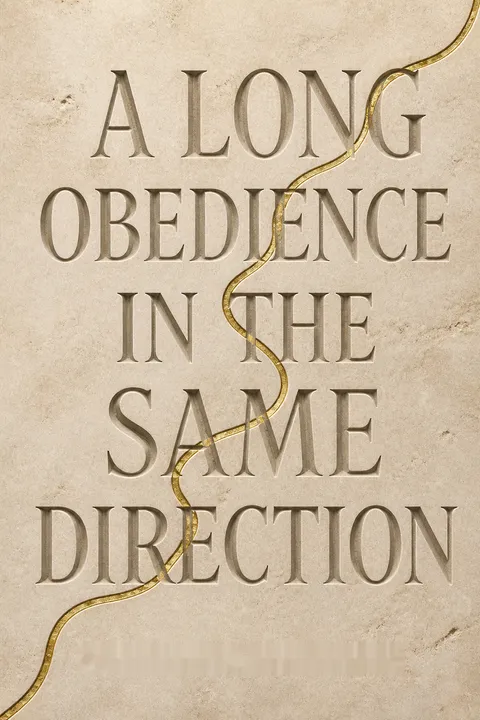
A Long Obedience in the Same Direction is highly praised for its profound, accessible wisdom about Christian discipleship through the Psalms of Ascent (120-134). Readers appreciate Peterson's emphasis on slow, patient spiritual growth over instant results, his honest portrayal of faith's challenges, and his beautiful writing style. Many consider it a masterpiece deserving repeated readings. Some critics found Peterson's interpretations occasionally stretched beyond the text or his theology imperfect. The book resonates particularly with those experiencing spiritual fatigue, offering encouragement for the "long haul" of faith through practical, scripture-saturated insights without quick fixes or gimmicks.
People Also Read








Glossary
Songs of Ascents
Pilgrimage psalmsThe name for Psalms 120 through 134, which Peterson reads as songs for people journeying toward God. He presents their use by pilgrims traveling to Jerusalem as a longstanding interpretive tradition, while noting that the historical connection is conjectural. In the book, the fifteen poems provide a sequence of themes for Christian formation.
A long obedience in the same direction
Lifelong faithful practicePeterson’s central description of Christian discipleship: a sustained commitment to follow Jesus and grow in faith through ordinary life. The phrase comes from Friedrich Nietzsche, whom Peterson cites, but Peterson uses it to name a specifically Christian journey shaped by Scripture, prayer, and repeated obedience rather than novelty or quick spiritual results.
tĕshubah
Turning toward GodA Hebrew term Peterson uses for repentance as a decisive change of direction. It involves turning away from a life organized around false assumptions and self-rule, and turning toward God. In his account, repentance is more than remorse or a passing feeling: it begins a new way of living and traveling in faith.
’ashre
Wholeness in right relationshipA Hebrew word Peterson distinguishes from another biblical word translated as blessing. In Psalm 128, it describes the happiness or well-being associated with living in right relationship with God. It is not simply a good mood or material success, but a condition of life grounded in God’s purposes.
bĕrakah
God's life sharedA Hebrew term Peterson uses for blessing as God’s action toward people: entering into relationship, sharing divine goodness, and giving life. It also describes human praise and gratitude in response to blessing received. The book uses the term to connect God’s generosity with worship and the community’s answer of praise.
the world
An atmosphere opposed to faithPeterson uses this theological term for more than human society or the created earth. It describes a cultural atmosphere that can erode faith, hope, and love by treating life as self-contained and immediate. He distinguishes this spiritual pressure from the world as creation, which he says is made and loved by God.
About the Author




Download PDF
Download EPUB
.epub digital book format is ideal for reading ebooks on phones, tablets, and e-readers.








