

Plot Summary
The Road to the Bush
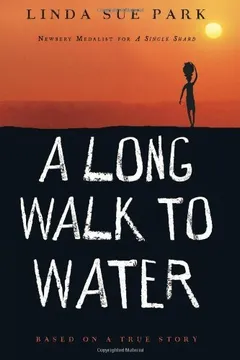
In 2008, eleven-year-old Nya walks for hours to fetch muddy water, then carries it home in a heavy plastic container. In 1985, eleven-year-old Salva sits in school thinking of his family and the milk waiting at home when gunfire breaks out.
His teacher sends the children away from their villages and into the bush. As soldiers and frightened villagers scatter through the dust, Salva runs from home without knowing whether his family has escaped.
The parallel openings make water and danger immediate, not abstract. Nya’s burden is a daily routine; Salva’s flight begins when ordinary routines collapse. Both children are defined first by what their bodies must do, while the alternating years reveal how survival can mean either enduring a familiar hardship or escaping a sudden one.
A Stranger's Small Welcome
After a group abandons Salva in a barn, an older Dinka woman gives him peanuts and lets him stay until she must leave. She persuades a passing group to take him, though some fear he will slow them down.
Salva walks hungry for days until Buksa, a boy from another tribe, follows a honey-guide bird to a hive, giving the travelers a rare feast. Salva then befriends Marial, another boy separated from his family. Their companionship is broken when a lion takes Marial during the night.
Each rescue depends on someone choosing to share risk or food, but none can promise lasting safety. Salva’s fear of being a burden grows from repeated abandonment; the peanuts, honey, and Marial’s companionship briefly counter it. Marial’s disappearance shows that even friendship cannot make the journey predictable.
The Price of Crossing
Salva’s uncle, Jewiir, finds him among the travelers and uses his rifle to hunt food and protect the group. When they cross the Nile in canoes woven from reeds, Jewiir helps Salva face the desert beyond. He breaks the punishing trek into short goals, urging Salva onward when thirst and a torn toenail nearly stop him.
Near the end of the crossing, Nuer gunmen rob the group and shoot Jewiir. Salva reaches the Itang refugee camp without him, then realizes the woman in an orange scarf is not his mother. He accepts that his family may be gone and resolves to endure one day at a time.
Jewiir turns endurance into a practical method: attention narrows to the next landmark instead of the whole impossible distance. After his loss, Salva must carry that method without his uncle’s protection. The false glimpse of his mother’s scarf makes grief concrete, forcing him to face uncertainty rather than rely on reunion as his only reason to continue.
The Boy Who Led
Salva spends six years at Itang before Ethiopian soldiers force the refugees toward the flooded Gilo River. He survives the crossing, where gunfire, crocodiles, and the current kill many people. Rather than wait for another rescue, Salva organizes a group of boys and leads them south by night, assigning jobs and sharing scarce food.
More than twelve hundred reach Kenya after a year and a half. Years in Kenyan camps bring another kind of waiting. Aid worker Michael teaches Salva English, and, after several rejected application lists, Salva is selected to resettle in America.
Salva’s survival changes from personal endurance into organized care. He applies the lessons of his lost family by assigning work, sharing supplies, and carrying younger boys when they tire. The leadership is not a sudden transformation into fearlessness; it is a response to seeing what happens when frightened people have no one to coordinate their next steps.
A Father Found
In Rochester, Salva learns English and adjusts to a new family, a new country, and winters unlike anything he has known. Years later, an email from a cousin reveals that his father, Mawien Dut, is recovering at a clinic in Sudan.
Salva makes the difficult journey and finds his father alive; he also learns that his mother and two siblings survived, while two brothers did not. After they part, Salva sees how contaminated water has damaged his father’s health. He begins building a project to bring wells to Sudan, raising money by speaking to schools and community groups.
The reunion revises Salva’s understanding of loss without undoing it: some family members survived, others did not, and years of separation cannot be returned. His father’s illness turns memory into a public responsibility. Salva’s project grows from an intimate encounter with contaminated water, rather than from an abstract wish to fix every hardship in Sudan.
Water Beneath the Fire
In Nya’s village, her sister Akeer becomes ill from dirty water and needs medicine from a distant clinic. The following year, workers arrive to drill near the village’s gathering place. Nya watches them struggle with leaking equipment, then sees muddy water burst from the borehole; the crew drills deeper and installs a pump.
The clean water ends her daily trips to the pond and makes a nearby school possible for girls as well as boys. Nya learns that the crew leader, Salva, is Dinka, a member of the tribe her Nuer community has long regarded as an enemy. She thanks him for bringing water.
The well changes more than the source of a drink: it returns time to Nya’s family and makes schooling newly possible. Its location, beneath a familiar gathering place, also unsettles the assumption that resources belong to one community alone. Salva’s work crosses a tribal boundary through shared labor and access, while Nya’s thanks gives that change a personal face.
Analysis
The book makes infrastructure and survival part of the same moral problem. Salva’s journey shows how war can strip a child of home, family, and control, while Nya’s routine shows a quieter deprivation repeated every day: hours spent obtaining unsafe water. Their parallel stories resist treating the well as a simple rescue. Salva has lived through the conditions Nya faces, but the solution depends on planning, money, skilled labor, and a community willing to maintain it.
The novel also gives leadership a specific shape. Salva does not become a leader by escaping fear; he learns to organize action while afraid, first for himself and then for other boys. His later work carries that learned responsibility into a different setting. The well’s location among Nuer people, despite Salva’s Dinka identity, makes cooperation tangible rather than sentimental. It does not erase old conflict, but it creates a shared resource and gives Nya time for school. The book’s hope is therefore practical: one person’s endurance matters most when it becomes useful to others.
Review Summary
A Long Walk to Water is a powerful and moving book based on true events in Sudan. It tells the parallel stories of Salva, a refugee during the civil war, and Nya, a girl struggling to access clean water. Readers praise the book's emotional impact, inspirational messages of hope and perseverance, and its ability to raise awareness about issues in Sudan. While some found the writing style simplistic, most reviewers highly recommend it for all ages, noting its potential to inspire empathy and action.
Characters
Salva
displaced boy turned leaderAn observant Dinka child whose education and family life are interrupted by civil war. Salva initially measures himself against the fear that he will slow others down. Memory, practical discipline, and attention to people more vulnerable than himself gradually become sources of strength.
Nya
water-bearing girlA Nuer girl whose daily work is to carry water for her family. Nya is capable and perceptive, but the demands on her leave little room for school or rest. Her attention to the people and work around her helps the reader understand what access to clean water could change.
Jewiir
Salva's soldier uncleSalva’s uncle and a former soldier, Jewiir offers protection, food, and steady encouragement during the journey. He treats Salva as someone capable of continuing, even when the boy is frightened or exhausted.
Marial
Salva's walking companionA boy Salva meets among the displaced travelers. Marial shares Salva’s longing for family and makes the journey less lonely through humor and companionship.
Mawien Dut
Salva's fatherSalva’s respected father, a cattle owner and village judge. His care for his children and his commitment to hoping for Salva shape the boy’s memories of home.
Akeer
Nya's younger sisterNya’s five-year-old sister. Akeer’s dependence on the family’s water and care makes the consequences of unsafe water especially visible.
Dep
Nya's older brotherNya’s older brother, who explains the well-building work to her and wants access to education. His hopes help show what the family’s daily water-gathering prevents.
Michael
camp teacherAn Irish aid worker who teaches Salva to read and write English in a Kenyan refugee camp. Michael gives Salva a practical skill and a reason to imagine a future beyond the camp.
Buksa
honey-guide listenerA young traveler from the Jur-chol people. Buksa’s ability to follow a honey-guide bird leads Salva’s group to food when hunger has nearly overcome them.
Nya's mother
careful family protectorNya’s mother cares for the younger children and shares the family’s exhausting water duties. Her worry for the men during seasonal moves reflects the danger of Nuer and Dinka conflict.
Plot Devices
Alternating timelines
connect two livesThe story moves between Salva’s flight beginning in 1985 and Nya’s life in 2008 and 2009. Their separate experiences let the reader see both the long consequences of displacement and the daily burden of fetching water before their stories meet.
The well
turn water into opportunityThe drilling project links Salva’s journey with Nya’s daily routine. A clean, reliable source of water reduces illness and frees children from long trips, making a school possible in the village.
Short daily goals
make survival manageableJewiir helps Salva break an unbearable desert crossing into smaller distances. Salva later uses the same practical approach to keep himself moving and to lead the boys traveling toward Kenya.
Download PDF
Download EPUB
.epub digital book format is ideal for reading ebooks on phones, tablets, and e-readers.








