

Key Takeaways
Read the ordinary record; it reveals what public history leaves out.
The daily record matters. In April 1789, Martha Ballard crossed the Kennebec during a violent spring flood to attend a birth. She was nearly swept into a stream, saw a tree fall across her path, and arrived with her cloak ruined. The journey is dramatic, but it appears among notes about weather, household work, and other patients. Ulrich argues that such routine entries are not historical clutter. Together, they show how people worked, traveled, traded, worshipped, and cared for one another.
Context makes fragments speak. A few lines can contain several stories: a seafaring husband leaves town, a pregnant woman waits for the midwife, and another household faces debt and imprisonment. The diary rarely explains these circumstances outright. Ulrich places it beside court files, maps, account books, and other diaries to recover what a brief entry only hints at.
What's striking is that the diary's value comes from accumulation, not from a single polished revelation. This resembles microhistory, a method that uses a small place or life to expose the workings of larger systems. It also anticipates a problem in data analysis: a repeated, low-drama observation can reveal a pattern that a vivid outlier cannot. Yet Martha's record is not a census of everyone. Her literacy, work, and social position shaped what she could observe. The method works best when its reach is broad and its limits remain visible.
Treat care as skilled work, not a private kindness.
One worker, many roles. During the August 1787 scarlet fever outbreak, Martha delivered four babies in three weeks, made sixteen medical visits, prepared three bodies for burial, and treated her own husband's sore throat. She gathered herbs, mixed remedies, watched through the night, and returned to household chores when she got home. Her diary records care as practical labor that involved knowledge, time, physical risk, and emotional steadiness.
The work was communal. When a child became critically ill, neighbors took turns watching, nursing, and helping the family. Martha's phrase for a grieving mother stands out because most entries are restrained. The diary shows that birth, sickness, and death were not events sealed inside private homes. They drew on a network of women and neighbors whose work sustained the whole settlement.
Care work is often treated as a feeling rather than an occupation, which makes its skill and cost easy to overlook. Martha's entries make the labor legible: someone must recognize symptoms, prepare a remedy, watch a patient, and keep the household functioning. Contemporary care-economy research similarly asks who performs necessary work when markets and institutions do not. The comparison should not romanticize self-sacrifice, however. A community can depend on a caregiver while leaving her exhausted and unsupported. Martha's competence is impressive, but the burden it concealed matters just as much.
Map healing as a neighborhood system, not a contest between professions.
A shared practice. Ulrich calls Hallowell's community-based, mostly female healing system social medicine. Women cared for the sick, assisted at births, prepared medicines, and learned through repeated experience. Some were experienced healers, others nurses or watchers, and many moved among those roles over a lifetime. During the 1787 epidemic, for example, a servant might nurse or do housework while a skilled neighbor tended a patient.
Doctors were not yet dominant. Physicians sometimes advised or treated patients, but women handled much of the routine care. Martha attended about 60 percent of Hallowell's births in 1787, and she was not the town's only female practitioner. The arrangements were cooperative but unequal: doctors carried titles and public standing, while women's work was often too ordinary to appear in official records.
This account resembles modern network models of health, in which outcomes depend on connections among households, caregivers, and specialists, not on one expert acting alone. It also warns against assuming that professional medicine simply replaced ineffective folk practice. In this period, doctors and midwives often shared remedies and basic ideas about the body. Still, the network was not egalitarian. Race, class, and social rank shaped access and recognition. Martha notes a Black woman healer without recording her name, a small but telling sign that community knowledge could be useful and still remain uncredited.
Follow cloth, credit, and marriage to find women's economic power.
Households were workplaces. Martha and her daughters spun and wove cloth, grew flax, and exchanged labor, tools, food, medicine, and credit with neighbors. Between 1785 and 1800, thirty-nine young women lived and worked in the Ballard household for a time. The work was distributed across a network: one woman spun, another warped a loom, and another wove the finished cloth. Men participated too, but women managed much of this production and trade.
Marriage meant provisioning. When Hannah and Parthenia married in 1792, the preparations included household goods and quilts made with neighbors' help. The brides continued living and working at Martha's house for weeks before setting up households of their own. This was not merely ceremony. The slow transition assembled the skills, materials, and relationships required to maintain a home.
These exchanges challenge the idea that economic activity is visible only when it appears in a merchant's ledger or a wage contract. Feminist economics makes a similar point: household production has value even when it is unpaid, reciprocal, or recorded in a woman's name alone. The evidence also complicates claims that women had no economic agency. Martha kept accounts and controlled parts of the household economy, but this should not be confused with equal authority. Most of the work still fell to women, and their influence operated within patriarchal limits.
Court records alone cannot reveal how communities regulated sex and support.
Pregnancy was public business. Of 106 women Martha delivered of their first babies, 40 had conceived before marriage. Thirty-one later married the child's father. Massachusetts law allowed an unmarried mother to name the reputed father, who could then be required to support the child. The procedure began with a woman's confession and testimony during labor, linking childbirth to local courts and community expectations.
The system had sharp limits. Martha also recorded Rebecca Foster's accusations that Judge Joseph North had assaulted her while her husband was away. North was acquitted, and the case left little in the official record. Martha's testimony preserves details absent from the court file, including that Rebecca had spoken of abuse soon after the alleged attack. The contrast shows why a lack of prosecution cannot be treated as proof that sexual conduct was private or that accusations were easily heard.
The chapter demonstrates a basic problem in legal history: court records show the cases that entered and survived the system, not the full range of behavior or informal settlements. That is a form of selection bias. At the same time, procedural rules could support a mother seeking child maintenance while exposing her to penalties and public scrutiny. The system was neither simply protective nor simply punitive. Rebecca Foster's case is especially difficult because the surviving evidence is incomplete. A careful account preserves that uncertainty rather than turning her testimony or the verdict into an easy conclusion.
Measure childbirth by outcomes, but remember who defined a complication.
The record is unusually large. Martha documented 814 deliveries between 1785 and 1812. She noted complications in 46, or about 5.6 percent, and recorded fourteen stillbirths plus five infants who died shortly after birth. Across nearly 1,000 births in her career, she lost one mother at delivery; five patients died during the period after childbirth. These figures were strong for her time, though they are far worse than modern standards of safety.
Numbers need context. A male physician's surviving record classified about 20 percent of births as abnormal, compared with Martha's 5.6 percent. The difference may reflect what each practitioner noticed and chose to record, as well as differences in practice. Newer interventions, including forceps and opiates, did not automatically make birth safer. Martha's experience also shows that a delivery was a social event, with a midwife, attendants, and follow-up care, not simply a clinical procedure.
The comparison raises a methodological question that still matters in medicine: whose categories define an outcome? A low complication count might indicate effective practice, underreporting, or a different threshold for calling a birth abnormal. The book is careful to show that the records cannot settle every question. That caution strengthens the larger point. Medical innovation is not equivalent to improved care unless outcomes are measured and compared fairly. At the same time, historical mortality figures cannot establish that traditional practice was generally safer. They show what happened in one community, under particular conditions.
Trace political conflict through the household work it threatened.
Land disputes entered daily life. Ephraim Ballard surveyed contested Maine lands for proprietors who claimed vast tracts, while settlers argued that their labor clearing and improving the land gave them a stronger claim. In 1795, armed men awoke Ephraim in the woods, threatened him, and stole his surveying papers and instruments. Martha recorded the attack alongside ordinary work, just as she later noted the 1809 resistance to surveys amid gardening and births.
The Revolution had no single meaning. Proprietors saw attacks on surveyors as disorder; settlers viewed resistance as a defense of the rights they believed they had fought for. The conflict eventually became known as the Malta War. Martha's diary does not offer a neutral overview, but it shows how political struggles over ownership and authority affected families, work, and safety.
Political history can make land appear as an abstract asset, while Martha's record restores the labor and danger attached to it. The dispute also reveals competing definitions of property: legal title on one side, improvement and occupation on the other. Neither perspective should be mistaken for the whole story. The diary's family connections and Ephraim's employment give it a clear bias toward proprietors. Its strength is not neutrality, but its ability to locate political conflict inside lived routines, where risks and dependencies become concrete.
Aging reveals the unpaid support hidden inside family independence.
A household can turn against its manager. As Martha's daughters married and left home, dependable help disappeared. New servants came and went, and she struggled to keep up with washing, cooking, animals, and deliveries. In 1804, Ephraim was jailed because he fell $800 short while collecting Augusta's taxes. He could leave the jail yard by day, but he remained confined at night for more than a year.
Her needs went unmet. Martha lacked the wood her husband had usually supplied and broke old fencing into pieces to keep a fire. She also lived uneasily with her son Jonathan's family after they moved into her house. These hardships changed the diary's tone. It became a place to register exhaustion, indignation, and requests for patience, not just a ledger of tasks completed.
Martha's difficulties expose a weakness in the ideal of the self-sufficient household. Its independence rests on labor being available, often from women, relatives, and hired helpers whose own needs may be precarious. Social scientists call such arrangements dependencies, but dependence is not the same as helplessness: Martha remained skilled and active while relying on others for fuel, companionship, and help. The account also resists a simple tale of neglect. Family members offered support unevenly, and Martha's own expectations and pride shaped how she received it.
Do not let a sermon turn the Purrinton murders into a simple cause.
The horror resisted explanation. In 1806, Captain James Purrinton killed his wife and six children. His son James escaped, and his daughter Martha survived for several weeks before dying. The community crowded around the bodies, funeral, and surviving relatives. Martha's account is restrained, emphasizing the neighbors who found the family, the efforts to care for the wounded, and the funeral procession that separated the murderer from his victims.
Interpretations were contested. Some commentators blamed Purrinton's Universalist beliefs, arguing that disbelief in judgment had led him to kill his family. Others might read the event through the patriarchal authority that placed a household under a father's control. Neither explanation is proven by the diary. After the killings, Martha spent time with a troubled neighbor, helping with quilting and ordinary exchanges that drew her back into community life.
The tragedy shows how communities use stories to make unbearable violence intelligible. Religious explanations can create moral order, but they can also turn a complex act into an indictment of a disliked belief. A structural account of family power identifies a different danger, though it too cannot establish Purrinton's motive. The strongest reading holds the interpretations apart from the known events. Martha's practical attention to survivors matters here: care can help a community continue without pretending that the violence has been explained.
Use Martha's 9,965 days to question whose work official records count.
The diary preserves what institutions omit. Martha kept her record for 9,965 days, from 1785 until shortly before her death in 1812. The town's tax lists, merchant accounts, and official histories generally recorded men, property, and public offices. Martha's diary documents women's medical work, textiles, gardening, trade, and care for the poor, along with the names of people who came and went.
Even preservation involved editing. An early historian copied about a third of the diary, retaining useful public and genealogical details while cutting much of the sexual, domestic, and economic material. Ulrich reconstructs the life by reading the diary with deeds, court files, maps, and other records. The result is not a transparent window onto the past, but a more complete account of a woman whose name and work were otherwise easy to lose.
Archives are not neutral containers. What survives depends on who could write, whose papers were kept, and what later readers considered important. Martha's diary is powerful precisely because it joins repetitive work to exceptional events, but it also reflects her choices and silences. Reading it alongside legal and financial records is a form of triangulation: different sources correct one another without producing a perfectly complete picture. The larger lesson is practical for historical research: absence from official documentation should prompt questions about record-making, not a quick conclusion that the work never happened.
Analysis
A Midwife's Tale is both a biography and an argument about historical evidence. Martha Ballard's diary does not merely add a woman's perspective to a settled account of the early Republic. It changes what counts as evidence of economic, medical, and political life. The town's ledgers foreground male property and trade; the diary makes visible the labor that sustained households and connected neighbors. Its daily entries also complicate the familiar division between public politics and private domesticity. Land disputes, courts, epidemics, and religious conflicts enter kitchens and sickrooms, while food, clothing, childbirth, and care shape the practical limits of public life.
The book's method is especially powerful because it treats the diary as a record with both density and gaps. A terse note is not self-explanatory, so Ulrich compares it with deeds, court proceedings, maps, account books, and other diaries. This triangulation gives the reader a way to assess interpretation rather than simply accept it. But the reconstruction remains partial. Martha's literacy and position as a respected white midwife determine what she could record; her reticence leaves some relationships and motives obscure. Her perspective is invaluable without standing for every woman in Hallowell.
The book also resists a progress narrative in which professional medicine, legal institutions, or republican politics steadily improve life. Eighteenth-century healing could be collaborative, yet it relied on remedies later rejected. Midwives could be highly skilled, yet their expertise was not equally recognized. Courts could compel fathers to support children, yet fail to protect a woman accusing a powerful man. Family labor could provide independence, then leave an aging woman without reliable help. These contradictions make the book more than recovery of a forgotten life. They reveal how social systems distribute recognition and risk, and how apparently ordinary records can expose those arrangements. Martha's achievement is not that she escaped her era, but that her sustained documentation lets readers see its workings at human scale.
Review Summary
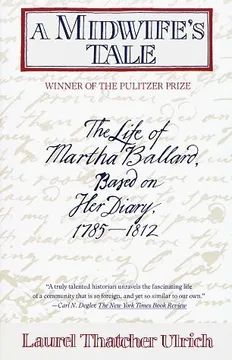
A Midwife's Tale is widely praised for its meticulous scholarship and accessibility, earning the 1991 Pulitzer Prize for History. Readers admire Ulrich's ability to extract rich social history from Martha Ballard's sparse diary, illuminating 18th-century New England life, midwifery, women's economics, and social dynamics. Many readers discovered the book through Ariel Lawhon's fictional adaptation, The Frozen River. Some find the academic style dry, but most appreciate the vivid portrait of an extraordinary ordinary woman whose dedication, resilience, and record-keeping preserved an otherwise lost slice of American history.
Glossary
social medicine
Community-based healingUlrich's term for the neighborhood system of care in Hallowell, where women and other local helpers treated illness, attended births, nursed patients, and prepared the dead. Knowledge developed through repeated experience and personal relationships rather than solely through formal medical institutions. Physicians participated, but they were one part of a broader, often hierarchical network.
social childbirth
Birth with community attendantsA model of childbirth in which a laboring woman was attended not only by a midwife but also by female relatives, neighbors, and other helpers. These attendants provided practical assistance, observation, and companionship. In Martha Ballard's community, birth connected households and activated networks of care rather than taking place as an isolated medical event.
reputed father
Man named as a child's fatherA legal designation for the man an unmarried mother identified as the father of her child. Massachusetts procedures could require that man to contribute to the child's support. The process included a woman's confession and testimony during labor, joining childbirth, local judgment, and the law. It did not by itself establish that the man had committed fornication.
lying-in
Recovery period after childbirthThe period after delivery when a mother recovered and gradually resumed household activity. In Hallowell, this did not necessarily mean prolonged bed rest. Many women returned to ordinary tasks quickly, while the length and comfort of recovery depended on health, available help, and household resources. Martha's diary often marks recovery by a woman's return to her kitchen.
memory economy
Trade tracked through personal trustUlrich's description of local exchange that depended heavily on relationships and remembered obligations rather than complete written accounts. Neighbors traded food, labor, cloth, tools, and services, often settling debts later or informally. Martha recorded some transactions, but many exchanges never appeared in her diary or in official accounts.
family economies
Household-managed work and tradeThe partly distinct economic activity organized within a household. In the Ballard home, Ephraim managed surveying, mills, and lumber-related work, while Martha managed midwifery, textiles, household goods, and exchanges with neighbors. Their activities supported one another, but the diary shows that one household could contain separate systems of labor, management, and credit.

Download PDF
Download EPUB
.epub digital book format is ideal for reading ebooks on phones, tablets, and e-readers.








