

Key Takeaways
Turn a complaint into a question you are willing to own.
A question needs an owner. A beautiful question, in Berger’s sense, is ambitious but answerable enough to act on, and capable of changing how a situation is understood. Van Phillips discovered the difference between wondering why prosthetic feet were so poor and deciding to do something about it. After losing his lower leg in a boating accident, he was given a basic artificial foot that made walking difficult. His question began as why nobody could make a better one. It became more powerful when he stopped waiting for somebody else to solve it and entered the prosthetics field himself.
Inquiry beats complaint. Phillips spent years learning the field and developing a new design. The shift from they to I did not mean he had all the expertise or resources. It meant accepting responsibility for finding the next step. Questions can expose a need, but only commitment turns that discovery into change.
The distinction between complaint and ownership is useful because it separates diagnosis from agency without pretending that every problem is individually solvable. Phillips could act because he could enter the relevant field and work on a concrete design; structural problems may demand collective action, institutional power, or resources an individual does not possess. The practical question is therefore not simply, Who will fix this? but also, What part of the problem can I responsibly influence, and who must join me? That framing preserves initiative while avoiding the fiction that personal determination alone can overcome every barrier.
Move from diagnosing reality to imagining alternatives, then testing one.
A useful sequence. Berger’s Why-What If-How model organizes inquiry into three moves: understand the situation, imagine a different possibility, and work out how to make it real. The moves are not a rigid recipe, but they help prevent a common mistake: trying to build a solution before understanding the problem. When Edwin Land’s young daughter asked why a photograph could not be seen immediately, he first reconsidered the waiting built into photography, then imagined putting the development process inside a camera, and finally began designing and testing an instant camera.
Keep moving by stages. Land’s first model did not meet every ambition. The early camera was followed by further questions about color and ease of use, which took years to address. The method is valuable precisely because a large challenge can be advanced through smaller questions, even when the full answer remains distant.
The sequence resembles a practical version of the scientific method: define the phenomenon, generate hypotheses, and test them against the world. Its strength is not that creative work always follows a clean order. It often loops backward when tests reveal that the original problem was misframed. The model is best used as a set of changing mental postures. First, suspend premature fixing. Then allow possibilities to widen. Finally, narrow enough to act. That shift in posture can help teams avoid treating ideation, evaluation, and execution as if they were the same kind of thinking.
Step outside expertise long enough to notice what familiarity hides.
Fresh eyes find openings. Expertise makes some problems easier to solve, but familiarity can also make existing arrangements seem inevitable. Berger describes beginner’s mind as approaching a subject without assuming that established explanations exhaust its possibilities. He also uses vuja de for the experience of looking at something familiar as if it were strange. Comedian George Carlin used that outsider’s attention to notice the odd rules and habits people rarely examine. A puzzle involving a grid of sixteen small squares makes the point: a quick glance finds sixteen, but patient inspection reveals many more squares formed by combining them.
Pause the autopilot. Stepping back can mean leaving the daily rush, temporarily setting aside expert certainty, or examining a routine from another person’s perspective. The aim is not to reject knowledge, but to see what it has taught the mind to overlook.
This is a strong account of how attention can become a source of discovery. In cognitive science, familiar patterns help people process information efficiently, but that efficiency also encourages selective attention: once a routine is categorized, its details fade from awareness. Deliberate observation interrupts that compression. Still, outsider status is not automatically an advantage. A novice may notice an overlooked possibility, but may also miss constraints that experts understand for good reasons. The productive stance combines beginner’s openness with enough learning to distinguish a genuine opportunity from a problem already solved or an obstacle that cannot be ignored.
Investigate the real problem before committing to its obvious solution.
Get close to the problem. Contextual inquiry means learning about a challenge through direct observation, listening, and interaction in the setting where it occurs. It helps test whether the question itself rests on faulty assumptions. Aid groups once responded to a shortage of infant incubators by donating more machines. Many were abandoned because they broke and local technicians could not repair them. The better question was why existing incubators were not being used. That led designers to consider a simpler model made with readily available car parts.
Dig beneath the symptom. The five whys is a technique for asking why repeatedly to move from an obvious explanation toward underlying causes. A factory may blame a worker for a defective part, then discover that inadequate training or organizational priorities contributed to the error. The number five is a prompt, not a law. The aim is to uncover causes, not to keep asking until an answer sounds profound.
This approach guards against a common failure in public policy and product design: confusing the visible absence of a tool with the deeper conditions that make it useful. On-site observation can reveal maintenance, trust, incentives, or access problems that distant decision-makers miss. The five whys adds a causal discipline, but causal chains are rarely single-file. Repeated why questions can oversimplify systems if they force every problem into one root cause. Combining the method with multiple perspectives and direct evidence helps avoid turning a useful diagnostic into a neat story that is easier to tell than the reality is to change.
Give strange combinations room to form before demanding certainty.
Creativity connects existing material. Connective inquiry is the process of linking ideas, observations, or knowledge from different areas to imagine a new possibility. Tim Westergren’s work as a musician and film composer gave him ways to think about musical taste. He later connected that knowledge to the problem of talented musicians struggling to find listeners. His speculative question was whether music could be analyzed through hundreds of characteristics and matched to people likely to enjoy it. That idea became the basis for Pandora’s recommendation system, which combined human musical judgment with software.
Let ideas incubate. Berger argues that creative possibilities can emerge after sustained attention, including during periods of rest or distraction. The question keeps the problem active while the mind makes less obvious associations. This does not mean waiting passively for inspiration. It means gathering useful material, focusing on a challenge, and allowing time for connections to form before dismissing an idea as impractical.
The account treats creativity less as mysterious genius and more as recombination: original work often rearranges materials that already exist. That makes curiosity and broad exposure valuable, since the mind has more pieces available to connect. Rest can also support problem solving by reducing the pressure to produce an immediate answer. Yet incubation is not a substitute for knowledge or deliberate effort. A striking analogy may generate a promising hypothesis, but it can also be merely clever. The next test is whether the connection explains a real need and can survive contact with evidence.
Make ideas visible, test them early, and learn from distinct failures.
Turn speculation into evidence. A prototype is an early, tangible version of an idea that makes it easier to inspect, share, and test. MIT student Gauri Nanda developed Clocky, an alarm clock that rolls away so its owner must get out of bed to switch it off. Her first versions used borrowed components and improvised materials. Testing exposed problems she had not anticipated: the clock had to survive falling from a bedside table and move unpredictably enough to be difficult to catch.
Treat failure as information. Van Phillips developed roughly two hundred to three hundred versions of his prosthetic foot, many of which broke under weight. Each failure raised practical questions about materials and design. The important measure is not whether a trial fails, but whether the next attempt reflects what was learned. Repeating the same mistake is not progress. Changing the design in response to evidence is.
Early prototypes are valuable because they replace abstract agreement with observable behavior. A drawing may make an idea understandable; a working model reveals friction that discussion cannot. This is especially useful when costs of testing are low and uncertainty is high. The method also needs guardrails. Not every failure is informative, and repeated experiments can waste time if the goal is unclear or feedback is ignored. A good test states what uncertainty it is meant to reduce. Then an imperfect result can be useful, rather than being celebrated as failure for its own sake.
Teach questioning explicitly before school trains curiosity out of students.
Curiosity needs room and practice. Berger reports that children ask tens of thousands of questions between ages two and five, while questioning drops sharply as schooling progresses. The decline coincides with systems that often reward correct answers, cover prescribed material, and leave little time for students’ own investigations. The relationship is not proof that schooling alone causes the decline, but it raises a serious educational question: are students learning to inquire, or mainly to respond?
Give students ownership. The Right Question Institute’s Question Formulation Technique teaches students to generate questions about a prompt, improve them by making them broader or narrower, choose the most useful ones, and decide what to investigate. In Deborah Meier’s Central Park East schools, students practiced questions about evidence, perspective, connections, possibilities, and relevance. The point is not to discard knowledge. It is to make students active participants in finding and evaluating it.
Questioning is often praised as a natural talent, which can conceal the social conditions that make it safer for some people than others. Students may stay quiet because they fear looking uninformed, challenging authority, or confirming a stereotype. Structured exercises help by separating question generation from immediate judgment, while giving more students a route into the discussion. However, inquiry-based teaching still requires strong instruction and accurate content. A classroom full of questions is not automatically a classroom full of learning. Teachers need to help students develop questions, investigate them, and assess the answers critically.
Build workplaces where challenging questions earn time, attention, and resources.
Make inquiry part of the system. Companies often reward confident answers and short-term execution, even when the market has changed. Clayton Christensen studied successful firms that kept improving established products while newcomers found opportunity in simpler, cheaper offerings for overlooked customers. His work began by asking why smart managers were missing a pattern visible across industries. Companies need to revisit fundamental questions about their purpose, customers, and the business they are actually in, not just ask how to improve current operations.
Reward exploration. A questioning culture requires more than slogans. Leaders must tolerate challenges, protect space for experiments, and allocate resources to learning as well as proven plans. W. L. Gore encouraged employees to spend part of their time on independent projects. One engineer’s work on smoother bicycle cables helped inspire a new guitar-string product. The broader lesson: inquiry survives when organizational incentives make it safe and worthwhile.
Organizations learn through questions only when the answers can affect decisions. A suggestion channel that executives ignore is not a culture of inquiry; it is a ritual that can deepen cynicism. The more demanding change concerns incentives: short-term targets can make exploration appear wasteful, even when a company faces long-term disruption. Protected experiments can help, but they should connect to strategic learning rather than become an unaccountable side project. The question for leaders is both whether employees may speak and whether the organization can respond when their questions expose a threat to existing priorities.
Treat a life change as an experiment, not a verdict about identity.
Act to learn about yourself. People often wait for a perfect answer about the right career or life direction before trying anything new. Organizational researcher Herminia Ibarra argues that career changes more often unfold through experiments and adjustments, sometimes over several years. Short assignments, side projects, or temporary work can test an interest more reliably than abstract planning alone. The result may surprise the person who began the search.
Question the path itself. Jacqueline Novogratz left a secure banking job for work supporting entrepreneurs in developing countries because she questioned what she wanted her life to serve. A useful personal inquiry asks not only how to climb, but why that particular mountain matters. Berger also recommends examining what activities make a person feel engaged, what has worked before, and what small change could test a new direction. A trial is not a life sentence; it is a way to gather evidence.
This view treats identity as partly discovered through action rather than solved in advance. That is psychologically useful because people often learn what they value by seeing how they respond to real situations, not by reasoning from an imagined ideal self. Small trials can also make change less intimidating by limiting the cost of being wrong. Still, experimentation is easier for people with time, money, and social support. A fair application distinguishes prudent risk-taking from avoidable precarity and looks for trials that fit the person’s actual constraints.
Ask questions that help people reveal needs instead of accepting your fixes.
Listen before designing. Mick Ebeling wanted to help Tony Quan, an artist with ALS who could no longer draw with his hands. Rather than assume a solution, Ebeling asked how Quan might create art again and brought together programmers and engineers to explore the problem. Their collaboration produced the Eyewriter, a device that let Quan use eye movements to control a laser and draw. The question became actionable because it centered a real person’s need and invited people with different skills to contribute.
Make inquiry respectful. Social activist Fran Peavey asked residents near India’s Ganges River how they felt about its condition and how they explained it to their children. Rather than dictate a cleanup plan, she framed questions that helped residents identify their own concerns. Their response included a children’s poster contest about caring for the river. Good questions create participation; they do not disguise a preselected answer as consultation.
This is inquiry as a form of relationship, not merely a technique for producing novelty. Listening can correct the designer’s assumptions and give affected people a genuine role in defining success. Diverse collaborators then add capabilities the original questioner lacks. These are ethical as well as practical gains: a solution is more likely to fit its users when they help shape it. The caution is that asking questions can still be performative. If participants have no influence over the decision, consultation may extract stories without transferring power. The test is whether their knowledge changes what happens.
Analysis
Berger’s central argument is that questions are not ornamental preliminaries to thinking. They are instruments for directing attention, exposing assumptions, and organizing action under uncertainty. The book’s strongest move is to connect a simple cognitive act with concrete transformations: a better prosthetic foot, an instant camera, a new business model, a classroom that gives students ownership of inquiry, or a device that restores an artist’s ability to create. Those stories make questioning legible as practice rather than personality.
The Why-What If-How progression is effective because it distinguishes three tasks that organizations and individuals often collapse. Diagnosis asks what is actually wrong. Imagination asks what else might be possible. Implementation asks what evidence and resources are needed to proceed. This structure is not a linear law. In real problem solving, tests revise the diagnosis, and new observations reopen the possibilities. Its value is as a navigation aid, not a promise that innovation follows a tidy sequence.
The book also makes an important institutional point: curiosity is unevenly protected. Schools and firms may praise creativity while rewarding obedience, speed, and confident answers. A question culture therefore depends on power, time, and incentives, not simply on individual courage. The examples of students, employees, and community members suggest that the right to ask questions is also a right to participate in defining problems. A useful qualification is that questions do not guarantee insight. They can be loaded, vague, or directed toward an answer already favored by the questioner. Inquiry needs evidence, domain knowledge, and mechanisms for correcting error. Nor can every person solve every problem alone. The book’s best practical lesson is consequently modest and demanding: ask a question that matters, check its assumptions against lived reality, and take the next testable step with others. The answer may remain incomplete, but the search can still make the problem clearer and the available choices more intelligent.
Review Summary
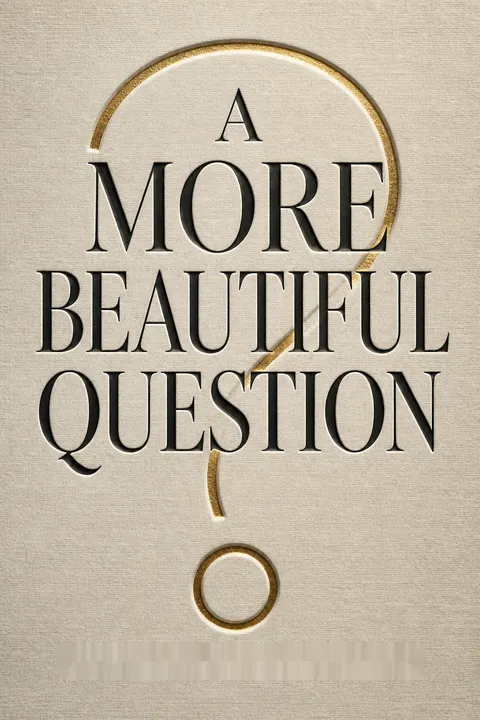
A More Beautiful Question explores the power of inquiry in sparking creativity and innovation. Berger argues that asking thoughtful questions is crucial for problem-solving and personal growth. The book provides examples from business and education, demonstrating how questioning can lead to breakthroughs. While some readers found it inspirational and practical, others felt it was repetitive or overly focused on Silicon Valley. Overall, the book encourages readers to cultivate a questioning mindset and offers strategies for developing better inquiry skills.
People Also Read








Glossary
Beautiful question
Actionable, perspective-shifting inquiryA question that is ambitious enough to change how a person sees a situation, but practical enough to pursue. It can expose an unmet need, challenge an assumption, or open a path toward change. Berger distinguishes these questions from abstract philosophical questions that may invite debate but do not readily lead to action.
Why-What If-How model
A sequence for inquiryBerger’s framework for moving from a challenge toward possible change. The Why phase examines the situation and its context. The What If phase generates possible alternatives. The How phase develops and tests a way to act. The stages can repeat or overlap; they provide orientation rather than a fixed formula.
Contextual inquiry
Learning in the real settingAn approach to understanding a problem through direct observation, listening, and interaction in the setting where it occurs. Instead of relying only on assumptions, reports, or artificial discussions, the questioner gets close to the people and conditions involved. This can reveal why an apparent solution does not fit actual needs.
Five whys
Repeated cause-finding questionsA problem-solving technique associated with Toyota in which a person asks why repeatedly to move beyond the most obvious explanation and investigate underlying causes. The name suggests five rounds, but the number is not mandatory. The method is useful when it uncovers systemic contributors rather than settling for blame or a convenient first answer.
Vuja de
Seeing the familiar anewA term Berger uses for looking at a familiar situation as if it had never been encountered before. This shift can reveal assumptions, inconsistencies, and opportunities hidden by routine. It differs from simply noticing something new: the object or practice may be ordinary, while the observer’s perspective changes.
Connective inquiry
Questions that join distant ideasBerger’s term for using questions to connect knowledge, observations, or influences that usually belong to separate fields. These connections can produce new possibilities by recombining existing ideas. The process depends on both curiosity and material to connect, and it often generates hypotheses that still need practical testing.
Question Formulation Technique
A method for improving questionsA process developed by the Right Question Institute to help people generate and work with their own questions. Participants create questions about a prompt, consider how changing a question’s form changes its scope, prioritize questions, and decide what to investigate. It is designed to teach inquiry as a skill rather than leave it to instinct.
Question-storming
Group brainstorming through questionsA group exercise that focuses on generating questions about a challenge rather than immediately proposing solutions. Participants explore different angles, then select the most promising questions to investigate. The method can reduce pressure to produce a polished answer on demand and help a group discover when its original framing is limiting progress.
Appreciative inquiry
Change through strengths-focused questionsA change approach that emphasizes questions about strengths, successful experiences, and existing assets, rather than focusing only on deficits and blame. Berger draws on it to explain how the tone of questions can shape the responses people give and the possibilities they notice. Positive framing is not denial of problems; it directs attention toward resources that can support improvement.
Beginner’s mind
Open attention without fixed assumptionsA Zen concept Berger applies to innovation and inquiry. It describes approaching a subject without letting established expertise or habitual categories determine in advance what can be seen. A beginner’s perspective can reveal alternatives that experts overlook, although effective problem solving also requires learning the relevant facts and constraints.
FAQ
What's A More Beautiful Question about?
- Focus on Inquiry: The book emphasizes the power of questioning as a tool for innovation and problem-solving across various fields, including business, education, and personal development.
- Framework for Questioning: Warren Berger introduces a three-part model—Why, What If, and How—to guide readers through the process of inquiry, helping them formulate and tackle significant questions.
- Real-World Examples: It includes stories of innovators who have used questioning to drive change, such as Van Phillips, who revolutionized prosthetics by questioning existing solutions.
Why should I read A More Beautiful Question?
- Enhance Creativity: The book helps rekindle natural curiosity and improve the ability to ask meaningful questions, encouraging a shift from seeking answers to valuing questions.
- Practical Applications: It offers insights and frameworks applicable in various contexts, from business to personal life, providing practical advice on cultivating a culture of inquiry.
- Inspiration from Innovators: Featuring inspiring stories of successful questioners, the book motivates readers to adopt a similar approach in their endeavors, illustrating the transformative power of inquiry.
What are the key takeaways of A More Beautiful Question?
- Value of Questions: Questions are often more valuable than answers, especially in a rapidly changing world, as they lead to innovation and adaptation.
- Three-Part Model: The Why, What If, and How framework guides readers through the stages of inquiry, helping formulate questions that lead to actionable solutions.
- Cultural Shift: Berger emphasizes the need for a cultural shift in organizations and education systems to encourage questioning, fostering creativity and adaptability.
What are the best quotes from A More Beautiful Question and what do they mean?
- “Always the beautiful answer / who asks a more beautiful question.”: This quote by E.E. Cummings suggests that the quality of our questions shapes the answers we receive, leading to profound insights.
- “If you dream of something worth doing and then simply go to work on it... it is amazing how quickly you get through those five thousand steps.”: Edwin Land's quote emphasizes persistence in pursuing questions and ideas, highlighting that action on a dream leads to progress.
- “You don’t learn unless you question.”: Joi Ito’s quote underscores the fundamental role of questioning in learning, suggesting that curiosity and inquiry are essential for growth.
How does questioning relate to innovation in A More Beautiful Question?
- Catalyst for Change: Questioning is a critical starting point for innovation, with many successful innovations tracing back to a fundamental question challenging the status quo.
- Examples of Innovators: Stories of innovators like Steve Jobs and Jeff Bezos illustrate how a questioning mindset leads to groundbreaking products and services.
- Encouraging a Questioning Culture: The book advocates for environments that encourage questioning, leading to greater creativity and problem-solving.
What is the Why, What If, and How model in A More Beautiful Question?
- Three Stages of Inquiry: The model breaks down the questioning process into Why (understanding the problem), What If (exploring possibilities), and How (implementing solutions).
- Practical Framework: It serves as a practical framework for approaching problems systematically, guiding the inquiry process from initial questioning to actionable outcomes.
- Encourages Iteration: The model emphasizes that questioning is not linear, encouraging revisiting earlier stages as new insights emerge for deeper understanding.
Why do we stop questioning as we grow older, according to A More Beautiful Question?
- Natural Decline: Children ask thousands of questions, but this tendency declines with age due to factors like schooling and societal expectations.
- Educational Systems: Many systems prioritize memorization over inquiry, stifling curiosity and discouraging questions that challenge norms.
- Cultural Pressures: Social and cultural pressures lead individuals to conform and avoid questioning authority, resulting in a loss of natural inquisitiveness.
How can I develop my questioning skills as suggested in A More Beautiful Question?
- Practice the Model: Use the Why, What If, and How framework to practice formulating questions in various contexts, becoming more comfortable with inquiry.
- Embrace Curiosity: Cultivate a mindset of curiosity by seeking new experiences and knowledge, engaging with diverse perspectives to inspire new questions.
- Create a Supportive Environment: Surround yourself with people who encourage questioning and open dialogue, reinforcing your questioning skills.
What role does questioning play in business, according to A More Beautiful Question?
- Driving Innovation: Questioning is essential for driving innovation, with companies that encourage it more likely to adapt and succeed in changing markets.
- Challenging Assumptions: Business leaders are encouraged to question conventional wisdom and assumptions, leading to new opportunities and strategies.
- Fostering a Culture of Inquiry: A culture that values questioning enhances collaboration and creativity, leading to more effective problem-solving and decision-making.
How can organizations create a culture of inquiry as discussed in A More Beautiful Question?
- Encourage Open Dialogue: Foster an environment where employees feel safe to ask questions without fear of judgment, leading to innovative ideas and solutions.
- Provide Training: Implement training programs focusing on developing questioning skills, helping individuals learn to formulate and ask meaningful questions.
- Reward Curiosity: Recognize and reward employees who demonstrate curiosity and inquiry, reinforcing the value of questioning and encouraging others.
How does A More Beautiful Question suggest we overcome the fear of failure?
- Embrace Uncertainty: Accept uncertainty as a natural part of innovation, freeing individuals to take risks and explore new ideas.
- Reframe Failure: View failure as a learning opportunity rather than a setback, asking "What can I learn from this?" to turn failures into valuable experiences.
- Focus on Action: Shift focus from potential negative outcomes to possibilities of success by asking "What if I succeed?" motivating forward movement.
What is the significance of the Innovator’s Dilemma discussed in A More Beautiful Question?
- Understanding Market Dynamics: The Innovator’s Dilemma explains why successful companies often fail to innovate, focusing on existing products for best customers and neglecting emerging markets.
- Opportunity for New Entrants: This creates opportunities for new entrants to disrupt the market with simpler, more affordable solutions, changing industry dynamics.
- Need for Questioning: Questioning is essential for recognizing and addressing the Innovator’s Dilemma, with leaders needing to ask the right questions to adapt and thrive.
About the Author

Download PDF
Download EPUB
.epub digital book format is ideal for reading ebooks on phones, tablets, and e-readers.








