

Key Takeaways
Follow promises beneath assets; the bank is only one link.
Credit had a long chain. Nelson opens with his father repossessing appliances bought on installment plans. Those household contracts supported Woolco’s borrowing, which in turn supported its suppliers, creditors, and bank lines. The same structure appears throughout American history: a farmer’s loan, a land deed, or a cotton shipment could become an asset held by several financial institutions, each relying on someone else’s promise to pay.
The weak link can spread. Banks issued far more notes and credit than the gold or silver they held. This expansion, called the money multiplier, meant that a relatively small amount of unpaid debt could threaten a much larger volume of claims. When lenders could no longer tell which promises were sound, they stopped lending, turning a local default into a broader contraction.
The chain-of-credit lens usefully shifts attention from a single reckless bank to the relationships that make borrowing scalable. It resembles network analysis: the danger depends not only on one node’s weakness, but on how many other institutions depend on it. That perspective also complicates the language of personal responsibility. A borrower may default, but the consequences depend on underwriting, resale, leverage, and public rules. The framework is strongest when it traces those connections concretely. It should not imply that every borrower is blameless or that every downturn has one identifiable weak link.
A market maker's failure can freeze credit far beyond his own creditors.
Duer borrowed on trust. In 1792, financier William Duer tried to corner the market in federal bonds, borrowing heavily from wealthy associates and small lenders alike. His debts were estimated at more than $2 million, an enormous sum in a young country with little readily available money. His credit also suffered after a badly supplied military expedition ended in a devastating defeat against Indigenous forces.
Doubt spread outward. As creditors demanded repayment, banks restricted lending and people sought gold and silver. Other signers on Duer’s notes could be held responsible when he failed, extending losses beyond the original borrower. Nelson calls the resulting uncertainty symbolic doubt: the moment when holders stop trusting the value of financial promises. The panic helped spur the creation of the New York Stock Exchange and gave opponents a crisis to use against Hamilton’s political faction.
Duer’s story shows how reputation functions as financial infrastructure. In markets where records are incomplete and assets are difficult to price, a trusted name can make a promise usable, until it cannot. The episode also demonstrates that political opposition may worsen a financial shock even when its grievances are legitimate. A run designed to weaken a rival can escape its intended target and harm unrelated borrowers. That is a valuable caution about destabilizing systems to punish insiders. Yet the focus on Duer also risks making a network failure look like one man’s morality tale.
When land secures loans, falling crop prices travel inland.
Credit followed cheap goods. After the War of 1812, English manufacturers flooded American ports with inexpensive clothing, including unfinished wool jackets. Jobbers bought goods at auction, then sold them west on credit. New state banks helped turn local debts into circulating paper money, allowing farmers and merchants to buy goods without carrying scarce coin. Critics called many of these lightly backed institutions caterpillar banks, because their rapid lending seemed to consume the economy around them.
The collateral was vulnerable. The federal Land Office also sold western land on installments, while banks lent to buyers and speculators. When Britain restricted American access to its Caribbean markets, flour prices plunged. Land values weakened, borrowers could not pay, and lenders demanded hard currency. Nearly one-fifth of land purchased on Land Office mortgages was forfeited between 1820 and 1824. The downturn spread from trade into farms, towns, and households.
This episode connects consumer access to systemic fragility. Credit helped more people buy goods and settle land, while also making both commerce and expansion depend on continued borrowing. That dual effect matters: easy credit can broaden participation without making the underlying assets safer. The chain also shows why a price shock travels unevenly. A fall in export demand hits farmers directly, then reaches banks, merchants, and workers through their obligations. The account is persuasive, though the relative weight of British trade restrictions, bank mismanagement, and land speculation remains difficult to isolate.
Cotton turned slave ownership into collateral for transatlantic banking.
Cotton became a financial chain. In the 1830s, faster shipping and expanding trade linked Southern planters to British lenders. Merchant firms financed American agency houses, which advanced money against cotton expected to reach Liverpool. A sight bill of exchange was a payment promise redeemable after it arrived abroad; banks treated these bills as valuable assets while the cotton was still at sea. The system made credit available to planters and merchants on a much larger scale.
The collateral was human. Credit helped raise cotton and slave prices, drawing more people into plantation ownership and the internal slave trade. When doubts about the bills, British lending, and American banks converged in 1836 and 1837, the credit chain broke. The people bought with borrowed money became part of the security creditors might seize. Jackson’s attack on the Second Bank and his specie policies added pressure to an already vulnerable system.
The chapter’s central achievement is to make slavery visible not only as labor exploitation, but as a financial asset embedded in international credit. That perspective links moral violence to balance sheets without confusing economic explanation with moral excuse. It also shows how distant investors could benefit from a system whose human costs were concentrated elsewhere. The specific chain matters because it identifies where responsibility was distributed. Still, the crisis cannot be reduced to one political decision or one commodity. Cotton prices, institutional design, regulation, and policy choices interacted, and their relative importance remains contested.
A railway bond is only as sound as its land title.
Railroads sold future growth. In the 1850s, companies used government-granted land to support bonds sold to investors, including lenders in Europe. They expected settlers to buy nearby farms, repay mortgages, and generate traffic for the railway. But the land’s promised value depended on uncertain surveys, completed tracks, and future settlement. In Missouri and Kansas, disputes over who controlled land and the railroad turned financial competition into political conflict.
The paperwork failed. The Swamp Act allowed states to claim federal lands classified as wetlands, sometimes through dubious surveys. The 1857 version intensified conflicts with railroad land claims. As investors questioned the companies’ titles, bond prices fell. The Ohio Life Insurance and Trust Company, heavily exposed to railway lending, failed, helping trigger the panic of 1857. The crisis illustrates how a disputed deed can undermine a much larger structure of borrowing.
The episode connects property law to financial stability: collateral is only as credible as the legal claim behind it. That insight applies beyond railways, because a security can look standardized while resting on contested rights or incomplete documentation. It also reveals how infrastructure finance can shape political geography, not merely respond to it. The struggle over Kansas was about slavery and settlement, but it was also about who controlled a valuable route and its land. The argument is compelling, though the book’s interpretation gives financial conflict substantial weight in a political crisis with many causes.
American wheat's price shock crossed oceans before bank failures did.
A cheaper crop changed the market. After the Civil War, railroads, grain elevators, and steamships moved American wheat to Europe at falling cost. The new supply undercut established producers, including Russia and Austria-Hungary. In 1873, Vienna’s financial crash followed a period of land and banking speculation. The Bank of England raised its lending rate repeatedly, reaching 9 percent by November, tightening credit across the Atlantic.
Railroad finance took the hit. American railways had borrowed heavily, and some bonds depended on assets with little value beyond the companies’ reputations. When Jay Cooke could not finance the Northern Pacific Railroad, his firm failed in September 1873, helping ignite the American panic. Bank failures and unemployment followed. The crisis also changed migration: shipping companies found it profitable to carry European workers to America on return voyages that had once carried American food east.
The wheat story makes globalization tangible. A grain shipment was not just a commodity; its price could alter land values, railroad revenues, bank portfolios, and migration routes. The episode also cautions against treating technology as the sole cause of crisis. Railways and elevators made trade cheaper, but financing decisions and international interest rates determined how shocks spread. The account’s strength is its attention to timing and cross-border transmission. Its main limitation is that a single commodity cannot explain every local outcome. Domestic policy, banking practices, and regional differences still shaped who absorbed the losses.
A sugar tariff can become a currency crisis when reserves run thin.
Sugar shaped public finance. By the late nineteenth century, imported sugar supported American canning and food manufacturing, while sugar duties supplied roughly $50 million a year to the federal government. In 1890, the McKinley Tariff removed the duty on raw sugar and introduced subsidies for domestic producers. At the same time, the government committed to buying large quantities of silver. Together, these policies drained more than $100 million a year from federal finances.
Confidence depended on gold. The United States had limited tools to defend its reserves. As the Treasury’s gold fell below $100 million in 1893, overseas investors questioned whether the government could maintain the dollar’s value and repay debts in gold. A global wheat glut and the Baring Brothers’ troubles added pressure. The result was a financial panic, followed by mass unemployment, the Pullman strike, and major shifts in party control.
This case widens the meaning of fiscal policy. A tariff can influence not only prices and industrial competition, but also the government’s capacity to support its currency and reassure lenders. The episode also exposes the political cost of narrow bargains: measures crafted to satisfy sugar producers and silver interests affected the credibility of the wider economy. That said, a reserve threshold is not a magical cause by itself. Investor expectations, trade conditions, and confidence in policy interact. The book’s account is best read as a connected explanation, not as proof that one tariff change mechanically caused a depression.
The Fed globalized dollar credit, while affiliates hid its riskiest loans.
The dollar gained reach. Created in 1913, the Federal Reserve helped smooth seasonal credit strains and supported the banker’s acceptance, a short-term dollar promise guaranteed by a member bank and eligible for purchase by the Fed. During World War I, the weakening of British financial power helped make dollar instruments more important internationally. The United States shifted from owing foreign lenders to lending abroad.
Risk moved off the books. After 1924, American banks sold dollar bonds to foreign governments and municipalities, often through security affiliates that were separate from their regulated parent banks. When foreign lending fell sharply in 1928, money flowed into stock-market loans. The 1929 crash exposed the speculative boom, but the book argues that defaults on foreign bonds helped trigger the bank failures that followed in 1931 and after. Small Midwestern banks holding those bonds proved especially vulnerable.
The story distinguishes a market crash from a banking crisis. Falling share prices can be dramatic, but the deeper danger lies in what institutions hold and whether those assets can be valued or sold. That distinction remains useful in financial analysis, where liquidity and solvency are often confused. The Federal Reserve also illustrates an institutional tradeoff: a public backstop can stabilize credit while enabling large institutions to expand. Nelson’s account challenges explanations centered only on the money supply. Its own emphasis on foreign bonds is a strong interpretation, but historians and economists continue to debate the Depression’s causes.
Financial crashes reorganize politics, not just balance sheets.
Hard times create political openings. Nelson uses crash politics to describe the way downturns intensify blame, weaken governing parties, and create new coalitions. The 1792 panic helped Democrats attack Hamilton’s financial system. The 1819 depression helped Andrew Jackson build a mass political movement. After the 1837 crash, Jackson’s opponents formed the Whig Party. The 1893 crisis helped fuel Populist organizing and reform movements in both major parties.
The response is not automatic. Economic anger can support reform, but it can also encourage scapegoating and repression. After 1873, armed groups helped dismantle Black political power in the South, while workers faced violence during strikes. After 1893, labor conflict pushed some voters toward Republicans, while Populist ideas influenced later Democratic and Progressive reforms. The Depression of the 1930s helped unite urban workers and rural reformers in the coalition associated with Franklin Roosevelt.
The political lens corrects a common tendency to treat crises as technical events with purely economic consequences. A downturn changes who is trusted, who is blamed, and which policies become imaginable. The same material distress can produce very different coalitions depending on organization, identity, and institutions. This is where the book’s stories of workers, immigrants, farmers, and voters matter as much as its bank records. The framework should not imply that crises alone create political change. Organizers and political choices turn hardship into movements, while many affected people remain excluded from the benefits of reform.
Demand transparent collateral before treating a promise as cash.
Opacity magnifies panic. Nelson’s recurring warning is that lenders often cannot distinguish sound assets from weak ones once promises have passed through several institutions. Elizur Wright, an abolitionist and actuary, argued for transparent accounting of insurance companies’ assets and obligations. His methods helped make the value of long-term promises more measurable. The same problem appears in the 2008 crisis described in the book, when mortgage debts were repackaged into securities that buyers could not reliably assess.
History offers a test, not a script. Nelson compares modern collateralized debt obligations and derivatives with earlier chains built on land, cotton, and railroad bonds. In each case, leverage and uncertain assets can make a seemingly liquid market seize up when trust disappears. But crises do not repeat with identical causes. The practical lesson is to ask what supports a financial claim, who can verify it, and whether the chain can withstand defaults.
Transparency is not merely a virtue for regulators; it is a condition for price discovery. When asset quality is legible, investors can discriminate among risks rather than fleeing every claim at once. Wright’s actuarial work offers a useful bridge between ethical accountability and quantitative measurement. Yet disclosure alone cannot prevent a bubble: investors may see risks and still expect someone else to bear them, or rely on public rescue. The stronger principle is paired oversight: clear information, credible collateral, and limits on leverage. Historical analogies help identify recurring vulnerabilities without pretending that every crisis has the same trigger.
Analysis
Nelson’s central move is to treat financial history as the history of promises changing hands. The narrative begins with a repossessed television and expands outward, following household contracts, land deeds, cotton bills, railroad bonds, and international loans. This approach gives financial abstractions a physical and social life. A bank’s assets are not just entries on a balance sheet; they are claims on farmers’ harvests, settlers’ mortgages, enslaved people, or future trade. When confidence falters, the losses travel through these claims into employment, migration, and political power.
The book’s strongest contribution is its insistence that crises are transnational and politically consequential. It challenges accounts that explain panics through banks alone or through aggregate economic measures detached from historical records. Commodity prices and international lending matter, but so do wars, tariffs, land policy, slavery, and the political institutions deciding which promises count as money. The history of the 1837 crisis, in particular, makes the costs of credit painfully concrete by showing how slave ownership underwrote loans across the Atlantic.
The same ambition creates risks. The book connects many shocks and institutions, and its interpretive reach sometimes makes causation difficult to rank. A trade restriction, a bank’s lending rules, a political fight, and a fall in commodity prices can all matter without any one being sufficient. Its accounts are most persuasive when evidence establishes the links in the chain, and less decisive when they imply that a specific policy or financial instrument explains a broad political transformation. The reader should therefore treat the book’s histories as detailed causal arguments, not settled formulas.
Its lasting practical insight is narrower and stronger: financial stability depends on knowing what a promise rests on, who bears the loss if it fails, and how many other institutions rely on it. That question connects early American land offices to modern structured debt without erasing their differences. The history is not a cycle with a fixed script. It is a repeated human problem of leverage, opacity, and misplaced confidence, expressed through changing assets and institutions.
Review Summary
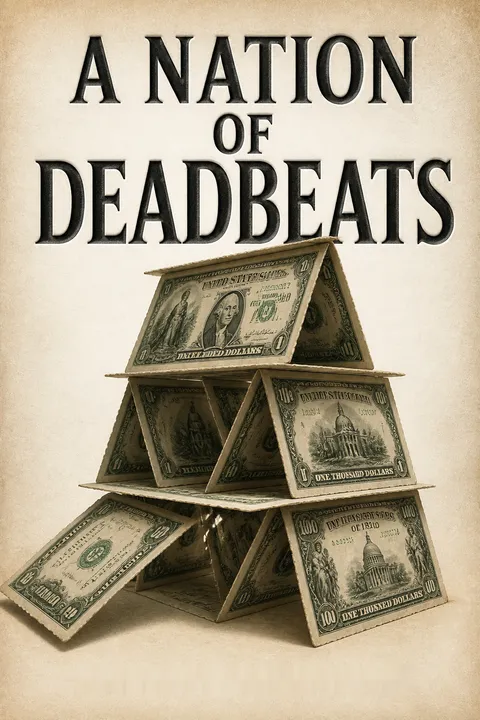
A Nation of Deadbeats examines America's financial panics from 1792 to 1929, revealing recurring patterns of asset bubbles, over-leveraging, and government intervention. Reviewers praise Nelson's chronological approach connecting economic crises to major political shifts, though some find the financial instruments complex and sourcing inadequate. The book illuminates overlooked panics (1792, 1819, 1837, 1857, 1873, 1893, 1907) that reshaped American history. Readers appreciate its accessibility and relevance to modern crises, though a few question the author's depth of economic understanding. Most consider it essential reading for understanding America's cyclical financial history.
People Also Read


Glossary
symbolic doubt
Loss of trust in promisesNelson’s term for the point when lenders, investors, or depositors stop believing that financial documents represent reliable value. A note, bond, or bank bill may continue to exist on paper, but uncertainty about who can pay makes holders demand cash or gold instead. When many institutions hold similar claims, that doubt can spread and contract credit.
crash politics
Politics reshaped by financial distressNelson’s name for the political effects of financial downturns. Crashes make economic hardship a public dispute over responsibility, weaken parties in power, and create openings for new leaders and coalitions. The results vary: financial anger can support reform, party realignment, or scapegoating and repression. It is a political pattern, not a guarantee of any single outcome.
money multiplier
Credit expanded beyond reservesThe process by which banks issue more notes or credit than the gold and silver held in their vaults. Banks assume that not every customer will demand reserves at once, so the same underlying reserve supports multiple claims. The arrangement expands lending in normal times, but simultaneous demands for payment can expose the gap between promises and available reserves.
caterpillar banks
Rapidly expanding state banksA critical nickname used in the book for the many state and regional banks that multiplied after the War of 1812. They issued local paper currency and extended credit that helped connect eastern wholesalers with western merchants and farmers. Some lent far beyond their specie reserves, so their notes could lose value and their failures could intensify financial contractions.
agency house
Merchant intermediary financing tradeA firm that operated as a financial intermediary for international commerce, especially in the cotton trade of the 1830s. American agency houses used credit supplied by British merchant firms to advance money to planters and factors, often against cotton expected to reach market. They could function much like banks while avoiding the same regulation and reserve requirements.
banker's acceptance
Bank-guaranteed trade paymentA short-term bill of exchange, denominated in dollars, that a member bank guarantees by marking it accepted. The bank remains responsible for payment even if the original borrower defaults. The Federal Reserve could purchase eligible acceptances at a discount, helping create a market for dollar credit and support American participation in international trade.
Download PDF
Download EPUB
.epub digital book format is ideal for reading ebooks on phones, tablets, and e-readers.








