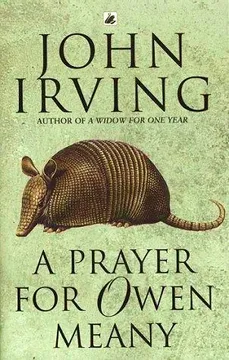


Plot Summary
The Boy They Lifted
Writing from Toronto as an Anglican, John Wheelwright1 credits his belief in God to Owen Meany,2 the tiny, granite-dusty boy2 with a permanently damaged voice. They meet as children in Gravesend, New Hampshire, where Sunday-school classmates lift Owen2 overhead to hear his furious protests. Owen2 never betrays them to their teacher, Mrs. Walker, and John1 slowly recognizes a strange dignity beneath the teasing.
Owen2 is precise about baseball cards, history, and rules, yet his own baseball body makes him an unlikely player. When John1 worries that his unknown father7 may be dead or indifferent, Owen2 insists that God knows the man’s identity. John1 does not believe him yet, but that assurance becomes the first crack in his disbelief.
The opening makes belief begin not with doctrine but with attention to a person whom everyone else treats as an object of amusement. Owen’s refusal to expose his tormentors resembles the martyrdom John will later use to understand him, though at first John participates in the cruelty. The promise about John’s father also establishes Owen’s unusual certainty: he speaks as if hidden facts are already settled, while John experiences them as painful absences. The narrator’s adult faith therefore grows from a friendship whose moral meaning he understands only gradually.
The Armadillo Arrives
John’s mother,3 Tabby Wheelwright,3 has raised him without naming his father.7 When she meets Dan Needham,4 a warm, gawky history teacher, Dan4 wins over six-year-old John1 by giving him a stuffed armadillo to protect.
After a long courtship, Dan4 marries Tabby,3 legally adopts John,1 and becomes the steady father4 John1 needs. Owen,2 whom Tabby3 often chauffeurs and affectionately touches, grows close to both of them.
John1’s north-country visits to Aunt Martha’s10 family bring roughhousing and an uneasy childhood attraction to his cousin Hester;5 Owen2 eventually joins the cousins and earns their respect by organizing a game around hiding himself. The armadillo becomes a shared treasure, a small, strange creature in which the boys invest more tenderness than they can say aloud.
The armadillo introduces the book’s habit of letting objects carry emotional knowledge that children cannot yet articulate. Dan’s gift makes affection tangible, while his adoption gives John a lived example of fatherhood that does not depend on biology. Tabby’s ease with Owen complicates the boundary between friend and family, and Owen’s entry into the Eastman cousins’ rough world shows his hunger for experience beyond the quarry. Hester’s early power over John is introduced as both play and danger, a tension their later relationship never entirely sheds.
An Angel in the Bedroom
During a night at Front Street, Owen2 wakes feverish and walks into Tabby’s3 room, where the dressmaker’s dummy beside her bed resembles an angel in the dim light. John1 follows and recognizes the dummy, but Owen2 insists that he saw a living presence moving through the room. Later, Harriet Wheelwright6 enters in a soaked nightgown after accidentally turning on a running tap; Owen2 screams, mistaking her for a ghost, and alarms the household.
John1 remembers the incident as a feverish misunderstanding. Owen2 instead treats it as a warning that he interrupted a divine messenger at work. From then on, ordinary accidents begin to look to him like parts of a design, and he resists any explanation that reduces them to chance.
The scene establishes the unstable border between perception and interpretation. Owen’s fever explains the apparition to John, but Owen converts the experience into a durable account of his place in the world. The dummy matters because it resembles Tabby without being alive, foreshadowing how representation, memory, and the supernatural will blur throughout the story. Harriet’s comic entrance becomes frightening through Owen’s response, showing that the meaning of an event can outlast its cause. His conviction offers purpose, but it also narrows the space in which he can doubt.
The Foul Ball
During a dull Little League game, John’s mother3 arrives and walks along the third-base line, looking toward the stands. With two outs, Owen2 comes to bat in John’s1 place. Usually instructed not to swing, he is told to hit away; the ball that finally meets his bat becomes a foul strike that crosses the field and hits Tabby3 at the temple.
She dies before John1 can reach her. Coach Chickering covers John’s1 head with his jacket, while Owen2 leaves with his bicycle and carries the ball away. Police Chief Pike immediately asks for the supposed murder weapon. John1 is left with grief, anger at his mother3 for never naming his father,7 and the knowledge that his best friend’s2 one great swing has ended a life.
The tragedy fuses the novel’s ordinary and theological registers in one brutally accidental instant. A child follows a coach’s instruction during a game everyone considers meaningless, and the result seems too disproportionate to accept as mere chance. John’s divided response is psychologically credible: he grieves Tabby while also resenting the unanswered question she left behind. Owen’s departure with the ball turns an object of play into evidence, relic, and burden. The scene also establishes the sound of a bat striking a ball as a lifelong trigger for both boys.
The Armadillo Mutilated
After Tabby’s3 funeral, Owen2 sends John1 his prized baseball-card collection, then drives back to the quarry. John1 and Dan4 understand that the cards are not a gift meant to be kept; they are Owen’s2 way of sharing what the accident has taken from both boys. John1 gives Owen2 the stuffed armadillo in return, hoping to receive it again.
Owen2 does return it, but he has removed its foreclaws. Dan4 helps John1 see that the damage expresses Owen’s2 sense that both of them have been maimed. The armless toy also recalls the mark of Watahantowet, the sagamore who sold the land that became Gravesend. John1 cannot yet grasp the full message, but the exchange makes grief visible.
The boys use exchange to communicate what their age and shock make unsayable. Owen gives up the collection that organized his private world; John risks losing the armadillo that joined his childhood to Dan. The missing claws are not random damage but a symbolic act that joins personal loss to the town’s older history of dispossession. John initially experiences the gesture as betrayal, because he wants the toy returned intact. Dan’s interpretation opens a more difficult possibility: friendship can include accepting an injury that cannot be repaired.
The Little Lord Jesus
At the first Christmas after Tabby’s3 death, Owen2 refuses the humiliating role of Announcing Angel and persuades the church to cast him as the infant Jesus. He rearranges the pageant, directs the other children, and finally condemns his parents8 for attending, forcing them to leave. That evening, while playing the Ghost of Christmas Yet to Come in Dan’s production, Owen2 sees his own full name on Scrooge’s grave and collapses.
He will not accept Dan’s4 explanation that fever and theatre have confused him. On the same Christmas Eve, Lydia dies at Front Street; John1 finds the frightened maid Germaine beside the body. Owen’s2 vision appears to have mistaken its subject, but he insists the grave showed his own name, not Lydia’s.
Owen’s theatrical authority becomes an unsettling rehearsal for the certainty he brings to real life. He treats the Nativity not as a charming pageant but as a sequence whose details must answer to scripture, and his parents’ presence exposes a private wound the congregation cannot understand. The grave vision creates a second kind of performance: Owen believes he has witnessed the ending of his own story. Lydia’s death encourages John to reinterpret the vision as a misreading, while Owen’s refusal preserves the possibility that the future has already made a claim on him.
The Voice Takes Over
At Gravesend Academy, John1 struggles with schoolwork while Owen2 becomes the anonymous, capital-lettered columnist known as The Voice. He attacks the school’s required church attendance, rigid dress code, compulsory athletics, and poor dining-hall food, including the Friday fish-only menu.
His arguments win students’ support and unsettle faculty who mistake criticism for disloyalty. Owen2 also defends struggling students against cruel mockery, drawing on his own experience of being treated as entertainment. Inspired by John F.
Kennedy’s inaugural appeal to public service, Owen2 briefly imagines a way to serve without becoming a cynic. He invites Hester5 to the senior dance, where she arrives confident and striking; their growing intimacy leaves John1 envious and unsure of what they share.
The Voice transforms Owen’s unusual speech from a source of ridicule into an instrument of public influence. His capital letters are not merely a gimmick: they make a marginalized student impossible to ignore in an institution that claims to educate while demanding conformity. Yet Owen’s criticism is not detached rebellion. He asks the school to live up to its own ideals, especially when it punishes vulnerability more readily than cruelty. Kennedy’s language gives him a model for service, while Hester’s attention exposes John’s dependence on Owen and his inability to read the emotional life unfolding between them.
The Lady in Red
While searching for his father,7 John1 and Owen2 trace the red dress that Tabby3 had claimed came from a store destroyed by fire. Owen2 recognizes the shop’s label and finds Jerrold’s still open in Boston. Its owners remember Tabby3 as a singer who performed Sinatra songs at a supper club called The Orange Grove, billed as the Lady in Red.3
Her voice teacher, Graham McSwiney, confirms that she studied with him and sang there, though he describes her as talented but unambitious. He recalls a black pianist, Buster Freebody, but dismisses him as an unlikely lover. The discovery unsettles John:1 the mother3 he thought he knew had kept a whole life from him, and her silence about his father7 now feels more complicated.
John’s search for his father unexpectedly becomes a search for his mother’s identity. The red dress had seemed a harmless eccentricity, but its false story reveals how carefully Tabby managed what her family could know. Her secrecy is not evidence that she was false in every respect; rather, it shows that her inner life exceeded the modest role Gravesend assigned her. Owen follows material clues with the same exactness he applies to baseball cards and history. John, by contrast, learns that knowing someone intimately does not mean possessing the whole story.
Mary Magdalene Removed
New headmaster Randolph White14 centralizes power, weakens faculty oversight, and promotes changes designed to impress trustees and alumni. Owen2 counters through The Voice, but White14 eventually takes control of the school paper.
When Owen’s2 fake draft cards are discovered, he admits creating them to help students buy alcohol, though he has stopped after deciding the cards are wrong. The Executive Committee expels him, and White14 spreads damaging claims that endanger his college prospects.
Before the school can dismiss him quietly, Owen2 steals the statue of Mary Magdalene from St. Michael’s, removes her head and arms, and bolts her to the academy stage. At morning meeting, the Rev. Lewis Merrill7 prays publicly for Owen2 while the headmaster’s14 authority falters.
White’s administration turns an argument about student responsibility into a contest over who controls the institution’s moral language. Owen has genuinely broken rules, but his expulsion also reflects White’s resentment of a student who refuses to be managed. The mutilated statue echoes the armadillo and Watahantowet’s armless mark, making the act both protest and personal signature. Owen’s public removal of Mary Magdalene forces the academy to look at the consequences of excluding him. Merrill’s prayer offers a fragile counterweight: a ritual the school cannot entirely control.
A Finger for Freedom
After Gravesend expels Owen,2 John1 and Owen2 attend the University of New Hampshire; Owen2 joins ROTC to finance his education and keeps asking for a combat assignment, despite John’s1 alarm. He believes a recurring vision shows him saving Vietnamese children, while John1 dismisses it as a dream.
When John1 receives notice for his draft physical, Owen2 prepares a sterile cutting station at the monument shop. He explains that the Army disqualifies a man missing the first joints of a trigger finger.
John1 agrees, and Owen2 uses the diamond wheel to amputate John’s1 right index finger. The injury protects John1 from induction, but it deepens the mystery of Owen’s2 conviction: he is willing to damage his closest friend to keep him out of a future he believes is coming.
The finger is both a practical escape from conscription and an extreme act of intimacy. Owen makes John’s decision for him in a way that violates ordinary friendship, yet John consents because he cannot find another path. The precision of the diamond wheel turns the quarry’s craft into an instrument of bodily fate. John’s loss also literalizes the book’s recurring images of amputated limbs, while his continued reluctance to believe Owen marks the distance between them. Owen’s visions create obligations for himself and, increasingly, consequences for everyone he loves.
The Children in Phoenix
Assigned to the Army’s casualty branch at Fort Huachuca, Owen2 escorts the bodies of soldiers home and continues seeking transfer to Vietnam. On a Phoenix trip with John,1 they meet the family of a dead warrant officer, including his furious teenage half brother, Dick, who wears jungle fatigues and carries weapons.
Dick slips into the airport’s temporary men’s room with a Chinese grenade. When he throws it, Owen2 recognizes the children nearby and orders them to lie down in Vietnamese.
John1 passes him the grenade, then lifts Owen2 high enough to wedge it against the room’s upper ledge. The blast kills Owen2 and severs both arms, but the children survive. His dream’s children were not in Vietnam; the act he believed awaited him happens in Arizona.
The climax brings the novel’s repeated images into one physical act: the lift, the shot, Owen’s hands, and the children he has promised himself to save. His military assignment places him among casualties rather than combat, yet the violence he encounters is not a conventional battlefield. John’s lift completes the practice they have repeated since boyhood, now with consequences no game could contain. The Vietnamese children make Owen’s private vision concrete while challenging its geography. His heroism is not a victory over war; it is a single rescue inside a system that keeps producing the conditions for death.
The Baseball Returns
At Owen’s2 funeral, John’s father,7 Pastor Merrill,7 speaks with a conviction absent from his earlier sermons. Soon after, Owen’s voice guides John1 to the third drawer of Merrill’s7 desk, where the missing baseball has been hidden. Merrill7 confesses that he is John’s biological father7 and that he once prayed for Tabby3 to die; John’s mother3 had known his identity and chose not to tell him.
John1 stages a final encounter by placing Tabby’s3 headless dressmaker’s dummy in the churchyard, where Merrill7 mistakes it for her apparition and reveals his guilt. John1 disposes of the ball, the dummy, and Mary Magdalene’s arms in the sea. He leaves the United States, builds a life in Toronto, and keeps returning to Owen2 through prayer, teaching, and memory.
The resolution answers the mystery of John’s parentage without granting the comfort of a hidden, ideal father. Merrill’s identity explains Tabby’s silence, but his confession also exposes the self-centeredness behind his remorse. John’s use of the dummy turns grief into a deliberate confrontation, while throwing the ball and the stolen arms into the sea releases objects that have carried guilt for years. His departure for Canada is not a clean escape from history: he remains a teacher and a believer shaped by Owen, still wrestling with whether the pattern he sees is divine or human.
Analysis
The novel makes a private friendship carry the weight of public history. John1’s memories move between a New Hampshire childhood, the Vietnam years, and his life in Canada, showing how political violence enters ordinary places: a Little League field, a school newspaper, an Army office, a family’s funeral. Owen2’s faith is not presented as a tidy answer to suffering. It gives him a language for purpose, but it also drives him toward choices that frighten the people who love him. John1’s skepticism is equally incomplete; he distrusts certainty, yet depends on Owen2 to interpret the events he cannot bear to understand alone.
The book repeatedly turns objects into arguments. The ball joins accident to guilt; the armadillo and Mary Magdalene make bodily loss visible; the dressmaker’s dummy preserves a mother’s3 shape after her death. These things do not prove a supernatural design, but they make denial difficult. The recurring question is not simply whether Owen2 predicts the future. It is whether people can act responsibly when they cannot know what their actions mean.
Institutions claim to offer order, whether churches, schools, the Army, or the government. Yet each can abandon the vulnerable while preserving its own authority. Owen2’s criticism of Gravesend and of American policy comes from the same demand: institutions must answer for the lives they shape. His final rescue cannot redeem the war or restore John1’s family, but it gives one moment of meaning to people otherwise treated as expendable. John1’s life in Canada is no clean escape; his teaching and religious practice keep him in conversation with Owen2’s memory, where doubt remains part of belief rather than its opposite.
Review Summary
A Prayer for Owen Meany receives overwhelmingly positive reviews, averaging 4.24/5 stars. Readers consistently praise Irving's vivid characterization, particularly the unforgettable Owen Meany, whose unwavering faith, small stature, and distinctive capitalized voice leave lasting impressions. The novel's themes of fate, destiny, and faith resonate deeply, with many calling it a life-changing read. Critics note the slow pacing and lengthy political tangents as weaknesses, while the masterfully constructed ending is widely celebrated for its emotional power and narrative payoff.
People Also Read








Characters
John Wheelwright
Owen’s witnessing friendJohn is the retrospective narrator, a New Englander who becomes an Anglican schoolteacher in Toronto. He is observant but slow to interpret what he sees, often relying on Owen’s2 intelligence to make sense of school, literature, and the world. His deepest early wound is not knowing who his father7 is, though Dan’s4 steady affection gives him a secure experience of family. John’s humor and self-doubt keep him from becoming a simple believer or a simple skeptic. He often resists Owen’s2 certainty, yet his loyalty draws him into decisions he does not fully understand. As a teacher, he tries to pass on the attention and patience Owen2 once gave him.
Owen Meany
The unlikely prophetOwen is a physically tiny, intensely disciplined boy whose damaged voice forces him to speak in a piercing, unmistakable register. The Meany family’s8 granite business shapes his practical knowledge, while his reading, memory, and confidence set him apart from his peers. He values exactness, rules, and purpose, and he resents being treated as cute or comic. His friendship with John1 combines fierce loyalty with a capacity to make decisions for him. Owen’s faith is absolute but not uncomplicated: he challenges churches, institutions, and political leaders when their actions contradict their professed beliefs. He is drawn to service and responsibility, even when those commitments frighten the people closest to him.
Tabitha Wheelwright
John’s beloved motherTabby is John’s1 beautiful, affectionate mother, remembered through the warmth of her touch, her singing, and her easy welcome to Owen2. She appears gentle and modest, yet she quietly makes important choices: keeping her independence, pursuing voice lessons, and protecting her privacy. Her family often mistakes her calmness for simplicity, but she is more self-directed than they realize. Tabby gives John1 a childhood filled with attention and gives Owen2 a tenderness he rarely finds elsewhere. Her refusal to explain every part of her past leaves John1 with a lasting mystery, but it also reflects her desire to control what belongs to her.
Dan Needham
John’s chosen fatherDan is a history teacher, theater director, and the adult who becomes John’s1 dependable father. Tall, awkward, and generous, he understands young people as people rather than as problems to be managed. His amateur productions give Gravesend a shared imaginative life, and his home offers John1 a refuge after loss. Dan is patient with Owen’s2 intensity and recognizes the intelligence behind his strange behavior. His confidence in education sometimes blinds him to institutional failure, but his personal loyalty does not. He offers John1 affection without demanding that the boy erase his unknown origins7.
Hester Eastman
The defiant cousinHester is John’s1 cousin, an athletic and forceful girl raised among two competitive brothers12. She resents being treated as less worthy of opportunity because she is a girl, and she answers family expectations with provocation, independence, and blunt speech. Her attraction to Owen2 develops alongside her anger at the world that confines both of them, though she expresses that anger more openly. Hester’s musical talent and social boldness promise a life beyond Sawyer Depot, but she distrusts easy promises and conventional respectability. Her humor can be abrasive, yet beneath it lies a fierce capacity for attachment.
Harriet Wheelwright
The formidable grandmotherHarriet is John’s1 wealthy, exacting grandmother and the commanding figure of the Wheelwright household. She trusts manners, history, and practical judgment, while distrusting anything she considers vulgar or wasteful. Her standards can make her formidable, but she is not without tenderness: she gives John1 a stable home and helps Owen2 pursue opportunities unavailable to his family. She is a sharp observer of people, a devoted gardener, and eventually an enthusiastic critic of television. Her affection is often expressed through provision and instruction rather than softness, but she is an important anchor for both boys.
Lewis Merrill
The doubting pastorLewis Merrill is Gravesend’s Congregational minister, a thoughtful man whose education and self-questioning distinguish him from more confident preachers. He believes doubt belongs within faith, and his sermons make religious uncertainty speakable. A slight stutter and a troubled family life contribute to his anxious manner, but he listens seriously to Owen2 and finds unexpected energy in their arguments. Merrill’s sympathy for intellectual struggle makes him an important counterpoint to Owen’s2 certainty. He is neither a commanding authority nor a simple skeptic; he keeps trying to reconcile faith with the evidence of suffering.
Paul Meany
Owen’s granite-working fatherKnown to most people as Mr. Meany, he runs a struggling granite quarry and monument shop. He is taciturn, proud of his working-class independence, and wary of institutions that look down on quarrymen. His parenting is emotionally distant, yet he gives Owen2 access to the practical skills and responsibilities of the family trade. He respects Owen’s2 wishes more than he lets on, particularly when education and work pull the boy in different directions. The quarry’s noise, danger, and dust form the physical world Owen2 learns to master.
Mrs. Meany
Owen’s secluded motherOwen’s2 mother lives behind closed windows in a house clouded by quarry dust. She rarely speaks to visitors and appears absorbed in private fears, leaving others unsure how much of the outside world she can bear. Her isolation shapes the mystery surrounding the Meany household8 and contributes to Owen’s2 sense that his family has suffered a wrong no one else understands. The few moments when she turns her attention outward carry unusual weight because they break a long habit of withdrawal.
Aunt Martha Wheelwright Eastman
John’s protective auntMartha is Tabby’s3 older sister, married to lumberman Alfred Eastman11 and mother to Noah12, Simon13, and Hester5. She is warm and capable, but she shares the family’s confidence in social convention and sometimes misunderstands Tabby’s3 independence. She welcomes John1 to Sawyer Depot and loves her children, though her unequal expectations of Hester5 create lasting friction. Martha’s home gives John1 a livelier, rougher counterworld to Front Street, full of outdoor work, sports, and family noise.
Alfred Eastman
The lumberman uncleAlfred is Martha’s10 husband and a successful lumberman whose strength, money, and practical confidence shape the Eastman household. He is a generous uncle to John1 and a spirited presence around his children, though his hopes for his sons reflect the conventional ambitions of their community. His work offers a contrast to the Meany8 quarry: trees, sawmills, and lumber replace stone, blasting, and monuments. Alfred’s good humor makes the north country welcoming even when its rough games overwhelm John1.
Noah Eastman
The eldest cousinNoah is John’s1 older cousin and the eldest of the three Eastman children. He is a confident skier, an outdoorsman, and a considerate older brother, though he can join Simon13 in turning childhood games into tests of nerve. Noah’s later choices take him far from Sawyer Depot, reflecting a wish to see more of the world than the family business offers. He remains affectionate toward John1 and protective of Hester5, even when he fails to understand the depth of her resentment.
Simon Eastman
The reckless cousinSimon is John’s1 cousin and Noah’s12 younger brother, known for energy, risk-taking, and a taste for rough physical contests. He treats falling and getting back up as part of the fun, which makes him both exciting and alarming to the more cautious John1. Simon’s teasing can be cruel, especially when it concerns Hester5, but his family loyalty is real. His humor and daredevil habits make him a vivid part of John’s1 north-country childhood.
Randolph White
The decision-making headmasterWhite arrives at Gravesend Academy with a businessman’s confidence and a belief that strong administrators should make decisions quickly. He wants to modernize the school and strengthen its finances, but he repeatedly treats disagreement as a challenge to his authority. His practical language masks an appetite for control, especially when student criticism embarrasses him. White’s conflict with Owen2 reveals how an institution’s claim to educate can coexist with a refusal to tolerate independent judgment.
Randy White’s successor, Archibald Thorndike
The old-school headmasterArchie Thorndike is Gravesend’s longtime headmaster before Randolph White14. A genial outdoorsman and alumnus favorite, he is more comfortable with the school’s traditions than with changing them. He understands that bright students must be allowed to criticize the institution, even when he has no intention of changing everything they attack. His personal warmth gives him influence that is less formal but more durable than administrative power.
Father Findley
The Catholic priestFather Findley serves St. Michael’s Church and school. He is patient with Owen2 despite the damage done to the statue of Mary Magdalene, and he is willing to help rather than retaliate. His response shows that religious authority can be humane without being naïve. Owen’s2 uneasy conversations with him reveal how deeply the Meany family’s8 old conflict with Catholicism still shapes the boy’s view of faith.
Major Rawls
The blunt Army mentorRawls is an Army major at Fort Huachuca and a former combat officer who manages Owen’s2 work in the casualty branch. He speaks harshly and distrusts easy patriotic explanations, but his bluntness comes with experience and a hard-earned skepticism about war. He recognizes Owen’s2 ability to comfort bereaved families, even as he questions the boy’s desire for combat. His presence gives John1 a direct view of the military world Owen2 enters.
Mr. Fish
The devoted amateur actorMr. Fish is John’s1 neighbor, Sagamore’s owner, and a regular performer in Dan’s community plays. He takes amateur theater seriously, sometimes to comic effect, and brings a kind of earnest persistence to every role. His affection for Owen2 grows from years of watching the boy surprise and unsettle audiences. Mr. Fish represents Gravesend’s ordinary neighborliness: imperfect, habitual, and often more generous than the town’s sharper judgments.
Harry Hoyt
The unlucky Little LeaguerHarry is the quiet Little League player whose walk to first base helps bring Owen2 to the plate on the day Tabby3 is killed. He is not a star athlete, but he follows the game and takes his turn without drama. John1 later remembers how an ordinary play can become entangled with consequences no child could foresee.
Buzzy Thurston
The unreliable shortstopBuzzy is the Little League player whose routine ground ball is mishandled, extending the inning before Owen2 bats. He grows into a capable but unremarkable athlete, and later struggles with the pressures surrounding the Vietnam draft. His place in John’s1 memory illustrates how a small error can become inseparable from a life-changing event.
Plot Devices
The Foul Ball
Accident turned evidenceOwen’s2 foul ball kills Tabby3 during an ordinary Little League game. Chief Pike treats the missing ball as a murder weapon, while John1 and Owen2 privately make it a symbol of guilt, love, and the question of whether chance can be distinguished from divine purpose. Its later return through Owen’s voice allows John1 to identify his biological father7. The ball ties a childhood accident to the final revelation without resolving whether Owen’s2 knowledge came from God, instinct, or something the novel refuses to name.
The Armadillo
Grief made tangibleDan4 gives John1 a stuffed armadillo as a child, and both John1 and Owen2 become attached to it. After Tabby’s3 death, Owen2 returns the toy without its foreclaws, transforming a beloved plaything into a sign of shared injury and recalling the armless mark of Watahantowet. The armadillo connects domestic affection, Indigenous history, and the boys’ attempts to communicate grief without speech. Its mutilation also anticipates the book’s recurring concern with bodies altered by forces that exceed individual control.
Owen’s Voice
The sound of authorityOwen’s2 damaged vocal cords give him a high, strangled voice that makes classmates laugh and makes strangers stop. He refuses corrective treatment because he believes his voice has a purpose. At school, his written columns turn that same force into public criticism; later, John1 recognizes the voice as a presence that continues to guide him. The voice links bodily difference to moral authority, while leaving open whether its power is psychological, spiritual, or both.
The Stage and Roles
Performance exposes truthDan’s4 community productions repeatedly let Owen2 occupy roles that seem to exceed their theatrical purpose. As the infant Jesus, he directs the Nativity; as the Ghost of Christmas Yet to Come, he terrifies the cast and sees his own name on a grave. The theater also teaches John1 how an audience reveals itself through its reactions. Performance becomes a rehearsal space for belief, authority, and fear, but the novel never lets the reader dismiss Owen’s2 visions as only acting.
The Diary and Dream
A forecast without certaintyOwen’s2 diary records his belief that he knows his death, his purpose, and eventually the scene in which he will save children. The dream supplies images rather than a complete explanation: an explosion, Vietnamese children, a nun, blood, and ascent. Its details guide Owen’s2 choices but do not give him control over events. By placing the dream beside political history and practical Army paperwork, the book preserves an uneasy question: is Owen2 receiving prophecy, or using faith to make unbearable uncertainty livable?
Download PDF
Download EPUB
.epub digital book format is ideal for reading ebooks on phones, tablets, and e-readers.








