

Key Takeaways
Treat your future as a branching probability, not a destiny.
A metaphor, not a promise. Oluseyi grew up moving among dangerous neighborhoods, with violence, hunger, and unstable housing shaping what futures seemed possible. He uses quantum tunneling, a real phenomenon in which a particle sometimes crosses a barrier it would ordinarily be unable to pass, as a metaphor for his improbable route from the street to astrophysics. His life, he argues, was not prewritten: at many points, a different turn could have ended the journey.
Chance needs a path. The physics analogy is evocative, but it is not evidence that imagining a goal makes it attainable. His story also depends on teachers, books, family ties, and research opportunities. Possibility matters most when people and institutions help turn it into a route.
What's powerful here is the refusal to confuse a low probability with a predetermined outcome. That distinction resembles decision theory, where an unlikely event can still be worth pursuing if its value is high and there are steps that improve its odds. The metaphor also has a limit: quantum tunneling is not a model for human choice, and an exceptional success story cannot show that everyone can overcome the same barriers. The narrative works best as a case for keeping futures open while taking material obstacles seriously.
Feed curiosity with books when your school cannot keep pace.
Reading widened the map. As a child, Oluseyi moved repeatedly and often had little to read. He devoured the books he could find, including Greek myths, histories, and the novel Roots. In a Ninth Ward stairwell, an encyclopedia entry on Einstein introduced him to relativity and the idea that space and time are connected. That encounter made physics feel less like a school subject than a way to investigate reality.
Curiosity became practice. Later, he taught himself BASIC programming and built a computer model of special relativity for a science fair. The habit began with counting and taking apart objects, but books gave those instincts vocabulary and direction. Self-education opened doors, though it did not replace the instruction and preparation he would need in college.
The memoir makes literacy feel like intellectual mobility: a book can carry a child beyond the immediate limits of a neighborhood without pretending those limits have vanished. This connects to the idea of prior knowledge in learning science. New material becomes usable when a learner can attach it to existing interests, as physics did to Oluseyi's love of puzzles and hidden mechanisms. Still, self-teaching is uneven access, not an adequate substitute for schools. A student should not need extraordinary persistence to encounter a functioning library or a capable science teacher.
Find people who protect your curiosity before it pays off.
Protection made room. Oluseyi's older sister Bridgette dressed, fed, and watched over him through years of family instability. His friend Darin became another source of safety, stepping between him and bullies and treating his intelligence as something to share rather than mock. Their friendship gave the bookish child a place to be competitive, imaginative, and smart without having to perform toughness every minute.
Support comes in forms. Teachers who encouraged his academic ability, and adults who gave him books or meaningful work, also helped keep his interests alive. None erased poverty or danger. Their importance was more immediate: they made it possible for curiosity to survive those conditions. Encouragement mattered because it was paired with protection, access, and attention.
The important unit here is not praise but dependable attention. Developmental research often distinguishes a supportive relationship from a vague message that a child is talented: the relationship supplies safety, feedback, and chances to practice. Bridgette's care and Darin's defense are not interchangeable with school resources, but each reduces the cost of being different. The account also resists a tidy rescue narrative. One loyal friend cannot repair unstable housing or violence, yet the absence of even one ally can leave a young person to manage those burdens alone.
Giftedness can outrun a school system, but preparation still matters.
Ability met weak instruction. Oluseyi advanced through academic tracks at a Mississippi elementary school where Black students were concentrated in lower levels. He moved to the top track by completing the assigned work, yet later attended schools with serious educational shortcomings. A school psychologist measured his IQ at 162, but the score did not supply missing coursework or teach him how college operated.
Potential is not preparation. At Tougaloo, he was surprised by lectures, note-taking, and peers whose writing and academic habits were stronger than his. His first grades fell. The contrast shows two truths at once: he had real aptitude, and earlier success had been measured against low expectations. A label such as gifted can identify promise, but it cannot substitute for rigorous teaching and a bridge to the next level.
This distinction is crucial in debates about merit. A test score may identify a capacity, but performance also reflects accumulated instruction, academic norms, and access to support. Oluseyi's transition from high-school star to struggling college student illustrates how institutions can mistake unequal preparation for unequal potential. At the same time, the story does not make aptitude irrelevant. The sharper lesson is that ability is not a finished product: schools have a responsibility to cultivate it, and students need explicit instruction in the practices advanced study assumes.
Give restless talent a craft with rules, practice, and an audience.
Music redirected momentum. In middle school, Oluseyi was skipping football practice and disrupting class. Vice principal Mr. Jones brought him to band director Mr. Cross, who started him on a tuba mouthpiece and demanded daily practice and attention to timing. Oluseyi soon found that the instrument's deep, physical sound suited him. He learned music, joined stronger bands, and began arranging performances.
Discipline became usable. Mr. Cross defined discipline as training that makes punishment unnecessary. The lesson was not simply to obey. Repeated practice gave Oluseyi a way to turn energy into skill, and an ensemble gave that skill a public purpose. The same appetite for detail and sustained work later served him in research. Talent did not disappear; it acquired a structure.
A demanding craft can provide what abstract warnings cannot: immediate feedback, visible progress, and membership in a group with shared standards. This resembles deliberate practice, where focused repetition targets specific skills rather than relying on effort alone. The tuba also offered a socially valued identity that could compete with the tough persona he had built for protection. Yet discipline is not a cure-all. Its benefits depend on a mentor who notices the student, chooses a fitting challenge, and supplies instruction rather than merely punishment.
Ask for help early; hard problems reward collaboration, not lone brilliance.
Isolation cost him ground. At Tougaloo, Oluseyi skipped lectures and struggled to adapt to college expectations. At Stanford, he initially responded to unhelpful classmates by deciding to study alone. His results worsened despite long hours. He began to recover academically when Paul Estrada and Gavin Polhemus formed a study group with him, each bringing a different approach to physics problems.
Explaining builds mastery. The three met regularly, worked through problem sets, and compared ways of solving them. Oluseyi discovered that he could often see a problem's route intuitively, while his friends supplied other strengths. A later tutor, Daveed, made him explain chapters and complete every problem. The work improved because knowledge became something tested aloud, questioned, and shared.
Collaboration is not merely emotional support. It exposes hidden assumptions, gives learners multiple representations of a problem, and turns vague confusion into questions that can be answered. Oluseyi's experience also shows how competitive academic cultures can make collaboration feel risky, especially to someone already marked as an outsider. Not every group is generous or effective, so the advice is not to join any study circle blindly. It is to seek peers who exchange reasoning, challenge one another, and treat questions as part of the work.
Treat addiction as requiring honest support, not private willpower.
The habit took over. After heartbreak, academic setbacks, and family crises, Oluseyi began smoking crack cocaine. He and his friend JG planned to sell it, but repeatedly used their supply instead. The drug binges damaged their studies, finances, and safety. In California, Oluseyi returned to crack while balancing research, marriage, and impending fatherhood, hiding the relapse from his wife and mentor.
Disclosure changed the conditions. After being robbed at gunpoint, he told his labmate, then his advisor Art Walker and his wife Jessica. Jessica helped him enter an outpatient recovery program. In group sessions, he heard others describe how substance use stripped away dignity and brought consequences, not lasting relief. That recognition became a tool for resisting cravings. His recovery was supported by treatment and relationships, not a sudden triumph of will.
The memoir counters the moral story that addiction is simply a failure of character. It portrays craving as powerful, recurrent, and entangled with grief, secrecy, and access. That account aligns with contemporary models of addiction as a disorder involving reward, stress, and learned cues, while preserving personal responsibility for seeking help and protecting others. One person's recovery strategy cannot be universalized, and the narrative does not offer clinical guidance. Its useful contribution is narrower: secrecy feeds the private bargaining that keeps harmful behavior intact, while trusted support can interrupt it.
Make evidence outrank pride, especially when your assumptions feel certain.
Science demanded checking. At Stanford, Oluseyi joined Art Walker's solar physics group, which used rocket-launched telescopes to image the sun's corona in extreme ultraviolet and soft X-ray light. The images challenged established expectations, so Walker's team had to calibrate instruments, quantify observations, and answer skeptical colleagues with data rather than confidence alone. Oluseyi learned that a striking picture was not enough; its interpretation had to survive measurement and scrutiny.
Belief is not knowledge. Walker regularly asked whether a claim was known or merely believed. That question became a habit of scientific self-correction. It also applied to the researcher: assumptions about what a result should show can distort what the evidence actually says. Intellectual confidence is useful in a field that challenges outsiders, but confidence cannot replace verification.
This is the memoir's strongest account of science as a moral practice. Instruments extend perception, but calibration and interpretation determine whether the new view is reliable. The same discipline appears in good historical and legal reasoning: separate observation from inference, then make the inference answerable to others. There is a tension worth keeping visible. Skepticism is essential, yet skepticism applied selectively can become a gatekeeping tool, as when unconventional findings are doubted more intensely than familiar ones. Evidence standards should be rigorous and consistently applied.
Persist through biased gates without mistaking them for measures of ability.
The gate was not neutral. Oluseyi entered Stanford underprepared compared with classmates from elite institutions and faced academic isolation as one of few Black physics students. After he failed a qualifying exam, he was told to leave, transfer, or try again. Daveed, a student representative on the committee, told him he had passed the hardest sections but that the grading threshold had been shifted. His advisor Art defended his right to continue.
Work and identity both mattered. With intensive tutoring, Oluseyi passed the next exam, published research, and earned his PhD. Near graduation, he chose the name Hakeem Muata Oluseyi to claim an African heritage and a self-defined identity. The memoir presents achievement not as proof that barriers were imaginary, but as work done within them.
The story distinguishes evaluation from legitimacy. A qualification exam can measure knowledge, but procedures and discretion determine whether the measure is applied fairly. The account is especially pointed because Oluseyi's distinct reasoning style made anonymous work recognizable to faculty, according to his student advocate. A memoir cannot establish the prevalence of such practices across a whole field, but it can show how exclusion is experienced and contested. Persistence is valuable here, though responsibility for fair standards belongs to institutions, not only to the person forced to clear them.
Turn hard-won access into a ladder others can climb.
Representation became instruction. After earning his doctorate, Oluseyi taught and mentored Black and Latino students, including aspiring astronomers in South Africa. The students had entered an elite program from schools that had been denied equal resources, and many struggled with its honors exam. Rather than limit teaching to the imminent test, he taught advanced subjects such as cosmology and quantum field theory, aiming to help students see themselves as capable of mastering difficult science.
The results were concrete. Every student in that group passed the honors exam, and all scored in the top 20 percent. The program helped increase Black participation in South African astronomy. Oluseyi's point is not that inspiration alone fixes unequal education. High expectations worked alongside teaching, mentorship, and a role model who understood the distance between under-resourced schooling and elite science.
The ending reframes success as a transfer of capacity. A scientist's influence extends beyond publications when expertise is converted into curriculum, mentorship, and a wider sense of who belongs in the field. Teaching ambitious material can communicate respect rather than lowered expectations, provided students also receive the scaffolding to learn it. The reported exam results are striking, but a single cohort cannot isolate which part of the program produced them. The broader case remains persuasive: access improves when institutions invest in both high standards and the support required to meet them.
Analysis
A Quantum Life is best understood not as a simple tale of escape, but as a memoir about how ability becomes achievement only through changing conditions. Oluseyi's childhood supplies the book's central contrast: the same mind that counts coins, solves puzzles, and takes apart appliances must also navigate hunger, violence, unstable housing, and adults whose own hardships spill onto children. Curiosity is innate in the story, but its survival is social. Bridgette, Darin, teachers, band director Mr. Cross, and scientific mentors each make a different kind of future more imaginable.
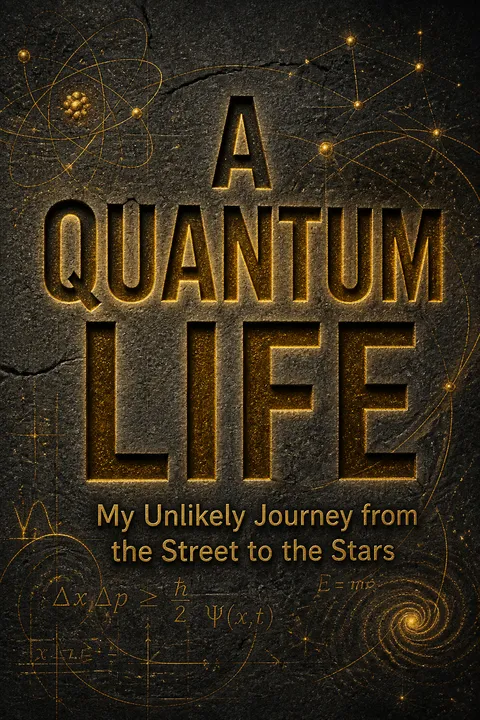
The quantum metaphor gives the memoir a memorable architecture. A life is not fixed by its starting point; it can branch. Yet the book is careful, if implicitly, about the limits of that metaphor. Quantum tunneling does not mean that desire overcomes any barrier, and Oluseyi's achievements cannot be separated from access to books, educational programs, research placements, treatment, and mentors willing to sponsor him. His trajectory is remarkable partly because many of those supports arrived by chance, while other institutions actively failed him.
The narrative's most revealing reversals concern identity and competence. At school, being smart can isolate him. At Tougaloo, intelligence does not spare him from being academically unprepared. At Stanford, hours of solitary effort are not enough until he learns with peers. In research, intuition becomes valuable only when disciplined by measurement, collaboration, and evidence. These turns complicate the familiar claim that exceptional talent simply rises.
The account also refuses a clean redemption arc. Crack use recurs, family relationships remain painful, and professional achievement cannot undo childhood harm. That messiness strengthens the book's argument: success is not proof that suffering was useful or deserved. The most transferable lesson is institutional as well as personal. People need more than belief in their own potential. They need environments that teach, recognize, and support it, and they can help create those environments for others once they gain access.
Review Summary
A Quantum Life is a compelling memoir that chronicles Hakeem Oluseyi's journey from poverty and adversity to becoming an astrophysicist. Readers praise the author's honesty, resilience, and inspirational story. The book offers insights into systemic racism, educational inequalities, and the power of mentorship. While some found the writing style straightforward, most were captivated by Oluseyi's remarkable life experiences. Reviewers appreciate the book's raw depiction of struggles with addiction and academic challenges. Overall, it's highly recommended as an engaging and thought-provoking read.


Glossary
Quantum tunneling
Particles crossing barriersA quantum-mechanical effect in which a particle has a nonzero probability of passing through an energy barrier, even when classical physics would predict that it cannot. Oluseyi uses tunneling as a metaphor for an unlikely life path through severe obstacles. The metaphor does not mean that human ambition literally follows the laws governing subatomic particles.
dark vision
Reading danger in surroundingsOluseyi's name for the heightened attention to threats that he developed while growing up in dangerous neighborhoods. It meant noticing signs of possible violence, drug activity, or police presence. The term describes a survival adaptation, not a supernatural ability, and reflects how constant danger trained his attention toward risk.
time dilation
Different observers measure time differentlyIn special relativity, observers moving relative to one another can measure different elapsed times between events. The effect becomes significant at speeds close to the speed of light. As a child, Oluseyi first encountered the concept through an encyclopedia article about Einstein and tried to explore it with a skateboard and a tossed rock.
spacetime
A unified space-time frameworkThe four-dimensional framework of three dimensions of space and one of time used in relativity. Different observers can disagree about measurements of distance and duration, while certain combined quantities remain invariant. The concept captivated Oluseyi as a child and became an early bridge between his imagination and formal physics.
BOOST
Navy officer-preparation programThe Navy's Broadened Opportunity for Officer Selection and Training program. It offered academic and military preparation to enlisted personnel, including people from communities with weaker schooling, with a possible route to Navy ROTC and college. Oluseyi entered the program after a recruiter noticed his aptitude, but a medical diagnosis ended his Navy service.
hundred-percenter
A person consumed by drug useA street term in the memoir for someone whose life has become dominated by obtaining and using crack cocaine. Oluseyi uses it for people who lose work, relationships, possessions, and safety to the drug. It conveys the totalizing character of addiction in the environments he describes, rather than serving as a clinical diagnosis.
MSSTA
Rocket-borne solar telescope arrayThe Multi-Spectral Solar Telescope Array, a research payload designed by Art Walker's group to image the sun in extreme ultraviolet and soft X-ray wavelengths. Because Earth's atmosphere absorbs much of this light, the telescopes flew on sounding rockets above the atmosphere. Oluseyi helped build the payload's truss and analyze the resulting solar images.
qualifying exams
Doctoral progress examinationsComprehensive examinations graduate students take to demonstrate command of the material required for doctoral research. At Stanford, passing the physics qualifying exams was necessary before beginning a PhD thesis. Oluseyi's experience reveals both their academic demands and the role that exam rules and faculty judgment can play in a student's progress.
FAQ
What's A Quantum Life: My Unlikely Journey from the Street to the Stars about?
- Personal Transformation: The book chronicles Hakeem Oluseyi's journey from a troubled childhood in New Orleans to becoming a renowned physicist at NASA. It highlights his struggles with poverty, addiction, and systemic racism.
- Themes of Resilience: Oluseyi's story emphasizes resilience and the power of imagination, showing how he overcame significant obstacles to achieve success.
- Scientific Exploration: The narrative includes his academic journey and contributions to astrophysics, particularly in solar physics and the universe.
Why should I read A Quantum Life by Hakeem Oluseyi?
- Inspiring Journey: Oluseyi's transformation from the streets to a successful career in science is a testament to the human spirit's ability to overcome adversity.
- Educational Insights: The book provides accessible insights into complex scientific concepts and the challenges faced by Black scientists in academia.
- Cultural Reflection: It offers a candid look at the challenges faced by Black individuals in America, emphasizing the importance of representation in STEM fields.
What are the key takeaways of A Quantum Life?
- Possibility of Change: Oluseyi's life exemplifies that change is possible with hard work and perseverance, regardless of one's circumstances.
- Value of Education: The memoir underscores the transformative power of education and mentorship in achieving one's goals.
- Embracing Identity: Oluseyi encourages readers to embrace their identities and experiences, using them as fuel for their ambitions.
What are the best quotes from A Quantum Life and what do they mean?
- “I must seek in the stars what was denied to me on earth.” This quote reflects Oluseyi's aspiration for a better life and his determination to reach for the stars.
- “I’ve learned that no matter how unlikely, anything you imagine for yourself is within the realm of possibility.” It emphasizes the power of imagination and belief in oneself.
- “My life has been an oscillating pattern of passing through walls.” This metaphor illustrates the challenges Oluseyi faced and his resilience in overcoming them.
How did Hakeem Oluseyi's childhood challenges shape his journey?
- Family Turmoil: His childhood was marked by family instability, including domestic violence and his parents' tumultuous relationship.
- Poverty and Violence: Growing up in the ghettos of New Orleans, he faced poverty and street violence, which shaped his worldview.
- Struggles with Identity: Oluseyi grappled with his identity as a "nerdy" kid in a tough environment, influencing his journey toward self-acceptance.
How did education impact Hakeem Oluseyi's life?
- Mentorship and Support: Teachers and mentors recognized his potential and encouraged his interest in science, playing a crucial role in his success.
- Access to Opportunities: Education opened doors for Oluseyi, allowing him to attend prestigious institutions and work at NASA.
- Transformative Power: The memoir illustrates how education can transform lives, especially for those from disadvantaged backgrounds.
What role did family play in Hakeem Oluseyi's journey?
- Complex Relationships: His relationships with family were marked by love, conflict, and disappointment, impacting his upbringing.
- Support and Sacrifice: Despite challenges, family members provided support and encouragement at various points in his life.
- Motivation for Change: The dysfunction in his family motivated Oluseyi to seek a different path and create a better future.
How does A Quantum Life relate to quantum mechanics?
- Quantum Tunneling Metaphor: Oluseyi uses this concept to illustrate how unlikely outcomes can occur in life, paralleling his own experiences.
- Uncertainty Principle: The memoir reflects life's unpredictability, similar to the uncertainty principle in quantum mechanics.
- Interconnectedness of Experiences: He draws parallels between quantum physics and the relationships and experiences that shape our lives.
What role does addiction play in Hakeem Oluseyi's story?
- Struggle with Substance Abuse: Oluseyi candidly discusses his battles with crack cocaine and its impact on his life.
- Path to Recovery: The book details his journey through rehab and the importance of seeking help and support.
- Impact on Relationships: His addiction strained relationships with family and friends, emphasizing the need for accountability.
How does mentorship shape Hakeem Oluseyi's career?
- Influential Figures: Mentors like Art Walker played a pivotal role in his academic journey, providing guidance and support.
- Building Confidence: Mentorship helped Oluseyi gain confidence in his abilities and overcome self-doubt.
- Paying It Forward: His experiences motivated him to mentor others, particularly students from underrepresented backgrounds.
How does A Quantum Life address the theme of identity?
- Cultural Heritage: Oluseyi explores his African heritage and the significance of embracing his roots.
- Duality of Experience: The book highlights the tension between his upbringing and his aspirations in academia.
- Empowerment through Knowledge: By pursuing education, Oluseyi reclaims his identity and empowers himself.
How does Hakeem Oluseyi's story inspire others?
- Resilience and Hope: His journey from the streets to academia serves as a reminder that change is possible.
- Breaking Barriers: Oluseyi challenges stereotypes and highlights the importance of diversity in STEM fields.
- Mentorship and Community: He emphasizes the value of mentorship and community support in achieving success.
Download PDF
Download EPUB
.epub digital book format is ideal for reading ebooks on phones, tablets, and e-readers.








