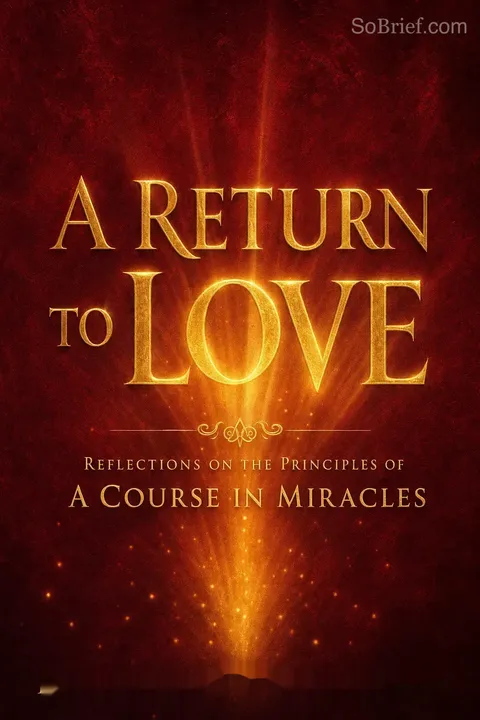


Key Takeaways
Return to love by unlearning fear, not by acquiring a better self.
A journey out of fear. Marianne Williamson tells of years spent moving between relationships, jobs, and distractions, convinced that some missing achievement would make her feel whole. In her mid-twenties, she found A Course in Miracles, a spiritual self-study program, and began working through its exercises. She describes the changes as a return to a love that had been obscured, not a virtue she had to manufacture.
A miracle changes perception. In this book, a miracle is chiefly a shift from interpreting a situation through fear to seeing it through love. It may alter how someone responds to a conflict without changing the external facts. The central practice is to notice fear, ask for help seeing differently, and choose kindness, forgiveness, or peace as the next response.
The memoir gives the argument a useful psychological shape: repeated self-sabotage can persist even after a person understands its origins. The book's emphasis on changing interpretation resembles cognitive reappraisal, a well-studied strategy in which people reconsider what an event means to change its emotional impact. That can widen choices without pretending the event did not happen. The spiritual language may be meaningful to believers, but a reader need not accept its metaphysics to test the practical move: pause before treating a fearful first interpretation as the only possible one.
Stop earning your worth; treat the ego as a fearful story, not your identity.
Worth before achievement. Williamson argues that a person's essential value does not depend on grades, appearance, career, or approval. In her Christian vocabulary, each person is created in love; failure and harmful behavior can require change, but do not erase that underlying worth. This distinction is meant to interrupt the belief that self-punishment is the price of becoming better.
A name for fear. A Course in Miracles uses the term ego for a mistaken identity built around separation, competition, and self-protection. It is not simply confidence or pride in the everyday psychological sense. Williamson describes it as a persuasive inner voice that presents selfishness and judgment as sensible ways to stay safe. The alternative is to notice that voice without assuming it defines the whole person.
Separating human worth from performance can support learning: shame tends to narrow attention toward concealment, while a secure sense of worth can make error easier to face. Self-compassion research similarly distinguishes accepting a person from approving every action. The theological claim that people are already perfect, however, can be confusing if read as a claim that behavior is harmless. Its most useful interpretation is that dignity is not conditional, while conduct remains open to honest evaluation, repair, and change.
Surrender the outcome, not your responsibility to act with love.
Release the forecast. Williamson defines spiritual surrender as loosening attachment to a particular result and asking what response would serve love and inner peace. A person interviewing for a job, for instance, can prepare and show up fully without treating that one offer as the only route to a good life. Faith, in the book, means trusting a benevolent order rather than trying to control every consequence.
Stay an active participant. Surrender is not meant to mean passivity. The book calls for people to use their abilities, make decisions, and take responsibility for the thoughts they bring to a situation, while releasing the demand that events unfold exactly as planned. This balance counters two extremes: frantic control, and waiting for spiritual help to do the work that remains one's own.
This distinction maps well onto a practical psychological divide: effort can be directed toward choices and preparation, while outcomes remain partly outside personal control. Letting go of the latter can reduce rumination and preserve attention for the former. The spiritual assurance that the universe is reliably benevolent is not something the book demonstrates, and life can deliver outcomes that are neither fair nor comprehensible. The practice remains valuable when framed more modestly: act responsibly, then avoid confusing uncertainty with a problem that can be solved by worry.
Forgive to free your mind, while keeping accountability and boundaries intact.
Release the grievance. In Williamson's account of A Course in Miracles, forgiveness means choosing not to let another person's worst act become the only fact that matters about them. She calls this selective remembering: holding on to what was loving while loosening the mental replay of injury and blame. The aim is inner peace, not a verdict that harmful conduct was acceptable.
Keep consequences visible. The book argues that compassion can make correction more possible than attack does. It even imagines prisons as places for rehabilitation rather than pure punishment. Yet forgiving someone does not require trusting them, reconciling, or removing consequences. The practical question is whether a response can protect people and address harm without turning revenge into its own purpose.
The strongest version of this idea distinguishes forgiveness from reconciliation, pardon, and restored trust. Those are separate choices, and safety may require distance or formal accountability. Research on forgiveness suggests that relinquishing persistent resentment can benefit the injured person's wellbeing, but pressure to forgive can compound harm, especially after abuse. Williamson's framework is most humane when forgiveness is voluntary and self-directed: it can release a grievance from the mind without denying the facts or granting the person who caused it renewed access.
Stop asking romance to complete you; use intimacy to practice mutual growth.
Question the rescue fantasy. Williamson calls a relationship organized around being completed by one uniquely perfect person a special relationship. In her account, this ideal can turn a partner into a cure for loneliness, and ordinary human flaws into evidence that love has failed. The search for a flawless match may therefore block the patience and honesty intimacy requires.
Change the relationship's purpose. A holy relationship is the book's contrasting term for a bond guided by acceptance, mutual learning, and a willingness to face each person's vulnerable places. It does not require the same form for every relationship, or mean that every couple should stay together. The shift is from asking what another person can supply to asking whether both people can meet each other with respect, truthfulness, and care.
The critique of romantic rescue is psychologically astute. Attachment research suggests that secure relationships can support exploration and growth, but they do not erase the need for individual self-understanding. The book's language of shared spiritual identity can make that mutuality feel expansive. Its caution is that acceptance should not become an excuse for tolerating chronic disrespect or incompatibility. A relationship can be a meaningful teacher and still be one that a person chooses to leave.
Speak honestly without turning pain into punishment.
Name the real feeling. Williamson warns that calling anger unspiritual can make it disappear from view without resolving it. In a story about a man who forgot a date and failed to call, she describes feeling hurt, then repeating a forgiveness practice until the anger loosened. When he contacted her again, she could respond warmly while declining to continue dating him.
Make room for repair. The book also recounts a couple whose relationship changed when the man finally explained the resentment he had been concealing. His partner said she had not understood the problem, and the conversation gave them a chance to address it. Williamson's practical point is to speak from ownership of one's feelings rather than accusation, and to listen for what the other person is actually saying.
This is a valuable correction to the idea that peace means never feeling anger. Emotion regulation does not require suppressing emotion; naming a feeling can help a person respond deliberately rather than react automatically. The date story also makes an important distinction: forgiveness can restore composure and strengthen a boundary at the same time. Still, honest speech is not automatically safe or constructive. Timing, power differences, and the other person's willingness to listen all matter, and some conflicts call for outside support.
Make work a channel for service, not a test of personal importance.
Begin with contribution. Williamson asks readers to think of work as a way to put their particular abilities in service of other people, rather than as a measure of status. She recalls running a small bookstore and deciding to treat customers as people to welcome and help, not merely as potential sales. She argues that any occupation can carry this purpose, from creative work to routine service.
Let money serve life. The book does not call money evil; it treats money as a resource whose effects depend on how it is used. Williamson urges readers to be open to material support, pay what they owe, and avoid treating poverty as proof of virtue. Her spiritual advice is to put service first, but the practical work still includes building skills, earning a living, and handling obligations with integrity.
Service can make work feel more coherent because it connects daily tasks to people who benefit from them. Prosocial motivation is also associated with persistence in many kinds of work. But meaning cannot substitute for fair wages, competent management, or sustainable business practices. A service ethic that romanticizes underpayment can benefit employers more than workers. The grounded version of Williamson's proposal is not to ignore compensation, but to pursue both: create real value for others and insist that the people doing the work are valued too.
Care for the body without mistaking illness for moral failure.
A body can be a means. Williamson draws on A Course in Miracles to argue that the body should be treated as an instrument for communication and care, rather than the whole of a person's identity. She recounts supporting people facing serious illness and cites an account of affectionate handling improving outcomes in rabbits fed a harmful diet. She also describes a doctor prescribing medicine when she developed a painful throat after praying for healing.
Do not blame the sick. The book sometimes presents disease as an expression of loveless thinking, but that claim should not be read as evidence that patients cause their illnesses through bad thoughts. Williamson's own examples include medical treatment and support services. A practical reading is to seek appropriate care, accept emotional and social support, and remember that illness does not reduce a person's dignity or capacity for love.
The book's attention to companionship and emotional support aligns with the broader biopsychosocial view that health is shaped by biological, psychological, and social conditions. But an anecdote about handled rabbits cannot show that love cures disease, and spiritual explanations can unfairly burden patients with blame. Illness has many causes beyond an individual's mindset. The humane contribution here is the insistence that sick people deserve connection and respect alongside medical care, not a promise that a changed perception can replace treatment.
Practice peace now, instead of postponing happiness until life behaves.
Return attention to today. Williamson argues that dwelling on past mistakes or rehearsing an unknowable future can shape present choices around fear. The Course's Workbook offers a year-long sequence of exercises intended to make a more loving perspective easier to access. The goal is not to deny painful history, but to stop treating it as the only possible script for what happens next.
Heaven as present experience. In this spiritual vocabulary, Heaven means awareness of love and connection, not simply a place reached after death. Williamson presents happiness as a choice of attention and response, even when circumstances remain difficult. A Course in Miracles also describes life as extending beyond the body, but this is a religious belief rather than an established fact. The practical invitation is to seek peace in the present without pretending grief or danger is unreal.
Daily practice matters because attention is trainable, and brief mindfulness or contemplative exercises can help people notice thoughts without obeying every one. The book's emphasis on the present also counters the habit of postponing life until a perfect future arrives. Yet happiness is not always immediately selectable; depression, grief, trauma, and material hardship can constrain mood and choice. The most compassionate reading treats practice as support for agency, not a test that someone has failed when pain persists.
Let inner change become public repair, not a substitute for it.
Love must take practical form. Williamson does not confine spiritual work to private feelings. She connects fear and separation to war, prejudice, environmental damage, and neglect of people in need. Her argument is that a peaceful outlook should lead people to feed, protect, teach, apologize, and repair, rather than admire love as an abstract ideal.
Start where responsibility is real. The book assigns each person a sphere of influence in daily life, while also calling for collective changes such as investment in children, rehabilitation, and honest acknowledgment of historical harm. Its account of social healing begins with individual changes in perception, but it does not have to end there. Love becomes credible through conduct and institutions that reduce suffering, not through private serenity alone.
This outward turn keeps spiritual practice from becoming a private comfort detached from consequences. Individual habits of empathy can influence how people cooperate, but large harms also arise from institutions, incentives, and unequal power. Personal goodwill alone cannot repair those structures. The most useful synthesis is both inward and civic: cultivate less dehumanizing perception, then translate it into policy, resources, and accountability. That approach preserves the book's moral urgency while avoiding the implication that social problems are merely errors in individual consciousness.
Analysis
A Return to Love is part memoir, part spiritual interpretation, and part practical guide. Its organizing claim is that fear is a learned way of seeing, while love is the deeper reality that people can recover through practice. Williamson begins with her account of self-loathing and repeated self-sabotage, then uses A Course in Miracles to interpret surrender, forgiveness, relationships, work, the body, and social responsibility. The movement is from private distress toward a broader ethic: a person's work, communication, and civic choices can express the love they are trying to reclaim.
The book's chief strength is its insistence that insight alone does not change a pattern. Readers are asked to notice their judgments, request another perspective, and behave differently in the concrete situation before them. Its relationship examples give that instruction emotional stakes, especially when forgiveness leads not to reconciliation but to a calm boundary. The career chapters likewise refuse to reserve meaningful service for prestigious occupations.
Its central tension is the gap between spiritual metaphor and factual explanation. The language that fear is unreal can help loosen its authority, but fear, illness, grief, and violence are also real human experiences with material causes. Some passages risk implying that sickness follows loveless thinking or that love itself can heal disease. Those claims are not established by the anecdotes presented. A responsible reading retains the book's compassion while rejecting patient-blame and preserving medical treatment, safety, and structural remedies.
The ideas travel best when translated rather than accepted as a single metaphysical system. A secular reader can treat the Holy Spirit as a name for a wiser perspective, or decline that translation and still use the exercises in attention, forgiveness, and service. The lasting question is practical: what would change if the next response were guided by care rather than fear? The book's answer is not guaranteed worldly success. It is a different way of participating in the world, one that aims to make inner peace consequential for other people.
Review Summary
A Return to Love receives mostly positive reviews, with readers finding it spiritually transformative and insightful. Many appreciate Williamson's interpretation of A Course in Miracles and her emphasis on love as a guiding principle. The book's famous quote about our deepest fears resonates strongly with readers. However, some criticize its heavy religious tone and oversimplification of complex issues. Critics also note that Williamson's personal anecdotes sometimes contradict her teachings. Overall, the book is praised for its wisdom on relationships, self-acceptance, and spiritual growth.
People Also Read






Glossary
Miracle
A shift in perceptionIn Williamson's interpretation of A Course in Miracles, a miracle is primarily a change from fearful perception to loving perception. It may change how a person experiences or responds to an event without necessarily changing the event itself. The term is spiritual, not a promise of supernatural intervention or physical cure.
Ego
A fearful separate identityThe Course uses ego differently from ordinary usage in modern psychology. It means the thought system that treats people as separate, vulnerable selves competing for scarce goods and protection. Williamson describes it as the source of judgment and self-defense, not as a person's essential identity.
Holy Spirit
Inner guide toward loveIn the book's Course-based theology, the Holy Spirit is God's continuing presence within the mind, offering an alternative to fear and guiding perception toward love. Williamson also uses the term for help that may arrive through a person, a therapist, a spiritual practice, or an unexpected insight.
Atonement
Correction of separation thinkingAtonement, as used in A Course in Miracles and Williamson's reflections, is the correction of the belief that people are fundamentally separated from God and one another. It is not treated as punishment for sin, but as a return to a loving understanding of identity and relationship.
Special relationship
Love shaped by needA special relationship is a bond organized around the belief that a particular person can fill an inner lack or provide salvation. In Williamson's account, this can lead to idealization, control, fear of rejection, and disappointment when a partner proves human. The term describes a fearful purpose, not a particular relationship form.
Holy relationship
A bond used for healingA holy relationship is a relationship whose purpose is reoriented from extracting completion to practicing love, honesty, acceptance, and mutual growth. In Williamson's interpretation, partners can reveal one another's fears and support change without needing to be flawless or to remain together at any cost.
Selective remembering
Remember love, release grievanceWilliamson uses selective remembering to describe a form of forgiveness: consciously giving less attention to fearful judgments and retaining awareness of the love given and received. It aims to loosen resentment and restore peace. It does not require denying what happened, excusing harm, or resuming contact.
Teacher of God
A demonstrator of loveIn the Course vocabulary used by Williamson, a Teacher of God is anyone who accepts the task of demonstrating a loving way of seeing and acting. Teaching need not mean formal instruction or religious authority. The emphasis is on conduct that models forgiveness, compassion, and a willingness to learn.
Mind training
Practice changing thought habitsMind training is Williamson's description of the Course's disciplined practice of noticing fearful thought patterns and rehearsing a loving alternative. Its Workbook contains daily exercises intended to make a new perspective more available in ordinary situations. The goal is a changed mental habit, not merely intellectual agreement with spiritual ideas.
FAQ
What's A Return to Love about?
- Exploration of Love's Power: A Return to Love by Marianne Williamson interprets the principles of A Course in Miracles, focusing on love's transformative power to overcome fear and pain.
- Spiritual Journey: The book emphasizes relinquishing fear and embracing love as our natural state and purpose on Earth.
- Practical Application: Williamson provides practical advice on applying these principles in everyday life, particularly in relationships, work, and personal growth.
Why should I read A Return to Love?
- Personal Transformation: The book offers insights that can lead to profound personal transformation, helping readers heal emotional wounds and foster healthier relationships.
- Guidance on Relationships: It provides a framework for understanding and improving relationships through love and forgiveness, relevant for anyone seeking deeper connections.
- Spiritual Awakening: Readers looking for spiritual guidance will find a path to awakening and understanding their true selves through love, as emphasized in Williamson's teachings.
What are the key takeaways of A Return to Love?
- Love vs. Fear: Love is the only reality, while fear is an illusion that leads to suffering. "Love is the essential existential fact."
- Miracles as Shifts in Perception: Miracles are shifts in perception from fear to love, highlighting the power of changing one’s mindset to transform experiences.
- Forgiveness as Healing: Forgiveness is a crucial tool for healing, allowing individuals to release grievances and see the innocence in others, leading to inner peace.
What are the best quotes from A Return to Love and what do they mean?
- “Love is what we were born with. Fear is what we have learned here.”: Emphasizes that our natural state is love, and fear is a learned response that can be unlearned.
- “Your holiness reverses all the laws of the world.”: Suggests that recognizing our inherent holiness and connection to love can transcend worldly limitations and challenges.
- “Miracles occur naturally as expressions of love.”: Highlights that when we act from a place of love, miraculous changes in our lives and the lives of others can occur effortlessly.
How does Marianne Williamson define a miracle in A Return to Love?
- Shift in Perception: A miracle is a shift in perception from fear to love, changing how we view our experiences and relationships.
- Natural Expression of Love: Miracles occur naturally as expressions of love, suggesting that aligning with love creates positive changes.
- Healing Power: Miracles are healing forces that transform our emotional and spiritual states, reconnecting us with our true selves.
What is the significance of forgiveness in A Return to Love?
- Key to Inner Peace: Forgiveness is essential for achieving inner peace, allowing us to release judgments and grievances that block love.
- Seeing Innocence: True forgiveness involves recognizing the innocence in others, helping us heal our own wounds and fostering deeper connections.
- Transformative Process: Forgiving is a transformative process that liberates the forgiver from resentment and anger.
How does A Return to Love address relationships?
- Holy vs. Special Relationships: Distinguishes between special relationships, based on fear and need, and holy relationships, grounded in love and mutual growth.
- Opportunities for Growth: Relationships are opportunities for spiritual growth, where individuals can learn to love more deeply and heal emotional wounds.
- Communication and Honesty: Stresses the importance of open communication and honesty, encouraging individuals to express true feelings to foster healing and connection.
What role does God play in A Return to Love?
- Source of Love: God is the ultimate source of love, and recognizing this connection is essential for true peace and fulfillment.
- Guidance through the Holy Spirit: The Holy Spirit serves as a guide to help individuals navigate their spiritual journeys and make choices aligned with love.
- Healing Presence: God's presence is a healing force that can transform perceptions and experiences when invited into our lives.
How can I apply the principles from A Return to Love in my daily life?
- Practice Forgiveness: Regularly practice forgiveness by consciously choosing to let go of grievances and focusing on the love within yourself and others.
- Shift Your Perception: When faced with challenges, ask for a miracle by shifting your perception from fear to love, changing how you experience situations.
- Cultivate Loving Relationships: Engage in relationships with the intention of love and support, recognizing each interaction as an opportunity for growth and healing.
What does Marianne Williamson say about fear in A Return to Love?
- Fear as an Illusion: Fear is an illusion that distracts us from our true nature, which is love. "Fear is our shared lovelessness."
- Impact on Relationships: Fear can lead to destructive behaviors and patterns in relationships, preventing genuine connection and intimacy.
- Overcoming Fear: Overcoming fear involves embracing love and recognizing that love is the only reality that can heal our wounds and transform our lives.
How does A Return to Love relate to A Course in Miracles?
- Foundation of Teachings: A Return to Love is based on the principles outlined in A Course in Miracles, interpreting and expanding upon these teachings.
- Practical Application: Serves as a practical guide to applying the concepts from A Course in Miracles in everyday life, making spiritual principles more accessible.
- Emphasis on Love and Forgiveness: Both texts emphasize love and forgiveness as central themes, reinforcing their importance for personal transformation.
What is the significance of the ego in A Return to Love?
- Ego as a Barrier: The ego is a barrier to love and connection, perpetuating fear, separation, and conflict.
- Ego's Defense Mechanisms: It defends against love by creating illusions of inadequacy and unworthiness, leading to self-sabotage and emotional pain.
- Transcending the Ego: Encourages readers to transcend the ego by embracing love and forgiveness, allowing for deeper connections and a more fulfilling life.
About the Author



Download PDF
Download EPUB
.epub digital book format is ideal for reading ebooks on phones, tablets, and e-readers.








