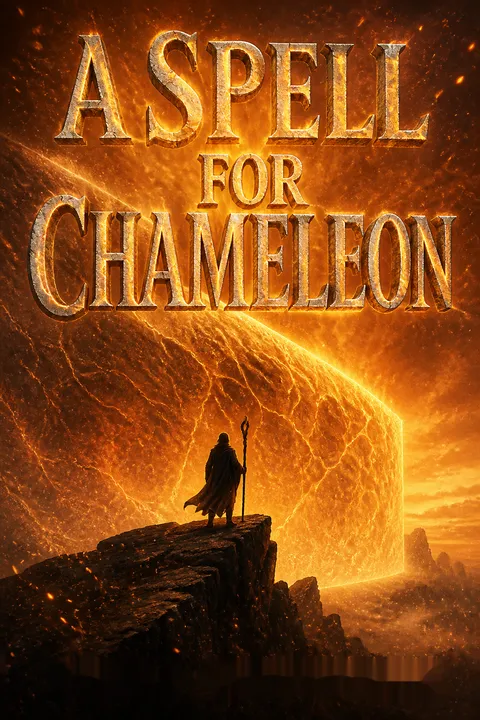


Plot Summary
A Talentless Birthday Looms
A chameleon lizard mimics deadly creatures to frighten Bink, then dies in a hawk’s claws, leaving him uneasy about the omen. At twenty-five, Bink must prove he has magic or leave Xanth. He longs to marry Sabrina, who believes the Good Magician Humfrey may identify a talent he has never been able to use.
Their walk is interrupted by pranksters who burn Sabrina with a hotseat and stop Bink with an invisible wall. When the same youths attack Justin Tree, a former man transformed by the Evil Magician Trent, Bink charges in despite having no magic. He treats Justin’s wound and decides to seek Humfrey, accepting that one year of service is worth a chance to belong.
Bink’s exclusion is not simply a lack of power. Xanth has made magic the test of citizenship, so his physical courage and intelligence count for less than a talent he cannot demonstrate. The pranksters turn that rule into daily humiliation, while his defense of Justin shows the ethical independence that the village’s ranking system overlooks. Sabrina’s confidence gives Bink hope, but it also makes his future seem dependent on a verdict from someone else. The dead chameleon establishes a world where appearances can imitate danger, while the real danger arrives from elsewhere.
Cherie Carries the Past
Bink sets out alone, refusing his parents’ offer of a protective guide because he wants to prove he can manage. A quarrel with Chester, an arrogant young centaur, nearly gets him strangled; Cherie, Chester’s companion, orders him to release Bink and carries the traveler onward.
She guides him around fresh chasms and through a forest whose peaceful spell can lull a person into dying in place. As she explains the human settlement of Xanth, Bink learns that earlier waves of migration included invasion, murder, and forced marriages.
His ancestors’ history is less noble than he believed. Cherie also warns that Xanth’s isolation may intensify its magic, though Bink is still more concerned with finding a talent than with the land’s larger dangers.
The ride gives Bink practical protection, but Cherie’s history lesson challenges the identity he has inherited. He has taken pride in his ancestors without asking whose suffering made their place in Xanth possible. His willingness to listen, even when the account embarrasses him, marks a difference between inherited loyalty and unexamined myth. Cherie’s warning about the peace forest adds a subtler danger: comfort can erase agency as effectively as violence. Bink’s curiosity helps him notice the pattern, though he has not yet learned that knowledge alone does not guarantee safety.
The Gap Takes a Shade
A newly opened chasm blocks the route Cherie expected, and Bink detours into a village where he substitutes for a farmer at a private hearing about rape. The judge’s ruling leaves the accused man unpunished, and the accuser, Wynne, guides Bink toward a crossing watched by a dragon.
When the monster attacks, Bink draws it away from Wynne, escapes into an underground cave, and finds himself trapped between the dragon and a lingering shade. The shade, Donald, asks to borrow Bink’s body long enough to tell his family where a silver tree grows. Donald’s flying talent lifts them out of the chasm. He reunites briefly with his wife, gives her the tree’s location, and fades, leaving Bink to continue south.
Bink’s instinct to protect Wynne carries him into danger, but the rescue is not rewarded with easy heroism: he survives only by trusting a dead stranger. Donald’s brief return makes the cost of unfinished responsibility intimate. He uses his last chance not to reclaim his life, but to provide for his wife and son. The private hearing, meanwhile, exposes how a community can preserve reputations by withholding public justice. Bink encounters different forms of power here, from the judge’s institutional authority to the shade’s borrowed body, and learns that good intentions do not make their consequences simple.
The Sorceress’s Crystal Promise
After days of losing his way around the chasm, Bink reaches the sea and runs along what appears to be a beach. The sand vanishes beneath him, and a sea monster drags him underwater. Sorceress Iris rescues him and takes him to an island whose crystal palace, gardens, servants, and luxurious food are mostly illusions.
Once Bink understands her talent, Iris offers him wealth, comfort, Sabrina as a concubine, and the prospect of becoming King, with herself wielding the real power. Bink recognizes that she wants a dependent figurehead. He refuses, despite the temptation and the prospect of exile, because he will not help her seize Xanth’s throne. He leaves by rowboat, choosing an uncertain road over a bargain that would cost his integrity.
Iris makes illusion persuasive by grounding it in genuine needs: food, shelter, attraction, and belonging. Bink does not reject her because the offer is unreal; he rejects it because its political terms would make him an instrument. His suspicion develops from the discovery that her palace is only a surface over a poor shack, but the decisive test is moral rather than visual. Sabrina matters less as an idealized beloved than as a measure of whether Bink will accept a relationship arranged for advantage. He chooses the harder uncertainty over a comfortable dependence.
The Spring’s Hidden Price
In the rough country beyond the chasm, Bink finds a wounded soldier and coerces a dryad into revealing the location of the Spring of Life. A drink heals Bink’s cold and restores the finger he lost as a child, but the Spring’s magic requires anyone it heals to serve its interests. Bink refuses that obligation, though the benefits remain.
He gives the water to the soldier, Corporal Crombie, whose wounds close. The two then meet Dee, a frightened young woman whom Crombie’s directional talent identifies as Bink’s greatest danger. Bink does not believe she intends harm, but he allows her to travel with them. Crombie agrees to escort Bink to Humfrey, repaying the life Bink saved.
The Spring turns healing into a political relationship: accepting help means surrendering some freedom to the helper. Bink’s refusal is important because he does not confuse gratitude with obedience, yet he still gives the water to Crombie, taking responsibility for another person’s survival. Crombie’s talent appears to offer certainty, but his suspicion of Dee shows that information without interpretation can become persecution. Bink’s choice to keep her near does not resolve the danger; it refuses to let a single magical signal decide who she is.
Crombie Points to Dee
A colored hailstorm catches Bink, Crombie, and Dee on a bare ridge. Crombie’s talent directs them toward a seemingly safe shelter beneath a tangle tree, already full from eating a giant animal. Dee enters first to test the carcass, and Bink follows; Crombie’s caution gives way when the hail grows too dangerous.
During the wait, Crombie explains his distrust of women, which Dee answers with anger. She walks into the storm, and Bink follows to search for her. He and Crombie find her tracks, but Dee refuses to rejoin them. The soldier then guides Bink through the remaining wilderness to Humfrey’s castle. Having repaid his debt, Crombie leaves Bink to face the Magician alone.
Crombie’s protective role is compromised by the prejudice he mistakes for insight. He can locate danger, but he cannot reliably tell the difference between danger and a woman who has incurred his distrust. Dee’s departure gives her a boundary of her own; Bink respects it even as he regrets losing her company. The tangle tree shelter is another Xanthian bargain, safe only because it has recently fed. Bink reaches his destination through other people’s help, yet the final question about his worth remains his to face.
Humfrey’s Answer Refuses
Bink crosses the moat on a bucking hippocampus, outwits a manticora guarding the entrance, and persuades Humfrey to hear his question. The Good Magician summons a demon, whose divination confirms that Bink has powerful magic but cannot identify it. Humfrey’s other instruments fail too, and he concludes that a powerful enchantment prevents Bink from naming his own talent.
With no answer to give, Humfrey waives his usual year of service and sends Bink home with a note affirming that he has magic. He explains that Bink’s talent may be dangerous to some powerful interest, but cannot tell him why. Bink leaves with proof he cannot use and a route across the chasm that depends on an invisible bridge.
Humfrey’s failure transforms Bink’s uncertainty into a more frustrating condition: he has power, but knowledge of it is blocked. The obstacle is not incapacity but an unseen rule acting on his self-understanding. The Magician’s willingness to waive his fee makes him more than a caricature of greed, though he still treats the mystery as an intellectual challenge. Bink receives evidence that he is not empty, yet the evidence has no social force unless he can demonstrate it. The invisible bridge literalizes the value of information: a safe path exists, but only for someone who knows where to step.
The King Sends Him Out
Bink follows Humfrey’s directions across the chasm and returns to the North Village for his citizenship examination. He offers the King the remaining Spring of Life water, hoping it will restore the old ruler’s failing health and judgment. The senile King rejects the implication that he is ill and pours the water onto the ground.
Bink cannot demonstrate his hidden talent, so the officials declare him unqualified and exile him. His parents and Sabrina watch as he leaves with only what he can carry. At the Shield, a keeper opens a five-second passage. Bink misjudges the timing, runs through the lethal barrier, and survives. Outside Xanth, grief overwhelms his brief sense of freedom, but he refuses to turn back and die.
The examination makes visible the gap between a person’s capacities and an institution’s criteria. Bink has evidence from Humfrey and a gift that might help the King, but neither can overcome a ruler unwilling to acknowledge his own decline. The failure is therefore political as well as personal. Bink’s parents respect the law even when it costs them their son, while Sabrina’s silence leaves him alone with his judgment. Crossing the Shield completes the exclusion the opening established. His tears show that choosing principle does not make loss painless.
Trent’s Army Waits Outside
Beyond the Shield, soldiers ambush Bink and bring him to General Trent, the exiled transformer once feared in Xanth. Trent has built an army in the outside world and found an elixir that can suppress magic near its source. A catapult can carry the elixir to the Shieldstone, but only if Trent learns its exact location.
He asks Bink to help him return and seize the throne, promising comfort and authority. Bink refuses, recognizing that the invasion could revive Xanth’s violent history. A captured woman named Fanchon appears willing to tell Trent what he wants, but Bink suspects the meeting is staged. Trent confines them together while he tries to extract the information by persuasion or threat.
Trent’s plan converts Bink’s exclusion into a weapon: the outcast is valuable because he knows the border and may know how it is maintained. His offer echoes Iris’s, but his means are military rather than seductive. He presents conquest as order and modernization, making the danger harder to dismiss as simple villainy. Bink’s refusal is grounded in loyalty to Xanth’s laws, even after those laws have failed him. Fanchon’s uncertain position prevents him from assuming that apparent cooperation means betrayal, a test of judgment that will recur.
Bricks Beneath the Prison
In the prison pit, Fanchon tells Bink that she gave Trent a false location for the Shieldstone. She left Xanth voluntarily, hoping that life without magic would solve a private problem, but keeps her other reason secret. Trent offers to transform her into a beautiful woman; she refuses.
When he threatens to turn both captives into basilisks and demonstrates his power, Bink and Fanchon experience the frightening animal forms before Trent changes them back. They realize that the transformation may fade outside Xanth.
While rain softens the pit floor, Fanchon quietly mixes mud and hay into bricks, hiding them behind a makeshift privacy screen. Bink finally understands that she has been preparing a way to lift the grate. Together they plan to escape and seize the elixir.
Fanchon’s refusal of beauty separates self-worth from the appearance Trent assumes she must want. Her secrecy does not make her untrustworthy; it reflects how little control she has over what others decide her problem means. The transformation demonstration turns Trent’s threat into bodily experience, making abstract power immediate. Yet the captives notice a limit: his magic may not hold beyond Xanth. Fanchon’s bricks convert patience into leverage. Bink’s delayed understanding also shows how easily he mistakes modesty for vanity and misses the intelligence working beside him.
The Ship Becomes a Trap
At night, Bink and Fanchon stack the bricks beneath the unanchored grate and escape. They swim to Trent’s ship, where they overpower the sailors and find the elixir guarded by a chained dog. Instead of destroying the vial, they use it as a hostage and take the vessel. A recovering sailor warns them that the current is carrying the ship toward the Shield.
They lower a lifeboat, but a storm and the current pull them toward the lethal barrier. When the elixir falls into the water, Trent joins them rather than abandoning them. A whirlpool seizes all three and drags them under. Bink expects to drown, while the loss of the elixir leaves Trent’s invasion plan without its essential weapon.
The escape depends on cooperation rather than strength alone: Fanchon makes the bricks, Bink handles the physical struggle, and their hostage strategy buys time. But the ship reveals that escape is not the same as control. Their lack of sailing knowledge leaves them at the mercy of currents they cannot read. Trent’s decision to follow them complicates the simple division between captor and captive; his survival is now tied to theirs. The whirlpool destroys the elixir and forces all three into a danger no one has planned.
Turtles Beneath the Shield
Bink wakes in an underwater cavern beside Fanchon and Trent, alive because a kraken weed caught them and the spilled elixir briefly killed it. The three follow an underwater current into a merfolk cavern, where hostile tritons threaten them. Trent transforms Bink and Fanchon into armored sea turtles, allowing them to withstand the tridents and reach an exit.
When a sea serpent attacks, Trent turns it into a harmless lovebug long enough for them to swim to shore, then restores it. The elixir is gone, and the trio cannot return through the Shield. Trent proposes a truce until they escape the wilderness. Bink and Fanchon accept because survival now requires cooperation, though neither has forgotten Trent’s ambition.
Trent’s transformations are used here as protection rather than domination, but the power remains unsettling because he decides what bodies his companions inhabit. The turtle forms turn apparent weakness into defense, while the sea serpent’s temporary reduction shows how narrowly magic can alter a threat without erasing it. The lost elixir ends the immediate invasion plan, not the conflict over the throne. Their truce is therefore practical, not reconciliatory. Each accepts dependence without pretending that trust has been fully restored.
Roogna Locks Its Doors
On the coast, Bink falls asleep in carnivorous grass and wakes trapped. Fanchon is caught by a nearby lethargy tree, while Trent sits entranced by a hypnotic gourd. Bink breaks free, knocks the gourd away, and wakes the Magician. Trent helps pull Fanchon from the tree, and all three extend their truce.
They head inland, where the wilderness herds them toward Castle Roogna, an ancient fortress that traps them behind a fallen portcullis. Ghosts, predatory rats, and zombies block their attempts to leave. During their first night inside, Bink learns that the castle’s ghosts are confined servants, not the power controlling the building. At dawn, he recognizes that Fanchon is connected to the women he met earlier in Xanth.
The wilderness repeatedly exploits ordinary vulnerabilities: fatigue, curiosity, and the desire to rest. Even Trent, the strongest magician among them, is caught by a gourd, which prevents power from becoming a guarantee of competence. Castle Roogna then shifts the danger from open terrain to architecture, making refuge another form of confinement. The ghosts’ helpless service hints that the castle’s history has not ended simply because its human occupants vanished. Bink’s recognition of Fanchon begins to reorganize his memories of earlier encounters, turning a series of apparent strangers into a pattern.
The Woman Behind Three Faces
Fanchon explains that she is Chameleon, a magical woman whose appearance and intelligence shift through a monthly cycle. Bink had met her as the beautiful but foolish Wynne and the ordinary, more perceptive Dee; Fanchon is her ugliest and most intelligent phase. She followed him into exile because he had treated each version with kindness, and she hoped the outside world would quiet her magic.
In Castle Roogna, she cooks with help from the ghosts while Bink studies the rooms and Trent searches the library. A cherry bomb explodes when Chameleon drops an unfamiliar fruit. Bink recognizes the fruit’s military use and begins preparing explosive charges, hoping to force the castle to let them leave.
Chameleon’s cycle makes Bink reconsider how quickly he has equated beauty with worth and intelligence with compatibility. His earlier encounters were not unrelated episodes; they were partial meetings with one person whose qualities he could not see all at once. Chameleon’s choice to follow him rests on remembered conduct, not on his status or magic. The castle gives her practical work and a place to contribute, while the cherry bomb discovery offers Bink a way to resist confinement. Both forms of agency emerge from close attention to what others overlook.
A Castle’s Cherry Arsenal
Bink plants cherry bombs around Castle Roogna and tells Trent he will destroy the fortress if it prevents their escape. Before threatening the castle, he sees Trent privately grieving over the illusory likenesses of his dead wife and son, represented by transformed roaches.
The revelation complicates Bink’s view of the Magician, but does not erase the danger of his ambition. Trent argues that Xanth’s isolation and concentrated magic may threaten its human population, and that contact with the outside world could be necessary.
Bink refuses to accept conquest as the solution. Rather than let the castle and everyone inside be destroyed, he shares the bomb locations. Trent then uses his knowledge of Roogna to secure their passage out without a fight.
Trent’s grief humanizes him without absolving his political purpose. Bink sees that the same man who seeks the throne can mourn deeply, which makes moral judgment more demanding than sorting people into pure categories. Trent’s argument about Xanth’s future also forces Bink to confront a possibility he would rather dismiss. Yet Bink refuses to let a potentially valid diagnosis justify coercion. By disclosing the bombs, he chooses responsibility over tactical advantage and makes room for a solution that preserves both lives and the historic castle.
The Wiggles Return
Beyond Roogna, the trio meets Herman the Hermit, a centaur exiled for practicing magic. He has gathered Xanth’s monsters to contain a renewed swarm of wiggles, tiny tunnelers capable of killing anything they pierce. When the defenders begin to fail, Herman proposes burning the swarm inside a controlled circle.
Trent transforms Bink into a salamander, and Herman carries him in a fireproof weed harness, directing the flames inward. The plan destroys the wiggles, but a wound from the swarm leaves Herman dying. At his request, Trent ends his suffering with a clean stroke of his sword. The gathered creatures fall silent to honor him. Bink sees Trent organize the battle effectively and preserve his secret while saving Xanth.
The emergency suspends the usual hierarchy between humans, centaurs, and monsters: every creature’s survival depends on collective action. Herman’s forbidden magic becomes the necessary answer, exposing how a community can mistake convention for nature. Trent’s role is neither simple savior nor tyrant here; he uses power under another person’s plan and accepts Herman’s request without delay. The final silence serves two purposes, honoring the dead and confirming that no wiggles remain. Bink witnesses leadership as disciplined service, a quality he had not expected from the man he opposed.
The Duel Finds Bink’s Magic
Near cultivated fields, Sorceress Iris appears and threatens to expose Trent, Bink, and Chameleon for violating exile. She offers to make Chameleon beautiful at every stage and renews her proposal to use Bink as a route to power. When Trent considers accepting a political alliance with Iris, Bink challenges him to a formal duel.
Chameleon stays beside Bink, and their affection becomes explicit before combat begins. Trent’s transformations repeatedly fail to harm Bink, revealing that Bink’s hidden talent protects him from magical injury. Trent’s sword can still wound him. Chameleon changes into a winged deer and takes a fatal-looking thrust meant for Bink. Trent refuses to kill either of them and sends Bink to Humfrey for healing water.
Bink’s concealed talent finally becomes legible through conflict: it protects his body, not his pride, social standing, or freedom from pain. That distinction explains why he could be humiliated throughout childhood while surviving magical threats. The duel also tests whether loyalty is merely a principle Bink applies to Xanth or a commitment to particular people. Chameleon’s intervention answers that question physically. Trent’s refusal to finish the fight marks a change in conduct, but Bink still needs outside help; ethical growth does not magically undo injury.
Iris Blinds the Phoenix
Trent transforms Bink into a phoenix so he can fly to Humfrey quickly, but Iris tries to stop him with an illusory dragon and a false storm. Bink recognizes that the threats have no substance, yet her fog hides his direction and makes him believe he has reached Castle Roogna. A hippocampus’s familiar snort tells him he is actually near Humfrey’s castle.
Bink lands and uses Humfrey’s magic mirror to explain that Chameleon is dying and Trent is trying to save her. Humfrey fetches healing water and a flying carpet, then carries Bink back toward the wilderness. The King has died meanwhile, and the Elders assemble a party to confront Trent and reach Chameleon before the wound proves fatal.
Iris’s illusions cannot injure Bink, but they can obstruct the people he loves by wasting his time. His talent’s protection is therefore powerful and incomplete. Bink must supplement it with observation, using a sound that belongs to the real world to correct his false visual bearings. Humfrey responds efficiently once Bink makes the emergency clear, though his concern for Trent’s trial complicates the rescue. The King’s death changes the political stakes during the flight, placing the kingdom’s future beside Chameleon’s immediate survival.
A Crown, Not an Exile
Humfrey reaches the wilderness with the Elders, and the healing water saves Chameleon. The group uses a magic mirror to review Trent’s actions, including his restraint toward Bink and his defense of Chameleon.
The Elders find Trent guilty of violating exile but waive execution, requiring him to marry and accept Xanth’s throne. He marries Iris, while Bink is restored to human form and granted permission to remain without demonstrating his talent. Trent appoints him to investigate Xanth’s magical mysteries.
Bink declines renewed interest from Sabrina and chooses Chameleon, who is nearing her ordinary phase. His omen resolves not as a prediction of his death, but as the image of the hawk carrying away the chameleon: he and Chameleon commit to a life together.
The ending revises the opening’s definition of belonging. Bink remains in Xanth not because he finally performs a useful spell, but because the new King changes the rule that excluded him. Trent receives authority through a judgment that considers both wrongdoing and subsequent conduct, rather than treating punishment as automatic. Bink’s appointment gives his restless questioning a public purpose, while his choice of Chameleon recognizes her as a whole person across changing phases. The omen’s meaning depends on hindsight: its image was accurate, but Bink had mistaken danger for doom.
Analysis
The novel makes citizenship depend on a visible magical talent, then follows a protagonist whose greatest power is defined by remaining unseen. Bink’s exclusion is therefore not an incidental obstacle but a pressure test for Xanth’s social order: the community recognizes only abilities it can classify, demonstrate, and regulate. His talent protects his body while leaving him open to shame and rejection, separating survival from belonging.
Magic in Xanth is not automatically benevolent. The Spring of Life heals in exchange for obedience; Iris uses illusion to make political dependence attractive; the Shield protects the kingdom while cutting it off from the world beyond. Even the wilderness’s harmless-seeming peace can kill through passivity. These systems invite Bink, and the reader, to ask who benefits from a spell and who bears its cost. Trent complicates moral judgment by joining genuine ambition to genuine restraint. He remains dangerous, yet his conduct changes through exile, grief, and shared peril. The story does not claim that personal decency makes political conquest acceptable. Instead, its resolution requires institutions to recognize change without ignoring harm. The Elders give Trent authority after weighing his actions, while Bink’s admission to Xanth no longer depends on proving a talent.
Chameleon’s shifting phases make attraction and identity another form of classification. Bink’s early desire for a beautiful, stable future gives way to acceptance of a partner whose qualities do not remain neatly fixed. His final choice does not cure her condition or reveal that difference was secretly a defect. It changes the terms of intimacy: love becomes an attention to the whole person, rather than a demand for an easier version. Across politics, magic, and romance, the book asks whether safety and affection can exist without turning other people into instruments of control.
Review Summary
A Spell for Chameleon receives mixed reviews, with some praising its imaginative world-building and humor, while others criticize its sexist themes and portrayal of women. Many readers enjoyed the puns and lighthearted fantasy elements, but found the protagonist's attitudes towards women problematic. The book's treatment of rape and gender roles sparked controversy, with some viewing it as offensive and others as a product of its time. Despite its flaws, some readers still appreciate the novel's creativity and consider it a nostalgic favorite from their youth.
People Also Read
Characters
Bink
The questioning outcastA physically capable young man from North Village who cannot display a magical talent, Bink is due for exile as he approaches twenty-five. He is curious to the point of distraction, constantly testing the logic of Xanth’s strange magic, and stubborn when he believes a person is being treated unjustly. His lack of status makes him sensitive to ridicule and to being treated like a child, but his instinct is still to protect others. Bink wants citizenship and marriage with Sabrina at first; the journey forces him to distinguish what he wants from what he merely believes he ought to want. His loyalty is strongest when it is tested against personal advantage.
Chameleon
The changing companionA young woman Bink encounters in several forms, Chameleon is struggling to understand and manage a condition that alters her life. She is resourceful, sensitive to how others judge her, and determined to find a way beyond the limits placed on her. Her changing relationship with appearance and intelligence complicates her trust in romance and in promises of magical improvement. Chameleon remembers how people treat her even when their treatment changes with her circumstances. She values practical solutions, plans carefully under pressure, and can be generous without surrendering her judgment. Her connection with Bink grows from his willingness to see more than the surface presented to him.
Trent
The exiled transformerA powerful Magician able to transform living creatures, Trent was exiled after seeking the throne of Xanth. He is disciplined, physically capable, widely read, and skilled at presenting political ambition as a practical necessity. His years outside Xanth have given him experience with a different society, but his plans still place him at odds with the kingdom he hopes to govern. Trent respects competence and keeps his word when it conflicts with his immediate advantage, though it is often difficult to know whether this restraint comes from principle or calculation. His confidence makes him persuasive, and his polished manner can conceal how much power he is prepared to use.
Humfrey
The costly answer-seekerThe Good Magician lives in a fortified castle and trades information for a year of service. His specialty is divination, supported by unusual instruments and summoned demons, but he does not pretend to know everything. Humfrey is brusque, self-interested, and absorbed in scholarship. He sees questions as problems to be formulated correctly, rather than wishes to be granted. Though he dislikes the demands of public office, his knowledge makes him an important adviser when Xanth faces a crisis.
Iris
The ambitious SorceressIris is a powerful mistress of illusion who can make a poor island appear to be a palace and can project convincing images over a distance. Intelligent and practiced in self-presentation, she wants political authority and is prepared to recruit others as instruments of her ambition. Her talent gives her unusual command over how people see a situation, but she also relies on the trappings of status she creates. Iris is not merely a beautiful image: beneath it is a resourceful woman who works, plans, and expects others to recognize her capabilities.
Sabrina
Bink’s village sweetheartBink’s beautiful and talented fiancée, Sabrina belongs deeply to Xanth and its expectations. She encourages him to consult Humfrey rather than surrender to the possibility of exile, giving him hope when he feels unworthy. Her affection is shaped by her belief in his potential and by her attachment to the life they share. Sabrina represents the future Bink imagines before the journey exposes the difference between romantic expectation and durable intimacy.
Crombie
The danger-finding soldierA wounded soldier whose talent points toward whatever poses the greatest threat to a chosen person, Crombie meets Bink after being healed. He is brave, practical, and suspicious, and he repays help through action rather than sentiment. His past has made him distrustful of women, so he sometimes mistakes his fear for sound judgment. Despite his rough manner, he is capable of teaching Bink useful fighting techniques and of reconsidering his own conclusions.
Cherie
The centaur historianA knowledgeable centaur who rescues Bink from Chester, Cherie carries him across dangerous country and explains the history of human migration into Xanth. She is warm, observant, and willing to challenge the human stories Bink has accepted as fact. Her scholarship is practical: she knows which paths, rivers, and forests can kill a traveler. Cherie treats Bink with kindness without pretending that their cultures share the same assumptions.
Chester
Cherie’s proud companionA strong, quick-tempered centaur, Chester initially treats Bink as an intruder and nearly kills him. He is proud of his strength and status, but he responds to Cherie’s authority and can acknowledge respect despite resentment.
Roland
Bink’s principled fatherBink’s father is a powerful man with a stunning gaze and a strong sense of personal honor. He encourages his son to find his own way, while refusing to bend the law simply because Bink is his child. Roland’s restraint can look cold, but it comes from a commitment to fairness that applies even when it hurts his family.
Bianca
Bink’s protective motherBink’s mother has a limited ability to replay the recent past, a talent she once used to save him from poison. Bianca is protective and emotionally expressive, and she believes her son needs care even when he wants to prove his independence. Her love is genuine, though Bink sometimes experiences it as a reminder of how others underestimate him.
Herman the Hermit
The exiled centaurA centaur living alone in the wilderness, Herman has been rejected by his own kind for practicing magic. Years of isolation have made him a capable naturalist, and he remains alert to threats others dismiss. He is resourceful, courageous, and committed to protecting the wider population of Xanth.
Justin Tree
The wounded village treeOnce a man, Justin was transformed into a tree by Trent and retained his ability to speak at a distance. Villagers seek his advice, and Bink treats him as a person rather than public scenery. His vulnerability helps reveal Bink’s instinct to defend those who cannot defend themselves.
Donald
The stranded prospectorA dead prospector whose lingering spirit can possess Bink briefly, Donald has spent years hoping to tell his family where to find a silver tree. His talent for flight lets him escape the Gap dragon, but his final purpose is to provide for the family he left behind.
The Storm King
Xanth’s fading rulerThe aging King of Xanth has a powerful weather talent that has diminished with age. His pride makes it hard for him to acknowledge his decline, leaving the kingdom without effective leadership at a dangerous time.
Martha and the farmer
Bink’s first hostsA wary farming couple give Bink a bed and food after the chasm blocks his route. Their household shows how ordinary people in Xanth combine useful small talents with practical suspicion of strangers.
Plot Devices
Xanth’s magical talents
Power with narrow limitsMost people and creatures have a specific talent, such as making an invisible wall, replaying a few seconds, or transforming living things. A talent’s boundaries shape both its usefulness and its danger. Bink’s inability to demonstrate a talent makes him an outsider, while his encounters with other people show that magical ability does not equal wisdom, kindness, or social value. The distinction between doing magic and being magical also complicates what counts as a person, a creature, or a citizen.
The Shield and Shieldstone
A border made lethalAn invisible magical barrier prevents living creatures from crossing into or out of Xanth. The Shield protects the kingdom from invasion but also isolates it from the outside world. Its power depends on the Shieldstone, whose location is a closely guarded secret. Trent’s plan to suppress the Shield exposes the tension between security and stagnation, while Bink’s exile makes the barrier personally consequential before it becomes the target of a military scheme.
The Spring of Life
Healing with stringsThe Spring can cure injury and illness, even restoring Bink’s lost finger, but those it heals become bound to act in its interests. Its magic turns a seemingly generous gift into a question of consent and power. Bink refuses the obligation but still uses the water to save Crombie. The Spring’s rules complicate later choices about whether healing can be accepted without surrendering independence.
Chameleon’s cycle
Appearance alters judgmentChameleon moves through changing phases of appearance and intelligence, affecting how others approach her and how she understands herself. Bink first experiences these phases as separate women, so the device also tests his memory and assumptions. Her condition links beauty to social power without treating beauty as a reliable measure of character. Her pursuit of a way to become normal drives important choices throughout the journey.
Bink’s hidden talent
Protection without recognitionHumfrey’s tests reveal that Bink possesses unusually strong magic, but an enchantment prevents him from identifying or demonstrating it. The concealment explains why he has survived numerous magical threats without understanding why, while leaving him vulnerable to embarrassment, physical force, and political exclusion. Its protective effect becomes clear only when Trent’s harmful transformations fail during the duel. The talent functions as both a mystery and a critique of a society that judges ability only by public display.
Xanth Series Series

Download PDF
Download EPUB
.epub digital book format is ideal for reading ebooks on phones, tablets, and e-readers.








