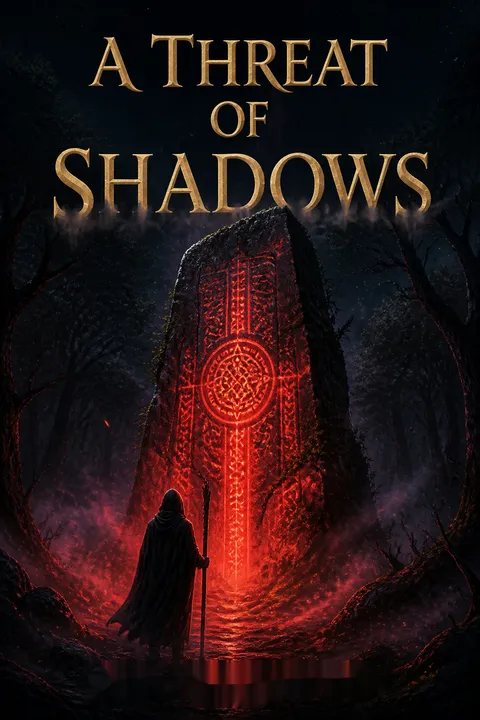


Plot Summary
Ghosts Bar the Way
After a year away, Keeper Alaric rides back through a forest where false howls and accusing ghosts torment him with the memory of his dying wife, Evangeline. He burns away the runes controlling the visions, then forces open the hidden passage to the Keepers’ Stronghold. He needs a record of Kordan, an old Keeper whose work may hold a cure for rock snake venom.
In the library, the Shield welcomes him without accusation, but warns that Queen Saren still needs his counsel and Keeper Will has disappeared. Alaric refuses to explain his absence or return to court. When the Shield identifies Kordan’s only scroll as restricted, Alaric’s fragile hope falters, but he descends to the forbidden shelves anyway.
The forest makes Alaric’s guilt physically obstructive: his past does not merely trouble him, it tries to turn him away from the only place that may help Evangeline. Yet he destroys the runes rather than accepting their version of events. His conflict is already double-edged. He seeks knowledge from the Keepers while refusing their community and its judgment. The Shield’s gentle welcome challenges Alaric’s assumption that he must be condemned, but his desperate task leaves him unable to accept belonging before he has secured a cure.
A Life in Red
Kordan’s scroll recounts how his attempt to save a snake-bitten boy instead stripped the child of his vitalle, leaving him alive but hollow. The warning makes Alaric recognize his own ruby as a Reservoir Stone: he created it by draining Evangeline’s life energy and preserving her body in crystal.
Through the Stronghold’s Wellstone, he gives the Keepers access to the memories he has guarded, including the poisoned arrow that began his search, the forbidden Shade Seeker texts, and the blood doctors’ failed experiments.
He shares them only because Kordan may have recorded the antidote there. But Kordan’s memories stop at his own Wellstone. Alaric has surrendered his secrets and still has no cure, only a clue pointing toward a buried treasure.
The red stone gives Alaric’s love a disturbing material form: he has kept Evangeline’s body alive, but the act that sustains his hope also makes her life usable as stored power. Kordan’s failure mirrors Alaric’s in advance, showing that compassion can become dangerous when it is translated into technical control. Sharing his memories with the Keepers is not reconciliation so much as a costly gamble. The scene distinguishes preserving a body from saving a person, a distinction Alaric is not yet ready to face.
The Treasure Road
Kordan’s memories reveal that his own Wellstone cannot be read through the Stronghold’s, so Alaric realizes the antidote must lie elsewhere. He leaves the Stronghold before dawn, carrying Evangeline’s ruby and a map of Kordan’s Blight, where the scroll says Kordan buried a treasure beneath an oak.
At a tavern, Alaric meets Brandson, a generous young blacksmith, Douglon, a suspicious dwarf, Gustav, a theatrical old wizard, and Ayda, an elf whose presence seems to bend the room’s attention. They are already hunting a legendary gem with a map Douglon found. Alaric joins them, claiming to be a royal historian. That night, Ayda enters his mind and discovers his secret, but agrees to keep it.
The accidental-seeming fellowship changes Alaric’s journey from solitary research into a problem of trust. He conceals his identity because he expects rejection, then accepts help from people whose motives he scarcely understands. Ayda’s intrusion makes intimacy feel both comforting and coercive: she sees the grief he hides, but she does so without permission. The map creates a practical reason for Alaric to remain with the group, while its unexplained coincidence quietly raises the possibility that their meeting is not entirely their own choice.
The Blazing Smithy
On the road, Alaric secretly uses a spell to make Brandson more forthcoming, learning that the group seeks Kordan’s gem and that Douglon’s cousin Patlon is tied to the map. When they reach Kordan’s Blight, Brandson finds his smithy burned and a childhood symbol identifying Patlon’s threat. The group hides at Milly’s farm, where Alaric deciphers the ancient runes on Douglon’s map.
They point not to Kordan’s Blight but to Bone Valley, a forbidden neighboring valley associated with a dragon. Brandson and Douglon recognize that the map has been misread for months. Milly joins the expedition, partly to escape the threatened village, and the group sets out together, carrying the treasure hunt into a place no one visits.
Alaric’s small manipulation of Brandson anticipates Gustav’s larger influence, even as Alaric tells himself his own spell merely assists the truth. The burned smithy makes the group’s shared adventure costly: Brandson loses his home because of Douglon’s private feud. Yet the response is not simple blame. Milly offers shelter, and the group redirects its fear into action. Reading the map also establishes Alaric’s value beyond magic. His Keeper training can interpret histories and symbols that brute force, confidence, and local knowledge cannot.
Fire Above Bone Valley
Crossing Bone Valley, the travelers find ancient bones beneath a silent forest. That night, a red dragon swoops down and kills Gustav, apparently swallowing the old wizard as he flees. Alaric shields the others and brings the dragon down briefly, but his magic leaves him badly burned and cannot stop it.
Ayda walks into the open and transforms its fire into falling shards, then befriends the dragon, Anguine, and persuades it to leave. Alaric admits he is a Keeper and explains that he joined to reach Kordan’s treasure. At dawn, the group honors Gustav with a rough grave marker. Milly’s observation about the nearby oaks sends them to the largest tree, where they find the treasure hole empty and Gustav’s shovel abandoned beside it.
The dragon reveals the difference between Alaric’s disciplined but costly craft and Ayda’s effortless, bewildering power. He spends himself trying to protect the group, while she changes the terms of the encounter by refusing to meet violence with violence. Gustav’s supposed death offers a brief release from danger, but the empty hole turns grief into betrayal. The group’s makeshift memorial matters because they mourned someone they barely knew. Their kindness was real even if the person who received it had already been using them.
The Wizard’s Second Face
The missing treasure convinces Douglon that Gustav survived and stole it. In the hole, Milly finds a bronze medallion whose looping runes repel Alaric’s attention and describe the draining of life through sacrifice.
Alaric identifies its darkness as Shade Seeker magic, while Ayda recalls Gustav’s fierce protectiveness of it. He concludes that the wizard had been manipulating the group, then set out with the stolen Wellstone. A borrey, a creature whose mating call lures women to their deaths, soon targets Milly.
Alaric sends Brandson and Douglon to shelter her, while Ayda changes into a tree to evade the creature. Alaric protects her until it leaves. When Ayda returns to human form, he learns she is an elven princess, not merely a wandering elf.
Gustav’s deception transforms the group’s earlier warmth into a question about agency: the travelers may have chosen one another, but their choices were quietly steered. The medallion makes that control visible as a corrupt technology, a tool that bends attention before it bends action. In contrast, Alaric’s defense of Milly and Ayda depends on cooperation and risk rather than hidden compulsion. Ayda’s transformation shows that her strangeness is not a decorative mystery. It is a survival skill, one that hints at a much larger burden.
Ayda’s Buried Kingdom
Ayda explains that eight years earlier, the elves collected the fragments of Mallon’s power into themselves so they could make his body vulnerable. The plan failed at a terrible cost: the elves died, their remaining life and will bound inside Ayda, while Mallon survived in a hidden grove, trapped but not dead.
Gustav means to find him and restore his power. Patlon rejoins the travelers with news that nomads are gathering in the Scale Mountains, and his feud has also put Douglon under a treason charge from the dwarven king.
Alaric persuades the group to pursue Gustav and protect Mallon’s body. Brandson and Milly refuse to go home, understanding that a revived Mallon would endanger ordinary people first. The companions ride toward Queenstown to enlist help.
Ayda’s history reframes her cheerfulness as a hard-won surface over collective trauma. She is not simply the last survivor: she carries the people who sacrificed themselves, a living archive that cannot rest. Her disclosure also shifts the stakes from a private cure to a political catastrophe. Brandson and Milly’s insistence on joining matters because they reject the idea that only rulers and magicians have a claim to confront danger. Their ordinary losses give the coming conflict its human scale.
The Queen’s Delayed Welcome
A storm drives Alaric’s party into Queenstown, where guards arrest Douglon on the claim that he plans to seize the dwarven throne. Queen Saren welcomes Alaric after two years of absence but must negotiate to keep Douglon free, trading the strategic Kollman Pass for a path to resolve his case. Alaric tells her about Gustav, Mallon, and the gathering nomads; Saren orders military preparations.
He also visits Ewan, the royal apothecary, who explains how Alaric’s long absence left Saren vulnerable to a failed coup and ambitious nobles. Ewan shares his own grief over his wife’s death, and Alaric turns one flower on her grave to stone as a lasting memorial. Their exchange helps Alaric see that his past actions need not dictate his next choice.
The court sequence tests whether Alaric can return to responsibility without pretending that his absence caused no harm. Saren’s bargain over the pass is not a simple rescue; she secures a larger political exchange while forcing Alaric to acknowledge the consequences of leaving. Ewan provides a different model of response to grief. His loss is neither solved nor converted into a grand mission. Alaric’s stone flower uses the dangerous boundary-crossing magic for remembrance rather than control, suggesting that method alone does not determine moral meaning.
Horwen Was Gustav
Alaric uses an old treaty to expose Duke Thornton’s unlawful demands and restore Saren’s leverage at court. Afterward, he finds a concealed message from Will, the missing Keeper, who confirms that Mallon lives and warns that Ayda carries a dangerous darkness.
Will also describes an old Shade Seeker among the nomads, disguised as a western lord. Alaric recognizes that Lord Horwen, who had attended the council, was Gustav. Searching Horwen’s abandoned rooms, he finds Kordan’s oak-carved box and realizes the treasure Gustav stole from Bone Valley was the emerald, not the Wellstone.
Kordan buried the emerald as a memorial to the boy he failed to save. The Wellstone must instead be at Kordan’s unfinished tower, so Alaric changes course before Gustav can reach it.
The revelation of Horwen as Gustav shows how easily a person can mistake distraction for judgment. Alaric had not lacked information; Gustav had shaped what seemed worth noticing. The mistaken treasure deepens that failure, because Alaric’s assumptions sent him toward the wrong object and delayed his search for the cure. Yet the oak box also revises Kordan’s character. The emerald was not merely abandoned evidence of forbidden research; it was a grave marker, a final act of grief. The story resists reducing a flawed choice to a complete identity.
Kordan’s Hollow Stronghold
The group reaches Kordan’s hidden valley, where a rough wall and tunnel imitate the Keepers’ Stronghold. Bandits attack on the trail, and Douglon is struck by an arrow while shielding Ayda. Ayda saves him by sharing some of her own power, leaving him able to sense the trees. Inside Kordan’s unfinished tower, the travelers find dragon claw marks, wreckage, and the empty stand where the Wellstone once sat.
Alaric reads Kordan’s journal and learns that his experiments in healing always demanded a larger sacrifice than the life restored. Kordan considered sacrificing a dragon or multiple people to save one human. Alaric realizes Gustav may use Anguine as the price of raising Mallon, and the group races toward the Shade Seekers’ valley.
Kordan’s ruined tower is a failed imitation not only of Keeper architecture but of Keeper ethics. He tried to preserve the institution’s shape after leaving its community, while his experiments increasingly treated life as a quantity to exchange. Douglon’s rescue provides a counterexample: Ayda’s power is used to restore a companion, though it leaves a lasting change and a moral complication. Alaric recognizes the danger in Kordan’s arithmetic because it resembles his own temptation to calculate what he might sacrifice for Evangeline.
The Fire Lizard Remembers
On the approach to Sidion, the travelers encounter monsters made from once-human captives. Ayda refuses to kill them and uses her power to quiet some, while Brandson and Douglon protect the group.
At night, a fire lizard approaches their camp, but Ayda reaches its mind and recovers a trace of the person inside. The creature accepts the name Nox and guides them to the keep, revealing that Gustav plans to summon the valley’s monsters for a mass sacrifice. At dawn, Ayda slips away under Gustav’s influence.
Gustav then traps the others inside a ring of boulders with spells and guards, taking their weapons. When he discovers Alaric’s ruby, he identifies it as a Reservoir Stone and recognizes that Evangeline’s life energy could help awaken Mallon.
The monsters force the party to confront the afterlife of violence: people can be changed until their former selves are nearly inaccessible, yet Ayda still insists that their suffering matters. Nox offers a fragile version of recovery, remembering enough to choose a name and a course of action. Gustav’s capture reverses the group’s earlier agency and makes Alaric’s secret visible to their enemy. The ruby ceases to be a private symbol of hope and becomes a resource others can exploit, sharpening the conflict between love and possession.
Kordan Chooses Again
Alaric breaks Gustav’s binding spell by drawing on the vitalle inside the surrounding stones, then frees his companions and drives away the controlled creatures. At the keep, they find Gustav beginning a ritual around Mallon’s body.
The wizard has trapped Ayda as a tree inside the rune circle and placed the stolen Wellstone nearby. Alaric realizes the circle can be disrupted only by replacing its intended sacrifice. Nox returns to the circle and reveals that he is Kordan, transformed long ago after his failed attempt to save the bitten boy.
He gives Alaric the antidote recipe, acadanthus leaves brewed as tea, then chooses to power the ritual himself, knowing it will kill him and leave Mallon weak. Alaric removes Evangeline’s ruby from the spell and lets Kordan make that choice.
Kordan’s identity completes a long moral loop: the Keeper who once tried to overcome death by treating lives as fuel now chooses his own sacrifice freely. That distinction does not erase his earlier harm, but it changes what his final act means. Alaric’s removal of Evangeline’s ruby is equally decisive. He stops treating her preserved life as a tool for a future rescue and refuses to let Gustav claim it. The sacrifice remains tragic, but the participants’ agency, rather than an imposed calculation, defines the choice.
The Darkness Returns
Kordan’s energy revives Mallon, but the Rivor rises weakened. He immediately tries to draw Ayda toward him, claiming the darkness she has carried since the elves’ sacrifice. Alaric breaks Gustav’s influence over her by opening his mind and reminding her of the bonds she has formed with the group.
Ayda then draws the darkness from herself, while the remaining elven spirits bind it into a single mass. Alaric holds Mallon in place as Ayda adds the frozen flame necklace, restored to fire, to the spell.
The darkness, elven power, and flame collapse together in a blast that destroys the altar, Mallon, Gustav, and Kordan. When the dust settles, the courtyard holds only a deep crater. The threat is ended, but the last of the elves has paid the cost.
Mallon’s return makes Ayda’s inner life the battlefield: the force that once threatened to consume her becomes the instrument of his destruction. Alaric cannot save her through command or magic alone. He helps by restoring her sense of relationship, giving her a reason to act from something other than rage and isolation. The final combination of darkness, elven spirits, and flame is not a clean victory. It turns long endurance into an explosive release, ending Mallon while extinguishing the people who had kept him contained.
A Cure, Then Goodbye
Alaric brings the group to his castle, where Evangeline lies preserved in crystal. He brews Kordan’s acadanthus antidote for Brandson, then learns through Ayda that Evangeline is conscious within her still body and wants to see him.
Alaric releases the protective runes and returns the ruby’s remaining energy, but it cannot restore enough life. Evangeline wakes briefly, free of the fever and able to speak, then Ayda gives her own remaining vitality to heal the damage completely. Evangeline lives; Ayda dies in Douglon’s arms.
Alaric later seals Ayda’s body in crystal beside the flowers she wore, preserving her for years. With Evangeline beside him, he accepts that he is still a Keeper and plans to return to court, while the missing Will and Evangeline’s unexpected knowledge of elven history remain unresolved.
The cure does not deliver the simple reward Alaric pursued. Acadanthus tea treats the venom, but it cannot replace the life he drained from Evangeline; Ayda must choose to give what remains of her own. This makes the ending a rebuke to Alaric’s private bargain, not a denial of his love. Ayda’s death is an act of agency, but also a loss that cannot be made painless by preserving her body. Alaric’s renewed Keeper identity begins in grief and limitation, rather than certainty that every life can be saved.
Analysis
A Threat of Shadows turns the rescue quest into an inquiry about what love permits a person to do to another. Alaric’s motive is sympathetic: Evangeline is dying, and his established skills cannot cure her. Yet the ruby reveals the danger of making preservation the only measure of care. He can keep her body from changing, but he cannot know whether the person he loves can be restored by force, stored energy, or sufficient sacrifice. His pursuit repeatedly converts life into a technical problem, and Kordan’s history warns that compassion does not make such calculations harmless.
The story sets Alaric’s private crisis against a social world made of relationships and obligations. Saren’s court, Brandson’s found family, Douglon’s complicated kinship, and Ayda’s burden of an entire people all resist the fantasy that one individual can solve suffering alone. These relationships also expose different forms of power. Gustav’s influence works by disguising control as choice. The Keepers’ runes impose order through study. Ayda’s magic is immense, but her most consequential actions arise from attachment and consent, not sheer capacity.
The book’s moral argument is not that past choices cease to matter. Alaric’s actions leave consequences for Evangeline and for the Keepers, while Kordan’s experiments leave him changed. Rather, the story refuses to make a person identical to a single act. Kordan can choose differently at the end; Alaric can return to Keeper work without pretending his failures were noble; Nox can seek freedom without recovering an innocent past. Redemption is presented as renewed action under conditions that cannot be undone.
The resolution complicates triumph. Mallon is destroyed, but the cost is Ayda’s remaining life, and the cure Alaric sought cannot itself restore Evangeline. Her survival depends on another person’s freely chosen gift. The ending therefore grants Alaric what he longed for while denying him the belief that love can abolish mortality. He comes back to the world not as its savior, but as someone willing to serve it, grieve within it, and accept the limits of what he can repair.
Characters
Alaric
Grieving Keeper in exileA gifted Keeper, historian, and energy-worker, Alaric has spent years advising rulers and studying the forces that shape Queensland. His marriage to Evangeline gives his learning an intimate stake, and her poisoning drives him beyond the limits his order has set. He is perceptive about patterns but not immune to self-deception: grief narrows his attention until he mistakes desperate control for rescue. Alaric’s reserve comes partly from shame and partly from a genuine need to act without institutional permission. He values knowledge, loyalty, and the ordinary lives that political maps can flatten. His central struggle is whether a terrible past disqualifies him from choosing responsibility again.
Evangeline
Beloved absent wifeEvangeline is an innkeeper whose warmth, humor, and practical generosity draw Alaric out of his scholarly habits. She enjoys stories, bargains with confidence, and notices when he is too absorbed in searching for answers to appreciate what is already beside him. Their marriage rests on companionship as much as romance: she welcomes his odd interests while teasing him about them. Though absent from much of the present-day journey, her memories shape Alaric’s choices and expose the difference between love and possession. She represents a life with daily pleasures and mutual recognition, not merely the person Alaric wants to save.
Ayda
Unruly elven travelerAyda is a bright, distractible elf who talks to trees, reads emotional colors, and unsettles people with her ability to influence attention. She appears playful and socially effortless, yet her humor often hides loneliness and a reluctance to explain what she carries. Her remarkable magic makes her both a protector and a danger to herself; she can act with enormous force before considering the cost. Ayda forms relationships across boundaries that her culture and others treat as fixed, including with humans and dwarves. Her generosity is real, but so is her difficulty recognizing when those around her love her without being compelled to do so.
Douglon
Blunt dwarf treasure-hunterDouglon is a gruff dwarf with a battle-axe, a sharp distrust of humans, and a talent for turning family grievances into public trouble. His long rivalry with his cousin Patlon complicates his loyalty to the traveling group, while his pride makes it difficult for him to admit fear or affection. Beneath the insults, he is more tender-hearted than he wants others to know. He values autonomy and rejects the possibility of being pushed into royal responsibility, even when his ancestry gives him a claim to power. His bluntness is both armor and honesty, often exposing what more polished characters would rather leave unsaid.
Brandson
Orphaned village blacksmithBrandson is a young blacksmith whose kindness turns a collection of strangers into a household. Orphaned by the yellow plague, he has built a family through hospitality rather than blood, taking in people others might dismiss. His generosity is not naivety alone: he expects people to become better when trusted, though that expectation leaves him vulnerable to exploitation. Brandson’s skill with metal and his willingness to stand beside friends give him a practical role in dangerous situations, even when he lacks a warrior’s training. He carries grief for his parents and uncle, and his choice to face a renewed threat grows from a refusal to let Mallon keep taking people from him.
Milly
Practical village milkmaidMilly is Brandson’s neighbor, a capable farm worker whose calm generosity gives the group shelter after the smithy burns. She offers help without treating it as a debt, and she is willing to challenge the travelers when their plans exclude ordinary people. Her practical judgment often cuts through the grand language of wizards and treasure hunters. Milly is neither a warrior nor a scholar, but she pays attention to people and sees value in those others have written off. Her growing closeness with Brandson develops through shared care and danger rather than dramatic declarations.
Gustav
Storytelling old wizardGustav presents himself as an eccentric, boastful wizard who delights in legends, theatrical gestures, and elaborate claims about his past. His apparent foolishness makes it easy for others to underestimate him, while his appetite for influence and power remains difficult to read. He is attentive to what people want and knows how to exploit the gap between their intentions and their awareness. Gustav’s loneliness complicates his allegiance to Mallon: he longs to be valued, even by someone who treats other people as instruments. His outward bumbling persona is a deliberate contrast to the patience and calculation with which he pursues his aims.
Kordan
Former Keeper researcherKordan was a Keeper whose experiments with seeds and the boundary between life and death led him into dangerous forms of magic. His surviving writings reveal a curious, methodical mind, but also how intellectual focus can narrow moral attention. Kordan is troubled by what he has done and attempts to record his failures as a warning, though his remorse does not undo their consequences. His work on Reservoir Stones and healing becomes central to Alaric’s search, making him a distorted mirror of the protagonist: both men want to save life, and both must confront what their methods demand.
Nox
Northern fire lizardNox is an intelligent fire lizard with a long history of captivity and service to the Shade Seekers. He can communicate through thought and retains more memory than most of the valley’s transformed creatures. Cautious and weary, he wants freedom more than renewed status or restored identity. His guarded view of redemption gives Alaric’s hopeful beliefs a necessary test: some harms cannot be undone, even when a person chooses differently now. Nox’s decision to help the travelers emerges from his own judgment, not obedience.
Mallon
Ancient mind-stealing tyrantKnown as the Rivor, Mallon is a Shade Seeker whose power once bent minds, commanded armies, and spread disease and terror across Queensland. He sees other people as sources of power or tools for his plans, a worldview that makes loyalty to him a form of self-erasure. Even in absence, the fragments of his will continue to shape events and leave damage in those who resist him. Mallon functions as both a political threat and a dark extreme of magical ambition: power without reciprocal obligation, restraint, or concern for the lives it consumes.
Queen Saren
Queen under pressureSaren is a humane ruler who must learn to pair compassion with political calculation. Alaric once served as her closest adviser, and his absence leaves her to confront court factions, a failed coup, and the demands of neighboring powers. She still values his judgment, but she no longer waits passively for him to decide when he is ready to help. Her warmth toward ordinary visitors coexists with a growing command of negotiation and statecraft. Saren’s leadership is shaped by grief for her husband and by the knowledge that good intentions alone cannot keep a kingdom stable.
The Shield
Keeper council leaderThe Shield leads the Keepers with patience, extensive knowledge, and a willingness to see people as more than their worst decision. He understands the order’s restrictions and the dangers behind them, but he does not confuse prohibition with moral infallibility. His relationship with Alaric is affectionate yet candid: he offers a path back without pretending that the protagonist’s choices have no cost. The Shield embodies the institutional memory Alaric both needs and resists.
Ewan
Patient royal apothecaryEwan is a skilled apothecary and an old friend who listens without rushing to judge. He understands poisons and remedies, but he also knows the limits of medicine through his own experience of losing his wife, Reece. His grief is quieter than Alaric’s, worn into daily life rather than driven by the hope of a cure. Ewan offers Alaric a model of companionship that does not demand a solution before sorrow can be spoken. His practical knowledge helps the group, while his counsel helps Alaric distinguish remorse from permanent self-condemnation.
Will
Missing Keeper brotherWill is a fellow Keeper and Alaric’s longtime friend, known for storytelling, curiosity, and a willingness to linger where others would move on. His journey into the Greenwood connects him to the mystery of the elves and Mallon’s fate. Will’s hidden message shows a more cautious side beneath his sociability: he records fears he cannot safely entrust to ordinary channels. His disappearance leaves Alaric with both practical uncertainty and the ache of a friendship interrupted.
Patlon
Restless dwarf cousinPatlon is Douglon’s cousin and childhood companion, a capable hunter whose pride and poor communication help turn a treasure dispute into a serious feud. His choices contribute to Douglon’s troubles with the dwarven king, but he is not simply an adversary. Patlon has a practical loyalty to his people and can recognize when a larger danger matters more than a family quarrel. His relationship with Douglon carries the intimacy of brothers who know exactly how to provoke each other.
Duke Thornton
Ambitious southern dukeThornton is a young noble who uses the instability of Saren’s court to strengthen his political position. He treats authority as something to be accumulated and tested, and he dismisses people whose titles or appearance do not impress him. His maneuvers over southern trade routes expose how private ambition can exploit a ruler’s isolation. Thornton is a human political threat, distinct from the magical dangers surrounding Mallon.
Plot Devices
The Wellstone
Memory and power vesselA crystal that stores memories and vitalle, the energy associated with life. The Keepers use their Wellstone to preserve records and make accumulated knowledge accessible, while Kordan’s personal Wellstone holds his own memories and research. Gustav seeks it as a reservoir for the power needed to revive Mallon. The distinction between the two stones drives Alaric’s false lead and later brings the history of Kordan’s experiments directly into the present. The Wellstone makes memory tangible, but its ability to store energy also raises the question of whether knowledge and life can be separated from the people who produced them.
The Reservoir Stones
Life held as energyReservoir Stones form when a person’s vitalle is extracted and condensed into a gem. Alaric creates a ruby from Evangeline’s life energy to preserve her body while he searches for a cure. Kordan creates an emerald during a failed attempt to save a boy. The stones preserve only part of a person’s life, so they cannot simply restore someone whole. Gustav’s plan gives the ruby a second, dangerous purpose, forcing Alaric to decide whether he will keep treating Evangeline’s remaining energy as a resource.
Influence Magic
Choices quietly redirectedInfluence magic alters attention and inclination, making a target feel that a suggestion is their own idea. Gustav uses it subtly, drawing people toward the treasure hunt and making himself easy to overlook. His influence affects the travelers in different ways, obscuring his intentions without erasing their personalities. The magic makes the plot’s coincidences suspect and turns trust into a question of consent. Alaric must eventually recognize that his own mind is being shaped before he can help Ayda resist the same force.
Keeper Runes
Magic shaped by knowledgeKeepers use runes to channel, direct, and store energy. Their precision depends on understanding meaning and connection, not merely reciting a formula. The ancient runes on Douglon’s map conceal Kordan’s route, while Gustav’s hastily written ritual runes form a circle around Mallon and its intended sacrifices. Alaric’s ability to read them gives him a way to challenge a stronger opponent through interpretation rather than force. Runes also embody the book’s ethical tension: knowledge can protect life, but the same technique can be arranged to consume it.
The Frozen Flame
Stored potential becomes weaponAyda transforms fire into a solid, harmless crystal while preserving its potential to burn again. She gives Alaric a small flame-shaped pendant, which becomes a symbol of their friendship and of her unusual power. Because the flame can later be restored, it offers Alaric a substitute source of latent energy when he needs to prevent Gustav from draining Evangeline’s ruby. Its eventual use against Mallon depends on the difference between an object that is inactive and one whose power has been erased.
The Keeper Chronicles Series
Download PDF
Download EPUB
.epub digital book format is ideal for reading ebooks on phones, tablets, and e-readers.








