

Key Takeaways
Treat mental health as everyday care, not a problem reserved for others
Everyone has mental health. It changes across a lifetime, and anyone can struggle when personal vulnerabilities meet enough stress. Hepburn’s mental health jam jar makes this interaction visible: vulnerabilities fill some of the jar, while stressful events add more. When the contents exceed its capacity, difficulties can emerge. The metaphor shifts distress away from personal failure and toward a combination of circumstances and susceptibility.
Care is whole-person care. The mind is shaped by the brain, body, and environment together. Sleep, physical health, relationships, and living conditions can all affect how a person feels and responds. A personal toolkit of coping strategies can help create more capacity, but it is not a promise of constant happiness or a substitute for appropriate treatment.
The jar metaphor is useful because it explains unequal responses without ranking people by toughness. It also gives two distinct routes for action: reduce avoidable pressure, or strengthen support and coping. Its limit is that a metaphor can make distress sound like a simple threshold problem. Mental health difficulties are not always predictable from a neat balance of inputs, and social conditions can be hard to change. The model works best as a compassionate starting point, not a diagnostic test or a reason to blame someone for an overflowing jar.
Check sleep, food, and water before searching for a deeper explanation
Start with the body. Hunger, thirst, tiredness, pain, and illness can affect mood and concentration. The brain may search for an elaborate explanation for feeling bad when the immediate cause is simple: eating after an unrecognized bout of hunger can make the distress ease. Sleep also supports attention and memory, while poor sleep can make everyday demands feel harder.
Build in pleasure, too. Looking after the basics includes eating regularly and variedly, drinking enough, and noticing whether caffeine or alcohol is affecting wellbeing. It also means making room for rest, enjoyment, and relaxation. Small enjoyable activities can be planned across the week rather than left to whatever time remains. If food difficulties make regular or varied eating hard, the book recommends speaking with a health professional.
This advice guards against a common reasoning error: interpreting every unpleasant mood as evidence of a deep personal problem. Checking basic needs is a low-cost first step that can interrupt an avoidable spiral. The same principle applies to enjoyment, which is often treated as a reward for finishing everything else. Still, bodily basics do not explain every form of distress, and advice about diet or sleep can feel inaccessible to people facing illness, shift work, or financial strain. Practical care should account for constraints, not imply that distress is simply a failure of routine.
Build wellbeing through connection, movement, awareness, learning, and giving
Five sources of support. Hepburn groups everyday contributors to mental health into five pillars: relationships, physical activity, attention to the present, learning, and helping others. Connection can offer validation and perspective. Movement can shift mood without requiring a formal workout. Present-moment attention helps people notice what they feel and need. Learning keeps curiosity active, and giving can strengthen social ties while creating a sense of contribution.
Make them ordinary. These activities need not be ambitious: a conversation with someone trusted, gardening, noticing the surroundings on a walk, listening to an informative programme, or taking time to help another person all fit. The point is not to complete a perfect checklist. It is to notice which sources are missing from daily life and find a realistic way to restore one.
The framework is broad enough to resist the idea that wellbeing comes from one magic habit. It also connects personal care with social life: helping and being helped are not opposites, and activity can be gentle rather than athletic. Its breadth is a strength, but it can become another performance checklist if every pillar is treated as an obligation. The practical test is whether an activity fits a person’s circumstances and feels nourishing or meaningful, not whether all five boxes are filled every day.
Use values as directions for daily choices, not trophies to earn
Values guide action. Values are enduring qualities a person wants their actions to express, not goals with a finish line. A goal might be completing a particular project; a value might be curiosity, care, or connection, which can shape many choices across a lifetime. Hepburn suggests identifying a few central values by asking what feels fulfilling, what qualities matter in others, and what a person hopes will be remembered about them.
Check the direction. Her values signpost is a way to pause before a choice and ask whether it moves toward or away from what matters. For instance, picking up a phone might support connection if it means contacting a friend, or pull away from a value if it becomes aimless scrolling. Values do not make decisions effortless, but they can clarify what a difficult choice is asking.
Values offer a useful counterweight to achievement-only measures of a good life. Because they describe a direction rather than a completed outcome, they remain available during illness, setbacks, or changed plans. The distinction also prevents goals from becoming proxies for self-worth. However, values can conflict: time devoted to work may express responsibility while limiting family connection. The signpost is therefore a prompt for deliberate trade-offs, not a machine that produces one objectively correct answer.
Notice your capacity before one small hassle becomes the breaking point
Capacity has a limit. The capacity cup represents the emotional and practical resources available at a given time. Work, caring responsibilities, medical concerns, and even positive plans all take up room, in different amounts for different people. When the cup nears its brim, a minor setback can provoke a reaction that seems out of proportion. A parent’s sharp response after a demanding workday, rushed pickup, and stressful drive may make more sense when the accumulated load is visible.
Act in the amber zone. Notice personal warning signs such as tension, irritability, or feeling overwhelmed. Then remove or postpone a demand where possible, decline something new, ask for help, or take a break. These actions are not evidence of failure. They protect limited resources for what matters and can prevent stress from escalating into a more damaging spiral.
The cup gives a practical explanation for why the same task can feel manageable one day and impossible the next. It encourages people to interpret reactions in context rather than turning one bad moment into a verdict on character. The idea also makes capacity partly visible, which can help when asking others for support. Its subjective nature matters: a drawn cup cannot measure anyone’s capacity or guarantee that a stressor can be removed. It is best used to prompt reflection and adjustment, not to compare people.
Name emotions and make room for them instead of declaring war
Feelings involve the body. Emotions include bodily sensations that the brain interprets, such as tension, warmth, or a racing heart. Naming a feeling can create enough distance to notice it and consider what it signals. Emotional granulation means describing feelings with greater precision than simply “good” or “bad.” A person might distinguish disappointment from embarrassment, or anxiety from excitement, even when several feelings arrive together.
Observe before reacting. Hepburn’s approach is to notice the sensation, breathe gently, allow it to be present without judging it, and offer a supportive reminder that feelings change. The emotions cycle then helps trace how a trigger, thoughts, bodily reactions, and actions affect one another. The goal is not to erase emotion, but to understand it and choose a response. If exploring long-suppressed feelings feels overwhelming, the book advises seeking a safe professional setting.
A richer emotional vocabulary can turn an indistinct alarm into information that is easier to work with. This is not the same as obeying every feeling: anxiety may signal a real threat, or reflect an overactive prediction, so context still matters. The distinction between acknowledging an emotion and letting it dictate behavior is especially useful. The practice also deserves a humane pace. Attention to bodily sensations can be uncomfortable for some people, so tolerating feelings should not be framed as a test of courage or something to force.
Change fixable stressors, but don't confuse avoidance with lasting relief
Find the source first. Feelings may follow a clear event, a gradual pile-up of demands, a memory, or basic needs such as hunger and tiredness. If a changeable trigger is causing harm, address it where possible. If a loss or other unchangeable event is at the center, focus instead on support and coping. Sometimes both are needed: workplace bullying calls for action against the bullying as well as help managing its effects.
Check what avoidance costs. Social media can inform and connect people, but endless scrolling, constant alerts, validation-seeking, and comparison with polished images may worsen mood or displace valued activities. The book notes that studies link heavier use with poorer mental health, while the direction of cause is not clear. Limits, muted accounts, and phone-free periods can help. Yet reducing exposure is not always the right answer if it means giving up something valuable.
This distinction avoids a simplistic message that people should merely become more resilient. Sometimes the distressing situation itself needs to change; in other cases, a person chooses to build tolerance for something they want to do. Social media is a particularly useful example because it can be both a source of connection and a source of pressure. The important question is not whether a platform is universally good or bad, but what role it plays in a person’s life and what its use is displacing.
Treat self-doubt and mistakes as information, not proof of incompetence
Self-doubt distorts credit. Imposter syndrome describes feeling fraudulent despite having relevant competence, often by crediting success to luck and treating errors as proof of personal inadequacy. The book cites an estimate that about 70 percent of people experience it. New roles, uncertainty, and high stress can intensify it. A useful check is to compare the harsh internal assessment with evidence, past achievements, feedback, and the likely causes of a setback.
Mistakes are part of learning. The brain revises predictions when outcomes differ from expectations, but people often treat errors as evidence that they should never have tried. That can lead to procrastination, avoidance, or perfectionism. Instead, ask what the mistake actually means, what can be learned, and what a fair response to a friend would be. A “Ta Da” list of small accomplishments can counter the tendency to notice only what went wrong.
The section usefully separates competence from the feeling of confidence. Discomfort may mean a task is new, not that a person is unqualified; equally, self-doubt can sometimes point to a genuine need for training or support. That makes evidence and outside perspective more useful than blanket reassurance. The mistake framework also values learning without romanticizing failure: some errors have real costs, and repair matters. Self-compassion should make honest correction easier, not replace responsibility.
Put your thoughts on trial without treating every thought as truth
Thoughts shape experience. Mental images and predictions can produce real emotional and physical reactions, even when the imagined event is not happening. Thoughts also filter what people notice: someone who expects to fail may find confirming evidence and overlook contrary signs. Common patterns include mind-reading, jumping to conclusions, blaming oneself, and turning one mistake into a judgment about the whole self.
Create distance, then examine. A person can notice a thought as a thought, rather than automatically accepting or fighting it. When useful, write it down and ask whether it is fair, what evidence supports other interpretations, and what would be said to a friend. The inner critic, self-imposed “shoulds,” and catastrophic predictions can be examined this way. The aim is a more balanced account, not forced optimism or certainty about the future.
The distinction between a thought and a fact is powerful because it creates a pause between interpretation and action. It also allows two strategies: letting a thought pass without engaging, or testing its accuracy when the conclusion matters. Neither method requires pretending that difficult circumstances are harmless. A balanced account may still identify genuine risk or injustice. The approach is most useful when it increases flexibility, rather than turning every thought into another problem to analyze.
Turn valued intentions into small actions, and plan for setbacks
Make change concrete. A useful goal is specific, achievable, connected to a value, and framed as something to move toward. Rather than a vague wish to be more sociable, a person might choose a manageable regular way to contact friends. Small habits are easier to sustain when attached to an existing routine, introduced one at a time, and supported by the environment. A reminder or prepared item can reduce the effort needed to begin.
Expect old patterns. New behaviors take effort, especially when someone is tired or overloaded. A setback does not erase prior progress; it can reveal a barrier that needs attention. Instead of self-criticism, ask what made the new behavior difficult and what adjustment might help next time. Goals also need flexibility: circumstances change, and a smaller step or a revised plan may fit better than abandoning what matters.
This approach treats behavior change as design rather than a referendum on willpower. Connecting a small action to an existing routine reduces the number of decisions required, while a supportive environment makes follow-through more likely. The emphasis on learning goals also leaves room for discovery instead of demanding immediate perfection. Still, not every obstacle can be solved by shrinking the task. Overload may require fewer commitments or practical support, not a more efficient personal habit.
Calm the body and protect rest to regain room for clear thinking
The body can shift the cycle. Stress activates the body’s action-ready response; the parasympathetic nervous system supports calmer, restful processes. Gentle breathing, movement, stretching, time outdoors, or pleasant physical contact may help change bodily sensations and make it easier to think. Hepburn suggests practising slow breathing when calm, including making the exhale slightly longer than the inhale, so the technique is familiar when stress rises.
Rest is functional. Breaks give the mind and body time to recover and can create space for attention and problem-solving. A short walk between tasks may be more manageable than waiting for a long holiday. These strategies do not remove a real external threat or solve every problem. Their role is to reduce immediate strain enough to support a more considered response and make ongoing demands easier to manage.
This is a valuable correction to the assumption that emotional problems must be solved through thinking alone. When someone is highly activated, bodily regulation can create the conditions for reflection, rather than serving as a substitute for it. The book also challenges cultures that equate busyness with worth. A useful qualification is that breathing exercises and touch are not universally comfortable; the point is to find a regulating practice that suits the individual, not to prescribe one technique to everyone.
Prepare support before crisis, and address harmful circumstances where possible
Make help easier to reach. Distress can make decisions and planning difficult, so Hepburn recommends preparing a mental health first-aid kit in advance. It can include trusted contacts, helplines, and information about local services. If low mood, anxiety, or other distress affects wellbeing or functioning, or lasts more than two weeks, the book suggests speaking with a healthcare provider. Seeking help is presented as ordinary care, not a personal failure.
Look beyond the individual. Some distress is a natural response to a painful event; some is sustained by chronic stressors such as financial difficulty, bullying, abuse, or trauma. Coping strategies may help, but they cannot by themselves make a harmful situation acceptable. When possible, the priority is to address the source, with appropriate support. The book also argues that individual treatment is only part of the picture, since social conditions shape mental health.
The first-aid-kit idea recognizes a practical feature of crisis: the moment when help is most needed may be the moment when finding it feels hardest. Advance planning reduces that friction and can make support feel more legitimate. The emphasis on circumstances also guards against medicalizing every reasonable response to adversity. A prepared list cannot fix limited access to care, however, and professional help is not always easy to obtain. That makes personal preparation useful, while leaving a clear role for better collective and public support.
Analysis
The book’s central achievement is to make mental health understandable without reducing it to either brain chemistry or personal attitude. Its repeated movement among body, brain, environment, and behavior gives readers a more complete map of distress than a simple instruction to think positively. The metaphors do much of the teaching: the jam jar explains vulnerability and stress, the capacity cup makes overload visible, and the emotions cycle links triggers to thoughts, sensations, and actions. Each turns an abstract process into something a reader can inspect.
The toolkit format is well matched to the subject. It treats strategies as options to select and revise, rather than a universal program that promises permanent happiness. Its most important ethical distinction is between coping with distress and changing what causes it. Breathing, self-compassion, and habit design may help someone function, but bullying, abuse, poverty, or chronic strain are not problems that can be solved by individual resilience alone.
The format also creates a tension. A book of exercises can make care actionable, but the sheer number of tools can feel like another set of duties to a person who is already overloaded. The book counters this by emphasizing small steps and personal fit, though readers may still benefit from choosing only one starting point. Its models are best treated as prompts for observation, not clinical explanations that diagnose a person or predict exactly what will happen.
The strongest practical sequence is therefore modest: notice the body and current load, name the emotion, identify whether the stressor can change, and choose one response aligned with personal values. If distress persists or functioning is affected, involve appropriate support. That sequence preserves the book’s hope without pretending that every problem can be managed privately or quickly.
Review Summary
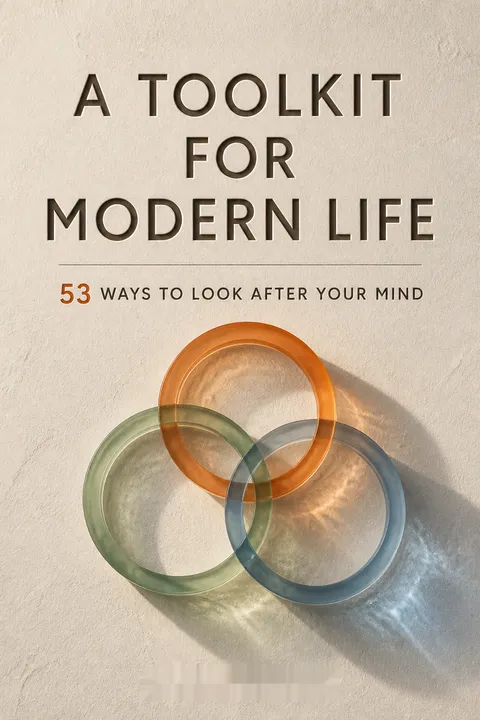
A Toolkit for Modern Life receives positive reviews for its accessible approach to mental health. Readers appreciate the practical exercises, cute illustrations, and clear explanations of psychological concepts. Many find it helpful for self-reflection and managing daily stressors. The book is praised for its engaging style and usefulness as a reference. Some readers note that the content may be basic for those already familiar with mental health topics. Overall, reviewers recommend it as a valuable resource for improving mental well-being and understanding emotions.
People Also Read




Glossary
mental health jam jar
Vulnerability and stress modelA metaphor for how mental health difficulties can arise when stressors exceed a person’s available capacity. Vulnerabilities may be biological, social, cognitive, environmental, or shaped by life experience; stressors change over time. Coping strategies and support can help create more capacity, while the model emphasizes that different people face different starting conditions.
capacity cup
Model of emotional loadA metaphor for the limited emotional and practical resources available at a particular time. Everyday demands, major stressors, and even positive plans take up capacity. Near the brim, a small additional demand may provoke overwhelm or an unusually intense reaction. Noticing warning signs can prompt a person to reduce demands, seek help, or care for basic needs.
The 5 pillars of mental health
Five wellbeing resourcesA framework organizing everyday contributors to mental wellbeing into social connection, physical activity, present-moment awareness, learning, and giving. The activities need not be formal or ambitious. A conversation, gentle movement, attention to surroundings, trying something new, or offering practical help can each bring one of these resources into daily life.
emotional granulation
Precise emotion vocabularyThe ability to distinguish and describe feelings in increasingly specific terms, rather than relying only on broad labels such as good, bad, happy, or sad. More precise naming can help a person understand what an emotion may signal and consider a response. Different emotions can also occur at the same time.
emotions cycle
Map of emotional responsesA way to examine how a trigger relates to thoughts, bodily sensations, emotions, and behavior, and how those responses feed back into how a person feels. Mapping the cycle can reveal actions that sustain distress or help regulate it. It is a reflection tool, not a claim that every emotion has an obvious cause.
values signpost
Values-based choice promptA visualization used to consider whether a choice moves toward or away from a person’s guiding values. Values are enduring directions for action, not goals that can be completed once. The signpost can bring a decision into awareness, especially when a habitual response or difficult choice might conflict with what matters.
mental health first-aid kit
Prepared support planA set of practical reminders and contact information prepared for times when distress makes planning difficult. It may include trusted people, helplines, and directions for accessing local professional support. Preparing it in advance reduces the effort required to identify next steps when mental health is deteriorating.
Download PDF
Download EPUB
.epub digital book format is ideal for reading ebooks on phones, tablets, and e-readers.








