

Key Takeaways
Treat the struggle with anxiety, not anxiety itself, as the central problem
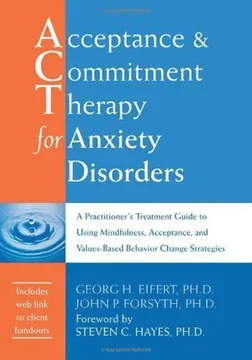
The target is the fight. Acceptance and Commitment Therapy, or ACT, starts from a counterintuitive idea: anxiety is not necessarily the thing making life unlivable. The exhausting efforts to suppress, escape, or control inner experiences can become the bigger problem. The book calls this pattern experiential avoidance. It can include dodging places, rituals, reassurance-seeking, or mentally wrestling with frightening thoughts, even when these tactics shrink a person’s life.
Keep life in view. A woman who avoids certain turns after a panic attack may feel temporarily safer, but complicated routes and constant vigilance begin to organize her day. ACT does not dismiss established treatments such as exposure. It changes the purpose: practice responding differently to anxiety so that meaningful activities are possible, whether or not anxiety disappears.
This reframing shifts attention from a symptom’s presence to its consequences, a distinction also useful in chronic pain and rehabilitation. Pain may persist while functioning improves, so symptom intensity alone can miss important gains. The approach is strongest when it asks whether a behavior is workable in context, rather than labeling control as inherently bad. Some anxiety management is sensible, and some symptoms deserve direct treatment. The practical test is whether the strategy protects health and agency, or whether it demands an ever-smaller life in exchange for brief relief.
A panic attack is common; a life organized around preventing another is the trap
Fear is an alarm. The book distinguishes fear, a present-focused response to immediate or imagined danger, from anxiety, the future-focused apprehension of what might happen. Both can help people prepare, escape genuine danger, or make a plan. The authors cite studies in which about 35 percent of young adults experienced at least one panic attack in a year, while roughly 3 to 5 percent met criteria for panic disorder. The difference is not simply having a frightening episode.
Watch what follows. People can develop a disorder when fear of another attack drives persistent worry, escape, and avoidance. Someone who leaves a crowded place during panic may get short-term relief, but may begin avoiding more settings where escape feels difficult. The central warning is not that fear is abnormal. It is that rigid avoidance can turn a normal alarm into a life-limiting cycle.
The distinction resembles the difference between a useful alarm and a costly alarm system that keeps sounding after the threat has passed. In learning theory, relief after escape can reinforce the escape itself, making it more likely next time. That helps explain why avoidance feels convincing even as life narrows. Still, the boundary between realistic precaution and excessive avoidance depends on actual risk, culture, and personal history. A functional assessment should ask what danger is present, what the behavior accomplishes, and what it costs, rather than treating every retreat as pathology.
Use control on hazards, not as a prerequisite for feeling safe inside
Control has a domain. People can often change external conditions: leave a dangerous road, seek medical care, or alter an unsafe environment. Inner experiences do not respond as predictably. Trying to command a feeling away can make attention revolve around whether it has disappeared. The authors connect this struggle to research on thought suppression, which can increase the salience or recurrence of unwanted thoughts.
The panic challenge. In one study described in the book, highly anxious women inhaled carbon-dioxide-enriched air, which produces panic-like sensations. Participants encouraged to control those sensations had more avoidance, and 20 percent left the study; none in the acceptance group did. A separate study with people with panic disorder found less anxiety and avoidance in the acceptance group, without a corresponding difference in symptoms or bodily responses. These findings are promising, not proof that control always backfires.
This is a useful distinction between changing an environment and trying to micromanage an internal state. Control theory works well when a system is responsive to a chosen input; emotions are not simple thermostats. The study results suggest that a control demand can add a second layer of alarm, especially when sensations are involuntary. But the evidence described here comes from specific experiments, not every clinical circumstance. Breathing strategies, medication, and planning can be useful when applied flexibly. The question is whether they support participation or become conditions that must be met before life can proceed.
Accept the feeling so your hands can keep choosing what matters
Acceptance is active. In ACT, acceptance means allowing thoughts, memories, sensations, and emotions to be present without automatically trying to eliminate or obey them. It is not approval, resignation, or a command to endure danger. The related idea of willingness is a behavioral stance, not a pleasant feeling: a person can dislike anxiety and still choose to take part in an important activity.
Notice, then choose. Mindfulness practice trains attention to return to present experience with curiosity and less judgment. The aim is not to relax on cue. Someone anxious about speaking in class might notice the racing heart and self-critical thoughts, then choose whether participation serves a personally important direction. Acceptance creates room for action; it does not promise that the action will feel comfortable or that symptoms will promptly fade.
The distinction between feeling and action echoes a core insight in emotion science: an emotion can prepare behavior without dictating it. Mindfulness may provide a pause in which a person notices both the internal signal and the surrounding situation. That pause can widen choices. The idea also needs clear limits. Acceptance should not be used to persuade someone to tolerate abuse, avoid medical care, or remain in a genuinely unsafe setting. Its value lies in separating unavoidable discomfort from preventable harm, then acting with care rather than on reflex alone.
Choose directions you can practice, not emotional states you must achieve
Values point, goals finish. The book treats values as ongoing directions for how to live, such as being a caring partner or pursuing learning. Goals are specific outcomes that can be completed, such as earning a degree. Feeling calm is an emotional outcome, not a life direction. A person can keep practicing a value even when anxiety remains or a particular goal is delayed.
Compare intention with behavior. The Life Compass exercise asks clients to identify important areas, rate how consistently their recent actions match their intentions, and identify barriers. A person might value family connection but rarely visit because travel brings panic. That gap is not a verdict on character. It identifies a place to make a small, observable commitment, such as arranging a visit or planning one step toward it.
This framework makes values measurable without reducing them to a score: the rating is a prompt for noticing discrepancies, not a judgment of worth. It also guards against a common planning error, confusing an outcome with the quality of action that could lead there. Goals still matter because they translate direction into steps. The harder question is whose values are being served. Family, work, and self-care can conflict, and socially approved aims may not be personally chosen. A useful values conversation makes room for those tensions instead of treating every declared priority as self-evident.
Make exposure serve a valued life, not a promise of symptom deletion
Practice with purpose. The authors call their ACT-framed exposure practices FEEL exercises, short for Feeling Experiences Enriches Living. These exercises deliberately bring on sensations, memories, or images that a client has avoided, while the client practices observing and allowing the experience rather than escaping or trying to control it. For example, a clinician might use a carefully chosen activity that evokes dizziness for someone who avoids movement because of panic sensations.
Link practice to life. The target should connect to a real barrier on the client’s Life Compass, such as returning to work or attending an important event. Repeated practice may reduce conditioned fear, but symptom reduction is not the stated measure of success. The book emphasizes informed agreement, individualized exercises, and graded practice. Exposure involving intense bodily sensations or traumatic imagery requires clinical judgment and should not be improvised without appropriate professional support.
The authors preserve exposure, a central behavioral method, while changing its motivational frame. That can make difficult practice more meaningful: the task is not merely to endure distress for a hypothetical future reward, but to move toward a chosen activity now. Contemporary exposure science also emphasizes learning that feared outcomes are not inevitable, not only waiting for fear to decline. A values frame can complement that learning. It should not obscure consent, pacing, or medical and trauma-related considerations. A client’s chosen purpose gives exposure direction, but does not remove the clinician’s responsibility to assess risk.
Notice the mind's warnings without handing them the steering wheel
Thoughts are events. Cognitive defusion is the practice of noticing a thought as a thought, rather than treating its wording as a fact or instruction. A person can distinguish “I will fail” from the experience of having a prediction about failure. The aim is not to replace a negative thought with a positive one, but to loosen the thought’s automatic control over behavior.
Step out of the contest. The book uses metaphors such as an always-on anxiety broadcast and a chessboard holding opposing pieces. They illustrate how arguing with anxious thoughts can keep attention trapped in an endless contest. The “self-as-context” perspective means noticing thoughts and feelings from the standpoint of the person experiencing them, rather than defining the whole self by their content. The person can hear the warning and still choose a direction.
Defusion resembles metacognitive distancing: the mind’s prediction remains available, but its status changes from command to mental event. That can reduce the urgency to debate every thought, an especially useful shift for repetitive worry or intrusive ideas. It is not a test of whether the thought is true. Some thoughts contain actionable information, and a racing heart can sometimes warrant medical assessment. Defusion is most useful when paired with attention to evidence and context. It changes the relationship to a thought, not the obligation to think critically about the world.
Track whether anxiety shrinks your life, then resume the next valued step
Count what matters. The book’s twelve-session treatment guide monitors distress, attempts to control inner experience, willingness, and actions consistent with chosen values. Its LIFE form records anxiety-related situations and responses; Daily ACT Ratings track distress, control efforts, vitality, and valued behavior. FEEL records and goal sheets help clients review practice and commitments. These tools make progress visible beyond a single symptom score.
Treat slips as information. A setback is a return to old avoidance patterns, not simply the return of anxiety. The suggested response is to notice what happened, respond with self-compassion, and recommit to a manageable action. Therapists are urged to adapt the manual rather than apply it mechanically. The authors also acknowledge that, at publication in 2005, the complete treatment program had not yet been tested as a package. Medication decisions should be discussed with qualified prescribers, not handled by abruptly stopping treatment.
Multiple outcome measures are valuable because symptom scales can miss whether someone has resumed work, relationships, or ordinary routines. A process measure can also reveal how change is happening. Yet self-report worksheets are vulnerable to memory and interpretation, so they work best alongside concrete behavioral indicators and the client’s own account of what matters. The book’s candor about the evidence base is important: a detailed protocol is not itself proof of effectiveness. Clinical confidence should follow outcome research and individual response, not the appeal of a coherent theory alone.
Analysis
This book’s main contribution is a change in the unit of analysis. Instead of asking only how much anxiety a person feels, it asks what the person does in response, what those actions accomplish in the short term, and whether their cumulative costs block a valued life. That functional lens gives a shared account of problems that look different on the surface: compulsions, agoraphobic avoidance, social withdrawal, worry, and trauma-related escape can all serve to reduce contact with unwanted experience.
The argument is persuasive when it distinguishes inflexible avoidance from context-sensitive protection. Its weaker form would be the slogan that control is the problem. The authors themselves allow that control is useful for external danger and that symptoms may improve. This distinction matters clinically: accepting anxiety is not equivalent to ignoring danger, refusing treatment, or rejecting symptom relief. Nor does the book show that every attempt at emotional regulation is harmful. Its stronger claim is that making internal comfort a prerequisite for valued action can become self-defeating.
ACT’s metaphors make an abstract behavioral model tangible. The finger trap, bus, and inner radio translate principles into experiences people can recognize, while values turn exposure from a test of endurance into a means of reclaiming daily life. That design is especially useful for motivation, but metaphor cannot substitute for assessment. A therapist must understand the client’s context, pace exercises carefully, and check whether the proposed value is truly theirs.
The source was published in 2005 and presents a promising, evolving treatment, not a settled verdict that ACT surpasses established CBT. It reports encouraging component studies and explicitly notes that the full protocol had not been tested as a package. Its enduring value is therefore both clinical and conceptual: it asks treatment to measure not only distress, but freedom of action. That broader outcome should complement, rather than erase, careful attention to symptoms, safety, and evidence.
Glossary
Acceptance and Commitment Therapy
Acceptance plus valued actionA behavioral therapy that aims to help people make room for unwanted thoughts and feelings while taking action in personally important directions. In this book, ACT reframes anxiety treatment away from requiring symptom control before life can resume. Mindfulness, acceptance, exposure-like exercises, values clarification, and committed behavior are used to increase flexibility in responding.
Experiential avoidance
Escaping unwanted inner experienceAttempts to suppress, escape, avoid, or alter unwanted thoughts, emotions, memories, bodily sensations, or situations that evoke them. The term describes a pattern of behavior, not a personality trait. In the book’s account, avoidance becomes problematic when it is rigid, offers only limited relief, and restricts activities or relationships that matter to the person.
Psychological flexibility
Adapting while pursuing valuesThe capacity to remain in contact with present experience and choose behavior in light of circumstances and personal values. For anxiety, flexibility means having more than escape or suppression as available responses. A person may feel fear, notice thoughts about danger, and still take a suitable step toward an important activity, while remaining responsive to genuine risk.
Creative hopelessness
Seeing old solutions failAn early ACT process in which therapist and client examine whether past attempts to control anxiety have worked over time and what they have cost. The intended hopelessness concerns the old strategies, not the person. By recognizing that familiar efforts are unworkable, clients can become open to trying a different relationship with anxiety and renewed action.
Cognitive defusion
Loosening thoughts’ controlA set of practices that helps people experience thoughts as thoughts rather than as literal facts, commands, or direct descriptions of reality. Defusion does not require replacing a thought with a more positive one or proving it false. Its purpose is to reduce the automatic influence of thought content so behavior can respond more flexibly to context and values.
FEEL exercises
Values-linked experience practiceThe book’s name for exposure-like exercises, expanded as Feeling Experiences Enriches Living. Clients deliberately contact anxiety-related sensations, images, or thoughts while practicing mindful observation and willingness. Exercises are chosen because the feared experience obstructs a valued activity. The intended outcome is greater behavioral flexibility; anxiety reduction may occur, but is not required for success.
Self-as-context
The observing perspectiveAn ACT perspective in which a person notices thoughts, feelings, memories, and sensations without reducing the self to any one of them. The book illustrates this with a board that holds competing chess pieces: experiences occur within awareness, but they do not define the whole person. This perspective can support observation without automatically joining the struggle.
Values
Ongoing directions for livingChosen qualities of action that give direction to life, such as being caring, curious, or engaged in learning. Values are not completed destinations or emotional states. Goals, such as completing a course, can be finished; a value, such as continuing to learn, is expressed through repeated actions over time. ACT uses values to give difficult practice a personally meaningful purpose.
Download PDF
Download EPUB
.epub digital book format is ideal for reading ebooks on phones, tablets, and e-readers.








