

Key Takeaways
Make theology answerable to what it does in the world
Belief has consequences. Henderson-Espinoza defines theology as an open inquiry into ultimate meaning and value, inseparable from how people live. If theology shapes social practices, then it is also ethics: faith is revealed not only by what someone professes but by what their actions make possible for others. The book therefore asks a practical question of every theological idea: so what changes in ordinary life because of it?
Her test is concrete. A church may claim compassion while excluding queer people, or preach care while ignoring poverty. For Henderson-Espinoza, such contradictions are not peripheral failures. They show that theology is already at work, shaping who belongs, whose needs count, and which harms are allowed to continue.
What's useful here is the shift from belief as private conviction to belief as a force with public consequences. It makes theology assessable through its effects rather than its vocabulary. That standard also makes the question harder: a good intention cannot excuse a harmful practice, but a harmful outcome alone may not reveal every cause or constraint. The book's emphasis on ongoing reflection and community accountability helps keep this test from becoming a simple verdict. It asks people to examine both what they mean and what their actions actually sustain.
Treat lived experience as knowledge, then translate it beyond the academy
Begin with the everyday. The book draws on lo cotidiano, a LatinoXa theological method that starts from daily lived experience as a source for reflection. Henderson-Espinoza uses her own story of becoming a theologian to connect personal history with race, gender, faith, class, and institutional power. Narrative is not decoration around theory. It can reveal the assumptions behind ideas and help people connect reflection to action.
A visit with Cuban LGBTQIA activists sharpened the limits of her academic position: she recognized that intellectual activism and on-the-ground organizing are different kinds of work. She argues for translating scholarship into action without pretending that her experience represents everyone’s everyday life. Activist theology should begin with the people most affected, not simply deliver ideas from the academy downward.
The method is strongest when story functions as both evidence and a check on abstraction. A personal account can expose the costs hidden by universal-sounding theories, while the author's attention to whose everyday is being centered guards against treating one life as a template. The same caution applies to storytelling itself: a compelling narrative can attract attention without changing material conditions. In this account, its value depends on whether it helps build relationships, redistribute intellectual authority, and move reflection toward shared work.
Let rupture expose what routine has taught you to accept
Uncertainty can open a path. Henderson-Espinoza uses Holy Saturday, the day between Jesus's death and resurrection, as an image for living through rupture without knowing what comes next. Rupture means a break or instability; it can cause paralysis, but it can also unsettle old assumptions and begin a process of change she calls becoming. The deaths of Trayvon Martin and Michael Brown, and the violence of Charlottesville, confronted her with the gap between claims of justice and lived reality.
Becoming is neither a clean beginning nor a guaranteed arrival. It asks people to notice what has broken, face their own participation in harmful systems, and imagine a different future. For the author, doubt can be spiritually productive when it disrupts complacency and makes room for new ways of relating and acting.
The Holy Saturday image gives uncertainty a serious role: it is not automatically a failure of faith or a problem to solve quickly. The account also avoids making rupture purely inspirational. The same break can deepen grief or produce indifference, and the book does not claim that pain itself creates progress. Its argument depends on what follows: reflection, imagination, and collective effort. That distinction matters because people facing violence should not be asked to treat their suffering as a necessary ingredient in someone else's transformation.
Name privilege plainly, then let accountability alter your conduct
Confession must lead somewhere. Henderson-Espinoza describes being mixed-race and Mexican American, trans and queer, and white-passing. She acknowledges that her skin color and education can give her access denied to darker-skinned people, even as other parts of her identity expose her to risk. Her mother's insistence on education helped open doors, while those doors also drew her into institutions shaped by whiteness.
This complexity leads to a recurring self-test: is she contributing to change, or merely presenting herself as someone who does? The answer cannot come from self-description alone. She calls for naming power, examining how it shapes one's actions, and remaining accountable to people most affected by oppression. The point is not to claim purity, but to keep privilege from becoming an excuse for complacency.
The account makes positionality more than a label: it is a changing set of advantages and vulnerabilities that affects what someone can do and how others hear them. That makes self-examination valuable, but confession can become a performance if it ends with the speaker's sincerity. The book's insistence on community accountability supplies a stronger measure: whether relationships and practices change. Its question about being a revolutionary or a charlatan is most productive when answered through conduct, not through a person’s own preferred identity.
Make protest a practice of listening, story, and material solidarity
Discomfort should change behavior. After Trayvon Martin's killing and George Zimmerman's acquittal, Henderson-Espinoza contacted Black friends and colleagues to express solidarity, then recognized that listening mattered as much as speaking. She describes protest as a response to ongoing wounds, including state violence and racism, not as a single event that resolves them. Silence, including her father's silence around racism and immigration, also shaped her sense of what needed to be challenged.
The book treats poetry and narrative as tools of protest because they can make suffering and resistance felt, not merely discussed. The coda includes poems by St. Louis activist Ree Belle, bringing the voice of an on-the-ground movement artist into a book led by an academic. Henderson-Espinoza also insists that creative work deserves compensation, treating art as labor within movements.
This view expands protest beyond public demonstration to include listening, relationship, and the stories that determine whose pain becomes legible. The inclusion and payment of a movement poet make that principle tangible: collaboration should not mean extracting artistic labor for academic prestige. Still, listening is not a substitute for action, and solidarity can remain symbolic if it does not affect resources, decisions, or risk. The section's strongest standard is therefore not whether protest communicates care, but whether it helps build conditions in which people can act and be heard.
Build across difference without asking the harmed to surrender justice
Bridging is not mere tolerance. Henderson-Espinoza describes bridging as an everyday effort to connect across deep differences while challenging the systems that turn difference into disadvantage. It is not simply asking people to get along. The work should change the unequal arrangements that benefit some while marginalizing others.
She locates this work between three institutions: the church, the academy, and movements for justice. Each can offer tools, but each can also reproduce exclusion or privilege its own authority. Her term militant peace names determined, relational peacemaking that resists oppressive systems without copying their violence. In practice, this means building community, accompanying people across differences, and making sustained efforts to reduce harm rather than treating inclusion as a slogan.
The distinction between bridging and tolerance is essential: peaceful relations cannot be built by requiring injured people to accommodate the structures that injure them. The book's three-institution model also resists the idea that any one arena holds all the answers. Its challenge is practical: relationships across difference can become unequal if those with more institutional access set the agenda. A bridge serves collective change only when the people most affected help determine where it leads and what must be dismantled along the way.
Follow Jesus by opposing empire, not by protecting religious institutions
Practice matters more than religious branding. Henderson-Espinoza reads the Gospel stories of Jesus as a call to resist power that suppresses human flourishing. She emphasizes Jesus's identity as a brown Palestinian Jew and rejects interpretations used to support white nationalism or Christian supremacy. Following Jesus, in this account, means taking the side of people pushed to the margins and challenging the systems that harm them.
The book names militarism, racism, and capitalism as interlocking forces that sustain empire. It also draws on Ignacio Ellacuría's historical theology: reflecting on faith from a specific historical moment, then using faith to examine that moment. The method keeps theology tied to actual conditions rather than treating it as an abstract defense of doctrine or church authority.
This reading makes the religious tradition answerable to the historical and political consequences of its use. It also prevents an easy division between spiritual belief and public life: the image of Jesus carries ethical implications for how power and suffering are understood. The approach is explicitly rooted in Christianity, so it does not claim that Jesus's story is the only source of resistance or moral insight. Its broader invitation is to test inherited religious language by whether it supports human dignity or sanctifies domination.
Audit money as theology, while changing structures beyond shopping choices
Economic life reveals values. Henderson-Espinoza calls poverty a major form of social violence and examines how capitalism shapes both institutions and daily habits. After completing her PhD, she worked as a visiting professor on adjunct pay, lived with limited resources, and relied on food assistance and public health care. That experience made economic insecurity more than a theory, while also showing how education and white-passing privilege helped her navigate systems that many people cannot easily negotiate.
She reconsidered where she bought coffee and groceries, choosing a community-supported agriculture program connected to coffee farmers. These decisions expressed a desire to direct money differently and reduce harmful consumption. But the book does not present shopping as a cure for economic injustice. It calls for community, shared resources, and a shift from individual advancement toward collective well-being.
The personal account shows how economic systems enter ordinary decisions, from access to medicine to the source of a cup of coffee. Its candor about the author's ability to navigate public systems also prevents hardship from being treated as a uniform experience. Individual purchasing choices can make values visible, but they carry limited power against structural inequality and can overstate consumer responsibility. The book's emphasis on community and collective change is therefore crucial: ethical consumption can be one practice, not a substitute for changing the conditions that produce poverty.
Protect rest as movement infrastructure, not a reward for finishing
Sustainable work needs limits. A year after the 2017 Charlottesville rally, where she was present as a public witness, Henderson-Espinoza reflects on trauma, risk, and the long-term work of resisting supremacy. Resilience, for her, is not simply enduring more. It requires building capacity in communities and choosing practices that counter the demand for constant production.
She describes taking a daily siesta and a weekly tech Sabbath, turning off devices from Friday evening to Saturday sundown. These pauses help her reconnect with people and with the material world beyond screens. She sees rest as a political and spiritual practice because it challenges work models organized around endless productivity. Resilience supports activism, but it is not a personal cure for systemic violence or a reason to ignore safety and care.
The section connects personal rhythms to the conditions that make collective work possible. Rest is not framed as a productivity trick that makes people more efficient; it is a refusal to let output define a person's worth. That distinction protects the idea from being absorbed by the very work culture it critiques. The harder implication is institutional: individuals cannot be expected to create sustainable movements through private self-care alone. Shared responsibility, safety, and workable limits must accompany personal practices of rest.
Analysis
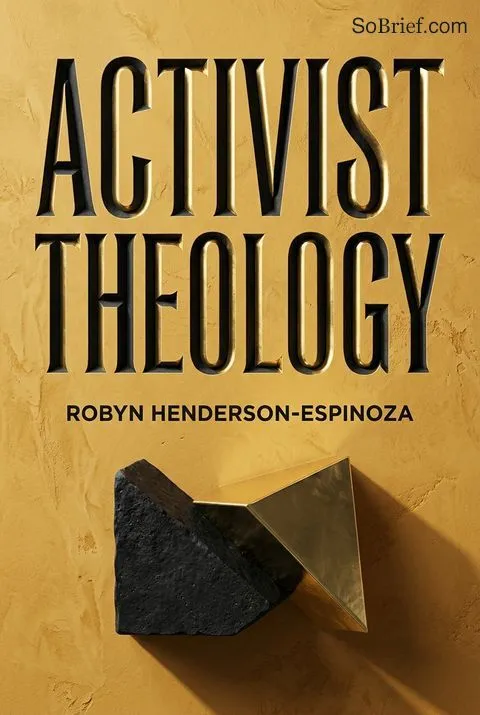
Activist Theology is a hybrid of memoir, theological argument, and movement invitation. Its form is part of its claim: a story about a mixed-race, queer, trans scholar's formation does not sit beside the theory as illustration; it demonstrates how knowledge arises from lived conditions and must answer to them. The book's recurring question, in effect, is whether a belief changes the way people relate, organize, and distribute power.
Its central contribution is to connect theological reflection with practical accountability. The author brings the church, academy, and justice movements into conversation while refusing to assume that any one institution is innocent or sufficient. Her own reflections on white-passing privilege and academic access add needed friction to a call for intellectual work in service of movements. She acknowledges that translating theory is not the same as organizing on the ground, and that her everyday experience cannot stand in for everyone else's.
The approach is strongest when it treats uncertainty as a reason to examine and act, rather than as a tidy source of inspiration. Holy Saturday gives grief and doubt room without promising quick resolution. The emphasis on stories, poetry, listening, and rest broadens the picture of what sustained activism can involve. At the same time, the book offers a moral orientation more than a detailed organizing manual. Ideas such as bridging difference and militant peace require local decisions about authority, resources, strategy, and safety. That limitation does not negate the argument; it clarifies its task. The book is asking readers to begin with their actual position, test their values against their effects, and build collective practices that move beyond good intentions.
Review Summary
Activist Theology receives mixed reviews, with an average rating of 3.93 out of 5. Positive reviews praise its call for lived-out faith and social justice, while critics find it repetitive and jargon-heavy. Some readers appreciate Henderson-Espinoza's personal stories and theological insights, particularly in later chapters. Others express disappointment with the book's academic tone and lack of practical examples. The inclusion of Ree Belle's poetry is widely praised. Overall, readers value the book's message but have varying opinions on its execution and accessibility.
People Also Read

Glossary
Activist theology
Faith translated into actionA way of doing theology that connects reflection on meaning and value to public and everyday practice. It seeks to translate theory into action and theology into practice, while bringing the church, academy, and movements for justice into conversation. Its stated horizon is collective liberation, especially for people most affected by interconnected systems of oppression.
lo cotidiano
Daily lived experienceA LatinoXa theological method that takes ordinary, lived experience as the starting place for reflection. Rather than treating personal and community stories as secondary to formal theory, it regards them as sources of theological knowledge. The method also requires attention to whose everyday life is being centered, since one person's experience cannot represent everyone.
Rupture and becoming
Breaks that open changeRupture is a break or instability that unsettles an existing way of understanding the world. Becoming is the ongoing process of responding to that disruption and developing new ways of being and acting. Neither is automatically liberating: rupture can lead to paralysis, while becoming depends on reflection, imagination, relationships, and work toward a different future.
divine doubt
Faithful questioning of certaintyA spiritual orientation that questions inherited certainty rather than treating doubt as a failure of faith. For Henderson-Espinoza, doubt can expose the distance between religious claims and their social consequences, and can prompt more critical action. It is not cynicism or indifference; it is a way of remaining open to change while refusing to assume that existing systems are just.
tyranny of the now
Crisis sustained by powerThe author's term for a climate of ongoing crisis created by arbitrary uses of power. It describes a present in which violence and oppression demand urgent attention, particularly from people who are already marginalized. The phrase names the pressure of immediate conditions without suggesting that urgency should erase the need for long-term imagination, community, and sustainable action.
militant peace
Determined, relational peacemakingA form of peacemaking that actively resists systems of oppression while refusing to reproduce their violence. It combines sustained effort against harm with relational practices such as accompaniment, community-building, and bridging across difference. The term is intended to challenge passive ideas of peace and to describe work oriented toward durable change and collective flourishing.
historical theology
Faith interpreted from contextA method associated in the book with Ignacio Ellacuría. It reflects on faith from a specific historical present, then uses that faith to examine the conditions of that moment. The approach treats context and standpoint as essential to theological reflection, because knowledge and social practice are shaped by where people live and what they experience.
economic supremacy
Economic power organized hierarchicallyThe author's term for economic arrangements that concentrate resources and power while producing or deepening inequality and poverty. It is connected to capitalism and to racialized and gendered patterns of access. The concept links large systems to everyday decisions about work, consumption, and money, while warning that individual purchasing choices alone cannot undo structural harm.
Download PDF
Download EPUB
.epub digital book format is ideal for reading ebooks on phones, tablets, and e-readers.








