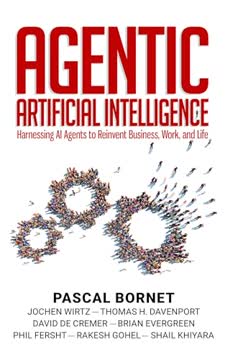
Key Takeaways
1. The Future of AI is Agentic: From Thinking to Autonomous Action
"AI agents will become the primary way we interact with computers in the future."
Bridging the gap. Current generative AI excels at thinking and analyzing, but it often lacks the ability to act, creating an "Execution Gap." This means humans are left to perform repetitive tasks, acting as "AI plumbers" to connect brilliant but helpless AI systems. Agentic AI, derived from "agere" (to do), fundamentally shifts this paradigm by enabling AI to take initiative, maintain persistent objectives, and adapt strategies autonomously.
Beyond chatbots. Unlike traditional generative AI that merely responds to queries, agentic AI can interact with applications, manipulate data, control hardware, and execute real tasks to achieve specific goals. This transformation is as revolutionary as the shift from typing commands to tapping icons, promising to redefine how we interact with technology and automate complex workflows. Examples include AI agents that can plan and book entire vacations, verify research findings, or coordinate emergency medical responses.
Market explosion. The agentic AI market is booming, projected to grow at 44% annually by 2030, with one in three enterprise software applications expected to integrate agentic AI by 2028. This growth is driven by customizable platforms, generalist agents (like OpenAI's Operator), and specialist agents (e.g., for sales or healthcare), signaling a fundamental shift in how businesses approach automation and productivity.
2. The Three Keystones: Action, Reasoning, and Memory Drive Agentic Intelligence
"What matters is whether someone can actually get things done (actions), think through complex real-world situations (reasoning), and learn from experience (memory)."
Beyond benchmarks. While AI systems may achieve impressive scores on academic benchmarks, these metrics alone do not predict real-world performance. Effective AI agents, much like capable human employees, require a holistic combination of three fundamental "keystones" to truly deliver value and navigate complex scenarios. Without these, even "superhuman" AI can be ineffective in practice.
Integrated capabilities. The "Action" keystone enables AI to execute tasks in the real world, moving beyond mere suggestions to tangible outcomes. "Reasoning" allows AI to make sense of complex situations, plan ahead, and make intelligent decisions, often requiring a "power of pause" for deeper thought. "Memory" is the foundation for learning and adaptation, enabling AI to retain, organize, and utilize past experiences to grow smarter over time.
Real-world impact. Failures in AI implementation often stem from overlooking one of these keystones. An AI agent might generate perfect plans (reasoning) but fail to execute them (action), or it might act flawlessly (action) but forget past interactions (memory), leading to fragmented experiences. Successful AI agents integrate these three keystones, transforming them from sophisticated tools into genuine workplace partners that can truly thrive.
3. Navigating Autonomy: The Five Levels of AI Agents Define Capabilities
"The question isn’t ‘Is it the ultimate agent?’ It’s ‘How effectively can it act today—and what’s next?’"
Structured progression. To make sense of the diverse landscape of AI agents, a "Progression Framework" categorizes their capabilities into five levels, mirroring the autonomy levels of self-driving cars. This framework helps organizations evaluate solutions, manage expectations, and plan their AI strategy, moving from basic rule-following to sophisticated autonomy.
Levels of autonomy:
- Level 0 (Manual Operations): Human-only tasks.
- Level 1 (Rule-Based Automation): Simple, deterministic tasks following fixed rules (e.g., RPA).
- Level 2 (Intelligent Process Automation): Combines automation with basic AI (NLP, ML) for cognitive tasks within rigid parameters (e.g., smart chatbots).
- Level 3 (Agentic Workflows): Agents generate content, plan, reason, and adapt in defined domains, but need human intervention in complex situations (e.g., multi-step business processes).
- Level 4 (Semi-Autonomous Agents): Operate independently within specific conditions, learn, and adapt strategies (e.g., research agents designing experiments).
- Level 5 (Fully Autonomous Agents): Theoretical pinnacle, capable of understanding any goal, learning across domains, and self-adapting with no human intervention.
Simplicity is key. The "Golden Rule of AI agents" emphasizes that "the simpler, the better." Organizations should start with lower-level agents to build familiarity, establish governance, and develop control systems before progressing to more autonomous systems. This approach allows for gradual learning and adaptation, ensuring that increased autonomy is balanced with appropriate human oversight.
4. AI Agents are Digital Colleagues with Unique Strengths and Inherent Limitations
"We’re treating humans like robots and AI like creatives. It’s time to flip the equation."
Distinctive traits. AI agents are not merely tools; they function as intelligent digital workers capable of operating 24/7, scaling infinitely, and applying universally across industries. They seamlessly integrate with existing systems, pulling data from multiple sources and executing processes across platforms, filling automation gaps without requiring a complete overhaul of infrastructure. This collaborative nature allows them to work alongside humans, supporting rather than replacing them.
Fundamental constraints. Despite their impressive capabilities, AI agents possess inherent limitations. They simulate intelligence by predicting patterns rather than truly understanding the world, leading to a "common-sense gap." They are highly dependent on data quality, prone to "hallucinations" (generating false information with high confidence), and struggle with genuine creativity, ethical reasoning, and nuanced judgment. These limitations necessitate careful design and human oversight.
Stochasticity dilemma. The probabilistic nature of Large Language Models (LLMs) introduces "stochasticity," meaning agents may produce varied responses to the same input, impacting consistency and precision. While this enables creative problem-solving, it poses challenges for tasks requiring high reliability. Solutions include temperature control, guardrail systems, precise instructions, and specialization ("one agent, one tool") to contain unpredictability.
5. Collective Intelligence: Multi-Agent Systems Outperform Solo AIs
"The future may well belong not to single, monolithic AI systems, but to sophisticated teams of specialized agents working together in harmony."
Power in numbers. Just as human teams achieve more than individuals, "Multi-Agent Systems" (MAS) demonstrate that multiple AI agents working collaboratively can achieve remarkable results, often outperforming even the most advanced individual AI models. This approach addresses complexity, leverages specialization, and offers superior resilience compared to monolithic AI systems.
Orchestrated collaboration. MAS can be organized hierarchically, with a manager agent coordinating specialized sub-agents, or through decentralized collaboration. The "one agent, one tool" principle is crucial for reliability, ensuring each agent masters its specific function. Effective MAS require clear communication protocols, robust coordination mechanisms, and strong error recovery to prevent cascading failures.
Emergent reasoning. Research shows that "diversity of thought" among different AI models in a structured debate framework leads to dramatic improvements in reasoning capabilities, even for smaller models. This "collective intelligence" can identify flaws, refine conclusions, and adapt to novel challenges, fostering a more nuanced handling of uncertainty and reducing error rates significantly.
6. Building Success: Effective AI Agents Demand Precise Design and Clear Instructions
"The best AI agents aren’t the ones with the most power, but the ones with the right balance of intelligence, tools, and knowledge."
Strategic foundation. Building successful AI agents begins with identifying the right opportunities using frameworks like "The Three Circles of Agentic Opportunity" (High Impact, Feasibility, Effort). It's crucial to automate tasks, not entire job roles, and to start with well-documented, proven processes. The "A.G.E.N.T. framework" provides a comprehensive approach to design, covering Identity, Gear & Brain, Execution & Workflow, Navigation & Rules, and Testing & Trust.
Clarity is paramount. Defining an agent's "Identity" (purpose, role, scope) is the most critical step, preventing unpredictable behavior and inconsistency. The "Gear & Brain" involves selecting the right AI model (balancing power, cost, efficiency), choosing precise tools (APIs, system controls, databases) with strict usage policies (rate limits, source reliability, circuit breakers), and curating high-quality knowledge sources.
Structured execution. "Execution & Workflow" requires defining clear input/output formats, structured workflows with activation criteria, and robust fail-safes like error handling and circuit breakers. "Navigation & Rules" establishes processing rules (filtering, prioritization) and ensures transparency through "Decision Trails." Finally, "Testing & Trust" involves simulating real-world use cases, collecting feedback, and refining performance through a "Progressive Trust Model" that gradually increases autonomy as reliability is proven.
7. The Agent Economy: AI Agents are Reshaping Business Models and Creating New Ventures
"The future of business automation isn’t just about efficiency—it’s about creation and innovation."
New economic paradigms. Agentic AI is giving rise to entirely new business models, moving beyond traditional software-as-a-service (SaaS) to "Agent-as-a-Service" (AaaS), where businesses pay for outcomes delivered autonomously by AI agents. This shift is creating "AI Agent Marketplaces" – digital platforms where specialized AI agents can be "hired" on demand, scaling expertise and creating new revenue streams for entrepreneurs.
AI entrepreneurship. The "Agent-to-Agent Economy" envisions a future where AI agents autonomously transact, negotiate, and manage daily life or business operations on behalf of individuals and companies. This creates a new layer of economic activity, operating at machine speed and challenging traditional marketing landscapes as companies will need to convince agents, not just humans, to buy their products. The "Truth Terminal" AI, which became a crypto millionaire, exemplifies AI's potential in financial markets.
Three horizons. Opportunities emerge across three horizons: enhancing existing processes (quick wins), reimagining existing services (e.g., AI-powered QR code menus), and creating entirely new products and services (e.g., digital companions, tokenized AI agents). Entrepreneurs can leverage frameworks like the "Agentic Opportunity Identification Framework" to spot high-value verticals and build the infrastructure (platforms, protocols) that will underpin this burgeoning agent economy.
8. Holistic Transformation: Enterprise-Wide AI Agent Adoption Requires Human-Centric Change
"The success of AI agent deployments depends as much on people as it does on technology."
Beyond technology. Implementing AI agents is not merely a technical upgrade; it's a fundamental organizational transformation impacting core employee behaviors, values, and perceptions. Successful adoption requires addressing human elements like fear of job displacement, building trust, and fostering collaboration between humans and machines. Leaders must adopt a "Leadership Duality Principle," managing the logical needs of AI while supporting the emotional needs of human teams.
Work redesign. Work design is crucial, determining what agents do autonomously and when human intervention is needed. This involves process improvement and reengineering, often supported by "process intelligence" tools. Roles will shift, with agents handling structured, repetitive tasks, freeing humans for higher-skilled review, remediation, and strategic functions, necessitating collaboration between technology and HR.
Changing mindsets. Transforming fear into opportunity requires transparency, evidence, and tangible success stories. "Day in the Life" workshops and "Future Role Roadmaps" help employees visualize evolving roles and new opportunities. Education must move beyond traditional training to "learning laboratories" and "Progressive Autonomy Models," empowering employees to experiment with and configure agents, fostering ownership and commitment.
9. Scaling with Safeguards: From Pilot to Production, Ensuring Trust and Control
"When it comes to AI agents, even well-intentioned designs can lead to unintended consequences."
The scaling paradox. While individual AI agent pilots often show impressive results, scaling them across an entire enterprise is a significant challenge, with very few companies successfully deploying Level 3 agents at scale. This requires a systematic approach, starting with grassroots workload mapping to identify high-impact, high-workload activities (the "20/80 principle") suitable for automation.
Systematic implementation. A structured three-phase approach—Process Redesign and Optimization, Deployment Sprints, and Testing and Production Migration—is crucial for methodical rollout. This involves reimagining processes from scratch with AI in mind, rapid iteration with user feedback, and graduated deployment to build confidence and manage risk. The "Automation Experience Advantage" from prior Level 2 implementations can provide a strong foundation.
Essential safeguards. As AI agents gain autonomy, robust safeguards are critical to prevent unintended consequences, such as the "Flash Crash" or the Air Canada bot incident. These include:
- Transaction Management: Hard limits, multiple approvals, real-time monitoring, audit trails.
- Ethical Guidelines: Embedded constraints, regular audits, stakeholder challenge mechanisms.
- Safety Controls: Emergency shutdowns, safety checks, redundant monitoring, clear chains of responsibility.
- Privacy Protection: Strict data access, privacy impact assessments, data retention policies.
These measures ensure agents operate safely and ethically within complex human and artificial ecosystems.
10. The New World of Work: Reinventing Human Skills and Education for the Agentic Era
"The paradox we’ve found is that embracing automation actually makes our distinctly human skills more valuable."
Human-machine symphony. The future of work is a sophisticated collaboration between human creativity and artificial intelligence, where AI agents handle complex analysis and operational tasks, freeing humans to focus on "Humics"—uniquely human capabilities. This evolution is creating new roles like "AI Orchestrators" and "Ethics Officers," demanding a shift from task-oriented to workflow thinking and from control to delegation.
The "Humics" advantage. Three essential competencies for the agentic age are "Change-Ready" (resilience, adaptability), "AI-Ready" (understanding AI capabilities and limitations), and "Human-Ready" (developing "Humics": genuine creativity, critical thinking, social authenticity). These foundational human abilities are timeless and serve as fertile soil for new, relevant skills to emerge, such as "holistic financial life planning" or "emotional innovation."
Education reimagined. Traditional education, focused on memorization and routine tasks, is ill-suited for the AI era. We must return to education's true purpose: fostering thoughtful reflection, purpose, and human development. This means reinventing curricula to emphasize interdisciplinary learning, real-world problem-solving, emotional intelligence, and critical thinking, with teachers becoming "learning architects" who guide students in effective human-AI collaboration.
11. Governing the Future: Proactive AI Governance is a Societal Imperative
"The key question isn’t whether to develop these technologies—they’re already here—but how to ensure they remain under meaningful human control while maximizing their benefits to society."
Unprecedented challenge. Agentic AI's extraordinary capacity for autonomous decision-making and adaptation introduces new categories of risk that current regulatory and corporate governance structures are ill-equipped to handle. The complexity of control increases exponentially with higher levels of AI agency, demanding fundamentally new, anticipatory, and adaptive approaches to governance.
Three-tiered control. Effective governance requires coordinated action at three levels:
- Governmental: Establishing clear regulatory frameworks, mandatory fail-safe mechanisms, and accountability for harm.
- Corporate: Implementing robust internal oversight (AI ethics boards, real-time monitoring) to align AI with human values and organizational objectives.
- Individual: Maintaining meaningful human oversight, developing new skills to supervise autonomous systems, and recognizing malfunctions.
Essential mechanisms. Key control mechanisms include manual override capabilities, continuous monitoring systems to track behavior and decision-making, and ethical frameworks embedded directly into AI systems. Future-proofing requires adaptive regulatory frameworks, regular assessments, and international coordination to prevent a "race to the bottom" in AI safety standards. Transparency and accountability, through decision trails and clear liability frameworks, are crucial for building public trust and ensuring responsible AI deployment.
Last updated:
Similar Books