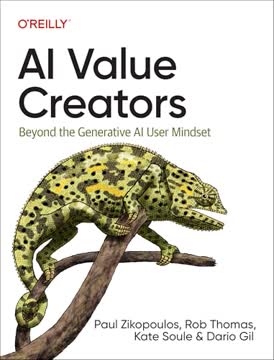
Key Takeaways
1. GenAI is a "Netscape Moment" demanding an "AI-First" mindset.
We’re pretty sure if he was around today, he’d note that if a computer is a bicycle for our minds, then GenAI and agents combine to become the bicycle for your business.
A transformative era. Generative AI (GenAI) and AI agents represent a "Netscape moment," akin to the internet's democratization in 1994. This era will fundamentally reshape industries, impacting everything from high-status brainwork to daily business operations. Companies that actively engage in shaping this journey will thrive, while those that don't risk falling behind, facing significant societal and business consequences.
Shift your mindset. Most organizations currently operate with a "+AI" mentality, merely adding AI to existing processes. The imperative is to transition to an "AI+" mindset, where AI is considered first, reimagining workflows and business models from the ground up. This involves breaking down processes into granular components, identifying where AI can automate rote tasks, and building human-centric workflows on top of this AI foundation.
The AI Ladder rebooted. To navigate this shift, a modernized AI Ladder emphasizes information architecture (IA) as the bedrock for AI success. A robust IA platform is essential for collecting, organizing, protecting, and governing data, which in turn turbocharges GenAI and agentic initiatives. This framework guides organizations from simply adding AI to existing applications to automating workflows and ultimately replacing them with AI-first approaches.
2. Become an AI Value Creator by leveraging your proprietary data.
In the past, we’ve seen a lot of value-extractive business models—if you’re on social media, you’re a part of one.
Control your AI destiny. There are three ways to consume AI: embedded in software, using someone else's model via API, or building on an AI platform. While the first two offer convenience, they limit differentiation and control over your data. Becoming an "AI Value Creator" means using a platform approach to build and customize AI solutions with your proprietary data, transforming it into a unique competitive advantage.
Your data is your superpower. Less than 1% of enterprise data currently resides in public Large Language Models (LLMs). This vast, untapped reservoir of internal knowledge is your most valuable asset. By steering trusted LLMs with your specific business data, proprietary knowledge, and expertise, you create models that are uniquely tailored to your operations, delivering unparalleled value and differentiation.
Avoid value extraction. Relying solely on third-party, opaque AI services risks having your usage and data extracted for someone else's benefit, creating an imbalance in value accrual. An AI Value Creator, like L'Oréal customizing models with its vast beauty science data, maintains control, ensures data privacy, and accrues long-term value, preventing their strategic data from becoming another company's competitive edge.
3. AI success hinges on a balanced platform of models, data, governance, and use cases.
AI SUCCESS = MODELS + DATA + GOVERNANCE + USE CASES
The four pillars of AI success. Achieving meaningful AI outcomes requires a holistic approach, integrating four critical elements: models, data, governance, and use cases. While models provide the intelligence, data fuels it, governance ensures responsible deployment, and well-defined use cases translate technology into tangible business value. Neglecting any pillar compromises the entire AI strategy.
A layered platform approach. Think of an AI platform as a layered cake, with each layer crucial for operationalizing AI:
- Base: Hybrid cloud and AI tools, built on open source for portability and efficiency.
- Data Services: A unified data fabric to discover, collect, organize, and govern all enterprise data.
- AI & Data Platform: The core, where models are governed, built, trained, and steered, integrating data lakehouses and workbenches.
- SDK: Integration points for developers to embed AI into products.
- Agents & Assistants: The top layer, empowering digital labor and scaling human capabilities.
Data as the differentiator. While models and governance are essential, your proprietary data is the ultimate differentiator. Public LLMs are largely trained on common internet data, leading to commoditization. True competitive advantage emerges when you steer these models with your unique business data, aligning AI with your specific values, vocabulary, and operational needs.
4. Prioritize horizontal AI use cases to unlock broad business value.
When you step back, you start to realize that if you master the horizontal use cases of AI (the patterns and the things they can do, such as see, hear, analyze, and more), you will more masterfully choose the right vertical use cases for your business.
Horizontal first, vertical second. To maximize AI's impact, focus on horizontal use cases—those that cut across all industries—before diving into industry-specific (vertical) applications. Mastering foundational AI capabilities like computer vision, natural language processing, or automation allows for versatile application across diverse business functions. For example, AI identifying defects in manufacturing is the same underlying technology as detecting skin cancer.
The "Big 3" horizontal opportunities. Three undeniable horizontal use cases offer immediate and significant value across almost any business:
- Customer Care: Automating responses, routing inquiries, and personalizing interactions to reduce costs and improve satisfaction.
- Code: Assisting developers with code generation, refactoring, documentation, and understanding legacy systems, boosting productivity.
- Digital Labor: Deploying AI assistants and agents to automate repetitive tasks, freeing human employees for higher-value work.
Shift left for massive gains. Horizontal use cases excel at "shifting left" – automating tasks early in a workflow to save time and money. Examples include:
- IT Automation: AI managing certificate health, system uptime, and application operations, leading to millions in annual savings and increased efficiency (e.g., IBM's "Client Zero" initiative).
- Digital Assistants: Handling routine customer inquiries, deflecting calls from human agents, and reducing wait times (e.g., Oregon DMV, CVS, Klarna).
- Code Documentation: Automatically summarizing code blocks, accelerating developer onboarding, and mitigating "enterprise amnesia."
5. Trust is the ultimate license to operate: build AI with fairness, robustness, explainability, and lineage.
AI that people trust is AI that people will use.
The ethical imperative. As AI becomes ubiquitous, trust is paramount. Companies must proactively decide to be "upstanders" in ethical AI, rather than "bystanders" who risk overreaching regulation. Your company's core values, like Superman's moral compass, will define how you wield AI's superpowers. Beyond mere accuracy, factors like fair use, transparency, and algorithmic accountability will become key competitive differentiators.
Four pillars of trustworthy AI. Implement these levers from the outset of any AI project:
- Fairness: Ensure training data and models are free of bias to prevent automated inequality at scale. Monitor for biases like erasure bias (e.g., DALL-E's gender representation) and correct outcomes.
- Robustness: Protect AI systems from adversarial attacks like data poisoning (malicious data injection) and prompt injection (tricking LLMs into harmful outputs). Utilize guardrail models (e.g., Llama Guard, Granite Guardian) to police inputs and outputs.
- Explainability: Provide understandable decisions or suggestions, allowing users and developers to interpret why an AI made a prediction. This is crucial for algorithmic accountability, especially in high-stakes applications (e.g., credit decisions, medical diagnoses).
- Lineage: Document the development, deployment, data sources, and maintenance of AI systems for auditability. Transparent data provenance, like nutrition labels for food, builds trust and helps identify harmful or unacceptable AI.
Navigating the dark side. LLMs present challenges such as knowledge cut-off dates, hallucinations (fabricating information), significant carbon/water footprints, and complex copyright issues. Diligence in vendor indemnification and understanding your "digital essence" (how your work is used in training) are critical. Furthermore, AI expands the attack surface for data poisoning, prompt injection, deepfakes, and quantum cryptography threats, necessitating robust security measures.
6. Upskilling everyone is non-negotiable for navigating AI's rapid evolution.
If you show up to work every day and you’re not scared of anything, then you likely aren’t learning anything either, and that’s likely a good time to do something new.
The skills imperative. In an era where technology skills age faster than ever, a robust, enterprise-wide upskilling plan is crucial for individual and organizational success. This isn't just for technical roles; every employee, from the boiler room to the boardroom, will be impacted by AI. Companies that invest in continuous learning will gain a significant competitive edge, as AI won't replace people, but people using AI will replace those who don't.
Levers for a lasting skills program. Implement a multi-faceted approach to foster a learning culture:
- Hire for Curiosity: Seek out individuals with an innate desire to learn and explore, as they are natural drivers of innovation.
- Recruit Digitally Minded Talent: Look beyond traditional degrees for individuals who embrace technology to improve processes.
- Inventory Skills: Establish a clear taxonomy and measurable levels for technical and soft skills, ensuring auditability and alignment with business needs.
- Plan for Everyone: Create customized learning paths with clear deadlines, executive sponsorship, and recognition for achievements.
- Embrace Learning & Forgetting Curves: Design modular, easily accessible content that supports "scramble learning" for quick refreshers.
- Combine Instruction, Imitation, & Collaboration: Foster learning through formal training, observation, and peer-to-peer interaction.
- Build a Sandbox: Provide frictionless environments for experimentation and practice, encouraging hands-on learning.
- Show Off Digital Credentials: Implement badging programs to authenticate and celebrate skill achievements, boosting employee morale and marketability.
- Culture Matters: Leaders must "be a verb, not a noun," actively participating in learning and transparently addressing employee concerns about AI's impact on jobs.
IBM's Challenge success. IBM's watsonx Corporate Skills Challenge, a voluntary initiative, saw 160,000 employees train on new AI offerings, generating 12,000+ prototypes and 8 million inferences daily. This not only significantly increased AI skills (88% reported improvement) but also channeled curiosity into a productivity multiplier, demonstrating that investing in skills is a value creator, not a cost center.
7. The future of AI is "multimodel" and "multimodal," not "one model to rule them all."
One model will not rule them all.
Beyond the "bigger is better" myth. While early LLM development focused on increasing model size (e.g., GPT-1 to GPT-4o), the future of AI is shifting towards a "multimodel" and "multimodal" approach. This means leveraging a system of diverse models—some small, some large, some specialized—working in concert to achieve superior performance and efficiency, rather than relying on a single, monolithic model.
The rise of Small Language Models (SLMs). SLMs (typically <13 billion parameters) are proving to be highly competitive, often matching or exceeding the performance of much larger LLMs on specific tasks. This is driven by:
- Data Curation: Training on higher quantities of high-quality, domain-specific data (e.g., Llama 3.1's 2000:1 data density ratio, Microsoft's "Textbooks Are All You Need" philosophy for Phi-2).
- Model Distillation: Using large "teacher" models to instruct smaller "student" models, transferring complex behaviors and knowledge efficiently (e.g., Vicuna from ChatGPT, DeepSeek-R1-Distill).
Systems of models for optimal performance. The true power lies in orchestrating these models:
- Model Routing: An AI router directs inference requests to the most suitable model in a library (small, medium, or large), optimizing for accuracy, cost, and latency. This can outperform a single large model while reducing operational expenses.
- Mixture of Experts (MoE) Architecture: LLMs with internal "experts" (parameter buckets) where only a subset is activated for a given task, making inference wicked fast and training more economical (e.g., Mistral 8x7B, DeepSeek-R1).
8. Generative Computing will transform LLMs into programmable, integrated software components.
What if we don’t just start building LLMs like they are software, but start building with LLMs like we build today’s software?
A new computing paradigm. LLMs are evolving beyond mere data representations to become a new style of computing: generative computing. This paradigm views neurons as a fundamental building block, complementing classical (bits) and quantum (qubits) computing. Instead of replacing existing approaches, generative computing integrates LLMs into the very fabric of software, applying software engineering principles to enhance efficiency, safety, and performance.
From messy prompts to structured programs. The current practice of using "mega-prompts"—long, unstructured text blobs—is inefficient and prone to errors. Generative computing advocates for:
- Structured Prompts: Clearly demarcating program instructions, data, and safety protocols within prompts.
- Runtime Orchestration: A "smart" runtime mediates access and capabilities, managing control flow, memory, and security, akin to how traditional software is executed.
- LLM Intrinsics: Capabilities built directly into the model (e.g., safety detection, uncertainty quantification) that can be invoked programmatically via structured flags or APIs.
Hardware co-evolution. This shift towards inference-time compute—where LLMs spend more time "thinking" to generate better answers—will drive the development of specialized hardware. Chips like IBM's NorthPole, with memory and processing co-located, are designed to optimize for low-latency, high-energy-efficiency inference, paving the way for a "generative computer" tailored to the demands of this new computing style. This ensures that as AI evolves, the underlying infrastructure keeps pace, maximizing performance and value creation.
Last updated:
Similar Books