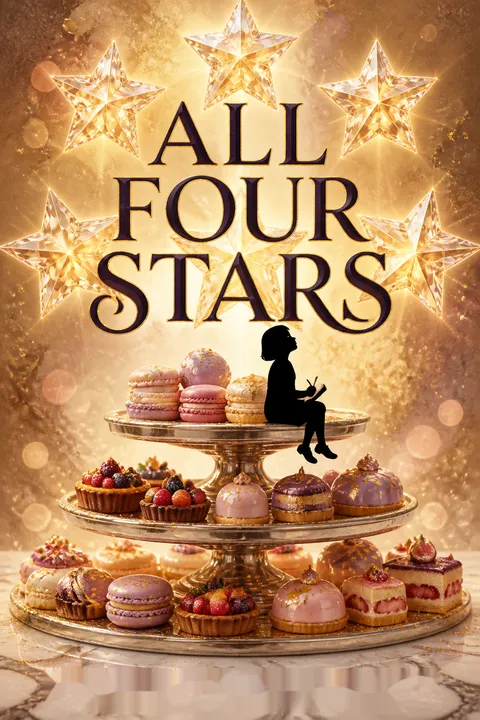


Plot Summary
The Blowtorch Burns
At eleven, Gladys Gatsby has spent years teaching herself to cook in the quiet hours when her parents are away. Now she is trying to caramelize crème brûlée with her father’s garage blowtorch when the flame catches the kitchen curtains.
Her parents rush in and put out the fire, but the singed room exposes the secret she has kept from them. Gladys admits she has made 142 recipes on her own. Her parents, frightened by the danger and convinced she needs more ordinary childhood interests, suspend her allowance and forbid cooking for six months.
They promise to try making meals themselves, though their microwave-heavy habits have already taught Gladys not to trust dinner. The accident costs her kitchen access just as she begins to imagine a larger life for her food.
The fire turns a private talent into a family crisis. Gladys’s parents respond to the danger they can see, but not yet to the loneliness and deprivation beneath her secrecy. Their ban is protective in intention and punitive in effect: it removes the activity through which she has built competence and comfort. Gladys, meanwhile, treats skill as proof that she should be trusted, overlooking how a child’s confidence can outrun safety. The burned curtains make the conflict material. Her cooking is no longer a harmless hidden pleasure, and the family must confront what their different ideas of care have allowed.
Aunt Lydia's Secret Recipe
That night, Gladys remembers how her love of food began. When she was seven, her aunt Lydia took her from East Dumpsford to Manhattan, where Ethiopian stew, matzo ball soup, and Chinatown dumplings showed her that meals could be vivid and varied.
Lydia later brought her to Mr. Eng’s Gourmet Grocery, where the shopkeeper let Gladys taste cumin and gave her cinnamon to take home. Soon Lydia mailed her a cookbook disguised as a children’s book, along with a journal for recording what she ate and made.
Gladys filled its pages while cooking secretly around her parents’ fast-food dinners. At school, that passion has left her isolated: classmates have formed tight groups, and she has learned to keep her food opinions private. The journals preserve both her appetite and her sense of belonging.
Gladys’s culinary education begins as a relationship, not a rebellion. Lydia offers her unfamiliar flavors, Mr. Eng gives her a first ingredient, and the journal makes attention itself a practice. Gladys learns to describe what she tastes because someone has treated her curiosity as worth developing. At home, however, food is reduced to convenience, and at school her enthusiasm marks her as strange. The journal becomes a private audience: it lets Gladys be both critic and witness to her own life. Her isolation is not simply a lack of friends; it is the cost of having no shared language for what matters to her.
A False Future Fails
Returning to school after the fire, Gladys meets Ms. Quincy, whose future-themed essay assignment includes a statewide contest and a five-hundred-dollar prize. Gladys needs the money for the kitchen damage, but fears that writing about food will confirm her parents’ belief that she has no life beyond cooking.
She invents a future as a veterinarian. At home, she tries to make friends with Sandy Anderson, the boy next door, whose mother has rabbits and a flour-dusted kitchen. Sandy initially suspects Gladys wants to cook his pets, but they bond over his homemade computer game and her cooking knowledge.
When Ms. Quincy returns Gladys’s essay, she praises its writing but challenges its lack of genuine feeling. Sandy does the same in his own way, reminding Gladys that she has always wanted to write about food.
The false veterinarian essay shows Gladys trying to make ambition acceptable before she has allowed herself to name it. The prize money gives her a practical reason to enter, but fear determines what she says about her future. Ms. Quincy’s critique is perceptive because it treats writing as evidence of desire, not just a school exercise. Sandy’s welcome matters differently: he shares Gladys’s experience of adults dismissing a serious interest as something to postpone. Their friendship begins in mutual recognition, though Sandy’s humor and Gladys’s guardedness make that recognition imperfect. Together, teacher and neighbor create the conditions for Gladys to risk telling the truth.
The Essay Goes Public
Gladys rewrites her entry around her real dream of becoming the New York Standard’s restaurant critic. Ms. Quincy selects it as the class submission and reads it aloud, including its descriptions of both wonderful dishes and terrible meals.
For the first time, classmates approach Gladys because they want her advice, recipes, and food reviews. The attention feels good, but it also drains her, while Charissa Bentley regains the center of the playground by dangling plans for an elaborate birthday. Then Ms. Quincy announces that an upstate student’s zombie essay has won the statewide prize.
Gladys loses the money and, with it, the hope of paying for the fire damage through the contest. At lunch, Owen and Parm’s argument about whose life is harder ignites a food fight, and Gladys hurls her own sandwich at the wall.
The essay gives Gladys recognition without giving her the reward she expected. Her classmates respond not to a more acceptable version of her but to the food expertise she had hidden, suggesting that visibility can arrive through the very difference she fears. Yet attention is not uncomplicated belonging: a queue of classmates turns her knowledge into a public service, and Charissa’s popularity contest shows how easily social approval becomes a resource to control. Losing to the zombie essay punctures Gladys’s belief that merit will reliably solve her family problem. Her sandwich throw is a small, uncharacteristic refusal to remain composed while disappointment is being explained away.
A Letter Finds Fiona
At the Standard, intern Anastasia sorts the essay-contest entries and mistakes Gladys’s letter-shaped essay for an application to the Dining section. She sends it to Fiona Inglethorpe, the section’s chief editor, instead of to the contest judges.
Fiona needs help because veteran critic Gilbert Gadfly has scalded his tongue and cannot taste, so she reads the pink-paper letter as a genuine application. After the statewide contest rejects Gladys, Fiona emails the address printed on the entry and asks for samples of her restaurant reviews.
Gladys assumes the message is a prank until Sandy traces its source to the newspaper’s servers. The mistake offers her a chance she never expected, but it also puts her in danger: Fiona believes she is corresponding with an adult professional, and Gladys has no restaurant reviews to send.
The accidental routing makes institutional procedure the unlikely mechanism of opportunity. Gladys’s essay reaches the editor because its form resembles professional correspondence, while Anastasia’s tired shortcut redirects it without anyone noticing. The error does not make Gladys’s writing less real; Fiona responds to its voice, though she misunderstands its author and purpose. That distinction creates the story’s central ethical pressure. Gladys has earned attention through genuine skill, but the opening appears under false assumptions. Her next choice must balance a child’s legitimate ambition against the deception required to keep the door open.
Two Reviews, One Chance
Gladys asks Sandy to verify Fiona’s message, then turns her family’s bad dinners into a fictional restaurant called Mom and Pop’s Kitchen. For a glowing review, she draws on the Indian feast she once ate at Parm Singh’s home, naming the invented establishment Singhs’ Paradise.
Fiona enjoys both samples and assigns Gladys a review of Classy Cakes, a new Manhattan dessert bistro, with a deadline in April. Gladys accepts before considering how she will get there. The Standard sends a contract, forms, and a thick freelancer-protocol document; Gladys signs and mails them without understanding much of the fine print.
Sandy researches the restaurant, but neither child can solve the travel problem. Gladys calls Aunt Lydia for help, only to learn that Lydia cannot afford a trip from Paris. Her best route is now a plan she must invent herself.
Gladys’s fabricated restaurant names conceal no fabricated meals. She transforms experiences she has actually had into polished criticism, which makes the lie ethically uneasy but creatively revealing: she already possesses a critic’s habits of memory, comparison, and judgment. Fiona’s assignment validates that ability while raising the stakes beyond school. The contract and protocol documents introduce adult systems that Gladys cannot fully read, a quiet reminder that access is not the same as power. Sandy can help with research, but not with permission or transport. Lydia’s inability to come forces Gladys to stop waiting for rescue and begin designing a route through the adults around her.
The Wrong Tower
Gladys uses Ms. Quincy’s spring-break project about a parent’s job to persuade her father, George, to take her on his tax-collection rounds in Manhattan. She hopes he will bring her to Classy Cakes afterward. But his final appointment is at the New York Standard itself.
When George insists she accompany him upstairs, Gladys panics, refuses, and makes such a public scene that Fiona sees her but never learns her name. Her father cancels their promised dessert, so Gladys returns home without visiting the bistro.
Back at school, she discovers that Charissa’s birthday outing includes a Broadway show, a limousine, and room for one chosen friend. Gladys realizes that winning Charissa’s favor may be her only remaining way into the city. The opportunity turns a friendship into a high-stakes audition.
Gladys’s plan depends on being close enough to an adult’s routine to borrow it, but the Standard building collapses that distance. Her father’s professional world and her secret workplace occupy the same address, forcing her to choose between exposure and refusal. The scene also reveals how little control she has over a supposedly independent plan: George can insist, then withdraw the promised treat. Charissa’s limousine offers another passage into Manhattan, but at a social price. Gladys now has to negotiate status and affection as carefully as schedules, making her dream vulnerable to someone else’s shifting approval.
Dessert Wins the Limo
Gladys learns that Charissa is choosing one companion for her birthday trip and starts competing through food. After Charissa loves one of Mrs. Anderson’s brownies, Gladys asks the neighbor to teach her Malaysian peanut pancakes, then offers one to Charissa.
Parm, now aware of Gladys’s Standard assignment, takes her to learn carrot halwa from Parm’s father, Mr. Singh. For a final gift, Gladys secretly buys ingredients from Mr. Eng and bakes a blueberry-rhubarb crumble while her parents attend school night. Charissa devours it and asks Gladys to make more.
As the desserts soften Charissa’s usual sharpness, she chooses Gladys for the limousine trip. Gladys’s cooking has bought the journey she needs, but the gifts also create something less calculated: Charissa responds to the care and skill in each dish, not merely to a present.
Food becomes a social language Gladys can use without surrendering her own taste. The pancakes, halwa, and crumble carry distinct forms of help: Mrs. Anderson offers instruction, Parm shares a family secret, and Mr. Eng supplies ingredients and access. Gladys is not simply a prodigy performing alone; her skill grows through a network of generous cooks. Her campaign for Charissa’s invitation is strategic, but the repeated act of making something for another person changes its meaning. Charissa’s attention begins as appetite and becomes curiosity about Gladys herself. The scene complicates the idea that social acceptance requires disguise: Gladys wins access by expressing her genuine passion.
A Window into Classy Cakes
In Manhattan, Gladys’s plan to slip out during the Broadway show collapses when Mrs. Bentley and Charissa keep her close. During intermission, Gladys escapes through a small restroom window and runs to Classy Cakes.
The restaurant has a three-hour wait and no takeout, so she sneaks inside and tastes desserts left on departing customers’ plates. A hostess catches her beneath a table and ejects her. Gladys returns to the theater, but Charissa has discovered the bluebarb crumble recipe online and persuaded her parents to reserve a table at the bistro.
On this second visit, the Bentleys order the entire menu for Charissa’s birthday. Gladys samples every dessert, fills her journal with careful notes, and at last gathers enough firsthand evidence to write the review Fiona needs.
The first visit exposes the gap between Gladys’s ambition and the conditions under which professional work is done. She reaches the restaurant through nerve and improvisation, but scraps eaten in hiding cannot substitute for a full, attentive review. Her ejection is humiliating, yet she has seen enough to understand what the assignment demands. Charissa’s second invitation transforms the same restaurant from forbidden workplace into shared celebration. Crucially, Gladys’s success depends on both her own persistence and Charissa’s response to the crumble. The meal becomes legitimate research because the friendship opens a door that secrecy alone could not keep open.
G. Gatsby's First Byline
Gladys submits her review under the byline G. Gatsby, hoping to keep her work private from her parents. The Standard publishes it prominently, and Mr. Eng recognizes the writer’s knowledge of ingredients; Ms. Quincy also identifies her student’s distinctive voice.
Fiona praises the article and says she hopes to assign more work. Gladys’s parents learn about the essay contest from Ms. Quincy, hear how strongly Gladys cares about cooking, and decide she has also built friendships with Sandy, Parm, and Charissa.
They restore her allowance and move cooking from the forbidden list to the approved one, with an adult required to supervise. Gladys finally has room to pursue food without abandoning school or friends. Then a Standard check for one thousand dollars arrives, and her mother spots it.
The resolution does not make Gladys choose between vocation and belonging. Her parents revise their judgment after seeing evidence of both: she has formed friendships, and her passion has produced disciplined writing rather than only household risk. Their compromise preserves safety while granting her a place in the kitchen. The byline protects Gladys’s privacy, but recognition still finds her through Mr. Eng and Ms. Quincy, whose familiarity with her work matters more than a name on a page. The final check unsettles the new balance with a comic threat of exposure. Gladys has earned adult attention, yet she is not finished negotiating what that attention will mean.
Analysis
All Four Stars makes a child’s private expertise collide with the institutions that decide whether children are ready to act: family rules, school assignments, a newspaper’s hiring process, and the social economy of popularity. Gladys’s parents are not villains, and their concern after the fire is justified. Their mistake is treating safety as a reason to erase the activity that gives Gladys focus and joy. The story’s resolution therefore depends on negotiation rather than simple rebellion: Gladys demonstrates that she can make friends and pursue a serious interest, while her parents set supervision rules instead of banning cooking outright.
The novel also distinguishes talent from access. Gladys can describe food with professional insight, but she lacks money, transportation, adult permission, and knowledge of workplace procedures. Her path to Classy Cakes is shaped by other people’s resources: Sandy’s research, Lydia’s advice, Mrs. Anderson’s teaching, Parm’s family recipe, Mr. Eng’s shop, and finally Charissa’s invitation. The sequence makes achievement relational without diminishing Gladys’s own ingenuity. She is the person who notices, writes, improvises, and keeps trying, but she cannot make the world accessible by effort alone.
Food works as both subject and social test. Gladys learns that taste is personal when Parm rejects beloved family dishes, and that a bad meal can be more than an abstract judgment when she eats her parents’ cooking. Her reviews are funny, yet their comedy depends on careful observation rather than cruelty. By the end, Gladys’s calling is not only to praise or condemn dishes; it is to help others notice what they are eating. The final thousand-dollar check keeps her success from feeling fully settled. Public recognition has arrived, but she must still decide how much of her new professional life to reveal at home.
Review Summary
All Four Stars is a charming middle-grade novel about 11-year-old Gladys Gatsby, who secretly loves cooking despite her parents' fast-food preferences. When she accidentally lands a job as a food critic, hilarity ensues as she tries to complete her assignment without getting caught. Readers praise the book's delightful humor, mouthwatering food descriptions, and relatable characters. While some found parts of the plot implausible, most enjoyed the story's balance of fun and realism. Many reviewers noted feeling hungry after reading and look forward to the sequels.
People Also Read

Characters
Gladys Gatsby
Secretly ambitious cookGladys is an eleven-year-old cook and food writer in training who pays close attention to ingredients, texture, and the difference between a meal that merely fills someone and one that delights them. She has taught herself through cookbooks, experiments, and a food journal, but her family’s suspicion and her classmates’ cliques have made her careful about showing what she loves. She is resourceful and observant, yet her eagerness to prove herself can draw her into unsafe or dishonest plans. Her central struggle is not whether she has talent, but how to pursue it openly while also making room for friendship, school, and the limits of being a child.
Sandy Anderson
Inventive next-door allySandy is Gladys’s young neighbor, a computer enthusiast who designs games and initially worries that she may want to cook his pet rabbits. His suspicion gives way to a friendship built on curiosity, humor, and the shared frustration of having adults dismiss favorite pursuits. Sandy is practical where Gladys is passionate: he researches Classy Cakes, checks whether Fiona’s email is genuine, and helps plan how Gladys might reach the city. He is not a cook, but he listens to Gladys’s reviews and takes her ambition seriously. His support helps her see that friendship can make a difficult plan possible without requiring him to share every interest.
Charissa Bentley
Socially strategic gatekeeperCharissa is the most popular girl in Gladys’s grade, accustomed to directing attention and using invitations to shape her friendships. She can be cutting toward people who disappoint her, and she often measures social life through appearance, exclusivity, and control. Yet her interest in unusual food reveals an appetite for pleasure that complicates her polished, status-conscious image. Charissa is quick to recognize what she enjoys, though less quick to express gratitude or vulnerability. Her relationship with Gladys begins within the school’s hierarchy, but their shared interest in desserts offers a different basis for connection, one grounded in curiosity rather than rank.
Parm Singh
Picky friend with secretsParm is Gladys’s closest school friend, a skeptical, highly selective eater who prefers familiar food and often assumes disappointment is more likely than success. Her reluctance to try her family’s Indian cooking frustrates Gladys, but it also reflects a child protecting herself from pressure and unwanted attention. Parm can be blunt and pessimistic, yet she is loyal when Gladys’s plans become serious. She understands school politics well and helps Gladys navigate them, eventually sharing access to a beloved family dessert. Parm’s guarded relationship with food gives the story a counterpoint to Gladys’s adventurous palate, while her friendship shows that care need not depend on identical tastes.
Ms. Quincy
Teacher who sees passionMs. Quincy is Gladys’s sixth-grade teacher, a well-traveled educator who values imagination, honest effort, and specific evidence of interest. Her confidence in students does not make her indulgent: she holds Gladys accountable for missed homework while also recognizing that the veterinarian essay lacks conviction. By challenging Gladys to write from genuine desire, she helps her find language for an ambition she has kept hidden. Ms. Quincy treats a child’s work as meaningful without pretending that children have adult freedom. Her teaching combines high expectations with close attention, making her a rare adult who notices both Gladys’s craft and the circumstances constraining it.
Aunt Lydia
Parisian culinary mentorAunt Lydia is Gladys’s adventurous aunt, a lover of restaurants and unfamiliar flavors who lives in Paris. She introduces Gladys to the range of New York City food and gives her a cookbook and journals that encourage her to cook, taste, and write. Lydia respects Gladys’s curiosity even when she cannot teach her directly in the family kitchen. She is warm, imaginative, and financially precarious, so her support takes the form of encouragement and perspective rather than easy rescue. Her visits help Gladys understand that good food is made through both technique and attention.
Mr. Eng
Keeper of curious ingredientsMr. Eng owns the gourmet grocery in East Dumpsford, a small shop filled with unusual produce, cheeses, spices, and baked goods. He treats Gladys as a serious customer despite her age, offering samples and explaining ingredients without condescension. His kindness gives her access to the materials and vocabulary that her household does not provide. He also understands the risks of being a small specialty shop in a town that favors chains, so Gladys’s appreciation means something to him. Mr. Eng represents a community built around shared knowledge, not just transactions.
Mrs. Anderson
Neighbor with an open kitchenSandy’s mother is a computer programmer and yoga instructor who also loves baking and experimenting with recipes. Her home is more welcoming than Gladys expects: the kitchen is messy from use, the cookbooks are well handled, and children are invited to taste what she makes. Mrs. Anderson offers Gladys practical cooking instruction and treats her suggestions as useful rather than precocious. She is affectionate with Sandy, though she sometimes pushes him toward activities he does not want. Her open kitchen gives Gladys a glimpse of what supportive adult guidance can look like.
Mr. Singh
Patient family cookParm’s father is a medical laboratory worker and an accomplished home cook who takes care with texture, timing, and spice. He teaches Gladys and Parm how to make carrot halwa by hand, insisting that the process matters as much as speed. His kitchen carries family knowledge across generations, even though Parm herself keeps much of that food at a distance. Mr. Singh is patient without being indulgent, and he invites Gladys into a tradition through shared work rather than a lecture.
Fiona Inglethorpe
Dining editor with an openingFiona is the New York Standard’s chief Dining editor, a former restaurant critic with a strong personal attachment to pink foods and a sharp eye for writing. She is pressed for staff when Gilbert Gadfly temporarily loses his sense of taste, and she reads Gladys’s essay under the mistaken impression that it is a professional application. Fiona responds to the work itself, seeking samples and offering a real assignment. She expects professional standards and communicates through contracts and deadlines, but she is also willing to recognize a fresh voice when one reaches her desk.
Anastasia
Overworked newspaper internAnastasia is a New York Standard intern assigned to process the statewide essay entries. Tired of repetitive office work, she makes a shortcut with a pink letter that appears to belong to the Dining section. Her small procedural mistake redirects Gladys’s essay to Fiona and changes the course of Gladys’s opportunity.
George Gatsby
Tax collector and fatherGeorge is Gladys’s father, a city tax collector who values practicality and tends to improvise rather than follow a recipe. He is affectionate and proud of his daughter, but initially mistakes her intense cooking for an isolated hobby and responds to the fire with strict rules. His workday in Manhattan gives Gladys a possible route into the city, though his own schedule and authority make her plans precarious. He is capable of reconsidering his assumptions when he sees more of Gladys’s life.
Gladys's mother
Protective practical parentGladys’s mother is a real estate agent who favors low-fat substitutions and quick meals, and she worries that her daughter’s solitary devotion to cooking keeps her from making friends. Her response to the fire comes from genuine fear, but she initially treats restriction as the safest solution. She is attentive to appearances and schedules, yet also capable of warmth and change when Gladys’s teacher helps her understand the depth of her daughter’s interest.
Gilbert Gadfly
Veteran restaurant criticGilbert Gadfly is the Standard’s established restaurant critic, known for broad surveys of restaurants and many-dish tastings. A mishap with hot chocolate leaves him temporarily unable to taste, creating an urgent staffing problem for Fiona. His absence opens the professional opportunity that reaches Gladys.
Mr. Bentley
Charissa's wealthy fatherMr. Bentley is Charissa’s formal, well-off father, who complains about the cost of her extravagant birthday plans while ultimately accommodating her wishes. His reservations and limousine make the New York outing possible.
Mrs. Bentley
Charissa's watchful motherMrs. Bentley is Charissa’s elegant mother, who supervises the birthday outing and keeps close control of the girls during the Broadway show. She is protective and attentive to the event’s schedule, unintentionally making Gladys’s escape more difficult.
Moira
Gatekeeping restaurant hostMoira is the hostess at Classy Cakes, responsible for reservations and the long queue outside the popular new restaurant. She is brisk under pressure and refuses to make exceptions for Gladys, whose improvised attempts to enter bring her into direct conflict with the child.
Allison Sconestein-Alforno
Inventive dessert-bistro chefAllison Sconestein-Alforno is the pastry chef behind Classy Cakes and the creator of its unusual dessert menu. Her blueberry-rhubarb crumble inspires Gladys to experiment, while the range of her cakes, custards, and other sweets gives Gladys the material for a serious restaurant review.
Plot Devices
Gladys's food journal
Private record becomes a voiceThe journals Aunt Lydia gives Gladys teach her to record meals rather than let them vanish into memory. Gladys rates what she eats and describes both exceptional dishes and miserable family dinners, building the precise vocabulary and comic judgment that later make her reviews convincing. The journal is also an emotional refuge during a period when she has few friends who share her interest. On the trip to Classy Cakes, it becomes a practical reporting tool, allowing Gladys to gather details even while navigating an unstable plan. Its movement from secret diary to working notebook tracks her movement from private enthusiasm toward public authorship.
The future essay contest
A prize exposes her real ambitionMs. Quincy’s contest offers Gladys a chance at prize money after the kitchen fire, so it gives her a practical motive to write about the future. At first she chooses a safer, invented career as a veterinarian. Her teacher’s feedback forces her to confront the distance between that persona and the restaurant critic she actually hopes to become. The contest also makes her writing visible to her classmates and, through an administrative mistake, to the newspaper’s Dining editor. It is the hinge between Gladys’s hidden skill and the adult opportunity that follows.
The cooking ban
Restriction drives improvised accessAfter Gladys accidentally starts a kitchen fire, her parents ban cooking and place it on an unapproved-activities list. The rule gives the family conflict concrete form and forces Gladys to work through borrowed kitchens, neighbors, and secrecy rather than simply returning to her normal routine. It also raises the stakes of every recipe she makes, from the desserts intended for Charissa to the crumble she prepares while her parents are away. The ban is not merely an obstacle: it expresses her parents’ real fear and their mistaken belief that cooking and social development cannot coexist.
The misrouted essay
A clerical error opens a doorGladys writes her contest entry in the shape of a professional letter. At the Standard, Anastasia mistakes the pink-paper essay for a restaurant-critic application and sends it to Fiona Inglethorpe instead of the contest judges. Fiona reads Gladys’s genuine writing under a false impression of the writer’s age and experience, then asks for samples. The device connects a small act of bureaucratic carelessness to the central opportunity without making Gladys’s talent accidental. The mistake gets her noticed; her actual reviews and reporting work determine whether she can keep the assignment.
Food as social currency
Cooking builds unexpected alliancesThroughout the story, food carries information about relationships. Aunt Lydia uses unfamiliar meals to awaken Gladys’s curiosity; Mr. Eng shares ingredients; the Anderson and Singh kitchens offer instruction; and Charissa’s changing response to Gladys’s desserts shifts their relationship. Food can also divide: Parm rejects meals her family loves, while Gladys’s parents treat cooking as an unnecessary risk. The dishes Gladys makes are not magic solutions to social conflict, but they give characters something concrete to exchange, taste, and discuss. That shared attention allows friendships to form across differences that conversation alone has not bridged.
Download PDF
Download EPUB
.epub digital book format is ideal for reading ebooks on phones, tablets, and e-readers.








