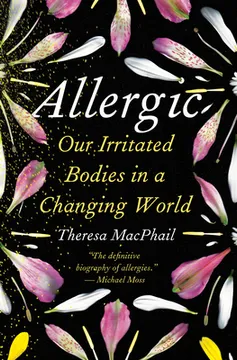


Key Takeaways
An allergy is a defense response aimed at the wrong target
Protection can misfire. The book opens with Theresa MacPhail’s father, who died after a bee sting triggered anaphylaxis. His mast cells and basophils released histamine, setting off a rapid cascade: swelling, constricted airways, falling blood pressure, and cardiac arrest. The immune response was not absent or weak. It was dangerously excessive toward a substance that is usually harmless to most people.
A process, not a single symptom. Allergy describes an immune reaction, not simply sneezing, a rash, or stomach pain. The body’s defenses must distinguish danger from harmless contact, and those decisions can vary by person and exposure. MacPhail’s own respiratory symptoms, despite negative standard allergy tests, show how an immune reaction can be real even when it is difficult to measure.
The opening story makes immune misclassification visceral: a system built to protect can become the immediate source of danger. This resembles a broader problem in biology, where useful defenses carry costs when their triggers are misread or their responses overshoot. The framing also avoids treating allergy as weakness. Still, an evolutionary explanation for why such responses exist cannot explain every individual case. The book is strongest when it holds both ideas together: immune reactions have biological logic, yet their consequences can be devastating.
Treat allergy tests as clues, not verdicts
Tests detect reactivity. Skin-prick and blood tests commonly measure sensitization, meaning the immune system recognizes an allergen. A positive result does not prove that ordinary exposure causes symptoms, and it does not predict how severe a reaction will be. For food allergy, false positives from skin and blood tests can reach 50 to 60 percent. A supervised oral food challenge, in which a patient consumes gradually increasing amounts, remains the clearest confirmation.
Symptoms need context. MacPhail had hay fever symptoms and visible nasal irritation despite negative skin and blood tests. Her allergist diagnosed localized allergic rhinitis, an immune reaction concentrated in the nose and eyes that standard tests did not reveal. A careful medical history, observed symptoms, and expert interpretation matter because allergy can resemble intolerance or other illness.
This is a useful lesson in measurement: a test answers the question it was designed to ask, not necessarily the question a patient cares about. Sensitization and symptomatic disease are related but distinct. Similar gaps appear throughout diagnosis, where a measurable marker can be mistaken for the condition itself. The practical challenge is that uncertainty cuts both ways. Overcalling allergies can lead to needless restriction, while dismissing symptoms because a test is negative can leave patients without useful care.
Allergy estimates vary wildly because doctors cannot agree what counts
The totals are estimates. The book reports that roughly 30 to 40 percent of people worldwide have some form of allergic disease, with some experts projecting 50 percent by 2030. But the numbers depend on definitions, access to diagnosis, and how researchers collect data. A review of 122 studies of childhood asthma found 60 different definitions. Applying different definitions to the same data changed which children counted as having asthma.
The burden exceeds emergencies. A U.S. survey found that 10.8 percent of adults had convincing evidence of food allergy, while 19 percent identified themselves as allergic and only 5 percent reported a physician-confirmed diagnosis. Mild and moderate conditions also disrupt sleep, concentration, work, school, and family routines. The uncertainty in counting does not make the suffering imaginary.
The book’s statistics are most revealing when treated as evidence about institutions as well as bodies. Definitions shape who gets counted, which conditions attract funding, and whose discomfort is recognized. This is a familiar challenge in epidemiology: categories make large patterns legible, but they can erase variation or create misleading comparisons. The answer is not to abandon population data. It is to report uncertainty clearly and pair aggregate counts with accounts of how illness alters ordinary life.
Genes shape risk; environments help decide which allergies emerge
Inheritance is not destiny. Allergies often run in families, but no single gene causes them. A study of more than 350,000 people found 141 genome regions associated with hay fever, asthma, or eczema. Even identical twins did not always share peanut allergy: one study found that only 66 percent did. Genes can raise susceptibility, while timing and surroundings influence whether that susceptibility becomes disease.
Defenses may have old uses. The toxin hypothesis suggests that mast cells and IgE responses could once have helped animals react quickly to venom. In experiments, mice with these defenses were more resistant to some venoms. That offers a possible explanation for why a system capable of harmful allergic reactions persists, but animal findings cannot settle the question for humans. Allergy emerges from many interacting biological and environmental factors, not a single inherited defect.
The distinction between predisposition and outcome is essential. It resists genetic fatalism while also avoiding the opposite mistake of implying that people can simply choose their way out of an inherited risk. The toxin hypothesis adds an evolutionary lens: a response can be useful in one setting and costly in another. Its evidence is intriguing but indirect, especially when derived from mice. Evolutionary stories should guide questions, not serve as proof of why a particular person became allergic.
Climate change lengthens pollen seasons while pollution carries allergens deeper
Exposure is changing. Warmer springs and milder autumns can extend the time plants release pollen. The book cites increases in pollen-season length between 1995 and 2015 of 21 days in Minnesota, 15 in Ohio, and 6 in Arkansas. Higher carbon dioxide and nitrogen can also help plants such as ragweed grow and produce more pollen.
Pollution adds another route. Research in Cincinnati found that children exposed to high levels of air pollution early in life were more likely to develop asthma by age seven. Diesel particles can bind to pollen and carry it deeper into the airways. Pollution is not the sole explanation, since housing, poverty, and other exposures overlap, but it is a contributor. The city studies in the book show that beautiful weather can still carry an unhealthy mix of invisible irritants.
These examples shift the problem from individual sensitivity to shared exposure. A person can avoid a particular tree or wash pollen off their clothes, but cannot personally shorten a pollen season or control traffic emissions near home. This is where environmental health meets urban planning and climate policy. The evidence also calls for care: pollution, pollen, and social disadvantage often cluster, making any single cause difficult to isolate. That complexity strengthens the case for reducing preventable exposures rather than waiting for perfect attribution.
Protect early-life barriers without blaming parents or worshipping dirt
Microbial exposure matters, but cleanliness is not the whole story. The hygiene hypothesis proposes that reduced contact with some microbes during childhood may leave immune responses less well regulated. Related research points to the microbiome, the communities of microbes living in and on the body, and to protective skin and gut barriers. Diet, antibiotics, birth conditions, and household exposures may shape those systems, especially early in life. These links are still being studied, and correlation does not prove that any one choice caused a child’s allergy.
Early food advice changed. Earlier guidance told parents to delay peanuts. The LEAP study found peanut allergy at age five in 13.7 percent of high-risk infants assigned to avoid peanuts, compared with 1.9 percent of those assigned to eat them. The result helped change guidance, but it does not justify improvising treatment. The book also finds no solid evidence that local honey or routine probiotic supplements prevent allergies.
This section’s central strength is its refusal to turn complex biology into parental blame. A child’s microbiome and immune development reflect many interacting influences, some beyond a family’s control. The LEAP result shows that medical advice can itself shape risk, which makes careful evidence review a public responsibility. At the same time, the hygiene hypothesis can be misread as a license to seek infections or avoid necessary medicine. The distinction between microbial diversity and dangerous exposure deserves to stay clear.
A tick bite can make red meat trigger a delayed allergic crisis
A new allergy reveals an ecological chain. Alpha-gal allergy is an immune reaction to a sugar found in most mammals. In some people, a lone star tick bite appears to sensitize the immune system; eating red meat can then cause symptoms hours later, an unusual delay for a food allergy. Researchers first connected the condition to patients who reacted to a cancer drug containing alpha-gal and were concentrated in parts of the southern United States.
The landscape is shifting. Lone star ticks have expanded beyond their familiar range, while deer populations and other ecological changes have supported tick growth. Reported U.S. cases rose from 24 in 2009 to more than 5,000 in 2020, though the true number is uncertain. The story shows how climate, wildlife, human land use, and immune responses can combine to produce a condition that once seemed inexplicable.
Alpha-gal makes environmental change tangible: a tick, a mammal, a sugar molecule, and a human meal become links in one causal chain. It also illustrates why medical categories can lag behind emerging conditions. The delayed reaction initially sounded implausible because familiar allergy patterns shaped expectations. Yet reported case counts are not the same as true prevalence, and shifting diagnoses can inflate apparent growth. This is a compelling example of how surveillance and clinical curiosity must adapt when nature rearranges the exposures people encounter.
Choose allergy treatments by trade-offs, not promises of a cure
Relief has costs and limits. Avoiding allergens remains central, while epinephrine can buy crucial time during anaphylaxis. Antihistamines and steroids ease symptoms but can have side effects, and newer biologic drugs can help some patients without curing allergy. Oral immunotherapy deliberately introduces small amounts of a food allergen to raise a patient’s reaction threshold. In one Palforzia study, about three-quarters of participants reached the maintenance dose, but serious reactions occurred in 3.5 percent and anaphylaxis in 1.2 percent over three years.
Success depends on the goal. A higher threshold may reduce danger from accidental exposure, but patients may still need to avoid the food and continue maintenance dosing. Drugs such as dupilumab can transform life for some people with eczema or asthma, yet they are costly, can cause adverse effects, and do not work for everyone. Treatment decisions require a clinician and a clear-eyed discussion of risks, benefits, access, and quality of life.
The book treats effectiveness as a value judgment as well as a clinical measurement. A parent may prize protection from a trace exposure, while another may judge daily treatment reactions and clinic visits too burdensome. Shared decision-making is therefore not a soft substitute for evidence; it is how evidence becomes relevant to a person’s life. The caution is that marketing can make a higher reaction threshold sound like a cure. Clear outcome definitions help patients compare benefits without mistaking partial protection for permanent resolution.
Treat allergy as shared infrastructure, not a patient's private failure
The burden is unevenly distributed. Mylan raised the EpiPen price from about $103 in 2008 to more than $600 in 2016, making an emergency medicine harder to afford. Families with food allergies also face confusing precautionary labels, cross-contamination risks, and limited access to specialists or safe food. Emily Brown’s family struggled to find allergy-safe food through assistance programs, prompting her to create a dedicated food pantry. Such obstacles turn avoidance, the standard treatment for food allergy, into a resource problem.
Public choices shape safety. Food labeling, school access to epinephrine, airline practices, pollution controls, and research funding all affect people with allergies. The book also describes bullying and cultural portrayals that make allergy seem trivial or laughable. Asking patients to manage every risk alone is inadequate when products, environments, and institutions help create those risks. Better care includes fair access to treatment and policies that reduce exposure and protect dignity.
Allergy exposes a basic feature of public health: individual safety often depends on systems other people control. A patient cannot inspect every factory line, secure every school’s emergency medicine, or filter the air outside a home. This makes accommodation less a special favor than a form of shared risk management. The harder question is how to balance competing needs without treating every restriction as costless. Transparent standards, accessible care, and attention to unequal burdens offer a more durable response than expecting patients to absorb the consequences alone.
Analysis
Allergic is most persuasive when read as both a scientific account and a study of how societies decide what counts as illness. Its narrative begins with a fatal reaction and ends with a collective problem, making the scale shift feel earned: immune cells misread substances, but institutions also misread patients when tests, labels, or diagnostic categories fail to capture their experience.
The book’s governing insight is that allergic disease is not explained by a single defect. Genes, barriers, microbes, pollutants, climate, food systems, and clinical practice interact. That framework is intellectually stronger than a hunt for one culprit, but it also creates a communication challenge. Readers may mistake a long list of plausible contributors for proof that each factor causes allergy. The text is careful about uncertainty, yet its compelling examples can make causal connections feel firmer than the evidence warrants. The distinction between association, mechanism, and demonstrated prevention deserves constant attention.
Its history also shows that medical categories are not neutral containers. Allergy first named a broad biological change, then became shorthand for harmful hypersensitivity. Contemporary arguments over IgE, asthma, eczema, and food intolerance continue that history. These definitions influence research priorities and whether patients are believed, counted, and treated. Measurement is therefore part of the story, not merely a technical prelude.
The final social argument follows from the biology. If risk is produced through shared environments and commercial systems, then care cannot stop at medication or individual vigilance. Yet structural remedies require political choices and are harder to test than a drug. The book’s most useful contribution is to make those choices visible: symptom relief matters now, while prevention demands better evidence, equitable access, and collective responsibility for the environments in which immune systems develop.
Review Summary
Allergic receives an overall rating of 3.87/5, with readers praising MacPhail's accessible yet scientifically grounded exploration of allergies, their history, rising prevalence, and treatments. Many appreciated the balance between personal narratives and complex biology, though some found sections repetitive or dry. Readers valued the nuanced discussion of potential causes—hygiene hypothesis, climate change, pollution, and lifestyle factors—while acknowledging the book offers few definitive solutions. Critics noted the lack of practical guidance, feeling the book is more historical overview than actionable resource.
Glossary
Anaphylaxis
Rapid systemic allergic reactionA severe, fast-moving immune reaction that can affect breathing, circulation, and other body systems. Histamine and related signals can cause airway narrowing, tissue swelling, and a dangerous drop in blood pressure. Without prompt treatment, anaphylaxis can be fatal. Epinephrine is used to interrupt the reaction and support breathing and circulation.
Atopy
Inherited tendency toward IgE responsesA predisposition to produce IgE antibodies in response to common environmental allergens. Atopy is related to allergy but is not identical to it: a person may show sensitization without having symptoms, and some allergic reactions do not follow the IgE pathway. The term describes a tendency, not a guarantee that a particular allergy will develop.
Sensitization
Immune recognition of an allergenA state in which the immune system has developed a measurable response to a substance, often shown by a skin-prick reaction or allergen-specific IgE in blood. Sensitization does not by itself establish that exposure causes clinical symptoms. It indicates recognition or reactivity, while an allergy diagnosis also depends on symptoms and their relationship to exposure.
Hygiene hypothesis
Early microbial exposure may regulate immunityA theory that reduced exposure to certain microbes in early childhood may contribute to poorly regulated immune responses and greater risk of allergic disease. The idea arose from observations linking smaller households and less contact with older siblings to higher hay fever rates. Related research explores farm environments and the microbiome, but the theory does not explain every allergy.
Old friends hypothesis
Lost microbes once helped regulate immunityA development of the hygiene hypothesis proposing that humans evolved alongside microorganisms that helped regulate immune function. Modern changes in environment, diet, and lifestyle may reduce contact with some of these organisms, disrupting microbial diversity and immune regulation. The idea does not mean that all microbes are beneficial or that exposure to infection is safe.
Barrier regulation hypothesis
Microbes help control what enters tissuesCathryn Nagler’s account of how the gut and skin barriers, resident microbes, and immune cells work together to determine what enters the body and how it is interpreted. When this relationship is disrupted, food or environmental proteins may cross epithelial barriers and provoke inflammation. The hypothesis emphasizes barrier function and microbial balance, not simply an overactive immune system.
Alpha-gal allergy
Tick-associated allergy to mammalian sugarAn allergy to galactose-alpha-1,3-galactose, a sugar found in most mammals. In some people, a tick bite is associated with sensitization, after which eating mammalian meat can trigger symptoms, often several hours later. The delayed timing and link to tick ecology made the condition difficult to recognize. Not everyone with antibodies develops symptoms.
Oral immunotherapy (OIT)
Repeated allergen doses raise toleranceA treatment in which a patient consumes gradually increasing amounts of a food allergen under medical supervision, followed by regular maintenance doses. The aim is to raise the amount that can be tolerated before a reaction occurs, especially after accidental exposure. OIT can cause allergic reactions, may require ongoing dosing, and does not necessarily eliminate the need for avoidance or emergency medication.
Learning Early About Peanut Allergy (LEAP) study
Trial of early peanut introductionA clinical study that compared peanut avoidance with early peanut consumption among infants at increased risk of allergy. At age five, peanut allergy was less common among children assigned to consume peanut, both in the subgroup initially testing negative and the subgroup showing sensitivity. The results overturned earlier advice to delay peanut introduction and helped change prevention guidance.
Toxin hypothesis
Allergic defenses may counter toxinsAn evolutionary explanation proposing that rapid immune responses involving mast cells and IgE may have helped ancestors respond to venom or other toxins. Experiments in mice found greater resistance to some venoms when these immune mechanisms were present. The hypothesis offers a possible protective function for reactions that can be harmful today, but human evidence remains indirect.
Download PDF
Download EPUB
.epub digital book format is ideal for reading ebooks on phones, tablets, and e-readers.








