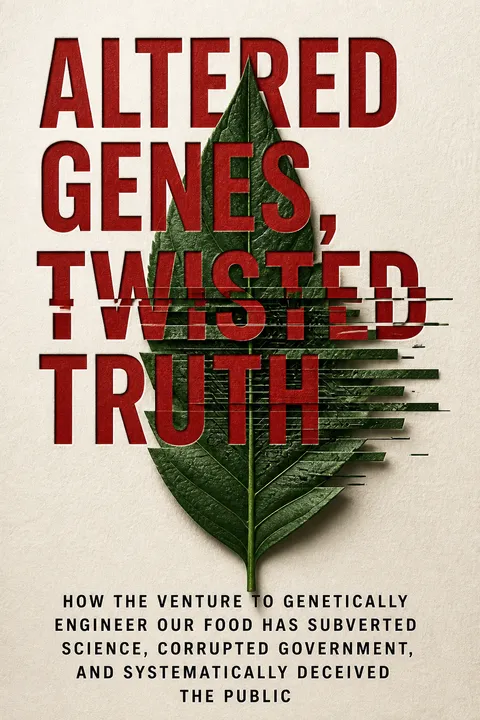


Key Takeaways
Do not mistake FDA permission for proof of food safety
The lawsuit exposed a gap. Steven Druker organized a 1998 lawsuit challenging the FDA’s policy on genetically engineered foods. In discovery, the agency turned over more than 44,000 pages of internal records. Druker argues these documents showed that FDA scientists had warned of unusual risks, while administrators adopted a presumption of safety without requiring meaningful testing. The agency treated the foods as GRAS, short for Generally Recognized as Safe, a legal category that can exempt substances from premarket approval when qualified experts recognize their safety on adequate evidence.
Permission is not proof. The court upheld the FDA’s 1992 policy on narrow administrative grounds. It did not find that GE foods had been proven safe. Druker’s central claim is that consumers and officials mistook a permissive policy for a scientific safety finding. He presents the FDA’s actions as both unlawful and decisive in enabling commercialization.
The distinction between authorization and evidence is crucial in any regulated field. A policy decision can reflect legal interpretation, institutional constraints, or economic priorities, not simply a scientific verdict. The book’s use of internal records makes that distinction concrete. Its strongest contribution is documenting what agency scientists said and what the public policy omitted. Its broadest legal accusation, however, is Druker’s interpretation of the record, not a court finding of fraud. Readers should keep those categories separate while asking whether regulators disclose uncertainty clearly.
Treat genetic engineering as a distinct process, not routine breeding
The methods differ. Recombinant DNA technology refers to techniques for cutting, joining, and transferring DNA sequences, including between organisms that cannot reproduce together through ordinary breeding. Druker contrasts this with sexual reproduction, which reshuffles existing genetic variants while preserving the basic organization of the genome. In his account, engineered crops may require foreign promoters to make inserted genes function, and the DNA can enter the plant genome at unpredictable locations.
The process has side effects. Plant cells are often grown through tissue culture before becoming whole plants, another step that can introduce changes. These interventions do not prove that a particular food is harmful, but they undermine the simple claim that genetic engineering is merely a more precise version of traditional breeding. Druker argues that each resulting organism needs assessment for unintended changes, rather than safety being inferred from the method’s name.
The useful question is not whether one breeding method is natural and another artificial. It is whether the method produces effects that require different screening. This is a process-based approach familiar from engineering: a new manufacturing route can create failure modes that product inspection alone misses. The book is persuasive in challenging casual equivalence. Yet a mechanism that can create unintended changes does not establish that every engineered crop is dangerous. The inference supports case-specific testing more directly than it supports a blanket conclusion about all products.
Check how broad the evidence is before trusting scientific consensus
Early evidence was narrow. In the 1970s, scientists met to assess risks from recombinant DNA research. Druker focuses on the Falmouth and Ascot meetings, where much discussion centered on E. coli K-12, a laboratory strain poorly suited to surviving outside controlled conditions. He argues that cautious, limited conclusions about this bacterium were later presented as broader reassurance about genetic engineering generally.
Scope can quietly expand. Druker also criticizes later reports that addressed particular environmental tests or limited classes of crops but were cited as if they settled food safety across the board. He calls the political use of narrow findings as broad scientific certainty molecular politics. The lesson is to ask what was actually tested, in which organism, and under what conditions before treating institutional agreement as settled knowledge.
Consensus is not a vote detached from evidence. Its value depends on the question asked, the expertise represented, and whether dissenting data are considered. The book’s historical cases show how carefully scoped findings can become public shorthand for much larger claims. That pattern is not unique to biotechnology; it appears whenever a technical result is translated for policy. Still, limited scope does not automatically mean deliberate deception. A sound assessment distinguishes intentional spin from ordinary overgeneralization, while demanding that public claims match the evidence’s actual reach.
Remember the tryptophan epidemic, but do not overstate causation
A striking warning appeared. In 1989, thousands of people developed eosinophilia-myalgia syndrome, or EMS, an illness involving unusually high eosinophil counts and severe muscle pain. Druker cites estimates of 5,000 to 10,000 cases, at least 80 deaths, and roughly 1,500 lasting disabilities. Investigators linked the cases to L-tryptophan made by Showa Denko, whose production used genetically engineered bacteria.
The cause remains disputed. Showa Denko’s product contained unusual contaminants, but researchers did not conclusively identify a single substance as the cause. Druker argues that the evidence points toward genetic engineering, especially because the company used engineered bacterial strains before the epidemic as well as during it. He also discusses a contaminant later identified by researchers, but that work was unpublished in the book’s account. The episode is a reason for scrutiny, not a settled proof that engineering caused EMS.
This episode illustrates a central problem in causal inference: a strong association can demand investigation without establishing the precise mechanism. The disappearance of the production bacteria, as Druker describes it, limited researchers’ ability to reproduce conditions and test explanations. That missing evidence matters. At the same time, uncertainty about cause should not be used to erase the event from safety discussions. The balanced conclusion is narrower and stronger: a serious outbreak linked to a novel production process warrants transparent investigation and careful monitoring, even when attribution remains incomplete.
Demand tests that can detect delayed, unintended effects
Comparison is not enough. Substantial equivalence is a regulatory approach that compares a genetically engineered food with a conventional counterpart and may treat them as similarly safe when selected compositional measures appear close. Druker argues that this comparison can miss changes outside the expected traits, including altered proteins or metabolic effects. He contrasts it with the FDA’s GRAS standard, which requires adequate evidence and expert recognition of safety.
Testing must match the uncertainty. The book highlights short feeding studies and assessments of isolated proteins that may not reveal effects from eating the whole food over time. It favors more comprehensive toxicological studies, including longer-term and multigenerational tests. This is Druker’s prescription, not a description of standard practice in the book’s account. His larger point is that absence of a detected problem is meaningful only when the test was designed and powered to find it.
A negative result is only as informative as the test behind it. In medicine and toxicology, duration, sample size, endpoints, and controls determine which effects can be detected. The book’s criticism is strongest when it identifies a mismatch between an uncertain intervention and a shallow test. The practical challenge is that no single study can guarantee safety, and very long trials can be costly or difficult to interpret. A credible system therefore needs layered evidence, including molecular analysis, animal studies where appropriate, and post-market surveillance.
Audit who controls the story as carefully as who controls the tests
Information was filtered. Druker recounts that major US outlets did not report the 1998 lawsuit in a way that conveyed the nine scientist-plaintiffs’ objections or the FDA’s internal warnings. He describes a 1999 Washington Post article that a reporter had developed using agency memos and expert interviews, but that editors substantially changed before publication. He also recounts Fox’s handling of an investigative series on recombinant bovine growth hormone, where reporters alleged that management demanded changes favorable to Monsanto.
Gatekeeping shapes belief. The examples support Druker’s argument that media dependence on advertising, ownership, and editorial decisions can narrow public discussion. The result, in his account, was a public that often believed GE foods were thoroughly tested by the FDA. The reader’s practical task is to compare claims with primary records and ask which relevant voices are missing.
Media systems influence not only what audiences believe, but which questions seem reasonable to ask. This is a form of agenda-setting: repeated reassurance can make uncertainty appear fringe even when experts disagree. The book’s firsthand accounts are compelling, though individual cases cannot establish a uniform media conspiracy. The more durable lesson is procedural. Readers should distinguish reporter intent from editorial policy, check whether claims are supported by documents, and notice when a story quotes advocates but omits the evidence that would let audiences evaluate them.
Measure crop promises against ecological consequences in the field
Benefits had tradeoffs. Druker challenges claims that GE crops broadly reduce pesticide use. He cites an estimate that herbicide-resistant crops led to an additional 383 million pounds of herbicide use in the United States from 1996 to 2008. Repeated glyphosate use also selected for resistant weeds. By the period discussed in the book, ten resistant weed species had been reported across 22 states, prompting farmers to use more herbicide and sometimes return to older chemicals.
Pest control can erode. Crops producing Bt insecticide may affect non-target organisms, while pests can evolve resistance. Druker also describes risks from escaped pollen and contamination of non-GE crops. These examples do not show every farm has the same outcome, but they challenge claims that engineered seeds automatically produce environmental gains. Evaluate the full farming system, including chemical use, resistance, and effects beyond the field.
The ecological lesson is to assess technologies as evolving systems rather than static products. A practice that reduces one input at first may create selection pressure that increases another input later. This resembles antibiotic resistance: repeated exposure changes the population the intervention was meant to control. The book’s cited figures are important but depend on methods of accounting and should be checked against other analyses. The central question remains productive: do benefits persist after resistance, chemical substitution, and effects on neighboring farms are included?
Use software engineering to expose uncertainty, not to prove harm
Complex systems resist prediction. Druker compares the genome to software, while emphasizing that living systems are far more interconnected and less understood than human-written programs. Software engineers test even small revisions to life-critical systems and use regression testing, meaning they rerun checks after changes to detect new faults. In contrast, he argues, genetic engineering inserts DNA into biological systems without comparable control over location or downstream effects.
The analogy has limits. Druker uses this contrast to argue that agricultural bioengineering resembles hacking more than careful engineering. The analogy highlights why precaution and testing matter, but DNA is not literally a computer program, and biological evolution is not software development. The strongest takeaway is methodological: when system behavior is poorly understood, claims of precise, predictable outcomes deserve especially careful verification.
The analogy works best as a warning about complexity, not as a one-to-one model of biology. Both software and genomes can produce unexpected interactions, but their architectures, testing conditions, and failure modes differ. Software engineering contributes a useful norm: every change can introduce regressions, so the whole system must be checked again. The analogy cannot establish that a crop is harmful. It does, however, expose a burden of explanation for anyone claiming that a poorly understood biological intervention is predictably safe.
Fund agroecology as a serious alternative, not a consolation prize
The book rejects a false choice. Druker argues that agriculture does not have to choose between genetic engineering and hunger. He points to the International Assessment of Agricultural Knowledge, Science and Technology for Development, a large international review that did not identify GE crops as necessary to address food insecurity. He also cites UN-reported projects in Africa where organic or near-organic methods increased yields, while noting that results varied across projects.
Invest in the whole system. Agroecological approaches combine crop diversity, soil health, locally adapted practices, and improved access to knowledge. Druker argues that these methods have received less funding and attention than biotechnology despite their potential. The practical conclusion is not that one farming method fits every place, but that public investment should compare alternatives honestly and support approaches that improve productivity without importing the risks he attributes to genetic engineering.
This closing proposal shifts the debate from whether one technology is good or bad to which portfolio of practices works in specific places. Agroecology’s focus on soil, diversity, and farmer knowledge can complement modern breeding and measurement tools. Yield claims from projects are encouraging, but averages across diverse regions do not guarantee local success. A serious transition requires extension services, market access, and long-term trials, not just a change in seeds. The book is strongest when it treats alternatives as investments worth testing, rather than as a slogan.
Keep regulatory failure and biological harm as separate questions
The court decided a limited issue. In Alliance for Bio-Integrity v. Shalala, the judge upheld the FDA’s 1992 policy under administrative-law standards and excluded some later evidence from consideration. The ruling did not find that GE foods had been proven safe, nor did it determine that they had caused specific illnesses. Druker argues the opinion gave the agency too much deference and overlooked conflicts among experts and weaknesses in the safety rationale.
Two questions need answers. Did regulators follow the law and accurately describe their evidence? Separately, do particular engineered foods cause harm? The first can be examined through agency records and legal standards. The second requires reliable biological evidence. Keeping them distinct strengthens criticism of regulatory failures without turning allegations about the process into proof of a specific health outcome.
This distinction is essential to fair reasoning. A flawed approval process can justify reform without proving a product is toxic; conversely, a product could cause harm even if approved through proper procedure. The book sometimes moves quickly between these claims, so readers benefit from tracking the evidentiary basis for each. Legal analysis asks what officials were allowed to do and what evidence they considered. Causal science asks what exposure produced what outcome. Treating those as separate but related inquiries makes the critique more credible.
Analysis
The book is best read as a prosecutorial history of agricultural biotechnology, not as a neutral survey of every position in the GMO debate. Its narrative strength comes from following a paper trail: Philip Regal’s early warnings, Druker’s lawsuit, the FDA’s internal files, disputed safety studies, and the media’s treatment of them. That structure makes an institutional argument tangible. The central charge is not simply that a technology may be risky, but that regulators and scientific institutions normalized uncertainty as reassurance while the public was told that safety had already been established.
The strongest material concerns process and governance. Internal disagreements, the distinction between a policy presumption and a scientific finding, and the limits of the court ruling are concrete questions readers can examine. The book is less conclusive when it infers broad biological danger from particular animal studies or treats the tryptophan outbreak as strong evidence that genetic engineering caused the illness. Those episodes justify scrutiny, but association, plausible mechanism, and demonstrated causation are different levels of evidence. The adaptation preserves that distinction rather than treating the author’s strongest interpretation as settled fact.
The book’s enduring contribution is to demand that standards be symmetrical. If industry studies support safety, independent scrutiny should be welcome; if independent studies report harm, they should face the same methodological standards, not harsher ones. Yet precaution also needs disciplined boundaries. A blanket prohibition cannot rest only on the fact that a process is novel or complex. The sounder argument is that each product requires transparent, independent assessment, and that regulators must explain what their tests can and cannot detect. The book makes that demand urgent by showing how scientific authority can become a substitute for evidence when public trust is not matched by public accountability.
Glossary
Recombinant DNA technology
Engineered DNA transferA set of laboratory techniques used to cut, join, copy, and transfer DNA sequences. In the book, the term primarily refers to inserting genetic material into organisms in ways unavailable through ordinary breeding, including transfers between species that cannot reproduce together. Druker emphasizes that the process involves more than simply placing a gene into a new organism.
Generally Recognized as Safe (GRAS)
Food safety exemptionA US legal category for substances recognized as safe by qualified experts, based on adequate evidence, under intended conditions of use. Substances that qualify may avoid the formal food additive approval process. Druker argues that the FDA improperly treated genetically engineered foods as GRAS despite internal scientific warnings and a lack of the evidence and expert agreement he says the law requires.
Substantial equivalence
Comparative safety approachA regulatory approach that compares a genetically engineered food with a conventional counterpart. If selected characteristics appear sufficiently similar, the engineered food may be treated as comparably safe without comprehensive testing for every unintended effect. Druker criticizes the approach as vague and too dependent on limited compositional comparisons, which may miss unexpected changes.
Eosinophilia-myalgia syndrome (EMS)
Tryptophan-linked illnessA serious illness identified during a 1989 US outbreak, involving elevated eosinophils, severe muscle pain, and other symptoms. Investigators linked cases to L-tryptophan produced by Showa Denko. The product was made using genetically engineered bacteria. Druker argues the engineering may have contributed to toxic contamination, while acknowledging that the precise cause was not conclusively established.
Molecular politics
Science used for persuasionA term used in the book for presenting limited or uncertain scientific findings as broad reassurance in order to influence public opinion and regulation. Druker applies it to episodes where conclusions about narrow research settings were portrayed as evidence that genetic engineering generally posed negligible risk. The term highlights how scientific authority can be used strategically in policy debates.
Coordinated Framework for Regulation of Biotechnology
US biotechnology policyA 1986 US policy framework directing existing federal agencies to oversee biotechnology under their established authorities, rather than creating a separate regulatory system for the technology. It emphasized regulating products rather than production processes. Druker argues that this approach encouraged agencies to presume safety and avoid scrutiny of genetic engineering’s distinctive potential for unintended effects.
Download PDF
Download EPUB
.epub digital book format is ideal for reading ebooks on phones, tablets, and e-readers.








