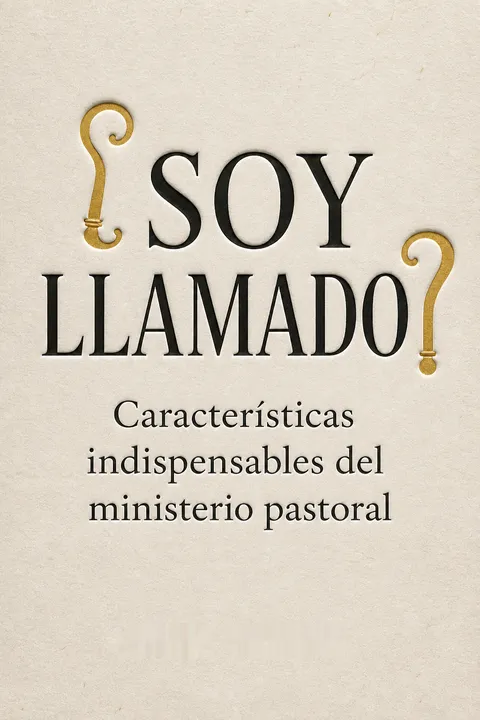


Key Takeaways
Anchor ministry in Christ, not in the status of being called.
Salvation comes first. Harvey distinguishes God’s call to salvation from a person’s possible call to pastoral work. The first is God’s action through the gospel, bringing people into relationship with Christ. A vocational role rests on that deeper identity; it cannot replace it. The distinction matters when ministry disappoints or ends: a person’s standing as a Christian does not depend on a title or position.
Thomas Scott illustrates the difference. Scott was an Anglican minister who initially approached John Newton to argue, not to learn the gospel. Over time, Newton’s counsel helped expose Scott’s spiritual confusion. Scott’s later usefulness followed conversion, not the other way around. Harvey’s point is that ministry credentials, talent, and ambition cannot compensate for a life that is not rooted in Christ.
What's important here is the protection against occupational identity taking over personal identity. Research on professional burnout often distinguishes commitment to a vocation from self-worth that depends entirely on performance. That distinction is especially relevant to pastors, whose work and public persona can blur together. A Christian identity that precedes a role can make service more resilient and make relinquishing authority less catastrophic. The framework is specifically theological, not a substitute for professional support or institutional safeguards, but its practical insight travels: meaningful work is healthier when it matters deeply without becoming the sole answer to who someone is.
Let the local church test and train the pastor you hope to become.
The church is the setting. Harvey argues that pastoral work is not a free-floating career in preaching or religious leadership. It is service among a particular congregation, where a man’s character, teaching, and care can be seen over time. Seminaries can deepen biblical and theological knowledge, but they cannot fully assess how a student treats people or applies that knowledge in ordinary church life.
Charles Simeon’s long pastorate makes the point. Appointed to a Cambridge church, Simeon faced a hostile congregation that even restricted access to its pews. He stayed rather than force a showdown that might injure the church, eventually serving there for 54 years. The story is not a rule that pastors must endure every harmful situation. It shows that love for a congregation, not personal advancement, should shape a ministry decision.
This is an argument for apprenticeship and situated assessment. Skills such as listening, conflict repair, and communicating complex ideas are difficult to evaluate in a classroom alone; they become visible in relationships and real responsibilities. The church can therefore provide a richer training ground than credentials by themselves. Yet local institutions can also protect insiders, misread dissent, or fail to train well. The strongest version of Harvey’s case pairs church-based discernment with accountable leadership and serious theological education, rather than treating either a seminary or a congregation as infallible.
Treat godly character as evidence of a call, not a future upgrade.
Character is a qualification now. Harvey reads the biblical standards for elders as visible qualities already taking shape, not a wish list for someone to achieve after appointment. Most are expected of Christians generally: self-control, gentleness, hospitality, integrity, and freedom from greed or violence. Pastors are not a superior class of believer; they are expected to model these qualities with particular consistency. The standards also require maturity, since untested authority can feed pride.
Lemuel Haynes offers a historical example. Born enslaved in eighteenth-century New England, Haynes became the first African American formally called to pastoral ministry in the United States. He served a Vermont congregation for 33 years despite racial prejudice. His story highlights the importance of character and recognized service, while also showing that a person’s gifts can be obscured by unjust barriers. Desire matters, but it is not sufficient evidence by itself.
The emphasis on observable character usefully counters selection systems that mistake confidence, polish, or educational prestige for leadership fitness. In organizational psychology, integrity is best judged through patterns across situations, not a single interview or self-description. That makes sustained community observation valuable. The harder question is who gets to define respectable character, especially where culture or power shapes the assessment. Haynes’s story makes that tension concrete: evaluation should be rigorous about conduct while remaining alert to prejudice that can deny qualified people a fair hearing.
Use your home as the first proving ground for pastoral leadership.
Private life reveals public claims. Harvey takes the biblical household qualifications seriously: a pastor’s faithfulness, self-control, and ability to lead should be evident in close relationships, not only from a pulpit. He recounts meeting a gifted ministry candidate whose wife attended a church teaching beliefs he opposed. The difference raised a question about the couple’s shared life and his leadership at home, rather than simply adding another résumé concern.
The standard is not perfection. Harvey argues that a pastor’s home should show faithful care, not flawless marriage or children who can be forced into faith. A parent cannot produce conversion by control. The relevant evidence is a pattern of responsibility, respect, repair after conflict, and openness to counsel. For single men, the principle still applies: present habits in private relationships reveal how a person handles trust and responsibility.
Close relationships expose behavior that public performance can conceal. Family-systems thinking similarly treats recurring patterns at home as informative about how a person handles conflict, authority, and repair. That makes the household a meaningful source of evidence, but not a simple scorecard: a spouse’s or child’s struggle cannot automatically be attributed to a leader’s failure. The book’s distinction between faithful parenting and control is crucial. Assessment is fairest when it asks how a leader responds to difficulty, includes the family’s perspective without coercion, and avoids making relatives responsible for validating his vocation.
If you cannot teach the gospel clearly, desire alone is not a call.
Teaching is essential work. Among the qualifications for elders in the Pastoral Epistles, Harvey singles out the ability to teach as the distinctive skill. Pastors must explain Scripture, apply it to life, and correct teaching that distorts the gospel. Strong delivery alone is not enough. A preacher’s task is not to display personality or offer generic inspiration, but to make the message of Jesus understandable and consequential for the congregation.
David Martyn Lloyd-Jones shows the weight of the choice. A successful doctor, he wrestled for years over leaving medicine to preach. He concluded that his medical work could restore people physically while leaving their spiritual need untouched. Harvey uses his decision to illustrate the seriousness of pastoral teaching, not to prescribe leaving another career. Preaching also demands study, self-examination, and endurance; the skill should be tested through real opportunities and candid feedback.
The book usefully distinguishes communication ability from charisma. In teaching research, learning depends not just on a speaker’s confidence but on whether listeners can follow, retain, and apply what is presented. That suggests a practical assessment: examine biblical accuracy, clarity, and the audience’s understanding, not merely stage presence. At the same time, preaching is not the only form of consequential ministry, and a church can overvalue the pulpit at the expense of other gifts. Harvey’s claim is narrower: for the pastoral office he describes, competent teaching is indispensable.
Shepherd people with care, shared leadership, and dependence on Christ.
Shepherding means sustained care. Harvey draws on Peter’s instruction to elders to describe pastors as responsible for feeding, watching over, and protecting a congregation. That includes preaching, practical counsel, and attention to people facing grief, illness, addiction, or conflict. Care is not the same as avoiding hard conversations; a pastor may need to speak truthfully while remaining gentle. The model is Christ, the chief shepherd, not the pastor’s own authority or personality.
Leadership should be shared. Harvey notes that the New Testament commonly describes elders in the plural. A team can bring different strengths, distribute burdens, improve decisions, and reduce the danger of one leader dominating a church. Peter’s own story gives the work emotional depth: after denying Jesus, he is entrusted with caring for others. Pastoral authority, in this account, grows from restored dependence and service, not personal superiority.
Shared leadership is a practical safeguard as much as a theological preference. Research on teams finds that diverse perspectives can improve decisions, particularly when members can disagree without penalty. A group of leaders can also make pastoral work less isolating and create more points of accountability. Still, plurality is not automatically healthy: a team can become a closed circle or diffuse responsibility. Its benefits depend on clear roles, honest disagreement, and meaningful access for the congregation. The central insight remains strong: care for a community is too consequential to rest on one person’s unchecked judgment.
Keep unbelievers in view; pastoral work cannot stop at the church door.
Evangelism requires action. Harvey interprets Paul’s instruction to Timothy to do an evangelist’s work as a real responsibility, not merely a church program or a topic for sermons. Pastors should have relationships with people outside the congregation and explain the gospel in ways that make sense to them. This is difficult when a pastor’s daily routine consists almost entirely of Christian meetings, so it requires deliberate effort to enter ordinary community life.
Charles Spurgeon’s example was more than a pulpit. Though famous for preaching, he also trained ministers, supported church planting, and pursued personal conversations with people outside the church. Harvey’s point is not that every pastor must imitate Spurgeon’s gifts or schedule. A pastor’s concern for the lost should shape both personal habits and preaching, while avoiding church growth based only on moving believers from one congregation to another.
This expands pastoral leadership beyond internal maintenance. Organizations often optimize for the people already inside them because their needs are visible and urgent; outreach requires attention to people who are not yet stakeholders. Harvey’s argument therefore identifies a predictable institutional blind spot. It also resists reducing evangelism to a growth metric: relationships and clear communication matter more than a tally of attendees. The challenge is to honor members’ need for care while protecting time for outward engagement. A balanced congregation can treat welcome, service, and truthful conversation as connected practices rather than competing departments.
Test inner desire through preparation and the church’s independent judgment.
Calling has three strands. Harvey’s threefold cord of calling names an internal desire for ministry, preparation for the work, and external confirmation by other people in the church. These strands are not a sequence or a private feeling made official by enthusiasm. Church leaders assess character and ability, while the congregation also observes how a person treats others and whether his ministry bears fruit.
John Bunyan’s path shows the process. Bunyan was a tradesman and a reluctant preacher. Members of his congregation noticed his ability to explain Scripture and encouraged him to speak; he accepted after further reflection. This differs from self-appointment: the church recognized and tested what was emerging. External confirmation protects both the aspiring pastor from self-deception and the congregation from being led by someone whose desire exceeds his readiness.
The framework distributes discernment across the person, the work, and the community. This resembles good hiring practice: self-assessment matters, but so do demonstrated performance and independent references. The arrangement limits the influence of enthusiasm or charisma alone. It also raises an important question: what if the church’s judgment is mistaken? Harvey’s model is strongest when confirmation comes from multiple informed people over time, rather than a single gatekeeper. External assessment should neither rubber-stamp ambition nor treat institutional approval as a substitute for evidence.
When doors stay shut, prepare faithfully and welcome redirection.
Waiting is active preparation. Harvey advises aspiring pastors to pray, tell a pastor about their desire, serve where the church needs help, study, seek correction, and develop a sustainable livelihood. He recounts spending years working night shifts as a security guard while serving in his church. The unglamorous season gave him time to mature and learn ordinary faithfulness. Preparation is not proof that a pastoral job is guaranteed; it is useful whether or not the role arrives.
A closed door can clarify fit. Mike McLernon entered a church staff role but found that he did not enjoy the people-centered work at the level pastoring required. After an evaluation, he returned to engineering and later supported a church-planting effort through that profession. Harvey also points to deacon service as a substantial calling. The aim is gospel service, not obtaining a title at any cost.
This account treats delay as a period for skill-building and better information, rather than as empty time. Career-development research supports exploration through low-risk experience: real tasks often reveal fit more accurately than imagined futures do. The book also makes a valuable distinction between ministry and paid ministry; meaningful service is not confined to an official role. Still, waiting can become an excuse for indefinite avoidance, so preparation should include concrete responsibilities and honest feedback. Redirection is most credible when it follows careful assessment, not merely one discouraging season.
Analysis
Harvey’s book is a theological guide to discerning a specific vocation, not a general manual for finding purpose. Its central move is to shift the question from “Do I feel called?” to “What evidence would make this desire trustworthy to the church?” The answer is distributed across spiritual identity, observable character, household relationships, teaching ability, pastoral care, evangelistic concern, preparation, and communal confirmation. The recurring biographies make that argument memorable: Simeon’s endurance ties vocation to a congregation; Bunyan’s reluctant preaching shows how a community can recognize gifts; Newton’s delays make patience part of formation rather than an accidental obstacle.
The strongest practical contribution is its resistance to self-appointment. A strong inner conviction may be sincere and still be incomplete. The book asks aspiring leaders to submit desire to evidence and to people with enough proximity to notice what ambition can hide. Its account of preparation also avoids a simple credential-versus-experience choice: theological study matters, but it must connect to lived service among actual people.
The framework has clear boundaries. Harvey writes from a conservative Christian tradition that reserves pastoral office for men, a position assumed rather than argued in depth here. Readers from other traditions may reject that premise while still finding the book’s questions about character, teaching, accountability, family life, and communal discernment useful. Some standards also require careful application. Family behavior is evidence, not a perfect measure of a pastor’s worth, and institutional approval can reflect prejudice as well as wisdom. The book is most persuasive when its tests are treated as sustained, communal judgment rather than rigid checkboxes.
Ultimately, the book’s test of calling is not whether someone can imagine a ministry future, but whether a life of service is already taking shape, whether others can see it, and whether the person can accept a different form of faithfulness if pastoral office is not the right fit.
Review Summary
Am I Called? receives overwhelmingly positive reviews, praised for its biblical approach to discerning pastoral calling. Readers appreciate Harvey's clear writing, practical advice, and focus on character qualifications. The book is recommended for men considering ministry and current pastors alike. Some criticize its limited scope to male pastors and casual writing style. Overall, reviewers find it insightful, challenging, and helpful in examining one's call to pastoral ministry, with many considering it a must-read resource.
People Also Read










Glossary
effectual call
God’s call to salvationThe effectual call is God’s action through the gospel that summons a person to himself and brings about a response of saving faith. Harvey treats this call to Christ as the foundation for every other vocation. A possible call to pastoral ministry is secondary; it cannot replace or outrank the believer’s identity in Christ.
internal calling
Inner desire for ministryInternal calling is a person’s inward, persistent desire to preach, teach, and care for a local church. In Harvey’s account, it may appear suddenly or develop gradually, and it includes more than ambition: it should be accompanied by character, gifts, pastoral concern, and a commitment to the gospel. On its own, it is not sufficient evidence for appointment.
external confirmation
Church affirmation of a callExternal confirmation is the church’s evaluation and affirmation of a person’s suitability for pastoral ministry. Church leaders assess biblical qualifications, character, and ability, while the broader congregation observes the person’s conduct and effect on others. It gives the aspiring pastor an independent assessment and protects the church from self-appointed leadership.
threefold cord of calling
Three sources of discernmentThe threefold cord of calling is Harvey’s model for discerning pastoral vocation through three connected strands: internal desire, preparation through service and growth, and external confirmation by the church. The strands are not sequential steps or interchangeable proof. Together, they provide a more reliable basis for judgment than private conviction or credentials alone.
plurality
Shared church leadershipPlurality refers to leadership of a local church by multiple elders rather than a pastor acting alone. Harvey connects this pattern to support, shared judgment, diverse gifts, and accountability. It can reduce isolation and limit domination by one strong personality, though it depends on leaders who can work together honestly and remain answerable to the congregation.
Download PDF
Download EPUB
.epub digital book format is ideal for reading ebooks on phones, tablets, and e-readers.








