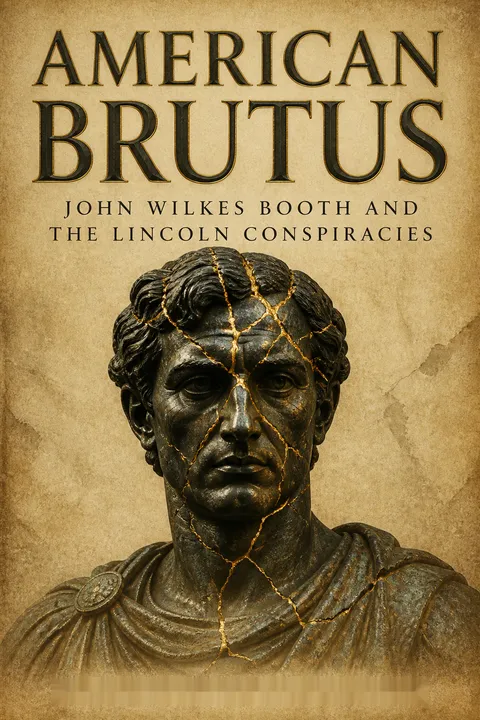


Key Takeaways
See Booth as a calculating organizer, not a pawn or a madman
A star with a cause. John Wilkes Booth was a popular, successful actor with friends across the North and South. The familiar picture of a failed performer driven suddenly mad does not fit the record Kauffman assembles. Booth had long absorbed political arguments about tyranny, slavery, and the Union, and he imagined himself in the company of historic rebels who killed rulers they considered oppressive.
Conviction and performance intertwined. Booth could be warm, generous, and charming, yet also ruthless in pursuit of a political act and lasting fame. His public likability helped him move unnoticed; his talent for acting helped him manage what others believed about him. The book presents him as the plot’s leader, not as a mere instrument of Confederate officials.
What's striking is how little explanatory work the label of madness does here. Booth's political conviction and his capacity for calculated planning can coexist with delusion, vanity, or moral blindness. That distinction matters: understanding a perpetrator's reasoning is not the same as accepting its premises. The case also cautions against treating charm as evidence of goodness. Social warmth can be genuine and still serve as a tool of influence. Kauffman's evidence supports a portrait of agency, though no archive can settle every question about Booth's private state of mind.
Treat Booth's manufactured accomplices as part of the plot itself
A second plot made of smoke. Kauffman calls Booth's false impressions a shadow conspiracy: a deliberately enlarged picture of support that made the real operation seem backed by more people and authority than the evidence shows. Booth hinted at Confederate approval, exaggerated his oil wealth, and gave misleading accounts of where he was going. These stories gave recruits confidence and made potential witnesses fear that exposure would implicate them.
Innocence could be made to look guilty. Booth created suspicious-looking connections with people he did not trust, including actor Sam Chester, who refused to join, and John Mathews, who carried a letter for him. He arranged circumstances that could make others seem to have helped plan the crime. The strategy blurred the line between a genuine participant and someone caught in a web of staged appearances.
This is a sharp account of how coercion can operate without formal command. A person who believes many powerful allies are involved may take risks, keep quiet, or recruit others, even when that belief is false. The same tactic can manufacture evidence against people who were never trusted insiders. That makes Booth's strategy a problem of both manipulation and information contamination. The interpretation is persuasive where actions are documented, but the exact purpose behind each misleading story remains an inference rather than a confession.
Build history from dated events, not inherited stories
Sort before you narrate. Kauffman entered summaries of documents from the 11,000-page Lincoln Assassination Suspects file into a searchable database. He could arrange reports by date, place, person, horse, or financial transaction, then compare how separate witnesses described the same events. This helped reveal changing roles among the plotters, overlooked trips, and the repeated movement of horses and weapons.
A record needs context. A sworn statement, a private letter, and a recollection written decades afterward do not carry equal weight. Kauffman asks who made each statement, when it was made, and what the speaker had to gain. The earliest account is not automatically true, but later memories often conflict with contemporary evidence. Organizing fragments made it possible to reconstruct a chronology without pretending every gap had an answer.
The method resembles modern data analysis, but its deeper lesson is about provenance: information is inseparable from how and why it was produced. Search tools can expose patterns a reader would miss across thousands of pages, yet they cannot distinguish truth from a repeated rumor on their own. That still requires close reading and judgment. Kauffman's approach is strongest when it makes competing accounts visible instead of smoothing them into a seamless story. Its limitation is the archive itself: missing records can make some patterns impossible to test.
Read Maryland's border politics as infrastructure, not proof of guilt
A divided state mattered. Maryland sat between Washington and the Confederacy, and its residents faced martial law, military surveillance, and deep disagreement over slavery and Union policy. In 1860, Lincoln received only about 2.5 percent of Maryland's vote. Southern Maryland's rivers, roads, and local relationships also supported a busy underground movement that carried people, letters, and goods across the Potomac.
Booth used the terrain socially. He visited the region under the cover of looking for land and horses, then cultivated people who knew its routes and safe houses. The geography made escape possible, while resentment toward federal authorities made some residents willing to help. But political sympathy was not the same as participation in murder. The borderland explains the plot's logistics; it does not establish the guilt of everyone who lived there.
The book treats geography as an active part of political history. Rivers, checkpoints, and familiar households can shape what a clandestine group is able to do, just as much as formal organizations do. This is a useful corrective to histories that draw the conflict only around capitals and armies. It also demands caution: a community that shelters smugglers or resents an occupation is not automatically a conspiracy network. Context can explain opportunity without excusing violence or turning regional identity into evidence.
Track how prisoner rescue gave way to political murder
The first rationale was capture. In 1864, Booth recruited old friends Sam Arnold and Mike O'Laughlen into a scheme to seize Lincoln and carry him to Richmond. The stated purpose was to force the Union to resume prisoner exchanges, which could return experienced soldiers to Confederate ranks. John Surratt and Thomas Harbin could help with the southern route; George Atzerodt could handle a river crossing.
The rationale weakened as defeat approached. The prisoner exchange resumed in January 1865, and the original justification lost force. Kauffman argues that Booth's plan shifted toward assassination as the Confederacy collapsed. After Lincoln spoke publicly in favor of voting rights for some Black men, Booth reacted with renewed fury. The exact moment and motive of the change are reconstructed from fragmentary evidence, but the plot's later targets included Lincoln and Secretary Seward. Atzerodt was assigned to attack Vice President Johnson, but did not do so.
The changing objective illustrates how an operation can retain its language after its purpose has changed. A humanitarian rationale about prisoners helped recruit men, while the political conditions that supposedly justified it disappeared. That shift is important, but it is also one of the book's more interpretive claims: plans rarely leave a clean record of when intention hardens into action. A careful reader should distinguish the documented sequence from the author's explanation of Booth's internal decision.
Treat Ford's Theatre as a prepared crime scene, not a sudden stage
The familiar venue became an instrument. Booth knew Ford's Theatre and its people. Before the shooting, someone prepared a barricade for the passageway to Lincoln's box and drilled a small peephole into a door. Booth timed his entry for a moment when the stage would be clear, then shot Lincoln from close range and leapt to the stage. The audience froze in confusion, giving him seconds to escape through the back door.
The wider attack had multiple targets. At nearly the same time, Lewis Powell attacked Secretary of State William Seward at home, badly injuring him and several others. Booth had also assigned Atzerodt to kill Johnson, but that part of the plan failed before it began. These near-simultaneous actions made the event look like a bid to decapitate the government, even though the scope of official Confederate involvement remains disputed.
The theater's details matter because space is part of a plan. Sightlines, doors, props, and the audience's attention all shaped the seconds in which Booth acted. This resembles human-factors analysis, which studies how people and environments interact under pressure. It also explains why the crowd's hesitation was not simple cowardice: people needed time to interpret an event that initially seemed theatrical. Preparation improved Booth's odds, but it did not make the operation fully controllable. The failed attack on Johnson shows the limits of coordination.
Expect panic to multiply false leads when agencies cannot coordinate
A vast response, no single map. Washington mobilized roughly 26,000 soldiers and issued orders to close roads, bridges, and rail routes. Yet police, military commanders, provost marshals, and investigators gathered information separately, with no one responsible for assembling a complete picture. Messages moved slowly, witnesses disagreed, and Booth's photograph was not widely distributed immediately.
Bad leads redirected real effort. Authorities confused Booth's small bay mare with a different, one-eyed horse linked to Atzerodt. Rumors of attacks and captures reached senior officers as though they were confirmed reports. Hundreds of people were detained on weak grounds, including men who merely resembled the assassin. Booth crossed a guarded bridge because the sentry did not recognize the danger in front of him. The pursuit had enormous manpower, but little reliable coordination at first.
This is a classic distinction between capacity and coordination. A state may command thousands of people and still fail to turn scattered observations into shared, dependable knowledge. Under threat, organizations often prefer action to uncertainty, which can produce both missed suspects and innocent detainees. Booth benefited from that gap. The chapter also shows why speed alone is not a sufficient measure of emergency response: without common records, clear responsibility, and disciplined verification, more activity can generate more noise.
Follow the escape through its improvised, contested chain of shelter
The route was not a clean getaway. Booth and David Herold fled south into Maryland, where Booth's leg was injured during the escape. They stopped at Dr. Samuel Mudd's farm for treatment, then sought help from Samuel Cox and Thomas Jones. Their first attempt to cross the Potomac failed, forcing them back onto Maryland soil. On April 23, they crossed again into Virginia, where local contacts moved them between homes.
Shelter created exposure. The pair reached the Garrett farm, where Booth and Herold hid in a tobacco barn. Union cavalry surrounded it, and soldiers set it on fire. Sergeant Boston Corbett shot Booth through the neck; Booth died hours later. The medical visit to Mudd became a central disputed link. The book follows the evidence but does not turn every act of aid, silence, or confusion into proof that a resident knew the whole plan.
The escape reads less like a master plan than a fragile chain of favors, bad weather, local knowledge, and improvisation. Each refuge reduced immediate danger while creating another witness or dependency. That pattern is common in clandestine logistics: success depends not only on a leader's design, but on the willingness and reliability of ordinary intermediaries. The Mudd case shows the interpretive danger. Providing care is an observable act; knowing the full purpose of a visitor is a separate claim that requires separate evidence.
Separate guilt from the emergency court used to punish it
The trial tested more than guilt. Eight people faced a military commission, although civilian courts were operating in Washington. The proceedings began behind closed doors, used broad charges, and gave the prosecution considerable control over what evidence entered the record. The trial heard 371 witnesses and filled 5,010 pages, yet important records and contradictory information were not available to the defense. Some testimony linking Confederate officials to Booth was later exposed as fabricated.
Sentences varied, and legality remained contested. Surratt, Powell, Herold, and Atzerodt were executed. Mudd, Arnold, and O'Laughlen received life sentences; Spangler received six years. The Supreme Court's 1866 Milligan decision rejected military trials of civilians when regular courts remained open. It sharpened the question of whether wartime necessity justified this tribunal, regardless of what individual defendants had done.
A verdict and a legitimate process answer different questions. The commission had to decide what the accused had done, but the nation also had to decide what powers it could use in response. Kauffman's account is valuable because it examines both, including the prosecution's evidentiary advantages and its questionable witnesses. A procedural critique does not automatically establish innocence, just as a guilty verdict cannot settle whether the procedure was lawful. That separation is essential whenever fear presses institutions to treat emergency as a blank check.
Booth's murder turned his intended symbol into a political liability
The result contradicted the performance. Booth hoped to resemble a historic tyrant-slayer and win honor for the Southern cause. Instead, Lincoln's death produced mourning and outrage across the country. Many Southerners, including prominent leaders, condemned the killing or feared its consequences. The assassination made it harder for Southern sympathizers to defend the rebellion and helped turn Lincoln into a martyr.
The story grew more distorted with time. Early witnesses disagreed about what they saw; later recollections sometimes turned Booth's swift escape into a limp or made observers more heroic than contemporary records suggest. The book also challenges later claims that Edwin Stanton organized the murder or that Booth escaped death. Such stories endured because the event left gaps and because Booth himself encouraged confusion. The record supports a complex plot, not every theory built around it.
Political violence is judged not only by the actor's intent, but by the meaning other people assign to it. Booth staged his act as a public argument, yet the audience for that argument rejected his framing. The backlash shows how symbolic violence can strengthen the legitimacy of the person it targets while discrediting the cause invoked in their name. The book's account of later myths adds a second lesson: uncertainty invites narrative, but narrative confidence is not evidence. Historical memory needs the same skepticism as an investigation.
Analysis
American Brutus is at once a biography, an investigative history, and an account of how institutions behave under shock. Its organizing claim is that Booth was neither a lone madman nor a mere instrument of Confederate officials. He led a real plot while manufacturing the appearance of a much larger one. That distinction explains both the conspirators' behavior and the investigation's persistent confusion. It also gives the book a strong narrative engine: the reader follows two connected stories, the actual operation and the false network Booth built around it.
Kauffman's most consequential contribution is methodological. He treats the archive not as a pile of authoritative statements, but as a body of claims produced by people with different incentives, at different times, for different audiences. His chronological database makes relationships among people, places, horses, and communications visible. This resembles network analysis, but the crucial work remains interpretive. A pattern can reveal a lead; it cannot establish what a person knew or intended. That distinction is especially important in the cases of Mudd, Weichmann, and those Booth made look implicated.
The book's boldest interpretations concern motive. The transition from a prisoner-rescue plan to assassination, and Booth's deliberate use of incriminating appearances, are supported by a dense chronology, yet they cannot be observed directly. The narrative sometimes turns circumstantial evidence into a coherent theory because a story needs decisions and causes. Readers should keep the difference between documented action and inferred intention in view.
The investigation and trial deepen the book beyond the assassin's psychology. A government with immense military capacity still struggled to coordinate information, while its response exposed the hazards of detention, rumor, and emergency justice. The military commission's verdicts did not erase the question of its legality. The lasting value of the book lies in holding these truths together: Booth was responsible, evidence was uneven, and the state could pursue justice while compromising the procedures that make justice credible.
Review Summary
American Brutus is praised for its meticulous research and engaging narrative of Lincoln's assassination. Readers appreciate Kauffman's detailed exploration of Booth's motivations, the conspiracy, and its aftermath. The book challenges common misconceptions and provides new insights into the events. While some find the level of detail overwhelming, most commend the author's thorough approach and ability to create suspense. The book is considered a definitive work on the subject, offering a nuanced portrayal of Booth and the historical context surrounding the assassination.
People Also Read


Glossary
shadow conspiracy
manufactured appearance of supportKauffman's term for Booth's deliberate creation of misleading impressions that his plot had more members, money, or Confederate backing than the evidence establishes. These appearances helped persuade recruits, confuse witnesses, and make outsiders seem implicated. The term distinguishes the real group of plotters from the larger, partly fictitious network Booth encouraged people to imagine.
event-based system
chronological evidence databaseKauffman's method for organizing assassination records as individual events that can be sorted by date, location, person, or other details. He entered summaries from the Lincoln Assassination Suspects file into a database, allowing him to compare scattered reports and notice relationships across time. The system organizes evidence; it does not by itself decide which source is reliable.
defendant declarations
accused people's statementsThe book's term for statements made by an accused person about a crime. Under the common-law rule Kauffman describes, a defendant generally could not introduce later statements to support a defense, while prosecutors could present certain formal statements through officials. This asymmetry could leave the accused unable to answer an account of their words given by a government witness.
irregular warfare
covert raids and subversionA Civil War term used for operations outside conventional battles, including espionage, raids, sabotage, prisoner escapes, and attacks intended to unsettle civilians. Confederate agents in Canada and sympathizers in border regions pursued such schemes, with varying degrees of official support. The term describes a broad category of activity, not proof that every suspected plot was authorized by Confederate leaders.
military commission
wartime military tribunalA tribunal composed of military officers rather than a civilian jury. During the Civil War, commissions were used to try certain offenses under military authority. The Lincoln assassination defendants were tried this way even though civilian courts were operating in Washington, a choice later challenged in light of the Supreme Court's Milligan decision on military trials of civilians.
Download PDF
Download EPUB
.epub digital book format is ideal for reading ebooks on phones, tablets, and e-readers.








