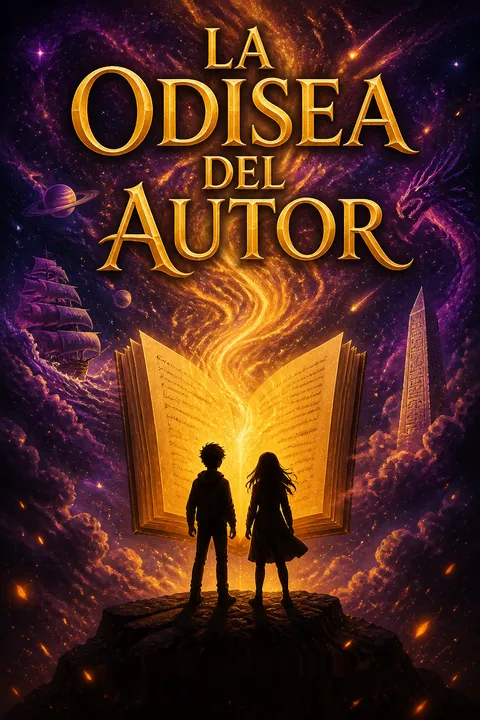


Plot Summary
Prologue
At her retirement party, former teacher Evelyn Peters remembers how she helped struggling students, including twins Alex and Conner Bailey. The twins suddenly appear in her old classroom, dressed for another world and urgently searching for Conner’s handwritten stories.
They explain that the fairy tale world is in danger, and Mrs. Peters gives Conner the portfolio she saved, after making him promise to keep writing. She also tells him how far he has come since his father died. Her final evening as a teacher becomes one last lesson in recognizing a student’s potential.
The prologue makes encouragement a plot mechanism, not merely a warm memory. Mrs. Peters preserved Conner’s stories because she saw promise in work he had not yet learned to value. Her request that he keep writing turns the portfolio into both a practical tool and a commitment to a future self. The twins’ return also makes teaching reciprocal: Mrs. Peters once helped them grow, and their visit confirms that her influence outlasts her classroom. Her idea of a favorite student rests on progress through difficulty, giving Conner’s creative journey an emotional measure before the adventure begins.
The Swan Lake Escape
The Masked Man conquers the fairy tale kingdoms with an army of villains drawn from other books, then gathers the displaced people at the drained Swan Lake to witness the execution of their rulers. Goldilocks and Jack turn the execution platform into a trapdoor. The Tin Woodman frees the royal families as the rescuers flee in a carriage, protected in turn by the Merry Men, the Lost Boys, and Peter Pan.
They reach a hidden dwarf mine sheltering refugees, where the royals agree to share refuge with people and creatures they once kept at a distance. But Alex and Conner are missing. They went to seek help from the Fairy Council and never returned, leaving the survivors to wait without knowing whether their champions are alive.
The rescue replaces the old order’s helpless spectacle with improvised cooperation. Its success depends on people from different stories trusting one another, while the mine forces rulers to share space with refugees they might once have excluded. The victory is deliberately incomplete: the royals survive, but the twins and Fairy Council are absent, and nearly every familiar institution has fallen. That gap turns refuge into a holding pattern. The survivors can preserve life, but they cannot yet imagine how to reclaim a world whose defenses and leadership have both disappeared.
A Birthday Interrupted
In the Otherworld, Alex and Conner recover the stories Mrs. Peters saved and decide to recruit their fictional characters as soldiers. Before they can begin, they visit their mother, Charlotte, and stepfather, Bob.
Charlotte confronts them for vanishing without warning and reminds them that it is their fifteenth birthday. She insists on a family dinner before hearing their crisis. At the Storybook Grill, the twins share memories with her and admit that their heroic work has left her frightened and excluded.
Charlotte accepts their mission and agrees to supervise the characters. Nearby, their former classmates, the Book Huggers, overhear the impossible explanation and realize the twins did not simply transfer schools. They begin following the mystery themselves.
The visit makes the twins’ heroism costly in a way that monsters cannot be: their mother has been living with uncertainty and no meaningful way to help. Charlotte’s anger gives the ordinary family world moral weight, rather than treating it as a pause between adventures. The birthday sharpens that conflict, since the twins have missed even the passage of their own lives. Their eventual agreement is not a simple permission slip. It is a negotiated return to family, with Charlotte choosing participation over helpless waiting and the twins acknowledging that their duty to strangers does not erase their obligations at home.
The Emperor Loses His Throne
After the royal families escape, the Masked Man’s allies turn against him. The Queen of Hearts, Captain Hook, and the Wicked Witch of the West had joined his campaign for rewards, and his failure to deliver those prizes ends their loyalty. The Witch drops him from the palace balcony, then the three villains decide to rule the conquered kingdoms themselves.
Injured but alive, the Masked Man overhears Morina propose a new alliance: she wants the villains to help her seize the Otherworld after the witches weaken it. She reveals that she has kidnapped a boy named Emmerich, the Masked Man’s unknown son, as leverage. The Masked Man abandons thoughts of reclaiming his throne at once and begins plotting around the child.
The coup reveals that the Masked Man’s empire was built on bargains he could not sustain. His allies do not oppose cruelty; they resent being denied their share of its rewards, then embrace the same domination for themselves. Morina’s proposal widens the danger beyond the fairy tale kingdoms, making conquest an exportable ambition. The revelation of Emmerich introduces a different kind of leverage: a relationship the Masked Man has never had to consider. Yet even this discovery initially registers as an opportunity to him, suggesting that power has trained him to interpret people through usefulness before affection.
Bree Tracks the Abduction
Bree Campbell refuses to accept that her friend Emmerich’s disappearance is an ordinary kidnapping. With the Sisters Grimm, she flies to Bavaria and uses their cross dimensional tracking devices in the boy’s bedroom.
The readings confirm that someone from the fairy tale world took him through his window. Emmerich’s distressed mother reveals that he was adopted after being found as a baby in Neuschwanstein Castle, with a note warning that his biological father was dangerous.
Bree realizes the boy may have come through the castle’s portal, not descended from the Brothers Grimm as she had assumed. Her investigation cannot yet identify the abductor, but the note turns a missing person search into a family mystery and points the Sisters toward the castle.
Bree’s investigation matters because it begins with attention rather than certainty. She trusts the mismatch between the official explanation and the circumstances, then tests her suspicion with equipment instead of forcing a theory onto the evidence. The adoption revelation destabilizes her own understanding of kinship as well as Emmerich’s. His mother’s secrecy came from a wish to protect him, yet it leaves him vulnerable to a history he was never told. The portal makes family origins materially cross dimensional, linking private identity to the same porous boundary the twins use to build their army.
Conner Meets His Pirates
Using the Portal Potion on his manuscript, Conner drops himself and Alex into a Caribbean adventure, where they are nearly drowned before Auburn Sally’s crew hauls them aboard the Dolly Llama. Conner expects his characters to recognize their author.
Instead, the pirates bind the twins and treat his knowledge of their lives as proof that he is dangerous. His spelling mistake even turns a command to lower the ship’s sails into a comic sale of pirate goods.
When the British Navy arrives, the twins watch Captain Auburn Sally battle and flirt with Admiral Jacobson, who resembles Jack. Conner warns her that the feared pirate Smoky Sails Sam is approaching. She tests his knowledge of her stolen ruby, then agrees to help the twins if they first help her defeat Sam.
Conner’s first encounter with his imagined world punctures the fantasy of authorship as command. The characters have lives and loyalties that do not automatically bend to the person who wrote them, and his errors become physical consequences rather than harmless edits. Alex’s caution is vindicated, but Conner’s embarrassment also reveals how personally he takes the rejection. Auburn Sally’s response gives him a more mature model of authority: she believes evidence, negotiates terms, and keeps her own interests in view. The story becomes a collaboration rather than a world Conner can simply operate.
The Fortress of Starboardia
Conner guides the Dolly Llama through the Bermuda Triangle to Starboardia, an island fortress designed to defeat attackers who outnumber its defenders. As Sam’s five ships close in, Alex uses magic to hide the fleeing vessel and slow the pursuit.
The crew reaches the fortress, where Conner explains its red safe zones and timed traps. Once Sam’s hundreds of pirates charge inside, Auburn Sally fires on the ropes holding a suspended net of boulders, activating the structure.
Rotating floors, falling stones, trapdoors, and swinging blades scatter the attackers. Sam finally catches up with Auburn Sally and shoots Jacobson, but the Heart of the Caribbean stops the bullet. The last trap crushes Sam. The rescued crew agrees to repay the twins by joining their fight.
The fortress converts unequal numbers into a problem of attention and timing. Conner’s knowledge supplies the design, but survival depends on the crew learning it together and responding under pressure. Alex’s magic helps the ship reach the island, while the sailors and pirates do the dangerous work inside it. Jacobson’s ruby necklace, previously a source of conflict and pursuit, becomes literal protection at the climax. The victory therefore grows from details and relationships introduced earlier, not from a sudden rescue. Conner also learns that a story’s stakes feel real once its people can be hurt.
The Queen Wants Planets
In Conner’s science fiction story, the twins board the BASK 8 and meet its planet collecting ruler, the Cyborg Queen. They need her army, but she agrees only after they promise to clear a newly discovered planet of its dangerous polycrabs. On Lollipopigust, Alex and Conner find a cheerful Blissworm and discover it is being used as bait.
The insects capture them and carry them into their queen’s underground colony. Alex frees the twins from their webbing while Conner recovers the bomb the Blissworm swallowed by tickling it until it spits the device out. They set it off and escape as the colony is destroyed. The Cyborg Queen keeps her bargain, and the Blissworm comes with them.
This adventure tests the twins’ ability to act inside a world whose rules are partly Conner’s own invention. His imagination produces both the useful tools and the hazards he has failed to anticipate, while Alex’s practical magic repeatedly keeps the plan from collapsing. Her instinct to spare the Blissworm complicates the story’s simple extermination mission, even though the polycrabs remain an immediate threat. The Cyborg Queen’s bargain also exposes a familiar logic of extraction: she wants a planet, and the twins must make it safe for her to take. Their victory recruits an army, but not without moral friction.
The Mine Welcomes Them Back
Back in the fairy tale world, Alex and Conner find the Northern Palace occupied by the three literary villains and discover that their friends have abandoned the earlier cave. Rook Robins leads them through a concealed tunnel to the crowded dwarf mine, where Jack, Goldilocks, the royal families, and hundreds of refugees have gathered.
Rook’s help lets him begin repairing the trust he damaged before. The twins announce that pirates and Cyborgs are joining their cause, then invite many refugees to the Otherworld to help supervise the growing army.
Meanwhile, Arthur, left behind in his own world, is struggling to train because he misses Alex. Mother Goose advises him to balance affection with responsibility, and he takes that counsel as a reason to prove he can fulfill his destiny.
The mine is not merely a staging point; it is a social experiment under pressure. Refugees teach one another skills, rulers share hardship, and Rook has to offer practical service without assuming that remorse entitles him to trust. The twins’ invitation brings relief, but it also turns the Otherworld home into a crowded coalition requiring care and coordination. Arthur’s parallel struggle echoes the central tension between private attachment and public responsibility. His response is energetic but somewhat self directed: he hears the advice about balance and converts it into a challenge to prove himself, showing how easily love can motivate growth while still distorting interpretation.
Bolt Finds His Power
The twins enter Conner’s superhero story and watch the older Ziblings dismiss their youngest brother, Bolt, as too immature to help. Alex recognizes the hurt in his face as the same shame Conner once felt when she mocked his academic struggles.
She apologizes, and Conner begins to see his story as a reflection of their childhood rather than a separate invention. When the Snake Lord traps the older siblings at the Eiffel Tower, Conner and Alex encourage Bolt to trust his own courage.
Bolt falls from the tower but absorbs enough surrounding electricity to awaken his full powers. He frees his siblings, destroys the Reptilalizer, and defeats the Snake Lord with a lightning strike. The family reconciles, and Professor Wallet agrees to help the twins.
The Ziblings plot makes recognition the hinge between fictional adventure and sibling repair. Alex does not simply sympathize with Bolt; she identifies the specific wound she helped create in Conner, then accepts responsibility without demanding immediate forgiveness. Conner, in turn, supplies Bolt with encouragement that he once needed himself. The story’s heroism is therefore not based on being the strongest sibling, but on acting before confidence is guaranteed. Bolt’s surge of power follows his decision to try, while his siblings’ apology follows his rescue. The sequence distinguishes earned self belief from praise alone, even as support helps make action possible.
Emmerich’s Father Returns
While Bree and the Sisters Grimm search Bavaria, the Masked Man reaches Emmerich’s witch camp and frees him. He hides his identity, calls himself Lloyd Bailey, and claims Alex and Conner sent him. Emmerich trusts the apparent rescuer and helps activate a portal at the very place where he was found as a baby.
They emerge in Neuschwanstein Castle, where Bree and Cornelia have just confirmed that the portal was recently used. Emmerich runs to Bree, but Lloyd draws a revolver and forces her and Cornelia to cooperate. He needs their route to the twins’ home and a nurse’s medical skill. Bree now understands that the missing boy has been brought back by the dangerous father named in his old note.
Lloyd exploits the very trust that makes rescue possible. Emmerich has spent his captivity hungry for home and familiar faces, so a relative who claims to know the twins offers exactly the reassurance he wants. His ability to open the portal confirms that his origins are magical, but the discovery arrives alongside deception rather than belonging. Bree’s evidence and the old note prepared the reader for danger, yet the revelation still lands through a personal betrayal: Emmerich is not simply found, he is carried into another person’s scheme. The castle’s portal links his beginning and present captivity in one place.
A Mother Joins the Story
Charlotte joins Conner in The Adventures of Blimp Boy, where they meet young archaeologist Beau Rogers and his aunt Emgee aboard a blimp. Beau has found the first three golden hands needed to complete the quest for a talisman that commands a buried mummy army.
When Conner reveals he also needs the talisman, Beau treats him as a rival, and the boys race through a pyramid full of traps. Conner reaches the pharaoh’s chamber first but turns back when mummies corner Beau.
After they recover the talisman together, Conner promises Beau its return. During the journey, Charlotte admits she fears she is missing her children’s lives. Conner reassures her that his stories carry pieces of her courage and work, and promises to share future writing with her.
The pyramid gives Conner a choice between instrumental success and responsibility to another person. He needs the talisman to complete an army, yet he abandons the quickest route when Beau is in danger. His kindness is not presented as effortless: he resents the delay, then acts anyway. The parallel conversation with Charlotte deepens the same question of who gets included in a life shaped by duty. She had mistaken the absence of a literal mother character for absence from Conner’s inner world. His account of the pirate captain and superhero clarifies that children often encode family influence indirectly, especially when they lack the language to name it.
A Hospital Becomes a Stage
The characters settle in a new hospital wing while Charlotte tries to manage pirates, sailors, fairytale refugees, and Cyborgs. When a psychologist and hospital donors find the crowded commissary, Charlotte claims the newcomers are performers and promises a show.
Trollbella writes and directs an extravagant account of her own life, assigning roles to the characters and forcing the divided groups to rehearse together. Their ridiculous performance delights the children in the hospital and briefly turns the makeshift army into a community. As the play ends, Goldilocks goes into labor.
In the adjoining operating room, Lloyd arrives with Bree and Emmerich, takes Charlotte hostage, and announces that he intends to drain his son’s magical blood to restore his own powers. At the same time, Morina ambushes Alex and curses her with enchanted dust.
The hospital brings caregiving, performance, and danger into the same institutional space. Charlotte’s improvised lie protects the characters, then creates a task that makes them work together rather than merely occupy neighboring tables. Trollbella’s self dramatizing play is comically self centered, but its audience needs exactly the distraction it provides. The sudden labor and hostage crisis expose the limits of pretending that stories can be safely contained as entertainment. Meanwhile, Morina’s attack weaponizes Alex’s own emotions, turning private insecurity into an external force. The chapter’s crowded convergence makes care feel precarious: the people who organize help are themselves vulnerable to being overwhelmed.
Midnight in the Cemetery
Conner frees himself and the other hostages, then redirects Lloyd’s stolen ambulance into Bree’s unfinished story, a cemetery where the dead rise briefly at midnight. Charlotte escapes by sedating Lloyd, but the fog separates her from Emmerich. Conner and Bree find the boy as Lloyd closes in, and the cemetery’s undead women, including Bo Peep, confront the man who betrayed her.
Lloyd falls into an open grave and is dragged beneath the earth. Bo Peep learns that Emmerich was raised by a loving adoptive mother and gives him her heart shaped necklace before returning to her coffin. Charlotte reaches Goldilocks in time to deliver her son, Hero, whose name reflects his parents’ hope that he will shape his own life.
The cemetery turns neglected history into active judgment. Bree’s imagined dead women are not passive symbols; Bo Peep recognizes the person who harmed her and meets him without fear of his weapon. The Masked Man’s attempts to control the living end in a setting where even the dead cannot be intimidated into silence. Emmerich’s reunion with Bo Peep does not erase the mother who raised him; instead, he receives an account of his origins alongside reassurance that he was wanted and protected. Goldilocks’s delivery places new life beside that reckoning, making the story’s end a handoff rather than a clean reset.
The Mine Falls Silent
After returning to the hospital, Conner tells the assembled allies that Lloyd is gone and Hero has been born. But the apparent relief breaks when he learns that the refugees left in the dwarf mine have all been turned to stone. Blubo, a young flying monkey, is the only survivor of the attack. Alex is missing, and a ruined restroom in the hospital suggests that Morina’s dust has transformed her in some way.
The story offers no recovery or explanation before shifting to Washington: President Katherine Walker is called to the Situation Room after officials report an unexplained magical event in New York City. The twins have assembled an army, but their allies are petrified and Alex’s fate remains unknown.
The ending withholds the satisfaction of a completed campaign. Lloyd’s removal resolves one immediate threat, but it does not restore the world or even guarantee the safety of the people waiting for the twins. The petrified refugees repeat the Fairy Council’s earlier condition on a more intimate scale: institutions and communities are present but unable to act. Alex’s absence makes the emotional danger especially sharp, since the sister who has repeatedly used her power to protect others may now be under its enemy’s control. The presidential summons expands the consequences beyond the fairy tale realm, turning a private rescue mission into a crisis without a visible boundary.
Analysis
An Author’s Odyssey treats stories as places with inhabitants, but its deeper concern is responsibility: what happens when imagination gives a person power over others. Conner initially expects his fictional characters to recognize his authority. The pirates refuse, the Cyborg Queen negotiates, and Beau competes with him for the talisman. In each case, the story world resists being reduced to its author’s intention. Conner’s growth comes from accepting that creation does not guarantee obedience, and that a good ending depends on how he treats the people inside it.
The book gives that question a family dimension. Alex must confront the way her competence once made Conner feel diminished. Charlotte must explain that she has been frightened and lonely while her children saved strangers. Conner’s stories then reveal that both women have already shaped him: his sister encouraged his writing, and his mother’s resilience entered his characters even when he thought he had left her out. Mrs. Peters supplies the same principle in an earlier form. Attention can alter what a child believes is possible, but it works best when it recognizes the child rather than prescribing a finished identity.
The war plot extends this ethic into politics. The royal escape succeeds because former rivals share a plan and a refuge. The army the twins assemble also depends on bargains, care, and mutual recognition, not simple command. Yet the ending refuses to equate cooperation with safety. The refugees are petrified, Alex is missing, and an unexplained magical crisis reaches the human world. Stories can carry hope across worlds, but the book insists that hope is not a substitute for vigilance, accountability, or continued action.
Review Summary
An Author's Odyssey receives mostly positive reviews, with readers praising Colfer's imaginative storytelling and character development. Many enjoy the adventure into Connor's stories and the introduction of new characters. Some critics note a decline in quality compared to earlier books, citing issues with writing style and pacing. The cliffhanger ending leaves readers eager for the final installment. Overall, fans appreciate the humor, creativity, and emotional depth of the series, despite some mixed opinions on this particular entry.
Characters
Alex Bailey
The gifted twinAlex is Conner’s twin sister, a powerful young fairy who approaches danger with planning, discipline, and a strong sense of responsibility. She often sees practical risks before her brother does, but that competence can make her impatient with his uncertainty. Her relationship with Conner is loving and sometimes competitive, shaped by years of being treated as the more capable twin. She is also learning that leadership involves more than solving the immediate problem: it requires listening, admitting harm, and letting other people act for themselves.
Conner Bailey
The imaginative twinConner is Alex’s twin, a developing writer whose humor often protects a more sensitive and self doubting nature. He turns people he loves into story characters, sometimes without understanding what those inventions reveal about his own memories. His plan to recruit characters from his school stories gives his imagination concrete consequences and forces him to negotiate with people he once assumed he controlled. Encouraged by teachers and family, Conner gradually treats writing not as a private escape but as a talent worth taking seriously.
Charlotte Bailey
The anxious, steadfast motherCharlotte is Alex and Conner’s mother, a nurse and the wife of Bob. She loves her children fiercely but has spent too much time fearing for them from a distance. Her frustration comes from being shut out of their dangerous work, not from wanting to diminish their purpose. Once they tell her the truth, she finds practical ways to help and insists that family feeling should be spoken rather than assumed. Her courage is domestic and hands on: she organizes, tends, and protects even when the situation becomes extraordinary.
The Masked Man
The hungry pretenderThe Masked Man is a calculating conqueror who uses literary villains and an assembled army to seize the fairy tale kingdoms. He craves authority and treats alliances as bargains for personal advancement. His confidence depends on appearing more powerful than the people around him, so setbacks provoke blame and renewed plotting rather than reflection. He is dangerous because he can improvise quickly and exploit other people’s trust. His ornate mask expresses the identity he wants the world to fear, while concealing how dependent his ambitions are on others.
Bree Campbell
The determined investigatorBree is a classmate of the Bailey twins and a friend of Emmerich. Curious and persistent, she follows a troubling hunch even when adults stop answering her questions. Her interest in mysteries becomes a form of loyalty: she gathers evidence, asks for help, and keeps searching when a case becomes frightening. Bree’s connection to the Sisters Grimm gives her access to cross dimensional knowledge, but she is not defined by expertise alone. She is a teenager learning to trust her judgment without mistaking suspicion for certainty.
Emmerich Himmelsbach
The missing castle boyEmmerich is Bree’s young friend, raised in Bavaria by a woman who adopted him after finding him at Neuschwanstein Castle. He is kind, curious, and eager to see the wider world, especially the places associated with superheroes. Because he does not know the truth of his birth, he has little protection against people who use family claims to win his confidence. His story places questions of origin beside the deeper question of what makes someone a parent.
Bob
The practical stepfatherBob is Charlotte’s husband and the twins’ stepfather. A doctor, he offers steady support without competing with the twins’ late father or demanding authority he has not earned. He helps Charlotte make room for the characters in their home and later helps care for the growing group. His calm, lightly humorous presence makes the family’s extraordinary circumstances feel manageable, even when a pirate ship occupies the backyard.
Evelyn Peters
The teacher who remembersMrs. Peters is the twins’ former sixth grade teacher and later principal. Precise, compassionate, and attentive to individual growth, she refuses to judge children by a single grade or mistake. She saved Conner’s early writing because she recognized a developing imagination beneath his clowning. Her influence comes from seeing potential without pretending a student has already perfected it. Even after retirement, she remains an important source of confidence and moral clarity for the twins.
Goldilocks
The daring rescuerGoldilocks is a bold ally of the Bailey twins and Jack’s partner. She takes action under pressure, helping organize the royal rescue and sheltering refugees in the forest. Her courage does not make her invulnerable; she is also preparing for motherhood in a world that offers little safety. She is practical, outspoken, and loyal to the people who have become her family.
Jack
The loyal partnerJack is Goldilocks’s partner and a resourceful rescuer who coordinates with allies across the forest. He is less interested in reputation than in protecting the people beside him. His partnership with Goldilocks combines affection with shared action, and their impending child gives their struggle a future beyond survival. Jack’s steadiness helps hold a frightened group together.
Queen Red Riding Hood
The sharp tongued queenRed is a queen who masks vulnerability with vanity, theatrical complaints, and quick judgments. She misses Charlie and struggles with the crowded, uncomfortable refuge, but remains part of the group’s shared effort. Her comic self regard can irritate those around her, yet it also makes her unusually direct about fear and loneliness. Red values friendship and attention, even when she has trouble asking for either plainly.
Morina
The rival witchMorina is a horned witch who resents being displaced by older witches and distrusts collective leadership. She is intelligent, strategic, and skilled at identifying what others want, then shaping an offer around it. Her ambition is not simply to survive the coming conflict; she wants control of the outcome and sees alliances as temporary instruments. That self reliance makes her effective, but it also leaves her isolated from the people she hopes to command.
Auburn Sally
The pirate captainAuburn Sally commands the all female crew of the Dolly Llama. She is adventurous, guarded about her past, and skilled at reading both danger and people. Her complicated connection with Admiral Jacobson does not weaken her authority; she remains the captain of her own ship and expects agreements to be reciprocal. She values freedom, loyalty, and competence, and judges newcomers by what they can prove.
Admiral Jacobson
The devoted pursuerAdmiral Jacobson leads the British sailors pursuing Auburn Sally across the Caribbean. His official duty and his affection for the captain are difficult to separate, though his crew understands the attachment better than he does. He is brave and principled, but also willing to let personal feeling complicate a supposedly clear contest between navy and pirates.
Bolt
The overlooked superheroBolt is the youngest of the Ziblings, a superhero family raised by Professor Wallet. His ability to generate electricity is still developing, and his older siblings’ confidence in their own powers leaves him feeling unnecessary. He wants to help people and to be taken seriously, but has not yet learned to distinguish his current limits from his potential. His earnestness makes him both vulnerable to discouragement and capable of surprising persistence.
Professor Wallet
The scientist fatherProfessor Wallet is a billionaire astrophysicist who adopts four orphaned children after a cosmic accident gives them superpowers. He combines scientific expertise with parental caution, setting limits because he worries about their safety. His care is genuine, though rules meant to protect can still leave a child feeling underestimated. He represents adult guidance that must make room for a young person’s growing independence.
Rook Robins
The remorseful guideRook is a young villager whose earlier actions endangered the royal families. He carries guilt and tries to help the refugees without assuming that his apology should settle the past. By guiding Alex and Conner to the hidden mine, he offers useful service while accepting that trust takes time.
King Arthur
The absent belovedArthur is a young king in his own world who is training under Merlin while missing Alex. His feelings make him question how love and duty can coexist. He is earnest and determined, but his tendency to turn emotional advice into a new achievement to pursue shows how difficult it is for him to sit with uncertainty.
Bo Peep
The lost birth motherBo Peep is Emmerich’s birth mother, a gentle figure associated with shepherding and a painful history with the Masked Man. She made a difficult choice to keep her child from danger and entrusted him to a safer home. Her compassion persists despite the harm she has suffered, and her story raises the difference between giving birth and providing a child with care.
Trollbella
The self appointed directorTrollbella is the queen of the Troblins, a confident performer who believes her life deserves the stage. She is dramatic, ambitious, and sometimes oblivious to other people’s preferences, yet she can organize a room when a task needs a leader. Her affection for Conner and her appetite for attention supply much of her comedy.
The Cyborg Queen
The collector of planetsThe Cyborg Queen rules the BASK 8 and travels the galaxy seeking habitable planets to add to her system. She is vain, demanding, and quick to turn a personal desire into public policy. Her enthusiasm for collection sits uneasily beside the needs of the worlds she claims to improve.
Plot Devices
The Portal Potion
A doorway made of writingThe potion, inherited from the Fairy Godmother, makes written stories glow and opens a passage into the world they describe. Alex and Conner use it to enter Conner’s school manuscripts and recruit characters for the war. The device gives writing physical consequences: an error can change what happens, and losing the manuscript can threaten the travelers’ route home. It also allows distinct worlds and their inhabitants to meet, turning the twins’ reading and writing into the machinery of the plot.
Conner’s Manuscripts
An army inside his storiesConner’s childhood stories contain distinct settings, characters, dangers, and solutions. Their inhabitants are not aware they are fictional and do not automatically trust their author. The twins must earn cooperation in Starboardia, Galaxy Queen, The Ziblings, and The Adventures of Blimp Boy. Each story also reflects people or experiences from Conner’s life, allowing the recruitment missions to expose his fears and relationships as well as provide soldiers.
The Mirror Dust
A weapon against perceptionThe Snow Queen and Sea Witch collect fragments of a shattered magic mirror and enchant the dust to intensify destructive emotions. Morina carries it toward Alex as a way to turn the young fairy into a weapon against the Otherworld. Its danger is psychological as much as magical: it distorts how its victim sees other people and herself. The witches’ plan connects an old history of jealousy to the new invasion and makes Alex’s emotional life part of the battlefield.
The Starboardia Fortress
A trap built for the outnumberedThe island fortress is assembled from wrecked ships and designed to protect a small defending force from a much larger army. A suspended net of boulders activates gears that rotate its levels and trigger traps at timed intervals. Red marked safe areas and an audible warning give the defenders a chance to survive the shifting structure. Conner’s knowledge helps explain the system, but the pirates and sailors must work together to use it against Smoky Sails Sam.
The Pharaoh’s Talisman
A commander for the deadBuried with Pharaoh Eczema, the talisman grants its wearer control over the mummified soldiers in his pyramid. Conner seeks it because the refugees need enough fighters to challenge the Literary Army. Reaching it requires surviving a maze, awakening the dead, and choosing whether to leave a rival behind. The object converts Conner’s personal story into a source of military power, while its shared history with the fictional archaeologist Beau makes possession a question of trust as well as necessity.
Download PDF
Download EPUB
.epub digital book format is ideal for reading ebooks on phones, tablets, and e-readers.








