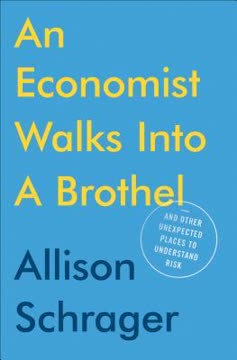
Key Takeaways
1. Risk is More Than Just Bad Outcomes; It's All Possibilities.
Technically, risk describes everything that might happen—both good and bad—and how probable each of these outcomes is.
Redefining risk. Most people associate "risk" solely with negative outcomes, like losing a job or wealth. However, financial economics defines risk as the full spectrum of potential outcomes, both positive and negative, along with their probabilities. This broader understanding is crucial because taking risks is essential for progress and improvement in life.
Brothel-nomics example. Legal brothels in Nevada offer a stark illustration of how risk is priced and managed. Sex workers pay 50% of their earnings to the brothel, and clients pay a 300% markup compared to illegal services. This premium covers the elimination of significant risks:
- For workers: Protection from violence, arrest, and sexually transmitted diseases.
- For clients: Anonymity, safety from blackmail, and disease screening.
This market clearly demonstrates that people are willing to pay a high price for risk reduction.
Strategic risk-taking. Recognizing the full range of outcomes allows for more strategic decision-making. Instead of avoiding risk entirely, we can take calculated steps to alter the probabilities in our favor. This involves understanding the "science of risk" from financial economics, which helps identify what's worth trying and how to maximize success.
2. Define Your "Risk-Free" Goal Before Taking Any Chances.
The biggest mistake people make when they take a risk is not having a well-defined goal.
Goal clarity is paramount. Taking a risk without a clear objective is like driving aimlessly; you might end up somewhere great, but it's unlikely. The first step in smart risk-taking is to precisely define your ultimate goal and what achieving it looks like. This clarity helps assess how much risk is truly necessary.
The "risk-free" concept. Financial economics introduces the powerful concept of "risk-free," which is whatever delivers your desired outcome with total certainty. This isn't a universal asset; it's specific to your goal. For example:
- Short-term savings: A savings account for a vacation next year.
- Long-term income: A fixed annuity or inflation-indexed bonds for retirement income.
Defining this risk-free option clarifies your objectives and helps you value the cost of certainty versus the potential gains of risk.
Calibrating risk. Once you've identified your risk-free option, you can determine if it's desirable or affordable. If not, you then calibrate how much risk you need or are comfortable taking to reach your goal. Kat Cole's success at Cinnabon, for instance, came from identifying the goal (increase sales) and choosing the lowest-risk path (smaller MiniBons) rather than a seemingly bold but riskier one (artificially sweetened rolls).
3. Measure Risk Accurately, But Beware of Skewed Data.
Data may be a terrible way to predict the future, but it is the best we’ve got because it is all we have.
Estimating future outcomes. Risk measurement involves analyzing past data to estimate the range of future possibilities and their probabilities. This provides a "workable range" for decision-making, helping us avoid both excessive caution and reckless optimism. For example, knowing airport travel usually takes 20-40 minutes helps plan, rather than assuming a 3-hour delay every time.
The challenge of skewed distributions. While financial models often assume a normal (bell curve) distribution of outcomes, many real-world scenarios, like the movie business, exhibit a "skewed distribution."
- Normal distribution: Symmetrical, most data clustered in the middle, volatility is a good risk measure.
- Skewed distribution: Asymmetrical, with a long tail of unlikely but potentially huge positive or negative outcomes.
In skewed markets, volatility underestimates risk, and most ventures (like movies or startups) are likely to lose money, with a few big winners subsidizing the rest.
Stale data and changing markets. A major limitation of risk measurement is that past data quickly becomes irrelevant in rapidly changing environments. Ryan Kavanaugh's Hollywood algorithm, which initially predicted movie hits, failed because it relied on stale data in an industry constantly reshaped by:
- DVD sales decline
- Rise of international markets (e.g., China)
- Dominance of franchise films
- Impact of streaming services and online reviews
This highlights the need to constantly update data and acknowledge when fundamental market shifts render old predictions useless.
4. Distinguish Between Idiosyncratic and Systematic Risks.
Being able to spot the difference is important because it determines what the best risk strategy is.
Two types of risk. Financial economics categorizes risk into two main types, each requiring different management strategies:
- Idiosyncratic risk: Unique to a particular asset or situation (e.g., a company's management change, a specific celebrity's popularity).
- Systematic risk: Affects the entire market or system (e.g., a recession, industry-wide changes).
Understanding this distinction is crucial for effective risk management in careers, investments, and daily life.
Paparazzi example. Paparazzi face both types of risk intensely.
- Idiosyncratic: Whether a celebrity is caught with a new lover, or if a specific photographer gets the "right shot." They manage this by forming alliances to pool luck and share tips, though these are often unstable due to incentives to cheat.
- Systematic: Industry-wide shifts like the "gold rush" era of celebrity tabloids followed by the crash due to digital media and the Great Recession. This risk is harder to manage and has driven many paparazzi out of business.
Career implications. Our jobs also carry both risks. A sales job, for instance, has high idiosyncratic risk (individual sales skills, client behavior) and high systematic risk (sales depend on the economy). Government jobs, conversely, have low systematic risk due to stable income regardless of economic conditions. Recognizing these risks helps individuals make informed career choices and understand why certain professions offer higher pay (compensation for higher systematic risk).
5. Overcome Irrational Biases to Make Better Risk Decisions.
When we face a risky situation, the desire to avoid loss can lead us astray from what financial economics predicts we should do.
The human element of risk. While rational models suggest we weigh all possibilities objectively, human emotions, particularly the aversion to loss, often lead to irrational decisions. This "prospect theory" suggests we are risk-averse when facing potential gains but risk-seeking when facing certain losses, often leading to bigger gambles to "break even."
Poker champion's discipline. Phil Hellmuth, a highly emotional poker player, became a champion by developing extreme discipline to overcome his natural biases. He learned to:
- Limit exposure: Never have too much personal money at stake, often playing with "staked" funds from investors.
- Eliminate extreme downside: Make side deals to guarantee a minimum payout, even if he loses.
- Broad framing: View each hand as part of a larger game, avoiding impulsive bets to recover losses.
- Avoid overconfidence: Seek out criticism to maintain focus and humility, preventing needless risks.
Applying poker lessons. We can apply Hellmuth's strategies to everyday life. For instance, when investing, avoid checking your portfolio too often to prevent overreacting to short-term losses (broad framing). In any risky decision, limiting your potential downside and having a clear, long-term perspective can help maintain rationality and prevent emotional "tilt."
6. Diversify to Get More Reward for Less Risk.
If you diversify correctly, you get the closest thing that exists to a free lunch.
The "free lunch" of diversification. Diversification is a powerful risk reduction tool that allows you to achieve the same, or even greater, expected reward with less risk. It involves spreading your investments or efforts across many different assets or opportunities, rather than putting all your "eggs in one basket." This strategy primarily mitigates idiosyncratic risk.
Modern portfolio theory. Pioneered by Harry Markowitz, modern finance shifted focus from just maximizing returns to optimizing the balance between risk and return. By owning a portfolio of assets with different risk characteristics, investors can offset each other's fluctuations.
- Example: Investing in both Apple and Hewlett-Packard in 1993 would have yielded a better risk-adjusted return than putting all money in the riskier Hewlett-Packard, even if Apple ultimately performed better.
- Index funds: These funds, containing hundreds or thousands of stocks, offer broad diversification at low cost, making it easy for everyday investors to reduce idiosyncratic risk.
Diversification beyond finance. The principle applies widely:
- Gig work: Having multiple "side hustles" diversifies income, reducing the idiosyncratic risk of a single job.
- Relationships: Dating multiple people helps clarify needs and prevents over-investment in a single, potentially unsuitable partner.
While diversification reduces idiosyncratic risk, it doesn't eliminate systematic risk, such as a market-wide crash or a recession affecting all income streams.
7. Hedge and Insure to Manage Remaining Risks.
Insurance works like magic. It reduces your risk, just like hedging does, but with one important difference.
Hedging: Sacrificing upside for certainty. Hedging is a precise risk management strategy that involves giving up some potential gains to reduce the odds of significant losses. It's about finding the right balance between risk and reward for a clear goal.
- Example: Airlines hedge against rising oil prices by locking in a fuel price, sacrificing potential savings if prices fall but gaining certainty if they rise.
- David Bowie's "Bowie Bonds": He sold future music royalties for an upfront lump sum, hedging against the uncertain future of music revenue in the Napster era.
Insurance: Downside protection with full upside. Unlike hedging, insurance allows you to protect against downside risk while retaining the full potential for upside gains (minus the premium paid). It transfers risk to an insurer for a fee.
- Example: Life insurance for a crab fisherman protects his family's income if he dies, while he can still pursue high-reward, high-risk fishing.
- Stock options: Financial instruments like put options act as insurance against a stock price falling, while call options allow betting on price increases without full upfront commitment.
Pricing risk with options. The Black-Scholes model helps price options based on four "Greeks":
- Vega: More volatility means higher insurance cost.
- Delta: Higher probability of needing insurance means higher cost.
- Theta: Longer duration of risk means higher cost.
- Rho: The value of the risk-free alternative influences the cost.
Understanding these factors helps assess if an insurance premium is worth the protection offered.
8. Beware: Safety Nets Can Encourage More Risk-Taking.
A safety net can either catch you when you fall or be used as a slingshot to propel you to new heights.
The moral hazard of safety. While risk management tools like insurance and hedging provide security, they can also create a "moral hazard." This phenomenon, known as the Peltzman effect, suggests that increased safety measures can embolden individuals to take even greater risks, sometimes negating the intended safety benefits.
Big wave surfing example. The introduction of jet skis in big wave surfing, initially a safety innovation for rescues, also enabled surfers to:
- Tow-in surfing: Be launched onto waves too large to paddle into, pushing the limits to 70-80 feet.
- Lower skill barrier: Less-skilled surfers might attempt bigger waves, relying on jet skis for rescue.
This illustrates how technology, while beneficial, can be "abused" as a crutch, leading to risk-taking beyond one's actual capabilities.
Finance and the Peltzman effect. The financial industry also grapples with this. Complex derivatives and hedging strategies, intended to reduce market risk, sometimes encourage excessive leverage and risk-taking. The near-collapse of Long-Term Capital Management (LTCM) in 1998, a hedge fund using sophisticated models and extreme leverage, demonstrated how even the best tools can fail when used to amplify risk beyond reasonable limits. This highlights the constant challenge of regulating innovation to prevent systemic blowups.
9. Embrace Uncertainty and Build Flexibility into Your Plans.
Plans are worthless, but planning is everything.
Beyond measurable risk. Even the most sophisticated risk models cannot account for "Knightian uncertainty" or "unknown unknowns"—events that are entirely unanticipated. Relying solely on predictable risk management can create a false sense of security and lead to vulnerabilities when the truly unexpected occurs.
Military lessons on uncertainty. General H. R. McMaster, a renowned military strategist, emphasizes that war is inherently unpredictable. Over-reliance on technology and centralized command, believing they can eliminate the "fog of war," leads to rigidity and failure.
- Battle of 73 Easting: McMaster's decisive victory came from his troop's training and his on-the-spot decision to push beyond orders, surprising the enemy.
- "Vampire fallacy": The belief that technology makes war fast and cheap, which has historically led to military overconfidence and costly mistakes.
Cultivating flexibility. To prepare for uncertainty in life and war, McMaster advocates for:
- Empowering lower ranks: Encouraging new ideas and challenging doctrine.
- Continuous learning: Rapidly circulating lessons learned.
- Mental agility: Commanders with the flexibility to change strategy.
- Training and education: Building confidence and rationality under stress.
This means accepting that plans will go awry and building resilience to adapt quickly, rather than rigidly adhering to initial assumptions.
Humility and adaptability. The process of risk measurement and management is valuable for understanding objectives and potential challenges. However, true mastery lies in combining this preparation with humility and flexibility. Like Kat Cole, who constantly adapts her strategies, we must be willing to recognize when something isn't working and change course quickly. This approach allows us to navigate an unpredictable world, take smart risks, and thrive amidst constant change.
Last updated:
Similar Books