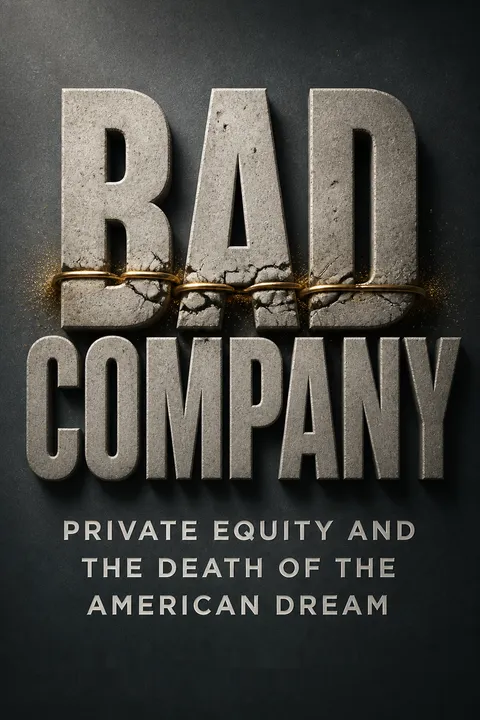


Key Takeaways
Private equity can win even when the company it buys loses.
The owner’s real objective. Private equity firms pool money from pension funds, university endowments, and wealthy individuals, then use it to buy companies. Their stated aim is to improve those businesses and sell them at a profit. But the firm can also earn money through fees, tax advantages, and asset sales, even when the company deteriorates. The company’s success may help the investors, but it is not the only route to returns.
A newsroom makes it visible. Megan Greenwell first saw the disconnect at Deadspin, the popular sports site she edited. Its new owner, Great Hill Partners, restricted successful coverage and micromanaged staff. The newsroom left, its audience collapsed, and the site was eventually sold to a company using it to promote online casinos. Great Hill, meanwhile, continued to rank highly for investor returns. The book estimates that private equity-owned companies employ 12 million people in the United States.
The key distinction is between a company’s health and its owner’s financial outcome. That distinction resembles a principal-agent problem: the party making decisions may not bear the full consequences of them. It also explains why familiar signs of success, such as a respected brand or loyal customers, may not protect a business. Still, ownership alone does not prove that a company will be harmed. The more useful question is whether the deal’s incentives reward durable operating gains, or allow returns to come from fees and asset extraction regardless of what happens to workers and customers.
Trace who carries the debt before trusting a buyout rescue.
Debt moves the risk. A leveraged buyout is an acquisition financed largely with borrowed money. In a typical deal, the acquired company, rather than the private equity firm, takes on most of the debt. From 2013 to 2023, loans funded 74 percent of the average buyout price. The firm can control the company without taking equivalent responsibility for its debts.
Fees soften the downside. A common arrangement called 2-and-20 charges investors an annual management fee, commonly 2 percent of committed capital, plus 20 percent of profits above a threshold. Other monitoring and transaction fees may apply. These fixed charges can produce income even when a company struggles. At Houdaille Industries, KKR put in a small fraction of the acquisition cost while assigning the company hundreds of millions in loans. The company later cut thousands of jobs, while KKR reported a strong return.
This structure resembles moral hazard: when decision-makers receive much of the upside but can shift losses elsewhere, they may tolerate risks that a fully exposed owner would avoid. The arrangement does not make every leveraged acquisition a failure. Debt can fund useful expansion, and some firms do improve companies. The crucial test is whether the borrowing finances a credible operating plan, or chiefly serves the transaction itself. Workers, creditors, and local governments rarely have the same information or bargaining power as the people designing the deal, which makes disclosure and accountability central, not cosmetic.
Toys R Us carried $5 billion in debt before it could adapt.
The balance sheet narrowed choices. In 2005, KKR, Bain Capital, and real estate firm Vornado bought Toys R Us in a deal financed with more than $5 billion in loans assigned to the retailer. They also sold much of its property and made the company pay rent on stores it had owned. The firms gained cash and rental income; Toys R Us took on new expenses.
A weak business lost room to change. Toys R Us faced Walmart and Amazon, but its owners did not build a strong online operation or substantially renew its stores. Interest payments alone exceeded $400 million a year, consuming much of the company’s earnings. In 2018, the chain liquidated, eliminating 33,000 jobs. Workers received no promised severance at the time, while Bain and KKR later agreed to contribute $20 million to a hardship fund after public pressure.
The case is compelling because the retailer faced genuine competitive pressure, yet its financing left it unusually little capacity to respond. It cautions against treating bankruptcy as a clean verdict on whether a business had a future: debt can help produce the failure later cited as proof that the company was doomed. A fair assessment should compare what happened with plausible alternatives, not assume survival was guaranteed. Here, the contrast with retailers that invested in online sales and customer experience makes the missed opportunity credible, even if no strategy could have restored Toys R Us to its former dominance.
A profitable hospital can still abandon the patients who need it.
Efficiency can mean fewer services. LifePoint combined hospitals in Riverton and Lander, Wyoming, under one system. After Apollo Global Management acquired LifePoint, Riverton lost its maternity ward, and the Lander hospital closed an inpatient mental health unit. Patients increasingly had to travel for care. Air ambulance flights from Fremont County rose from 155 in 2014 to 937 in 2019. SageWest also charged insurers far more than Medicare rates, according to the research cited in the book.
Revenue is not the whole scorecard. SageWest’s operating margin rose after the merger, even as local access declined. A 2023 study of private equity hospital acquisitions found a 38 percent increase in central line infections in the first three years after acquisition. That study does not show that every cut caused a particular outcome, but it strengthens concern that cost reduction can affect patient safety as well as convenience.
Health care exposes a basic weakness in judging services by financial performance alone. A hospital can improve its margin by concentrating on profitable procedures while leaving essential, low-margin care unavailable nearby. That is not simply an accounting issue: longer travel and reduced access can shift costs onto families and emergency systems. Yet rural hospitals also face real staffing and reimbursement constraints, and some acquisitions may keep facilities open. The hard policy question is therefore not whether efficiency matters, but who decides which services are expendable and whether the broader community consequences count in that decision.
When housing becomes an investment, renters can pay for neglect.
A home is also a revenue stream. CIM Group bought Southern Towers, a 2,346-apartment complex in Alexandria, Virginia, for $506 million, with $346 million financed by a low-interest Freddie Mac loan. Residents reported rent increases, added charges, pests, mold, and ignored repairs. In the first eight months of CIM’s ownership, the company brought 541 eviction proceedings at the complex, more than one-fifth of all filings in Alexandria during that period.
Loren’s apartment turned the pattern personal. After her family moved in, a major flood damaged fourteen apartments. Residents struggled to reach management and find temporary housing. Loren organized tenants and challenged the company’s response. Within months, CIM issued her family lease violations and declined to renew their lease. The company disputed residents’ accounts and blamed some problems on previous ownership. For tenants, the result was still instability and the loss of a home they had worked hard to secure.
The housing example shows how financial incentives meet an especially unequal relationship. A landlord can often wait out a complaint; a renter may have to choose between documenting a problem and risking conflict with the party controlling their home. Publicly backed loans make the issue broader than a private contract, since government-supported capital can help finance acquisitions without strong ongoing tenant protections. At the same time, deferred maintenance is not unique to private equity, and old buildings do deteriorate. Better evidence, enforceable repair standards, and protection against retaliatory lease decisions help distinguish ordinary building problems from a business model that shifts their costs onto residents.
A town loses its voice when owners strip its newsroom of reporters.
Local reporting is not just another product. Newspaper owners once benefited from strong advertising markets and loyal subscribers. As those revenues weakened, chains consolidated and cut staff. GateHouse, a private equity-owned newspaper group, eventually merged with Gannett. The combined company controlled one in six American newspapers and carried $1.79 billion in loans from Apollo at an 11.5 percent interest rate. Gannett and GateHouse together employed more than 24,000 people in 2018; by 2022, Gannett’s U.S. workforce had fallen to about 11,200.
Natalia saw what the cuts erased. At the Caller-Times and Indianapolis Star, she reported on local communities while working in increasingly smaller newsrooms. Later, she joined Votebeat, a nonprofit outlet focused on election administration. Her reporting explained voting systems to people often overlooked by mainstream coverage. When local news disappears, residents lose not only stories but practical information about government, schools, and civic life.
Journalism has a public-good problem: reporting can benefit people who never pay for it, while the cost of producing it still has to be met. That mismatch makes it vulnerable to owners who can sell buildings and reduce staff more quickly than they can invent a sustainable business model. Nonprofit newsrooms can protect editorial priorities from shareholder pressure, but philanthropy is unevenly distributed and may favor places with wealthy donors. Public support could broaden coverage, though it must be designed to avoid political control. No single funding source easily serves both independence and universal local access.
Organize around the money and decision-makers who can actually be pressured.
Workers found an unexpected audience. After Toys R Us closed, Liz and other former employees joined organizers from Rise Up Retail. Protests at company offices did not reach executives, so they spoke at public pension board meetings. Pension funds invest workers’ retirement savings in private equity, and their boards include beneficiaries. Minnesota’s public employees’ pension board paused new KKR investments over concern about Toys R Us. KKR and Bain later agreed to put $20 million into a hardship fund for former employees.
Tenants built collective leverage too. Southern Towers residents worked with African Communities Together and local officials to document problems and press CIM. Advocates also contacted public pension investors and federal housing agencies connected to the complex’s financing. These efforts did not resolve every dispute, but they brought attention to conditions residents could not force management to address individually.
The strategic lesson is to identify the dependency behind the powerful institution. A private equity firm may ignore a former employee’s appeal but care when a pension investor questions its reputation or future capital. Collective action also solves a coordination problem: isolated workers and tenants fear retaliation, while a documented group can make patterns visible and raise the cost of inaction. The approach has limits. Pension boards must balance ethical concerns with their duty to fund retirement benefits, and organizing takes time that financially insecure people may not have. Durable campaigns need practical support, shared evidence, and clear demands.
Build alternatives that answer to the community they serve.
Riverton tried a different ownership model. After years of service cuts at SageWest, local doctors, residents, and business owners formed the Riverton Medical District. A feasibility study found that a community hospital could be financially viable. The group raised $54 million through a federal rural development loan, a state grant, local contributions, and donated land from the Eastern Shoshone tribe. The planned nonprofit hospital would restore routine surgery, maternity care, and other services. Its construction began in December 2024.
Nonprofit journalism offers another route. Natalia’s work at Votebeat showed how a newsroom can prioritize accessible election information rather than maximizing shareholder returns. Neither model is a universal fix: community hospitals require unusual local leadership and large public financing, while nonprofit news funding remains uneven. Their importance is proof that investor ownership is not the only way to organize essential services.
These alternatives shift the question from whether a service can maximize returns to whether it can remain financially viable while meeting a public need. That is a meaningful distinction, not a rejection of budgets or operational discipline. Riverton’s project also shows how local trust, tribal partnership, and public financing can combine to overcome barriers that no single actor could handle. Still, the model is difficult to replicate where communities lack leaders, donors, or access to government credit. Alternatives therefore need institutional support, not just inspiring exceptions, if they are to change the broader landscape.
Analysis
Bad Company treats private equity not as a single villainous actor, but as a system whose incentives can separate investor returns from the well-being of the businesses investors control. Its narrative method makes that abstraction legible: Liz loses a job and a workplace community, Roger watches essential care disappear, Natalia sees reporting capacity drained from local news, and Loren confronts a landlord with power over her family’s stability. Their stories differ, but each turns on a similar asymmetry. Financial owners can make decisions at a distance, while workers, patients, readers, and tenants absorb the consequences locally.
The book’s strongest analytical contribution is to make the transaction structure matter. Debt placed on portfolio companies, fees that do not depend on operating success, sale-leasebacks, tax preferences, and limited transparency are not incidental technicalities. Together, they help explain why a company’s failure need not mean its owner failed. This account also complicates the familiar claim that a takeover is a rescue: the relevant measure is not whether ownership changed, but whether the business gained the capacity to improve its service and survive.
The argument is most persuasive when it distinguishes financial outcomes from public value, and when it acknowledges genuine constraints. Rural hospitals face thin margins; newspapers suffered real advertising shocks; Toys R Us faced formidable competitors. Private equity is not the sole cause of these pressures, and some investments do strengthen companies. The book’s case is that the ownership model can intensify those pressures while transferring risk to people with little say in the strategy.
Its solutions are necessarily plural. Worker organizing and tenant coalitions can create leverage; disclosure and regulation can reduce hidden risk; public or nonprofit ownership can protect missions from some investor pressures. Each has limits, including funding scarcity, political resistance, and uneven community capacity. The larger lesson is that essential institutions need governance that makes their social obligations visible and enforceable. If society relies on markets to provide them, it cannot assume that private returns will automatically preserve public benefit.
People Also Read









Glossary
Leveraged buyout
Debt-financed company acquisitionAn acquisition in which the buyer finances a large share of the purchase with borrowed money. In the private equity deals discussed in the book, much of the debt is assigned to the acquired company rather than the investment firm. That can leave the company paying substantial interest while the owner retains control and limits its own direct exposure.
2-and-20
Management and profit feesA common private equity fee structure in which a firm receives an annual management fee, often 2 percent of committed investor capital, and a share of profits, commonly 20 percent above a specified threshold. The management fee does not depend on whether a particular company succeeds. Additional monitoring and transaction fees can also generate revenue for the firm.
sale-leaseback
Sell property, then rent itA financial transaction in which a company sells property it owns, often to an investor or a related real estate entity, then leases the same property to continue operating there. The sale can provide cash to the owner, but the business gains a continuing rent expense and loses control of a valuable asset. The book describes its use in retail, hospitals, and newspapers.
carried interest
Fund manager’s profit shareA share of investment profits paid to a private equity fund’s managers. Under the tax treatment described in the book, carried interest may be taxed as capital gains rather than ordinary income, generally at a lower rate. Critics call this treatment a loophole because the managers’ compensation receives preferential tax treatment compared with wages and many other forms of business income.
financialization
Profit increasingly from financeA broad economic shift in which companies and industries earn a growing share of returns through financial activities, such as interest, dividends, capital gains, and asset transactions, rather than through producing goods or delivering services. The book uses the concept to explain how financial strategies can become central to a business even when its public purpose depends on actual operations.
venture philanthropy
Growth-focused nonprofit fundingA funding approach that applies some venture-capital practices to nonprofit organizations. Funders select projects they believe can grow quickly, expand revenue, and scale their impact. In local journalism, the approach has helped some nonprofit newsrooms expand, but can favor communities with strong philanthropic networks and leave poorer or rural areas without comparable support.
news desert
Community with little local newsA community with no local newspaper or with very limited access to reliable local reporting. News deserts can emerge when papers close, newsrooms shrink, or publications stop covering local issues. The book notes that residents may lose practical information and civic oversight, while effects can include reduced accountability and higher public borrowing costs.
corporate practice of medicine
Corporate control of medical careThe legal and policy question of whether corporations, rather than licensed medical professionals, may own or control medical practices and hospitals. The book describes state restrictions intended to limit commercial control over clinical decisions, while noting that enforcement varies. Advocates argue that stronger limits could protect professional judgment and patient care from financial priorities.
Download PDF
Download EPUB
.epub digital book format is ideal for reading ebooks on phones, tablets, and e-readers.








