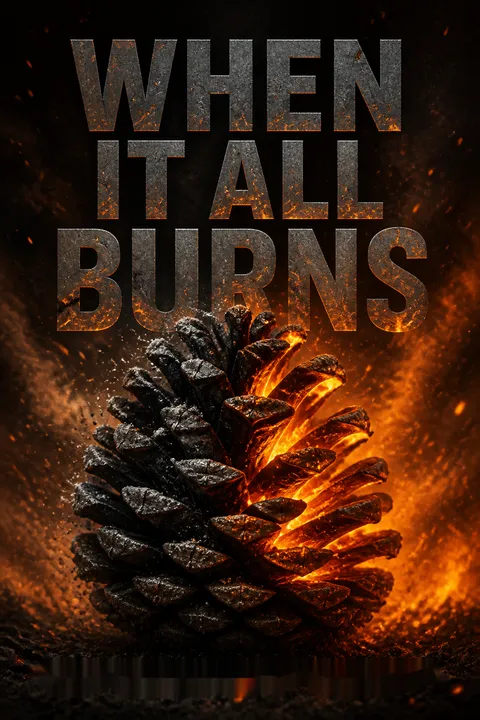


Key Takeaways
Treat wildfire as an ecological relationship, not a single enemy to defeat.
Fire has many forms. A megafire is a wildfire that behaves on a scale or with an intensity outside familiar patterns. Fire itself is not always destructive: some ecosystems depend on periodic flames to open cones, renew plants, and recycle nutrients. A fire regime means the pattern of fire in a place, including how often it burns, how intensely, and in what conditions. People alter that pattern through land use, suppression, and carbon emissions.
The ridge changes the question. In 2021, the narrator’s crew tried to protect a grove of ancient sequoias from a megafire, then retreated when the line became unsafe. The sequoias need fire, but not every fire. Understanding a blaze requires asking what kind of fire the landscape can withstand, and what has changed its conditions.
The distinction between fire as a natural process and a particular fire as a catastrophe is the book’s essential lens. It resists the familiar habit of labeling an entire force good or bad, replacing it with a question about fit: does this disturbance match the ecosystem’s history and present condition? That is a useful model for other environmental debates, where the same process can sustain one system and devastate another. The model also demands precision. Calling fire natural cannot, by itself, establish that a specific fire is ecologically safe.
Restore the right fire, in the right conditions, for each landscape.
Burning was skilled work. Cultural burning means the intentional use of fire by Indigenous communities to care for particular places, plants, animals, and community needs. It is not a single technique or a universal prescription. California’s Indigenous peoples used different patterns of fire to support food, materials, wildlife, water, and travel routes. Historical estimates suggest that Indigenous and lightning fires together burned about ten million acres in California each year before colonization, more than twice the acreage burned in the state’s worst recorded fire season.
Local knowledge matters. Chumash burning supported a mosaic of grasslands, shrubs, and forests. In the Sierra, frequent understory fires encouraged useful plants and animal pathways. Maya farmers in southern Mexico also described using carefully timed fires to nourish soil and forest diversity. These examples show that a burn’s value depends on place, timing, intensity, and purpose, not on fire alone.
This account widens the definition of expertise. Ecological knowledge is not only a set of measurements; it can also be accumulated through repeated observation, cultural practice, and responsibility to a specific place. The book’s examples make clear why a statewide acreage target cannot substitute for local judgment. At the same time, Indigenous practices should not be collapsed into a romantic template or transferred as generic techniques. Their effectiveness is inseparable from the communities, authority, and relationships that sustain them.
See fire suppression as part of the history of taking Indigenous land.
A ban reshaped livelihoods. When Spanish authorities prohibited Indigenous burning in California in 1793, the policy did more than reduce flames. Fire supported local food systems and other forms of livelihood, so criminalizing it helped push Indigenous people toward the mission economy. Under American rule, fire bans continued alongside land seizure, forced labor, and genocide. California’s Indigenous population fell from about 300,000 in 1769 to 16,624 in 1890.
Wilderness erased people. Later conservationists often imagined forests as untouched places where both people and fire were intruders. That story obscured Indigenous land management and helped make dispossession appear compatible with protecting nature. The result was not simply a different way of managing forests. It was the removal of people, knowledge, and practices that had shaped those forests for generations.
The historical argument matters because policies can preserve an image of nature while damaging the relationships that made a landscape resilient. The book connects ecological change to power: who is permitted to burn, whose knowledge is treated as legitimate, and who gets to define a place as wilderness. That framing adds a political dimension often missing from technical fire debates. It also cautions against treating historical violence as a complete explanation for each modern blaze. The history clarifies the inherited conditions; climate, weather, and local ecology still shape what happens next.
Plan for fire in a climate that no longer follows familiar patterns.
The baseline is moving. In California, average temperatures have risen about three degrees Fahrenheit since the early 1900s. The book describes longer droughts, earlier springs, reduced snowpack, and heat waves that dry vegetation and intensify fire behavior. Over about fifty years, climate change has extended California’s fire season by nearly three months. In 2021, the narrator’s crew faced temperatures near 120 degrees Fahrenheit in Big Sur, where fire conditions were far beyond what the season’s calendar suggested.
Climate is not the only factor. Logging and suppression have also left some forests unusually dense and uniform, with vegetation that can carry flames into the canopy. But chaparral landscapes have different histories and can be damaged by fires that come too frequently. The practical lesson is to assess weather, topography, fuels, and ecological type together, rather than expecting one cause or one treatment to explain every fire.
The book’s strongest account of climate change is not a graph but a mismatch between inherited expertise and present conditions. Fire crews rely on experience, yet experience is less predictive when the underlying climate shifts rapidly. That makes humility a safety practice, not an abstract virtue. The book also avoids a convenient either-or: climate change can intensify fire while past management shapes where and how it spreads. That distinction prevents fuel reduction from becoming a substitute for emissions cuts, or climate change from becoming an excuse to ignore local forest history.
Use suppression tactically, without mistaking it for a lasting solution.
Lines buy protection. Firefighters cut firelines by clearing vegetation down to soil, or use roads and other barriers to limit a fire’s path. A big box operation surrounds a large fire with a broad network of barriers and burns fuel inside that perimeter. Prescribed fire means deliberately setting a fire under planned conditions to reduce hazardous fuel or support ecological processes. These tools can protect people and homes, but megafires can throw embers across lines, create their own winds, and defeat plans based on older fire behavior.
The work contains a paradox. In the 2021 Sugar Fire, the crew built lines and attempted a controlled burn, but the megafire crossed the meadow and their position became unsafe. Suppression remains necessary when extreme fire threatens lives and forests. Yet decades of treating fire as an enemy have also helped produce landscapes where the next fire can burn more intensely.
The distinction between emergency response and prevention is crucial. A line can be the right decision today even if suppression as a permanent policy has contributed to tomorrow’s risk. This resembles crisis management in other systems: a temporary intervention can prevent immediate harm while leaving the conditions that generate repeated emergencies intact. The book’s account argues against both simplistic camps, total suppression and passive acceptance. Its harder question is how to protect people now while rebuilding ecological conditions that make future fires less destructive.
Fund and protect firefighters as skilled workers, not disposable seasonal labor.
The risk outlasts the fire. Federal hotshots were classified as forestry technicians, a seasonal job category created when fire suppression occupied only a small share of their work. By 2021, suppression consumed about 70 percent of the Forest Service budget, and hotshots spent roughly 90 percent of their time fighting fires. Yet base pay started around fifteen dollars an hour, and injured workers could lose the overtime and hazard pay that made their wages livable. Some relied on crowdfunding for medical expenses.
Bodies and relationships absorb the costs. The narrator sees colleagues suffer burns, broken bones, heat illness, and chronic smoke exposure, while partners carry fear and long absences. Aoki, the crew leader, had survived a burnover and endured lasting pain. The job’s danger is not only the rare fatal accident; it is also untreated injury, financial insecurity, and the emotional strain of repeatedly leaving home.
This section reframes workforce policy as part of climate adaptation. Expertise is not an abstract resource: it lives in workers who need time, health care, stable pay, and recovery to keep doing their jobs safely. The crew’s toughness can sustain performance under pressure, but it can also conceal preventable harm. Public praise is an inadequate substitute for institutional support. A serious safety culture must make it possible to report injury and exhaustion without turning basic self-preservation into a threat to income or status.
Follow the money that keeps the wildfire response focused on fighting.
Disasters create markets. The book describes private firefighting contractors, fire camps, aircraft, retardant suppliers, and postfire logging companies that receive public money during and after fires. In 2021, federal fire suppression cost taxpayers about $4.4 billion. The Forest Service budget devoted to suppression rose from around 16 percent in the 1990s to roughly 70 percent by 2021. Some aircraft drops are politically expected even when retardant is unlikely to stop an extreme blaze.
Incentives can prolong the cycle. After fires, salvage logging can remove dead trees and disrupt regeneration, then replant uniform commercial forests that may burn intensely again. This does not mean every contractor or firefighter acts in bad faith; suppression is genuinely needed in dangerous conditions. The concern is structural: when money and political influence cluster around emergency response and extraction, prevention and ecological restoration can remain underfunded.
The book’s fire-industrial complex argument is most useful as an incentive analysis, not as a claim that every participant conspires to cause fires. Organizations can make money from a response while still sincerely trying to reduce harm. The important question is whether public spending rewards the outcomes society wants. If budgets, contracts, and lobbying favor repeated suppression and postfire extraction, then prevention faces a built-in disadvantage. Scrutiny should therefore examine both individual conduct and the rules that shape institutional behavior.
Build trust before asking communities to accept more burning.
Preparation is contested. Forest managers often need to remove small trees and brush before a prescribed burn, lowering the chance that flames will climb into the canopy. Conservation groups may distrust such work because past “management” often meant destructive logging. In one California dispute, critics warned that a Forest Service project would clear-cut old growth. A court found those claims unsupported and ruled that the agency had relied on available science, but the conflict deepened public distrust.
Safety and legitimacy both matter. Prescribed burns are not risk-free. In New Mexico, an escaped Forest Service burn became the largest fire in state history and prompted broad restrictions on burning. The Forest Service reported that 99.84 percent of its prescribed burns did not escape. That record supports careful action, not complacency. Clear oversight, honest communication, and meaningful public participation help communities distinguish ecological preparation from commercial logging.
Trust is not a communications problem that can be solved with a better brochure. It depends on whether institutions acknowledge their history, explain tradeoffs, invite scrutiny, and change plans when concerns are warranted. The book also resists the opposite simplification, that distrust proves every proposed treatment is harmful. Both science and public accountability are necessary because neither technical expertise nor community suspicion is infallible. A credible process must show its work and make it possible to correct mistakes.
Give Indigenous fire practitioners authority, not just a seat beside agencies.
Fire can repair relationships. At Clear Lake, Pomo elder Sara explained how burning at the right time helps tule reeds regrow. Healthy reeds improve habitat and water circulation, and provide materials for baskets, boats, and cultural practice. The same landscape can be damaged by a burn that is too hot or badly timed. Her teaching emphasized attentive experience and the effects of present choices on generations to come.
Partnership must include sovereignty. The Tribal EcoRestoration Alliance brought Indigenous practitioners together with fire professionals and agencies to revive fire stewardship. California recognized cultural burning as a legal practice in 2021, and local collaborations began supporting burns shaped by cultural objectives. The book warns that agencies can appropriate Indigenous knowledge while leaving authority unchanged. Its closing vision is not merely more acres burned, but a shift toward care, shared responsibility, and Indigenous self-determination.
This is a deeper standard for collaboration than consultation alone. Knowledge has a history and a community; extracting a technique while excluding its practitioners from decisions repeats the very imbalance that damaged the land. Sara’s example also makes ecological care concrete: plant renewal supports water, wildlife, craft, and cultural continuity at once. The approach asks agencies to share power, not simply collect information. That is demanding, but without it, “learning from Indigenous knowledge” risks becoming another form of resource use without reciprocity.
Analysis
The book’s argument is strongest when it refuses a single-cause story. A wildfire begins with an ignition, but its scale depends on climate, vegetation, terrain, past land management, and political decisions. The opening retreat from the sequoia ridge makes that complexity immediate: a crew can work skillfully and still face conditions that defeat its line. The later history shows that those conditions were not simply inherited from nature. Suppression policies, commercial forestry, colonial violence, and carbon emissions have helped remake them.
The narrative’s central achievement is to place bodily experience beside systems analysis. Heat illness, chainsaw work, crew hierarchy, and the loss of a colleague’s health give the reader a measure of what abstract terms such as climate adaptation and labor policy mean in practice. The author’s departure from the hotshots also complicates the usual heroic ending. Survival is not the same as resolution, and loyalty to a crew can coexist with the need to protect a relationship and a future beyond the job.
The account is most persuasive when it distinguishes ecological contexts. Chaparral does not need the same fire pattern as a dense, logged conifer forest, and a controlled burn is not automatically beneficial simply because it is intentional. That nuance is essential. The book’s broader indictment of capitalism and colonial power can sometimes make large historical forces feel like a single explanatory machine. Its own examples offer a more careful view: institutions contain competing purposes, and practitioners can make different choices within them.
The practical conclusion is therefore not a return to an untouched past. The landscapes have changed, and the climate continues to shift. The task is to reduce fossil fuel emissions, restore appropriate fire, fund the people who do the work, and put Indigenous stewardship at the center without flattening its diversity. The book argues that fire policy is also a question of who has authority to care for land, whose bodies carry the cost of failure, and whether public institutions can earn enough trust to act before the next emergency.
Review Summary
When It All Burns is a compelling blend of memoir and research, recounting Jordan Thomas's experiences as a hotshot firefighter while exploring the history and future of wildfire management. Readers praise Thomas's vivid storytelling, deep insights into firefighting culture, and thorough examination of indigenous burning practices. The book effectively interweaves personal narrative with broader discussions on climate change, forest management policies, and the challenges faced by wildland firefighters. While some found certain sections less engaging, most reviewers highly recommend this thought-provoking and informative work.
People Also Read







Glossary
Megafire
Extreme, unusually behaving wildfireA wildfire whose size or behavior exceeds familiar historical patterns. The book uses the term for fires that can burn in unexpected seasons, intensify at night, throw embers far ahead, or generate their own winds and weather. A megafire is not simply a large fire; its defining feature is behavior that overwhelms established expectations and suppression tactics.
Fire regime
A place’s fire patternThe characteristic pattern of fire in a landscape, including its frequency, intensity, timing, and ecological effects. Different ecosystems have different fire regimes, and human communities can influence them through burning, suppression, land use, and other practices. Understanding a place’s fire regime helps distinguish a fire that renews ecological processes from one that exceeds the landscape’s capacity to recover.
Cultural burning
Indigenous fire stewardshipThe intentional use of fire by Indigenous communities to care for particular lands and relationships. Practices vary by community and ecosystem, and can support foods, materials, habitat, water, travel, and cultural continuity. The term refers to more than a technique for reducing fuel: it is connected to local knowledge, community purposes, and Indigenous authority over land and resources.
Prescribed fire
Planned, controlled landscape fireFire intentionally set under planned conditions to meet ecological or safety goals, such as reducing excess fuel or restoring fire-dependent processes. A prescribed burn requires assessment of weather, vegetation, topography, smoke, and nearby communities. It can reduce the risk of severe wildfire, but it is not risk-free, and its value depends on appropriate planning, timing, and local conditions.
Big box operation
Large perimeter containment strategyA strategy for containing a large wildfire by constructing an extensive perimeter of fuel breaks, often along ridges, roads, or other defensible features. Crews may burn vegetation between the line and the advancing fire so the wildfire reaches an area with less fuel. The tactic can be necessary for extreme fires, but embers and shifting conditions can still defeat the planned perimeter.
Wildland urban interface
Settlement beside fire-prone landThe area where homes and other development meet or intermingle with wildland vegetation. The book uses the term for places where buildings are exposed to wildfire and where protection of people and structures strongly shapes response decisions. The interface is a particular area of expertise for some state firefighters, distinct from the remote mountain terrain emphasized by federal hotshot crews.
MIST
Minimum impact suppressionMinimum Impact Suppression Techniques are methods for managing a fire while limiting disturbance to the landscape. Instead of aggressively removing vegetation everywhere, firefighters use knowledge of terrain, natural barriers, and ecological conditions to guide a fire away from vulnerable resources. In the book, a crew uses MIST to steer fire away from a reservoir while allowing it to burn in areas where it could benefit the forest.
Sacrifice zone
Concentrated burden of industrial harmA place or population that bears disproportionate environmental and social costs so that other groups or industries can benefit. The book extends the idea beyond geographic boundaries to firefighters’ bodies: smoke exposure, injury, low pay, inadequate medical support, and family strain accumulate among workers tasked with managing disasters intensified by fossil fuel use.
Fire-industrial complex
Institutions profiting from suppressionThe linked public agencies, contractors, and corporations that supply firefighting labor, camps, aircraft, retardant, and postfire logging. The term describes how wildfire response can become a major economic sector, with some businesses and institutions benefiting from repeated suppression and extraction. It does not mean every participant intends harm; it directs attention to incentives that can make prevention and restoration harder to prioritize.
Download PDF
Download EPUB
.epub digital book format is ideal for reading ebooks on phones, tablets, and e-readers.








