

Key Takeaways
Treat the person before you, even when medicine cannot promise survival
Dignity comes first. Orbinski’s first Somali mission begins at a feeding centre in Baidoa, where thousands are starving. He sees a man lying on a pile of bodies, apparently left for the morgue, and carries him to the medical tent. The man soon dies. The act does not save his life, but it refuses to treat him as already disposable. For Orbinski, humanitarian action begins by relieving immediate suffering and, especially, by not leaving people to suffer alone.
From pity to solidarity. Pity can reduce someone to an object of charity. Solidarity recognizes the other person’s dignity and agency, and asks what conditions made the suffering possible. Medical skill matters, but it is not the whole response: care can include protection, public testimony, and support for people’s right to shape their own future.
The scene offers a demanding standard for care: outcomes matter, but they do not exhaust the moral meaning of an action. A person who cannot be cured can still be treated as someone whose life matters. That distinction is useful far beyond emergency medicine, where efficiency can turn people into cases, queues, or costs. The tension is real: choosing one patient’s dignity cannot answer the needs of thousands. Orbinski’s point is not that personal care solves a crisis, but that no system should make efficiency an excuse for erasing the person.
Keep aid impartial, but never let neutrality become a gag
Principles need distinctions. Humanitarian impartiality means assistance is allocated according to need, regardless of a person’s side, religion, or identity. Independence means aid decisions should not serve political, economic, or religious agendas. Neutrality means not taking sides in the causes of a conflict. MSF’s founders, including doctors who had served in Biafra, rejected the Red Cross tradition of remaining publicly silent about abuses they witnessed. They wanted to provide care and speak about crimes that authorities sought to hide.
The founders also erred. In Biafra, some doctors believed they were supporting victims, but the secessionist leader resisted a road route for food because it might weaken his political case. MSF later recognized that aid could be manipulated by the people it meant to help. Its lesson was not to abandon testimony, but to scrutinize its own judgments and preserve impartial assistance while speaking about violations.
The distinction between neutrality and silence is crucial because humanitarian groups can be present at the scene without being outside politics. Public criticism may cost access; silence may leave victims invisible and perpetrators unchallenged. The Biafra example also guards against moral self-certainty: good intentions do not guarantee that an organization understands who benefits from its actions. The most credible witness is therefore not the one claiming purity, but the one that explains its evidence, examines its own role, and remains accountable for consequences.
Name organized violence accurately, because euphemism helps power evade responsibility
Words shape obligations. During Rwanda’s 1994 genocide, organized forces killed about a million people in fourteen weeks. Yet governments and news accounts often described the slaughter as tribal or political violence. The distinction mattered: a state-led campaign of extermination is not simply disorder between communities. Orbinski recounts how the United Nations resisted using the word genocide, even as warnings and evidence mounted. In doing so, it weakened the political pressure to act under laws meant to prevent and punish genocide.
Witnessing makes the victim visible. MSF publicly named the genocide and pressed for civilian protection. Its doctors could not stop the killings through treatment alone, but testimony helped challenge the story that nothing could be done or that the violence was incomprehensible. Naming was not a substitute for intervention. It was a demand that governments acknowledge what they knew and accept responsibility for their choices.
Political language does more than describe events; it helps determine which remedies appear legitimate or necessary. Calling an organized crime a spontaneous conflict can make non-intervention sound like restraint rather than a decision with consequences. Still, accurate labels alone cannot compel action. They need evidence, trusted messengers, and institutions willing to respond. Orbinski’s account makes the deeper point that factual description is part of protection: it resists the conversion of identifiable victims into an unfortunate, supposedly inevitable statistic.
Keep relief separate from military strategy, or civilians pay twice
Aid can become a weapon. In Somalia, food was a lifeline and a valuable resource that armed groups looted, taxed, and used to finance power. After aid workers called for greater security, a U.S.-led intervention entered under a humanitarian banner. Its mission expanded from protecting relief to using force and attempting political control. Orbinski describes the resulting violence, the collapse of local trust, and the eventual abandonment of Somalis to renewed instability.
The same boundary matters in later wars. After September 11, U.S. forces in Afghanistan dropped food alongside bombs, while officials described aid organizations as part of the military effort. Civilians could no longer easily distinguish independent relief from a belligerent’s campaign. When aid is tied to military goals, communities may see aid workers as combatants, putting both recipients and workers at risk. Relief cannot substitute for a political solution or credible civilian protection.
Coordination between armed forces and aid agencies can save lives in immediate emergencies, but coordination is not the same as subordination. Once aid is used to reward cooperation, gather intelligence, or win political support, its impartial character becomes harder to trust. That trust is operational, not merely symbolic: people must believe assistance is available without taking sides. The difficult question is where useful logistical cooperation ends and political control begins. Orbinski’s cases argue for clear boundaries, transparent purposes, and independent judgment.
Withdraw when aid sustains coercion, but make the cost visible
Presence can enable abuse. In Zaire, Rwanda’s defeated army and genocidal militias controlled refugee camps, diverted aid, recruited children, and punished people who wanted to return home. Humanitarian organizations delivered enormous amounts of assistance, but aid also helped sustain the armed structures holding refugees hostage. MSF repeatedly sought a force to separate fighters from civilians. When that did not happen, it withdrew from the camps, accepting that people would lose services rather than silently support the coercive system.
The dilemma recurred elsewhere. In North Korea, MSF could not reach large parts of the country or independently verify where food went. In Sudan, the government restricted access and rebel forces diverted food. Orbinski’s account shows that staying can lend legitimacy to controlled aid, while leaving can abandon people in danger. MSF’s response was to state the limits publicly and press political authorities to take responsibility.
This is an ethics of complicity, not a simple rule that organizations should leave whenever conditions are compromised. Aid workers must weigh immediate needs against the possibility that their operations preserve a system of abuse. A withdrawal can also harm people who have no power over the arrangement. The practical value lies in making the trade-off explicit: document restrictions, explain the decision, and keep advocating for access and protection. Otherwise, an institution’s visible presence may be mistaken for evidence that assistance is fair.
Turn access to medicines into a campaign, not a plea
A price barrier is political. In the late 1990s, patented HIV medicines cost about $15,000 per patient each year, beyond the reach of most people in poorer countries. MSF joined activists, health groups, lawyers, and local organizations to challenge rules that protected monopolies while patients died. Compulsory licensing allows a government to authorize generic production of a patented medicine under specified conditions. Parallel importation lets it buy a patented drug where the price is lower. South African law allowed these measures, but drug companies challenged it and Western governments applied pressure.
Organized pressure changed the terms. MSF supported public protests, legal challenges, price comparisons, and the purchase of generic medicines. The companies withdrew their case against South Africa in 2001. Generic treatment costs fell to less than $200 per patient annually. The campaign also helped secure the WTO Doha Declaration, affirming that trade rules could be interpreted to protect public health.
The campaign joined moral argument to practical demonstration. It did not ask the public to choose between innovation and access; it challenged the assumption that a patent system should determine who receives treatment. Coalition-building mattered because no single group had enough leverage on its own. The outcome also shows why legal victories need implementation: later rules for exporting generics became so cumbersome that promised access often remained theoretical. A durable campaign measures not only what a declaration says, but whether patients can obtain the medicine.
Build treatment with communities, because pills cannot replace a health system
Access requires people and systems. In Malawi, Orbinski finds an overcrowded hospital with one nurse, too few beds, and patients dying of AIDS-related illness. Medicines had become more affordable, but there were not enough health workers to deliver them. The shortage was intensified by illness among medical staff, vacant posts, and trained doctors leaving for better-paid jobs abroad. Drug access alone could not repair these conditions.
Local capacity changes what is possible. Orbinski and James Fraser founded Dignitas International to work with Malawi’s Ministry of Health, clinicians, village health workers, and community groups. The program trained staff, simplified treatment procedures, and supported care in both hospitals and villages. By the end of 2007, more than 5,000 people in Zomba were receiving antiretroviral treatment, while more than 100,000 had been tested or educated about HIV. The model treated communities as partners, not passive recipients.
The Malawi account connects medical treatment to the social infrastructure that makes treatment dependable: trained workers, local trust, and institutions able to keep patients in care. Community-based delivery can extend reach, but it should strengthen rather than excuse governments’ responsibility to fund health services. The useful principle is partnership, not substitution. A project that depends indefinitely on visiting experts may help individuals while leaving the underlying capacity unchanged. The test is whether local workers and institutions gain durable ability to provide care on their own terms.
Protect your capacity to serve; witnessing does not make anyone invulnerable
Witnessing has a cost. After Rwanda’s genocide, Orbinski returned to Canada unable to escape memories of what he had seen. He describes intrusive recollections, despair, anger, and a sense that something in him had broken. His parents noticed that he was changed. He sought counselling, spent time with Brother Benedict, and gradually found ways to live with the memories rather than deny them.
Service has limits. Orbinski also describes exhaustion during humanitarian work, including illness in Somalia and the decision to leave MSF’s international presidency when the work threatened to consume his life. Choosing family and a different role did not mean abandoning the questions that had drawn him to humanitarian action. It meant changing how he could contribute. His story resists the idea that courage requires endless exposure or that a worker’s suffering is proof of commitment.
The memoir treats care for the helper as part of the conditions for sustained service, not as a rival to commitment. That matters in institutions that can romanticize endurance and hide its costs. At the same time, personal recovery cannot be reduced to an individual wellness task when workers face repeated danger, inadequate support, or impossible workloads. Organizations share responsibility for rest, counselling, rotation, and honest limits. The point is not to remain untouched by suffering, but to preserve enough capacity to respond without mistaking self-erasure for solidarity.
Make citizenship practical: join, challenge, and change the institutions around you
Responsibility does not end at the clinic. Orbinski argues that humanitarian workers can treat patients and bear witness, while citizens must also engage the politics that shape who is protected and who is neglected. He urges readers to choose an issue, learn what is being done, and work through an organization or political party. Donations, votes, and letters are useful starts, but participation also means joining, debating, volunteering, and pressing institutions to change policy.
Begin with what can be done. The book’s examples range from public pressure over drug prices to local care programs in Malawi. Neither offers a perfect solution. The point is to make practical change possible, then keep examining who benefits and who remains unseen. Orbinski returns to Rwanda, Somalia, and the people he met not as finished stories, but as reasons to reject passivity and begin acting again.
This closing argument turns compassion from a feeling into a civic practice. Its strength is that it does not reserve agency for doctors, diplomats, or elected officials; organized citizens can alter the incentives those institutions face. The advice also avoids the fantasy that awareness alone is action. Still, participation is most effective when it is informed by people directly affected, sustained beyond moments of media attention, and open to revision when evidence changes. Citizenship here is neither purity nor omnipotence. It is accepting a share of responsibility for the public choices made in one’s name.
Analysis
Orbinski’s memoir is both a record of humanitarian work and an argument about its political limits. Its organizing tension is that emergency aid must act quickly, while the conditions that produce suffering are political and often maintained by the same powers that control access. The clinician’s bedside decision can be immediate; the public decisions that determine whether food, medicine, protection, or justice reach people are slower, contested, and selective. The book refuses the comforting separation between these domains.
Its strongest contribution is to distinguish humanitarian principles without pretending they remove ethical conflict. Impartiality governs who receives care. Independence guards against aid serving another agenda. Neutrality avoids taking sides in the causes of conflict, but does not require silence about attacks on civilians. These principles can pull against one another in practice. Speaking may cost access, while silence can make aid an alibi for political inaction. Orbinski’s answer is not a formula. It is scrutiny, testimony, and willingness to explain difficult choices.
The memoir also corrects two tempting simplifications. First, aid is not automatically benign: food can finance armed groups, and a hospital’s presence can legitimize a government’s restricted system. Second, military intervention is not automatically humanitarian because it uses that label. The consequences depend on political aims, conduct, and whether civilians remain protected when strategic priorities shift. These warnings do not imply that intervention or aid should never occur. They require closer attention to who controls them and who bears their risks.
The narrative’s personal scenes make this argument memorable, but they also expose the limits of a single witness. Orbinski is candid about uncertainty and error, yet his account remains one participant’s interpretation of contested events. That is not a reason to dismiss it. It is a reason to read testimony alongside other evidence and local voices. The book’s deepest practical claim is modest and demanding: no actor can do everything, but each has responsibility for the consequences of what they do, what they tolerate, and what they help others see.
Review Summary
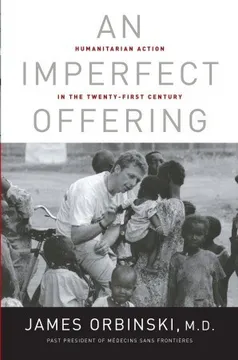
An Imperfect Offering is a powerful memoir by former Doctors Without Borders president James Orbinski. Readers praise Orbinski's honest, raw accounts of humanitarian work in conflict zones like Rwanda and Somalia. The book offers gripping personal stories alongside insights into the challenges of providing aid amid political complexities. While some found parts difficult to read due to graphic content, most reviewers were deeply moved and inspired by Orbinski's compassion and dedication. Many recommend it as an eye-opening look at global humanitarian crises and the politics surrounding aid work.
Glossary
Humanitarian space
Room for independent reliefThe practical and political room in which aid workers can reach people in need and provide assistance independently of military, political, or economic agendas. Orbinski also uses the idea more broadly to describe the conditions people need in order to live with dignity. This space can be restricted by violence, state control, or the use of aid as a political instrument.
Neutrality
Nonalignment in conflictA humanitarian principle of not taking sides in the political causes of a conflict. In Orbinski’s account, neutrality does not require silence about attacks on civilians, genocide, or violations of humanitarian law. It is distinct from impartiality, which concerns how assistance is allocated, and independence, which concerns freedom from outside agendas.
Impartiality
Aid according to needThe principle that humanitarian assistance should be provided to people affected by conflict or disaster according to their needs, without discrimination based on race, religion, political affiliation, or which side they support. The amount of assistance should reflect the level of need. It does not mean that every person receives identical assistance.
Independence
Freedom from outside agendasThe humanitarian principle that operational decisions should remain free from political, economic, religious, or other external objectives. Independence helps organizations assess needs and deliver aid without becoming an instrument of a government or military campaign. Orbinski treats financial independence, including reliance on private donations, as one way to protect independent action.
New Humanitarianism
Aid tied to political changeA trend Orbinski describes in which humanitarian assistance is linked to broader aims such as human rights enforcement, development, conflict resolution, or negotiated peace. These aims can address underlying injustice, but tying emergency aid to political conditions can turn assistance into leverage and make access dependent on political cooperation.
Campaign for Access to Essential Medicines
Collective action for affordable treatmentAn MSF-led campaign launched in 1999 to address the lack of medicines for diseases affecting poor populations. It combined public advocacy, legal and policy work, price research, generic purchasing, and partnerships with civil society groups. The campaign challenged patent and trade arrangements that prevented patients from obtaining existing treatments and pressed for research into neglected diseases.
Compulsory licensing
Authorized generic productionA legal mechanism that allows a government to authorize production of a patented medicine by another manufacturer, typically with payment of a royalty to the patent holder. As described in the book, governments may use it after negotiations over price fail. It can make treatment less expensive while leaving the patent in force.
Parallel importation
Buying a drug abroad cheaperA policy that permits a government to purchase a patented medicine from another country where it is sold at a lower price. It uses price differences between markets to reduce public health costs without requiring the government to manufacture a generic version. Orbinski presents it alongside compulsory licensing as a legal tool for improving access.
TRIPS Agreement
WTO rules on intellectual propertyThe World Trade Organization agreement on Trade-Related Aspects of Intellectual Property Rights. It establishes minimum intellectual property protections, including rules affecting medicine patents. Orbinski describes advocacy to ensure that TRIPS is interpreted in ways that allow governments to protect public health and expand access to medicines, rather than treating trade obligations as an absolute barrier.
Drugs for Neglected Diseases initiative
Not-for-profit drug developmentA not-for-profit drug research and development initiative launched in 2003 by MSF and partners. It focuses on diseases that affect poor populations and attract too little commercial research investment. The initiative develops treatments through collaboration among research institutions, public agencies, and health organizations, with the aim of making useful medicines accessible to patients.
Download PDF
Download EPUB
.epub digital book format is ideal for reading ebooks on phones, tablets, and e-readers.








