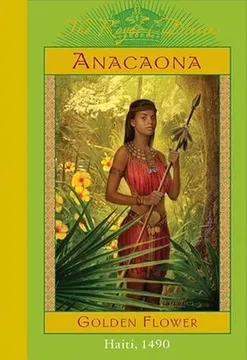


Plot Summary
Prologue
Before the story begins, an author’s note explains that Anacaona could not have kept a written diary in the modern sense. The Taíno preserved knowledge through songs, dances, images, and carved symbols, while marking time by harvests and the moon.
The book imagines Anacaona using a new cotton surface to record her thoughts across lunar cycles, turning a fictional diary into a form shaped by the culture it represents.
The note makes the book’s form part of its historical argument. Rather than treating writing as the sole measure of memory, it places Anacaona’s imagined record beside Taíno practices of song, image, ritual, and seasonal time. The result is not simply a diary translated into a different medium. It asks readers to understand history as something carried collectively, performed, and remade. That framing also distinguishes the novel’s inventions from what is known about Anacaona, inviting imagination without pretending that the surviving record is complete.
A Golden Flower Learns to Rule
Anacaona, niece of Xaraguá’s supreme chief Matunherí, is raised with her brother Behechio as a possible successor, learning the work of ruling through harvests, fishing, diplomacy, songs, and ceremonies. Her parents, Bibi and Baba, stay close even as Matunherí’s household prepares the siblings for leadership.
The weaver Cuybio gives Anacaona a cotton surface for recording symbols, and she begins shaping what she sees into ballads. Before her coming-of-age feast, niguas swell her feet and threaten her dance; the healer Bayaci treats her, and she recovers in time.
At the ceremony, Matunherí cuts her long braid, marking her passage into womanhood. Anacaona dances her own creation, while Caonabó, chief of Maguana, gives her dazzling birds and stirs her interest in him.
Anacaona’s first public transition makes private talent answerable to political expectation. Her dance is not merely an adornment to the ceremony: she creates it herself, then performs before the leaders whose approval will shape her future. The threatened injury to her feet puts that agency at risk, while her recovery lets her meet the demand without surrendering authorship. The cotton record and her ballads also establish an alternative kind of authority. She learns by observing people and practices, then preserves that knowledge in forms that can travel through a community.
Yaruba’s Unspoken Child
As Anacaona grows into her possible role, she wonders whether marrying Caonabó would let her help rule Maguana or cost her the chance to govern Xaraguá. Her brother Behechio, meanwhile, takes several wives.
One of them, Yaruba, confides that she longs to return to her home in Maguana and is carrying Behechio’s child, a secret she has told no one else. Anacaona urges her to stay, but the next day Behechio finds Yaruba dead beside poisonous yucca juice.
Anacaona keeps the pregnancy secret and arranges a burial in a sea-facing cave, where Yaruba can look toward home. Behechio withdraws in grief. By sitting with him at the cave, Anacaona helps him recognize how his treatment of a displaced wife caused real harm, and he returns to his duties with greater care.
Yaruba’s story makes political marriage legible through its smallest costs: a woman separated from her family, unable to leave without threatening relations between territories. Anacaona recognizes the resemblance between Yaruba’s predicament and her own possible future, so her sympathy is also an act of self-recognition. Concealing the pregnancy protects Behechio from another wound, but it also leaves Anacaona holding knowledge alone. Her patient presence at the cave gives grief room to change Behechio’s conduct. The episode tests leadership not through command, but through the willingness to see how power feels to someone with less freedom.
The Kalinas Reach Xaraguá
Kalina raiders strike several Xaraguá villages, taking food and carrying away women. Anacaona’s anger sharpens into a practical question: why should only the ruler’s household have trained guards?
She and Behechio propose village fighters, weapons, and watchful defenses, and Matunherí eventually orders weapons made and selected villagers trained in Kalina methods. Anacaona begins training alongside her brother. The work changes how she sees Behechio, who engages seriously with the protection of their people rather than only his household.
At the same time, Matunherí falls gravely ill, and the siblings take on more of his responsibilities. Their defense plan is in place when he can no longer manage every task, making their preparation a test of both military readiness and succession.
The raids turn Anacaona’s inherited concern for her people into an institutional proposal. Instead of accepting protection as a privilege reserved for the ruling household, she argues for distributing it across villages. That shift matters because it treats safety as a public responsibility rather than a marker of rank. Behechio’s willingness to plan with her also alters her private estimate of him: his capacity to rule becomes visible through collaboration. Matunherí’s illness accelerates the transfer of responsibility, showing that political maturity is measured not just by lineage, but by what a leader builds before a crisis arrives.
The Hurricane Changes Everything
While Matunherí remains sick, a trance brings his warning of a hurricane, and Anacaona and Behechio organize preparations across the villages. The storm arrives with little warning, tears roofs away, uproots trees, and floods fields.
At dawn, the scale of the destruction becomes clear: many people are dead, including Anacaona’s childhood friend Yeybona, her husband Piragua, and their son Nahe. Their bodies are laid to rest at sea, and Anacaona grieves among survivors who must burn many other dead to prevent illness.
In the aftermath, brightly colored birds, the kind Caonabó once gave her, fill the sky above Matunherí’s household. Seeing Behechio discuss an alliance with confidence, Anacaona freely accepts that Xaraguá should be his to rule, not hers.
The hurricane exposes the boundary between political competence and control. Anacaona and Behechio can prepare people, but they cannot bargain with the storm or restore those it takes. Her grief over Yeybona’s family is made public and communal, as leaders face the dead alongside ordinary villagers. The birds return as a sign of a future connection, but Anacaona’s decisive change is internal: she relinquishes sole claim to Xaraguá before anyone can force her to do so. This is not a defeat of ambition so much as a deliberate revision of it, grounded in trust in Behechio and in a widening sense of where her work may matter.
Caonabó’s Birds Return
After the storm, Caonabó’s messengers arrive, followed by the chief himself. Matunherí, whose health still falters, proposes an alliance between Maguana and Xaraguá through Anacaona’s marriage to Caonabó. Anacaona accepts with joy, seeing both a political bond and a chance to join the man she admires.
Before the wedding, she spends a period in isolation, then undergoes a ceremony in which fifteen men attempt to persuade her to abandon her choice. She resists them, confirming that the decision is her own.
At the public wedding, Matunherí blesses the union and Behechio drums as the two territories celebrate together. At dawn, Anacaona says farewell to her parents, brother, and people, then sails with Caonabó to Maguana, leaving the rule she once expected to claim.
The marriage is a political instrument, but the narrative refuses to reduce Anacaona to the instrument’s passive object. Matunherí presents the alliance as essential to the territories’ future, yet the choice is formally hers, and she accepts it from desire as well as duty. The temptation ceremony gives that consent a public test: she must refuse alternatives before her community recognizes her decision. Still, the departure costs her a homeland and a governing future. Her joy and grief coexist, revealing that agency does not erase sacrifice. Anacaona chooses a life whose possibilities are real but not fully under her control.
A Wife Becomes a Warrior
Maguana welcomes Anacaona with feasts, gifts, and a ball game, but a player’s suicide after losing shocks her and exposes customs unlike those of Xaraguá. In her new household, she soon discovers that being a cacique’s wife is not the same as being a ruler: attendants fulfill her wishes, yet few treat her as a friend.
She asks to join Caonabó’s hunt, proves her aim with a spear, and earns permission to train with his warriors. She also begins working with Simihena, a carver and dancer, developing new designs inspired by people and memories she misses. Anacaona’s days acquire purpose beyond ceremonial privilege. She learns the land, builds a friendship by choice rather than command, and begins making Maguana’s art bear her own imprint.
Anacaona’s adjustment is not a simple movement from freedom into luxury. The gifts and servants around her make her powerful in appearance while isolating her from reciprocal relationships. She answers that isolation by seeking practices in which skill, not status, can earn belonging. Hunting gives her a place beside Caonabó’s warriors; carving gives her a way to bring memory into her new surroundings. Her effort to befriend Simihena without ordering her to comply marks a subtle change in how she understands authority. She is learning to create influence through shared work, not merely through inherited rank.
A Chief Dies, A Daughter Arrives
When Matunherí dies, Anacaona and Caonabó sail back to Xaraguá. She reaches her uncle’s funeral in time to see Behechio recognized as the new cacique; Matunherí’s wife Guamayto chooses to follow him into death according to their custom. Amid the mourning, Bayaci discovers that Anacaona is pregnant. She returns to Maguana, where her daughter Higuamota is born and welcomed at a feast.
Anacaona’s parents visit, but stay in Xaraguá to counsel Behechio, who later becomes a father as well. Caonabó and Behechio affirm their alliance, with each promising support to the other’s territory. Anacaona now faces motherhood far from the family who raised her, but the child gives her a new bond between the two regions she has tried to serve.
This turning point braids succession, loss, and birth without allowing one to cancel another. Behechio inherits the office Anacaona once expected to share, while her pregnancy makes her future newly embodied and intimate. The return to Xaraguá confirms her continuing attachment to her family, but Bibi and Baba’s decision to remain with Behechio leaves her without their daily guidance as she becomes a mother. The political alliance between the brothers-in-law offers security, yet it cannot remove that loneliness. Anacaona’s authority is changing form: she remains a diplomat and warrior, but now imagines the future through the life she must protect.
Lightning Rods at the Door
Reports of pale-skinned strangers first reach Anacaona through messengers from Marién, where Chief Guacanagarí has welcomed them. Soon four armed men arrive in Maguana, firing metal weapons that scatter the villagers and demanding gold.
Caonabó tries to understand who they are, but their greed becomes plain when they dismantle ceremonial chairs for their ornaments. Anacaona sends her infant daughter Higuamota away with Marahay, a Kalina-born servant who knows the dangers of raids. One stranger fires at them; Marahay falls, and Anacaona rushes to recover her unharmed child.
Caonabó attacks, and the people kill all four intruders. The encounter changes the threat from distant rumor into immediate violence. Anacaona urges the leaders to gather in Xaraguá, where they can learn what is happening in Marién.
The strangers’ arrival dismantles the familiar categories through which Anacaona has interpreted danger. They are neither ancestral spirits nor ordinary visitors: their weapons create terror, while their treatment of gold reveals an appetite that courtesy cannot satisfy. Anacaona’s first response is intensely personal, moving Higuamota out of danger; her second is political, pressing for a wider meeting. That sequence matters. The protection of one child becomes inseparable from the survival of a people. Marahay’s presence also complicates the idea of a fixed enemy, since a woman from a rival group becomes the trusted guardian in a crisis.
Marién Burns at Night
In Xaraguá, Anacaona and Caonabó compare accounts with Behechio and Caonabó’s brother Manicaotex, then sail to Marién with fighters. They find Guacanagarí’s people terrorized, bodies displayed, and the newcomers forcing villagers to mine gold.
Guacanagarí, who had first offered the strangers hospitality in hopes of protection, now fears them. Anacaona and the other leaders pretend to help locate gold, buying time while their fighters gather. After dark, they attack with spears, stones, and burning peppers that fill the settlement with stinging smoke.
The wooden compound catches fire, and the allied fighters retreat to their canoes with casualties on both sides. Back in Maguana, Anacaona holds Higuamota again and later tells the battle as one part of a much larger Taíno story, refusing to let invasion erase every other memory.
The battle makes the cost of misjudging power brutally visible. Guacanagarí’s hospitality is not foolish in itself; he seeks an ally against the Kalinas, but the newcomers turn that welcome into coercion and forced extraction. Anacaona and the other leaders answer with tactical deception, adapting their knowledge of pepper smoke and night attacks to the weapons they face. Their victory is limited, not final, and the casualties prevent triumph from becoming uncomplicated. Anacaona’s later storytelling is therefore a form of resistance: she preserves the battle, but refuses to let the invaders become the sole subject through which her people remember themselves.
Epilogue
The historical epilogue follows Anacaona beyond the story’s final victory. Spanish forces later capture Caonabó and Manicaotex, who die at sea, and Anacaona returns to Xaraguá to rule with Behechio, eventually governing alone. In 1503, Governor Nicolás de Ovando orders the massacre of Taíno leaders gathered at a feast; Anacaona is hanged.
Her nephew Guarocuyá survives and continues resisting Spanish rule, while the fate of her daughter remains unknown. The epilogue describes the forced labor, disease, violence, and population collapse that devastate the Taíno, placing Anacaona’s story within a wider catastrophe.
The epilogue sharply revises the emotional meaning of the preceding victory. The allied attack in Marién demonstrates courage and tactical intelligence, but it cannot prevent a larger colonial force from returning with greater numbers and deeper systems of control. Anacaona’s fate is not presented as the consequence of personal failure; it follows from an invasion that steadily narrows the choices available to Taíno leaders. The historical note also resists a clean ending by tracing loss beyond the central character, while preserving uncertainty around Higuamota. Its account turns the novel’s concern with memory into an ethical demand: remembrance must include the violence that official histories can make seem inevitable or invisible.
Analysis
The novel makes leadership a series of concrete negotiations between personal desire and collective need. Anacaona is raised to rule, but the story does not treat succession as a simple reward for intelligence or courage. She must learn how authority works in practice: how harvests sustain a population, how a marriage can join territories, how a ruler’s household differs from a village, and how a policy of defense can extend protection beyond the elite. Her decision to leave Xaraguá is therefore neither a surrender nor a conventional triumph. It is a choice made within limits, one that redirects her capacity rather than erasing it.
The diary form reinforces this argument. Anacaona turns ceremonies, illnesses, games, deaths, and landscapes into material for songs and symbolic records. Her attention gives private experience historical weight, especially when she records the consequences of political arrangements for women such as Yaruba. The book also treats memory as a communal responsibility. In the final account of the battle, Anacaona does not deny its importance; she refuses to let the invasion become the only story her people can tell. That act resists the colonizer’s power to define a people solely through conflict or defeat.
The ending’s historical note complicates the story’s hard-won victory. Taíno resistance is resourceful, coordinated, and morally urgent, yet it faces a colonial system with returning forces, coercive labor, and catastrophic violence. The book does not mistake courage for guaranteed survival. Instead, it preserves Anacaona as a thinker, artist, diplomat, mother, and warrior, a person whose life exceeds both the political role she was trained for and the tragedy history records. Its deepest claim is that remembering a people must include their ordinary beauty and knowledge, not only the violence that destroyed so much of their world.
Review Summary
Anacaona received mixed reviews, with an average rating of 3.79 out of 5. Many readers appreciated learning about Taíno culture and history, praising Danticat's portrayal of the strong female protagonist. Some found the pacing slow until the arrival of Spanish colonizers, while others valued the focus on pre-colonial life. The book was noted for its educational value, cultural immersion, and sensitive handling of difficult topics. Critics mentioned issues with historical accuracy and writing style, but overall, readers found it a valuable addition to the Royal Diaries series.
Characters
Anacaona
Poet and future rulerAnacaona is the niece of Matunherí and the sister of Behechio, raised among the leaders of Xaraguá as a possible future cacica. Curious and observant, she turns ordinary events into songs, riddles, and symbolic records, using art to understand the duties around her. Her visions and attention to ancestral stories make her receptive to meanings others may dismiss, but she is also practical: she learns how food is grown, how people trade, and how a territory protects itself. Anacaona values family deeply while feeling the pull of public responsibility. Her inner life is shaped by a persistent question: how can she serve her people without losing the parts of herself that make her a distinct person?
Behechio
Anacaona’s brother and heirBehechio is Anacaona’s older brother and a fellow candidate to inherit leadership of Xaraguá. He is confident in public duties and initially more absorbed in marriage and household life than in Anacaona’s close ties to their parents. His authority is tested by the consequences of how he treats the people around him, and he is capable of reconsidering his conduct when confronted with grief. As a brother, he can be teasing, protective, competitive, and politically perceptive. His relationship with Anacaona combines affection with the pressure of shared inheritance. She watches him not only as family but as a possible partner in ruling, measuring his ability by the choices he makes for the territory.
Caonabó
Chief of MaguanaCaonabó rules Maguana, a fertile territory whose people know him as a strong leader and experienced defender. Anacaona first notices his generosity and fascination with brilliantly colored birds, then becomes drawn to his confidence and care for his people. He is strategic without being emotionally distant, and he values preparation against threats such as the Kalinas. His bond with his brother Manicaotex reveals a tenderness beneath his public authority. As Anacaona’s husband, he must make room for her abilities rather than treating her only as a ceremonial partner. His love of birds, his warrior training, and his interest in alliance all reflect a mind attentive to both beauty and danger.
Matunherí
Anacaona’s uncle and rulerMatunherí, whose title means the Most Highest One, is the cacique of Xaraguá and the uncle who raises Anacaona and Behechio as possible successors. He carries responsibility as a daily practice, receiving subchiefs, blessing newborns, and overseeing the territory’s needs. He expects discipline and can be stern when he believes ceremony or public honor is at stake, yet he also invests deeply in the siblings’ education. His authority is both familial and political, which makes Anacaona’s growing independence complicated: she loves him while needing to form judgments of her own. His relationship with the siblings models a style of leadership rooted in service, ritual, and the burden of making decisions for many people.
Bibi
Anacaona’s steady motherBibi is Anacaona’s mother, a source of intimate counsel and practical care. Their shared river baths give Anacaona a space of closeness that changes as the young woman enters public adulthood. Bibi understands both her daughter’s emotional attachments and the demands placed on a prospective ruler, helping her navigate ceremony, marriage, and family duty. She is observant without being controlling, and her love appears most clearly in what she prepares, repairs, and quietly anticipates. For Anacaona, Bibi represents the private home life that political advancement can interrupt.
Baba
Anacaona’s guiding fatherBaba is Anacaona’s father, a skilled craftsman who makes masks and ceremonial objects. He knows his daughter’s face and character well enough to create art for her without asking her to pose, and he supports her while she learns to inhabit public expectations. Baba’s craft gives Anacaona a model of knowledge made by hand, while his calm presence steadies the family through political change. He remains close to both children, even as their roles carry them into separate households.
Higuamota
Anacaona’s daughterHiguamota is the daughter of Anacaona and Caonabó, named for Caonabó’s mother. As an infant, she draws out a protective tenderness in Anacaona that is different from the responsibility she feels for an entire territory. Her presence links the families of Maguana and Xaraguá, but she is also a child whose safety depends on choices made by adults facing danger. Anacaona’s observations of her daughter’s small gestures give motherhood a vivid, everyday presence in the story.
Yaruba
A homesick wifeYaruba is one of Behechio’s wives and comes from Maguana, far from her own family. She longs for home and confides in Anacaona, trusting her with feelings she cannot safely share across the household. Her situation exposes the limits placed on women whose marriages also serve political relations. Yaruba is not simply a symbol of sorrow: she has a past, a place she loves, and a desire to shape where she belongs.
Yeybona
Anacaona’s childhood friendYeybona is a close friend of Anacaona, married to Piragua and mother to Nahe. Their friendship offers Anacaona a connection outside the ruling household, grounded in shared girlhood and family life. Through Yeybona, Anacaona witnesses the ordinary rhythms of birth, parenting, and community. Her presence reminds the future ruler that the fate of Xaraguá is made up of particular people, not only territories or titles.
Piragua
Fisherman and family manPiragua is Yeybona’s husband and Nahe’s father, a skilled fisherman who shares his family’s love of the sea. His work and friendships connect the village to the water that sustains it. He appears as part of Anacaona’s close circle beyond courtly life.
Nahe
Yeybona’s young sonNahe is the infant son of Yeybona and Piragua, named for the oar used in canoes. Anacaona watches him grow and tells him ancestral stories, seeing in his early life both the joy of new beginnings and the vulnerability of children.
Simihena
Maguana’s carver and friendSimihena is a carver and dancer in Maguana who becomes one of Anacaona’s first friends there. She inherits her family’s carving work and brings her own artistic judgment to it. Their friendship develops through shared making rather than rank or obligation, giving Anacaona a place to contribute to her new home. Simihena also offers a perspective grounded in the landscape and craft traditions of Maguana.
Marahay
Kalina-born protectorMarahay is an older Kalina woman who has served Caonabó’s household since his childhood. Captured as a girl during a raid, she has knowledge of Kalina language, customs, and warfare, which she passes to Caonabó and Anacaona. Her place among the Taíno complicates any simple division between peoples: she is shaped by capture and conflict, yet becomes a trusted source of knowledge and care.
Manicaotex
Caonabó’s brother and allyManicaotex is Caonabó’s brother and a subchief whose relationship with him is affectionate as well as political. The brothers train together, discuss defense and trade, and share responsibilities across their territories. Manicaotex is decisive in a crisis and helps turn a gathering of leaders into coordinated action. His closeness with Caonabó gives Anacaona a glimpse of kinship built on loyalty and shared work.
Guacanagarí
Cacique of MariénGuacanagarí rules Marién, a territory especially vulnerable to raids by the Kalinas. He is welcoming, sociable, and eager to protect his people, which shapes how he responds to unfamiliar visitors. His friendliness should not be mistaken for carelessness; he is making choices under pressure from a danger he has faced repeatedly. His predicament illustrates the difficulty of seeking security from outsiders whose motives are not yet clear.
Cuybio
Weaver and makerCuybio is a weaver in Xaraguá who invents a cotton surface for Anacaona’s symbolic records. He also makes ceremonial garments and objects, combining technical skill with an understanding of what Anacaona is trying to preserve.
Bayaci
Family healerBayaci is the healer trusted by Anacaona’s family. His remedies require him to share in the physical cost of treatment, reflecting a tradition in which healing is an act of communal responsibility.
Guarocuyá
Behechio’s young sonGuarocuyá is Behechio’s son and Anacaona’s nephew. As a young child, he represents the next generation whose safety and future shape the decisions of the adults around him.
Christopher Columbus
Leader of the Spanish expeditionChristopher Columbus appears in the historical material as the leader of the Spanish expedition that returns to the island with a much larger force. His arrival marks the expansion of a foreign presence driven by conquest and extraction.
Nicolás de Ovando
Spanish colonial governorNicolás de Ovando is the Spanish governor named in the historical epilogue. He represents the colonial authority that seeks to eliminate remaining Taíno resistance through organized violence.
Plot Devices
The lunar record
Memory measured by seasonsAnacaona’s imagined diary is organized by lunar days and agricultural seasons rather than by a conventional calendar. This structure keeps daily life connected to planting, harvest, weather, feasts, and the appearance of the moon. It also reflects the book’s premise that Taíno knowledge was preserved through practices other than written diaries. The changing seasonal headings provide a quiet measure of Anacaona’s growth, while the recurring cycles contrast with the political disruptions that grow more dangerous as the story proceeds.
Caonabó’s birds
A sign of distance and returnThe brightly colored birds Caonabó gives Anacaona first embody his attention and her longing for a life beyond Xaraguá. When she releases them, she tries to free herself from waiting for him. Their later appearance above the devastated territory renews the connection and helps Anacaona recognize that her future may lie in Maguana. Birds therefore carry both emotional and political meaning: they are a personal gift, a sign of alliance, and a reminder that choice can involve leaving one home for another.
Ancestral visions
Warnings across generationsAnacaona experiences dreams and sensations she interprets as messages from the opia, the spirits of the dead. Some visions echo later events, while others leave her uncertain about what she has perceived. They tie her private fears to the wisdom and stories of earlier generations, especially her grandmother. The visions also create tension between intuition and evidence: Anacaona must decide when to trust what she senses and when to act on practical information. As threats change, her inherited imagination becomes one way she prepares to understand the unknown.
Gold and lightning weapons
A foreign appetite revealedThe strangers’ metal weapons initially resemble supernatural power to the Taíno who witness them, while their repeated demands for gold expose a more human motive. The contrast between terrifying force and relentless extraction establishes the danger they pose. Gold is not merely a valuable object in these encounters; it becomes the measure by which the strangers judge people and places, while the weapons let them coerce others into surrendering it. This device shifts the story from the familiar threat of Kalina raids to a new kind of invasion.

Download PDF
Download EPUB
.epub digital book format is ideal for reading ebooks on phones, tablets, and e-readers.








