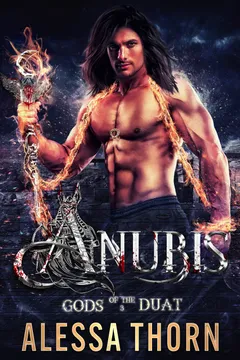


Plot Summary
Prologue
Anubis1 is born from Osiris13 and Nephthys's forbidden affair, then abandoned among the reeds to die. Jackals raise him; Isis15 later finds him and keeps him hidden from the gods.
The child grows into the guardian of the dead,1 honoring the animals that saved him and learning to respect powerful women who refuse to be ruled. His story begins with rejection, but his purpose becomes care: he gives the dead the regard the living often deny them.
The origin frames Anubis through abandonment rather than divine privilege. He is not made powerful by a secure family or a clear inheritance; he survives because animals adopt him and Isis chooses to protect him. That history makes his care for the dead more than professional duty. He knows what it is to be discarded and unclaimed. The prologue also sets up a contrast that matters later: Anubis is a god who governs endings, yet his own life is shaped by unexpected acts of rescue and belonging.
Wahtye Takes the Ka
While tending the dead in the Field of Reeds, Anubis1 is summoned to a human shrine by Wahtye,10 a sick sorcerer10 whose family is also dying. Wahtye10 demands that Anubis1 heal them. When the god1 refuses, Wahtye10 uses dark magic to seize his Ka, the soul that anchors his power and identity.
Anubis1 breaks free of the summoning circle, but the theft leaves him divided and unable to return to his duties. For nearly five thousand years he survives as a jackal, caught between animal instinct and buried memories. Recently restored to human form, he now searches for the missing Ka and the woman2 whose scent endured through the curse.
The stolen Ka turns a mythic figure into someone psychologically divided. Anubis's animal survival is not simply a disguise: it is the consequence of being severed from the part of himself that made duty and memory coherent. Wahtye's demand also inverts the usual power relationship between god and mortal. Anubis refuses to become a tool for human desperation, but that refusal costs him centuries of agency. His later search is therefore both practical and intimate: he needs his power restored, yet the memory that survived the curse points him toward a person, not just an object.
A Name Across the Gala
Tahirah Eskander,2 an Egyptologist working on a Saqqara excavation, is reluctant to attend a museum fundraiser until site director Aharon Cohen14 reminds her the dig needs money. Her research centers on Wahtye's10 puzzling tomb and its cache of Anubis1 statues. At the gala, she meets Waleed Said,9 a club owner who employs her younger sister,7 Rana.7
Then a tall, unsettling investor approaches and introduces himself as Anubis Akhom. Tahirah2 feels an immediate, hard-to-place familiarity, while Anubis1 recognizes the jasmine-and-death scent that stayed with him through his jackal years. He steers her away from Waleed9 and listens as she explains why she works to recover the stories of the dead.
The gala brings two kinds of recognition into collision. Tahirah understands the past through material evidence, while Anubis recognizes her through embodied memory that no archive could preserve. Their shared interest in the dead offers genuine common ground, but the encounter is also uneven: he knows she mattered to him before she knows who he is. Tahirah's reluctance to perform for donors emphasizes the tension between intellectual labor and the social machinery that funds it. Anubis enters that machinery as an investor, but his real motive is neither prestige nor ownership. He is following a trace left by a life he could barely remember.
The Tomb Remembers Him
Anubis1 visits the excavation and asks Tahirah2 to show him Wahtye's10 tomb. She explains that the priest10 seems to have taken his brother's burial place, scratched out other names, and inserted himself among the judges of the Duat. Anubis1 recognizes the deception and reacts with fury, especially when Tahirah2 shows him the false door behind which hundreds of small Anubis1 statues were buried.
Touching the exposed earth, he senses an echo of his missing Ka. He offers to fund the work without dictating what the archaeologists should do, and Thoth4 completes the investment so the site can remain open. The tomb is no longer only Tahirah's2 research puzzle; it is the place where Anubis1 may recover himself.
The tomb functions as evidence and provocation at once. Tahirah reads its substitutions as an archaeologist, reconstructing a man's attempt to manipulate his afterlife; Anubis sees the same choices as a personal violation whose consequences are still active. Their different expertise complements rather than cancels the other: her careful account locates the anomaly, while his bodily response confirms its importance. The false door is especially apt. It marks a boundary meant to connect the living and the dead, but Wahtye has clogged that passage with images of Anubis. The site promises access, yet it is also a record of attempted control.
A Jackal Becomes a God
After a late-night run, Tahirah2 meets Anubis1 in the streets of Saqqara. Three revenants rise from the dark and attack them. Anubis1 binds the corpses with glowing chains, commands them in the language of the dead, and destroys them when they reveal that cracks in the Duat are letting the dead escape.
Tahirah2 faints from the shock and wakes in Anubis's1 house, where Kema5 and Thoth4 confirm that he is the god of the dead.1 She also learns that the jackal she once fed and comforted was Anubis1 himself, cursed for millennia. He tells her Wahtye10 stole his Ka and that the damaged afterlife needs him back. Seeing no reason to dismiss what she witnessed, Tahirah2 agrees to help search the tomb.
The supernatural revelation does not make Tahirah abandon her habits of judgment; it gives those habits new evidence to work with. She accepts Anubis's identity because she has seen what he can do, not because a god demands belief. That distinction protects her agency within a story built around overwhelming power. Anubis, meanwhile, has to let someone see both the frightening god and the vulnerable survivor who once depended on her kindness without being recognized. The revenants widen his private loss into a public crisis. His missing Ka is no longer only a wound in his own life; the instability is releasing the dead into the human world.
The Dead Sing for Tahirah
At the dig, Anubis1 meets Ishak,8 Tahirah's2 bright young nephew,8 who lives with a serious heart condition and shares her fascination with the dead. Ishak's8 drawings and questions move Anubis,1 who recognizes the child's sense of being physically incomplete. Tahirah2 also explains that items have vanished from the site and suspects Waleed's9 interest in the excavation is not innocent.
Anubis1 visits Waleed's9 club with his uncle3 Set,3 then intervenes when a bouncer injures Rana.7 Later, he tells Tahirah2 that Rana7 has been passing information about the dig to Waleed.9 On the pyramid steps, Anubis1 uses his power to let Tahirah2 see and hear the lingering shades. Their wonder turns into a kiss, making the investigation personal for both of them.
Ishak gives Anubis a human-scale version of his own absence: a child who speaks of a broken heart and imagines an afterlife built around reading, safety, and freedom from illness. Anubis's tenderness toward him exposes the care beneath his intimidating authority. The family plot is more complicated. Tahirah wants to protect Rana, but evidence of her sister's ties to Waleed unsettles the trust between them before the reasons are clear. When Anubis lets Tahirah hear the ghosts, he does more than reveal his powers. He shares the world that defines his work, and she responds with curiosity instead of fear. Their first kiss grows from recognition, not rescue alone.
Blood in the Excavation
As Anubis1 and Tahirah2 kiss beside the pyramid, a van arrives at the site carrying Waleed's9 armed men. The intruders shoot a guard and begin searching for relics, with orders to kill Tahirah.2 Anubis1 shifts into his jackal form and fights them alongside Set,3 but one attacker reaches Tahirah2 and stabs her before fleeing into the dunes.
Thoth4 heals her while Anubis1 hunts down the assailant and returns covered in blood. He is shaken by how close Tahirah2 came to dying, and she insists that his presence did not make the attack his fault. Staying at Anubis's1 home for safety, Tahirah2 chooses to act on their attraction. Their intimacy deepens, even as Waleed's9 retaliation makes clear that the danger has not passed.
The attack forces romance and violence into the same physical space. Anubis's protective instincts save Tahirah, but his ferocity also reveals why intimacy with him cannot be separated from his power. His panic after her injury is a new kind of fear: he has always served the dead, yet he cannot accept the possibility of losing a living person he loves. Tahirah's response matters just as much. She does not mistake his violence for a reason to withdraw, nor does she let him take responsibility for Waleed's choices. Their growing relationship begins to involve mutual care, although the balance remains difficult when one partner can command supernatural force.
Two Homes Explode
After another night together, Anubis1 leaves Tahirah2 with Kema5 while Set3 investigates an alarm at his townhouse. Waleed's9 bomb detonates there, throwing Anubis1 into the Nile and leaving him badly injured. His magic cannot carry him to Tahirah,2 so he runs to her apartment and sees it explode as well.
He believes she is dead until Thoth4 pulls him away from the ruins and back to Kema's5 safe house in Alexandria, where Tahirah2 had already been taken after Kema5 sensed danger. They reunite, and Anubis1 admits how terrified he was of losing her. Tahirah2 chooses to stay with him and accepts his protective mark, which binds her more closely to his power and makes their commitment unmistakable.
The bombing turns separation into an emotional test rather than a simple action beat. Anubis survives the blast, but the more devastating injury is his mistaken belief that Tahirah has died. His godhood cannot immediately solve the crisis; damaged magic leaves him to cross the city in a mortal body, confronting helplessness at street level. Tahirah's survival depends on Kema's intervention, a reminder that protection is a network, not a single powerful man. The mark expresses their chosen attachment, but it also carries consequences Anubis has not fully considered. The moment is both romantic commitment and an ethically charged transfer of power.
Rana's Debt Comes Due
Rana7 sends Tahirah2 a warning that Anubis1 is dead and demands that she return to Saqqara with relics for Waleed.9 Anubis1 and Tahirah2 go to Rana's7 apartment and learn that she borrowed money for Ishak's8 medical needs, then passed Waleed9 photographs and small artifacts from the site to reduce her debt.
Rana7 believed Waleed9 would not kill Tahirah,2 but she admits she saw Anubis1 enter the building before it exploded. Tahirah2 confronts her sister7 over years of financial irresponsibility and the danger she created. Before they can leave, Waleed's9 armed man Adil arrives, threatens Ishak's8 safety, and forces Anubis1 and Tahirah2 into a vehicle. Their private family reckoning becomes a hostage crisis.
Rana's betrayal is neither excused nor made inexplicable by poverty. Her fear for Ishak gives her decisions a motive, but does not erase the risks she imposed on Tahirah or the excavation. Tahirah's anger draws on a longer history of caretaking: she has repeatedly rescued her younger sister, and now recognizes that rescue without boundaries has become part of their relationship. The scene also clarifies the emotional cost of family loyalty. Tahirah wants to protect Ishak and still loves Rana, but love cannot keep functioning as an unlimited loan. Waleed exploits that dependency, turning Rana's debt into leverage over both sisters.
Waleed's Last Bargain
At Waleed's9 desert mansion, the club owner9 demands that Anubis1 sign over control of the excavation and threatens Tahirah.2 Anubis1 spots a small Anubis1 statue on the mantel and feels his missing Ka inside it.
As a sandstorm batters the compound, his strength surges; he breaks his restraints, reveals his jackal-headed form, and kills Waleed9 and the men who attack him. Set3 helps secure the grounds, while Tahirah2 searches Waleed's9 office and discovers a hidden archive of stolen artifacts from sites across several countries.
Thoth4 uses magic to remove the concealed collection for examination. Anubis1 takes the statue containing his Ka, then destroys the mansion and its contents, ending Waleed's9 immediate threat and recovering the soul he has sought.
The confrontation brings the book's two forms of theft together. Waleed treats heritage as merchandise and people as leverage; Wahtye treated divine power as something he could seize to bargain for his own survival. Anubis's recovery of the Ka answers the original injury, but it occurs through another display of overwhelming force. Tahirah's contribution prevents the climax from belonging to violence alone. While Anubis fights, she uncovers the larger trafficking operation, turning evidence into a future obligation to the dead and the living communities who care for their history. The recovered soul restores possibility, but the consequences of Anubis's power remain unresolved.
The Queen Hears Shades
After Waleed's9 defeat, Tahirah2 visits Rana7 and gives her money from Anubis1 to clear the debt, while warning that she is not ready to forgive her. She urges Rana7 to leave the club and take responsibility for Ishak.8 Soon after, shades crowd around Tahirah2 in public, drawn by the power Anubis1 placed in his mark.
She is frightened by their sudden presence but wants to understand what they need rather than simply drive them away. Back at Thoth's4 house, Tahirah2 proposes that Wahtye10 used necromancy and Anubis's1 own death magic to separate the Ka. Her insight gives Thoth4 a new direction for research. Hermes11 brings Hades12 into the effort, and the gods prepare to enter the Duat.
Tahirah's development is expressed through two forms of boundary-setting. She refuses to let Rana's remorse erase the harm, yet she still helps protect Ishak and offers her sister a chance to change. With the shades, she chooses a different boundary: she wants contact on terms that do not require fear or submission. The mark has made her more than an observer of the dead, but she approaches that new role through the same skills that shaped her archaeology, listening closely and asking what evidence can support. Her theory is a decisive intellectual contribution. The gods' search for a solution now depends on a human scholar's ability to connect ritual, mortality, and divine power.
A Soul Rejoins Its God
Hades12 leads Anubis,1 Thoth,4 and Hermes11 into the Duat, where Anubis1 finds his palace and the surrounding realm in ruins. Thoth4 explains that Osiris13 failed to maintain the afterlife during Anubis's1 absence. In the former throne room, the gods ward the space, break open the statue, and use Hades's12 power to force the loose Ka back into Anubis.1
The restored god's1 magic rebuilds the palace and begins repairing the Duat. When Osiris13 appears, Anubis1 refuses to release him from his confinement, condemning his neglect of the dead. Hades12 then advises Anubis1 to delegate, making it possible to serve the Duat without abandoning his life in the human world. Anubis1 stays behind to stabilize the realm while the others return.
The return to the Duat makes the personal cost of Anubis's curse visible at architectural scale. The ruined palace is not merely a dramatic setting; it is the material consequence of a system that depended too heavily on one guardian and failed when he was removed. Osiris's self-preservation contrasts with Anubis's sense of obligation, but Anubis's restoration also reveals that devotion can become unsustainable when no one shares responsibility. Hades's counsel offers a political solution rather than a magical shortcut. Delegation allows care to endure beyond one person's presence, preparing Anubis to pursue love and duty without treating them as mutually exclusive.
A Crown Between Worlds
Anubis1 remains in the Duat for six weeks while he repairs its boundaries, leaving Tahirah2 to wonder whether he will return and whether his restored self still wants a human life. She and Kema5 establish a home near the Nile, and Tahirah2 learns to manage the shades drawn to her. Anubis1 finally comes back in full divine form.
He explains that Tahirah's2 mark and crown make her Queen of the Dead, but he does not ask her to give up archaeology or life in Egypt. Hades's12 advice has shown him how to move between worlds and share the work. Tahirah2 accepts both the crown and her profession. They choose a future that makes room for the Duat, the excavation, and one another.
The separation tests whether the bond can survive more than immediate danger and desire. Tahirah's fear that Anubis may not return is grounded in a real conflict: the realm needs him, and she cannot simply ask him to abandon it. His eventual offer changes the terms. Rather than demanding that she become only a queen or remain only an archaeologist, he recognizes that her human work is part of her identity and capacity. The crown becomes a symbol of added responsibility, not a replacement life. Their resolution is strongest where it resists a false choice between vocation and intimacy, although the balance will require continued negotiation.
Epilogue
At the Saqqara hospital, Anubis1 asks Hermes11 to heal Ishak,8 whose heart condition has kept him in and out of care. Hermes11 uses his caduceus to fill the boy's8 room with healing light, settling the debt Anubis1 owes him.
Rana7 is working at the hospital, and Tahirah2 has begun speaking with her again for Ishak's8 sake. With this last family concern addressed, Anubis1 prepares to take Tahirah2 to the Duat and show her the realm she will help rule.
The epilogue closes the story's concern with care by returning to the child whose fragility first brought Anubis and Tahirah into contact with family life. Ishak's healing is not presented as a reward for obedience or as a miracle that erases every difficulty. It is a deliberate act of reciprocity: Anubis asks Hermes to fulfill a debt by helping someone who matters to Tahirah. Rana's employment at the hospital also suggests a quieter form of repair, grounded in changed behavior rather than instant forgiveness. The final movement toward the Duat joins private love to public responsibility.
Analysis
Anubis1 makes care the measure of power. He is not defined only by authority over death; his original calling is to receive the people whom others have left behind. The curse exposes how vulnerable that system becomes when one guardian is removed, while Osiris's13 failure shows that possession of authority is not the same as willingness to serve. Anubis's1 return therefore requires more than recovering his Ka. He must rebuild a realm and learn not to confuse responsibility with solitary control.
Tahirah2 brings a different form of care. Archaeology asks her to infer lives from bodies, objects, and damaged records, and she approaches the shades with the same disciplined curiosity. Her expertise is not merely useful to Anubis's1 quest; it makes her a participant in shaping what their shared work might become. Her choice to remain an archaeologist while accepting the crown resists the idea that love must absorb a woman's existing identity. The supernatural bond complicates that choice because Anubis's1 mark gives her power before she understands its full consequences. Her consent matters, but so does the need for continuing negotiation.
The novel also refuses to make family loyalty simple. Tahirah's2 attachment to Rana7 does not excuse Rana's7 betrayal, and Tahirah's2 boundaries do not erase her concern for Ishak.8 Anubis,1 who knows abandonment from the beginning of his life, recognizes why a child needs advocates. The epilogue's effort to heal Ishak8 extends the romance outward: intimacy becomes a practice of taking responsibility for the people each partner loves. Across tombs, hospitals, and the Duat, the story treats remembrance as active work. The dead need more than reverence; they need someone willing to listen, judge fairly, and help them move on.
Review Summary
Most readers adored Anubis, praising its compelling romance between Anubis and Tahirah, rich Egyptian mythology, and satisfying crossover appearances from characters in previous books and the Greek gods series. Many consider it their favorite in the trilogy, highlighting the varied and strong female characters, feral yet tender portrayal of Anubis, and seamless blending of ancient mythology with modern settings. A few readers found the plot formulaic compared to earlier installments, and one reader objected to the casual tone and explicit language, but overall reception was enthusiastically positive.
Characters
Anubis
Jackal god of deathAnubis guards the dead and the borders of the Duat, the Egyptian afterlife. Raised first by jackals and later protected by Isis15, he is wary of divine family politics and more at ease among the dead than among the living. His sharp senses, blunt humor, and instinct to protect sit beside a deep commitment to treating every soul with dignity. A long curse leaves him negotiating between disciplined judgment and the jackal's bodily impulses. He is drawn to people who understand the dead rather than fear them, and his story asks whether a being defined by duty can also make room for a life of his own.
Tahirah Eskander
Archaeologist of the deadTahirah is an Egyptologist whose work treats burial sites as records of individual lives, not treasure stores. Practical, intellectually stubborn, and uncomfortable with social performance, she feels more at ease with the dead than with the living. She is devoted to her nephew Ishak8 and accustomed to taking responsibility when her younger sister7 struggles. That reliability can make it hard for her to recognize where care ends and self-erasure begins. Tahirah's curiosity is not credulity: she asks questions, weighs evidence, and insists on retaining her own judgment even when confronted with gods. Her scholarship and empathy make her a natural interpreter between the living and the dead.
Set
War god, loyal uncleSet is Anubis's1 uncle, a god of war and protection who combines blunt advice with a talent for practical intervention. He is comfortable with danger and understands how criminal networks operate, which makes him a useful ally when Waleed9 threatens the excavation. His affection often arrives disguised as teasing or food delivered at the right moment. Set's relationship with Ayla6 has softened his manner, but it has not dulled his protective instincts or his appetite for decisive action.
Thoth
Magic's irritable scholarThoth, god of magic and knowledge, is Anubis's1 uncle and one of the people helping him adjust to the modern world. Brilliant, exacting, and prone to overthinking, he researches the mechanisms behind magical problems rather than accepting easy explanations. His affection is often buried beneath threats, complaints, and dry humor. Thoth's partnership with Kema5 exposes a less guarded side, though he remains protective of the people in his household and quick to challenge Anubis1 when instinct outruns judgment.
Kema
Thoth's fearless partnerKema is Thoth's4 partner, a quick-witted woman with a magical heritage and a gift for opening doors between places. She is irreverent, socially perceptive, and willing to challenge the gods when their decisions overlook human consequences. Her warmth helps Tahirah2 navigate a world of magic without treating her as fragile. Kema's occasional visions also make her a vital source of warning, while her humor gives tense situations room to breathe.
Ayla
Set's steady belovedAyla is a human doctor and Set's3 partner. Kind and attentive, she notices when others are overwhelmed and offers practical care without confusing kindness with weakness. Her connection to Set3 gives her access to the gods' dangerous world, but she retains the perspective of someone trained to protect vulnerable bodies. Ayla supports Anubis1 and Tahirah2 while helping to temper Set's3 more violent instincts.
Rana Eskander
Tahirah's volatile sisterRana is Tahirah's2 younger sister and Ishak's8 mother. Charming and socially confident, she is accustomed to using attention to get through difficult situations, while financial pressure and old disappointments make her defensive about accepting help. She and Tahirah2 love one another but have a strained history shaped by unequal responsibility. Rana's relationship with her sister2 is complicated by her desire for independence and her dependence on the person who has repeatedly stepped in to help.
Ishak
A curious, fragile childIshak is Rana's7 young son and Tahirah's2 nephew. He lives with a serious heart condition, spends long stretches reading and drawing, and knows an unusual amount about mythology. His imagination treats the afterlife as a place that might offer comfort and freedom from illness. Ishak's questions cut through adult evasions, and his easy connection with Anubis1 comes from recognizing another person who feels incomplete.
Waleed Said
The artifact brokerWaleed is a wealthy club owner who uses charm, money, and intimidation to expand his influence. His interest in cultural heritage is opportunistic: he sees valuable objects and vulnerable people as parts of the same business. He employs Rana7 and understands how financial dependence can become leverage. Waleed's polished public manner hides a calculating appetite for control.
Wahtye
Sorcerer in the tombWahtye is an ancient sorcerer whose elaborate tomb has become the focus of Tahirah's2 research. Its altered inscriptions, crowded statues, and unusual false door suggest a man preoccupied with how he will be judged after death. He is desperate, ingenious, and willing to bend religious practice toward his own survival. Though his life is distant from the present, the physical traces he left behind continue to shape the choices of the living.
Hermes
The trickster fixerHermes is a Greek god of travel and trickery, as well as Kema's5 grandfather. Resourceful and playful, he moves easily among divine circles and is often able to locate help when others have exhausted their options. His teasing manner can irritate the more serious gods, but he is dependable when a difficult task needs unusual connections.
Hades
Underworld allyHades rules the Greek underworld and is an old friend of Anubis1. He is composed, authoritative, and accustomed to balancing the needs of a realm with relationships in the living world. His practical experience offers a perspective the Egyptian gods lack, particularly when they need to think beyond brute force and consider how responsibilities might be shared.
Osiris
The afterlife kingOsiris is Anubis's1 powerful divine relative and a ruler associated with the Duat. His distance from the people and duties around him complicates the family history that Anubis1 has inherited. He is proud and accustomed to authority, with unresolved relationships that shadow Anubis's1 understanding of duty, parenthood, and the gods.
Aharon Cohen
The dig's anxious directorAharon directs the archaeological excavation where Tahirah2 works. He is energetic, generous with praise, and continually worried about funding and the practical survival of the site. His enthusiasm for the research sometimes leads him to enlist Tahirah2 in donor events she would rather avoid.
Isis
Anubis's protective auntIsis is the goddess of magic who finds Anubis1 after his abandonment and gives him protection. Her compassion and independence shape his earliest understanding of family, while her distance from the other gods leaves a lasting absence in his life.
Plot Devices
Anubis's missing Ka
The stolen soulThe Ka is the soul and vital essence Wahtye10 steals from Anubis1. Its separation leaves Anubis1 without the full power he needs to return to the Duat, while his jackal form preserves only fragments of memory and instinct. A faint connection to the Ka draws him back to Wahtye's10 tomb, then to a small statue held by Waleed9. The search gives the romance and excavation a shared objective: Tahirah's2 archaeological evidence can help locate the object, and Anubis's1 supernatural senses can confirm its importance. Recovering the Ka resolves the original curse while creating the larger question of how Anubis1 will resume his duties.
Wahtye's false door
A tomb conceals evidenceThe false door in Wahtye's10 tomb is a ritual boundary between the living and the Duat, but the space behind it is packed with hundreds of Anubis1 statues. The discovery gives Tahirah2 an archaeological mystery to investigate and offers Anubis1 a physical location where he can sense traces of his missing Ka. The statues also express Wahtye's10 anxiety about judgment: he has crowded the tomb with images of the god whose authority he has violated. What first appears to be an oddity in the burial layout becomes a crucial clue in the search for Anubis's1 soul.
The consort's mark
Power binds two livesAnubis1 places a silver ankh mark over Tahirah's2 heart when they choose a lasting bond. It lets him find her and carries some of his power, which later draws shades to her and gives her a role in their passage between life and death. The mark functions as protection, but it is not a neutral gift: Thoth4 warns that it may change what Tahirah2 can perceive and what responsibilities the dead bring to her. The crown that appears later makes that responsibility visible. Together, mark and crown turn intimacy into a supernatural commitment that Tahirah2 must understand and accept for herself.
The restless shades
The afterlife leaks outwardRevenants and wandering shades reveal that the Duat is failing to contain the dead while Anubis1 is absent. At first they are threats, capable of attacking people in the streets. Later, Tahirah's2 mark allows shades to seek her out, transforming the supernatural crisis into a possible form of work she can help with. The shades connect the book's intimate plot to Anubis's1 public duty: restoring his soul matters not only to him, but to everyone stranded between worlds. Tahirah's2 archaeological attentiveness offers a different way to engage with them, based on listening and learning what they need.
Anubis Akhom
A mortal cover opens accessAnubis1 adopts the identity of Anubis Akhom, a wealthy investor, so he can enter the excavation without alarming its staff or drawing attention to his supernatural search. Thoth4 and Set3 help him adapt to modern life and establish the cover, while the investment also keeps the dig funded. The disguise creates an opening for him to meet Tahirah2 and inspect Wahtye's10 tomb. It is only partly successful: Anubis1 can imitate a human benefactor, but his instincts, unusual knowledge, and lack of familiarity with ordinary customs make the identity difficult to sustain.
Download PDF
Download EPUB
.epub digital book format is ideal for reading ebooks on phones, tablets, and e-readers.








