

Plot Summary
A Body Beneath the Press
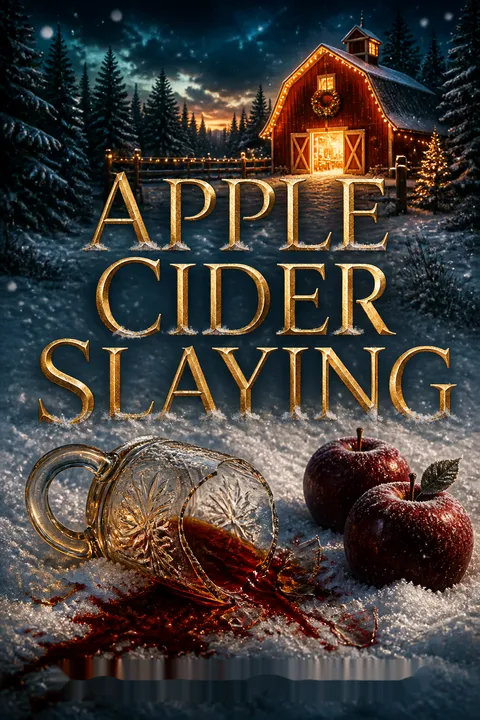
Winnie Montgomery hopes Christmas shoppers will revive Smythe Orchard, the family farm she shares with her grandmother, Granny Smythe. With the orchard nearly broke since her grandfather’s death, Winnie has prepared a plan for a year-round cider shop and needs banker Mr. Sherman to approve a loan. During his first visit, he notices sick-looking leaves on the trees, then follows Winnie to the old apple press building.
Inside, they find Nadine Cooper, Granny’s longtime adversary, dead beneath the machinery, her head bloodied. The visitors outside never see the body, but the discovery destroys Winnie’s carefully staged sales pitch. Nadine had come to the orchard earlier, demanding to see Granny, and left before Winnie could learn why.
The murder crashes into Winnie’s life at the exact point where she is trying to convert family loyalty into a viable business. Her plan is not merely ambition: the cider shop would preserve Granny’s livelihood and keep the orchard useful to the community. Nadine’s death makes that practical hope suddenly vulnerable to suspicion and scandal. The placement of the body also turns a familiar workplace into a crime scene, binding Winnie’s economic future to the question of who killed her neighbor.
The Sheriff Looks Homeward
Sheriff Colton Wise quickly focuses on Granny because she and Nadine had feuded for decades, and Granny cannot account for every minute around the time of the murder. Winnie defends her, then works her diner shift to hear what Blossom Valley is saying. Her friend Dot brings two orphaned kittens for Winnie to foster, a small responsibility that gives her something living to care for amid the shock.
That night, Winnie finds a masked intruder inside the press building. He knocks her down the steps and escapes on a four-wheeler. Colton doubts her account and warns her to find Granny an alibi. Convinced the intruder is connected to Nadine’s death, Winnie decides to investigate herself, despite the sheriff’s suspicion and the danger.
Winnie’s impulse to act grows from a specific injury: Colton treats Granny as a likely killer before he has evidence, while Winnie has seen the fear his suspicion causes her. The break-in complicates that loyalty by making Winnie a target too. Her choice to investigate is therefore both protective and reactive. The kittens offer a counterweight to the crime, asking for food and attention rather than explanations. Their dependence lets Winnie practice care even as her curiosity begins to pull her toward risk.
Nadine’s Other Life
With the orchard temporarily closed for a police search, Winnie joins Nadine’s hiking group to learn about the woman she knew only through arguments. The trail master, Oscar, describes Nadine’s vanity and recalls overhearing her end one relationship while admitting she had begun seeing someone else.
Other hikers remember her obsession with looking young, but none can name the men involved. On the hike home, Winnie notices a dead evergreen resembling the discolored orchard leaves that worried Mr. Sherman.
She suspects deliberate chemical damage rather than disease. Colton still distrusts her inquiries, but Winnie has found motives beyond Granny’s feud and a possible connection between the sick trees and Nadine’s death. The sheriff’s search has yielded no clear answer.
The hike alters Nadine from a one-dimensional neighborhood antagonist into a person whose private life exceeded Winnie’s limited view of her. That shift matters because it expands the suspect pool while exposing how easily gossip can masquerade as knowledge. Oscar’s story offers an intriguing romantic motive but no reliable identity, so Winnie must distinguish a clue from a conclusion. The dying trees create a parallel mystery: damage to the orchard may be intentional, which suggests that the crime could threaten more than one person.
A Festival Under Threat
To replace lost income, Winnie expands Christmas at the Orchard into a winter festival, designing games, advertisements, and cider samples while still pursuing her shop loan. At the vet’s office, where Dot’s kittens receive checkups, Winnie finds a threatening note on her car.
Colton refuses to treat it as proof of a connection to the murder. That night, a truck rams Sally, Winnie’s Mustang, and drives her toward a dangerous bend before speeding away. Shaken but uninjured, she hides the attack from Granny until Granny hears about it from a neighbor.
Meanwhile, Winnie learns her former boyfriend Hank Donovan is returning to town. The festival remains a fragile bid for the orchard’s future, but someone is now using fear to push Winnie away from the case.
Winnie responds to economic fragility with visible labor: she makes the festival larger because she believes a crowd can change the orchard’s prospects. The threats attack that same agency by making ordinary movement unsafe. A note can be dismissed; a truck forcing her toward a ravine cannot. Her decision to hide the collision from Granny reveals a familiar caretaker’s reflex, but it also repeats the secrecy she resents in others. Hank’s return adds emotional pressure just as Winnie’s past and present both demand attention.
Strike Two in the Barn
Mr. Sherman returns to taste Winnie’s cider and Granny’s baking, but his questions about costs expose gaps in Winnie’s business plan. During their walk to the Mail Pouch barn, they discover its contents wrecked and a small fire burning in a barrel.
Someone has carved a second warning into the floor. Colton arrives to investigate, then apologizes for treating Winnie and Granny as suspects. He agrees the vandalism likely comes from Nadine’s killer and helps Winnie clean the barn. When she points out the orchard’s damaged trees, he collects soil samples.
Their relationship shifts from antagonism toward trust, although Colton insists she stop investigating. The threatened barn is also Winnie’s proposed shop, making the vandalism both intimidation and an attack on the future she is trying to build.
The barn attack joins the murder investigation to Winnie’s economic ambition in a way the earlier threats did not. Someone has targeted the precise space she hopes to transform, so danger now threatens not only her body but the future she has designed. Colton’s apology marks a meaningful change in how authority operates: he begins to revise his judgment when the evidence no longer fits his assumptions. Their new cooperation is practical before it is romantic, grounded in shared work and a more honest reading of risk.
Land Beneath the Rumors
Winnie learns that local farmer Bentley has been buying property, then spots Extra Mobil papers among his files at the diner. At Hank’s sister Gina’s birthday party, she apologizes for their painful breakup and asks what the papers might mean.
Hank, who works for an oil-company competitor, suggests Bentley could be gathering land for future mineral leases. Their conversation brings some closure to a relationship damaged by Hank’s secret plans to move away, though it does not restore their romance.
Winnie also discovers Nadine promoted a Winchester plastic surgeon under a social-media label, explaining her youthful appearance and giving Winnie a possible identity for the lover Oscar overheard her leaving. When Colton reports herbicides in the orchard soil, Winnie’s suspicions harden. That night, a masked rider circles her home.
This section tests Winnie’s ability to separate emotional hurt from useful information. She apologizes to Hank without pretending his secrecy did not matter, then turns to him for expertise because the land documents suggest a motive larger than a private feud. At the same time, Nadine’s cosmetic-surgery secret reframes her carefully cultivated image as work and self-presentation, not an inexplicable miracle. The herbicide result links economic sabotage to the mystery, but the rider outside Winnie’s home makes knowledge feel less like control than exposure.
Fire at Winnie’s Door
The rider pours liquid over the grass around Winnie’s home, then threatens the property with a flame. Colton races toward the orchard after Winnie calls him, but Granny comes outside first with her shotgun and fires warning shots.
As the rider lunges toward her, his vehicle knocks her down before he escapes. Winnie finds Granny unconscious with a head injury and blames herself for provoking the attack. Colton stays to help the injured women rather than pursue the fleeing rider, and Granny is taken to hospital, where she remains unconscious.
The orchard’s danger has become personal in the worst possible way. Winnie’s fear and guilt return her to the same helplessness she felt after finding Nadine, but this time the person on the ground is family.
Granny’s decision to face the attacker reverses the usual family roles: the woman Winnie has been trying to protect becomes her protector. The consequence is not heroic triumph but bodily vulnerability, and that distinction keeps the scene emotionally costly. Winnie’s self-blame follows her belief that curiosity caused the danger, though the violence belongs to the attacker. Colton’s choice to attend to the victims instead of chasing the rider models a different definition of competence: care in the immediate crisis takes precedence over the satisfying pursuit.
The Suspect in Winchester
While Granny recovers, Winnie drives to Winchester to question Dr. Davis, Nadine’s plastic surgeon. She arrives disguised under a false name, then overhears Colton asking the doctor about Nadine and flees before he can catch her.
Colton pulls her over and invites her to lunch instead of scolding her; there they compare suspicions. He reveals Nadine’s son, Timothy Cooper, has arrived, and that the son’s story about driving all night is questionable.
Winnie shares her theories about Bentley and Extra Mobil, then learns Hank now drives a dark truck and interviewed with the oil company. On the drive home, Colton speeds ahead to a crash scene: Bentley has been forced off the road by a dark truck, but survives. Winnie realizes the threat may be connected to the land purchases.
Winnie’s visit to Dr. Davis shows both the usefulness and the limits of her amateur methods. She obtains no confession, only a glimpse of how easily her own assumptions can turn a lead into an accusation. Colton’s lunch invitation replaces their earlier power struggle with information-sharing, but his warning about the truck attack confirms the danger is still active. The crash also makes land speculation bodily: the dispute over property is no longer a financial abstraction but a force capable of putting Bentley’s life at risk.
Winterfest Fills the Orchard
At the hospital, Winnie finds Granny surrounded by friends who bring food, flowers, and offers to run the festival. Their support steadies her, and she persuades Mr. Sherman to attend Winterfest so he can complete his loan assessment. Volunteers transform the orchard with lights, games, cider, and food while Granny remains unconscious.
On the night of the festival, crowds fill the grounds, making Winnie’s campaign a success before she has secured the loan. Colton is missing, and Winnie hurries to the barn to meet Mr. Sherman. He arrives late in a truck, just as Colton calls to say he has identified the person behind the attacks. The banker approaches Winnie with a gun, turning her long-awaited business meeting into a trap.
Winterfest converts the town’s gossip into a more consequential form of attention: people arrive not to speculate about Granny but to help keep her orchard alive. Their labor gives Winnie evidence of community value that a banker’s ledger cannot fully measure. Yet success does not neutralize danger. The crowd and lights remain outside the barn as Winnie faces the person who has repeatedly undermined her future. The contrast sharpens the story’s central tension between public belonging and private vulnerability.
The Banker Takes Aim
Mr. Sherman forces Winnie into the barn and ties her to the makeshift support beam beneath stored boxes. He admits Extra Mobil paid him to acquire distressed properties cheaply, while Bentley tried to block the company by buying land himself.
Nadine had learned of Sherman’s scheme and planned to warn Granny; when she resisted his attempt to silence her, she fell and struck her head on the press. Sherman then poisoned the trees to pressure Granny to sell, attacked Winnie, and tried to remove evidence.
Winnie realizes his watch, which he once thought lost at the crime scene, is back on his wrist. As he prepares to shoot her, Dolly the kitten claws his leg. Winnie throws herself against the support beam, bringing the stored boxes crashing down on them both.
Sherman’s confession reveals that the apparent collection of unrelated crimes was a single campaign to manufacture desperation. His violence grows from financial coercion, yet his account of Nadine’s death also shows how a self-serving story can call murder an accident while describing deliberate concealment afterward. Winnie survives by using what is physically present: a kitten, a chair, and the unstable beam. Her resourcefulness is not a master plan but the quick intelligence of someone who knows the barn and refuses to surrender it.
A Shop Comes Home
Rescuers pull Winnie from the debris with a gunshot graze, a concussion, cracked rib, and multiple cuts. Sherman is taken into custody; Bentley’s testimony, the truck description, the four-wheeler tracks, and financial records help build the case, though Sherman has not yet admitted to murder in court.
Granny wakes on December 20 and comes home on Christmas Eve. While Winnie heals, neighbors help renovate the barn, and she sells two of Grampy’s restored Mustangs to fund the work.
When Granny returns, the Mail Pouch barn has become Winnie’s cider shop, stocked with her drinks and filled with friends. Colton’s care has become personal, though he leaves one phone call unexplained. Hank also plans to stay in town, but Winnie is focused on the business and the homecoming unfolding around her.
The ending answers the opening crisis with a change in who carries the orchard’s future. Winnie no longer waits for one banker to validate her plan: she combines savings, the sale of treasured cars, and the community’s labor to make the shop real. That sacrifice honors Grampy without turning memory into a museum. Granny’s return gives the achievement its emotional center, while Sherman’s case remains legally unfinished. The resolution favors repair and shared work over a falsely tidy victory.
Analysis
The mystery is built around the collision of three kinds of vulnerability: financial dependence, social exposure, and bodily danger. Smythe Orchard is nearly insolvent, so each threat has a material effect. Poisoned trees jeopardize the harvest; vandalism damages the proposed shop; suspicion risks driving away customers and lenders. In this setting, crime is not separate from livelihood. It works by making people less able to choose freely.
Winnie’s investigation grows from her refusal to let Colton’s first theory define Granny. Her loyalty is admirable but not infallible. She leaps from suggestive clues to suspects, sometimes mistaking proximity for proof, and the novel repeatedly tests whether care can coexist with restraint. Colton’s procedural skepticism initially feels like another form of dismissal, yet his eventual willingness to revise his judgment offers a model of authority that can learn. Their bond develops when each begins to treat the other’s knowledge as useful rather than threatening.
Nadine’s murder also exposes the limits of small-town familiarity. A decades-long feud gives Winnie a vivid version of her neighbor, but not a complete one. Hiking friends, social-media images, and the clinic in Winchester reveal a life that does not fit the role assigned to her. The community knows one another well enough to help, but not always well enough to understand.
The orchard’s resolution rejects both solitary heroism and simple rescue. Winnie’s plans matter, but the shop becomes possible through savings, the sale of cherished cars, and neighbors who give their time. Grampy’s legacy survives not as untouched property but as something people continue to build together. The book’s optimism is earned because it does not erase injury, grief, or unfinished justice. It shows a community repairing what it can while remaining alert to what still requires proof.
Review Summary
Apple Cider Slaying is a cozy mystery that delights readers with its charming setting, engaging characters, and well-crafted plot. Many reviewers praised the holiday atmosphere and the protagonist Winnie's determination to save her family's orchard. The mystery kept readers guessing, with unexpected twists and a satisfying conclusion. While some found pacing issues or character development lacking, most enjoyed the blend of small-town charm, apple-themed content, and suspenseful elements. Overall, it's considered a strong start to a new series that left readers eager for more.
Characters
Winnie Montgomery
Orchard-born problem solverWinnie is a twenty-eight-year-old waitress, business student, and granddaughter raised on Smythe Orchard. Her goal of opening a cider shop grows from practical concern for Granny’s failing farm and from a deep attachment to the life her grandparents built. She is observant, energetic, and resourceful, but her curiosity can outrun caution, especially when she believes someone she loves is being misjudged. Winnie’s humor and willingness to work keep fear from becoming paralysis, while her history of being left behind makes honesty and inclusion especially important to her. She values self-reliance, yet her relationships teach her that accepting help is not the same as surrendering control.
Granny Smythe
The orchard’s heartGranny is Winnie’s grandmother and the warm, capable center of the family orchard. She turns its harvest into pies, preserves, and cider, and she measures success partly by whether neighbors can afford what she makes. Her generosity is genuine, though it has sometimes weakened the business she is trying to sustain. She has spent decades in conflict with Nadine Cooper, but she still sees community ties as more important than old resentments. Granny’s humor, hospitality, and steady affection give Winnie a model of resilience that is less about never being hurt than continuing to care for people.
Colton Wise
The guarded new sheriffColton is Blossom Valley’s newly elected sheriff, a former Marine and experienced detective who approaches the murder through evidence and procedure. His professional caution initially makes him seem dismissive, especially to Winnie, whose loyalty to Granny drives her to investigate. Colton is disciplined and observant, but his reserve reflects the risks of becoming personally attached in a small town where a sheriff may have to investigate people he knows. As he learns more about Winnie and Granny, he becomes more willing to revise his first impressions. His connection with Winnie grows through shared danger, practical assistance, and a developing trust neither of them expected.
Dot Summers
Winnie’s loyal ranger friendDot is Winnie’s oldest friend, a forest ranger devoted to rescuing animals and protecting the natural world. She brings Winnie two orphaned kittens when they need a home and remains a steady presence through the murder investigation, the threats, and Granny’s hospitalization. Dot is candid, funny, and emotionally perceptive, often recognizing Winnie’s habits before Winnie does. Her loyalty does not mean she simply approves of Winnie’s risks; she challenges her while making sure she is not left alone. Dot’s growing interest in Jake gives her own life a tender subplot alongside her dependable friendship.
Nadine Cooper
The difficult neighborNadine is Granny’s next-door neighbor and longtime adversary, known to Winnie mostly through years of complaints and arguments. Away from the orchard, she belongs to a hiking group and cultivates a carefully maintained public image, details that complicate Winnie’s initial understanding of her. Nadine is proud, demanding, and keenly attentive to how others see her, but she is not reducible to the role of Granny’s nemesis. Her private relationships and ambitions remain largely hidden from the people around her, making her life a reminder of how little a feud can reveal about a person.
Mr. Sherman
The banker with leverageMr. Sherman is the bank officer assessing Winnie’s request for a small-business loan. He is cautious, numbers-minded, and alert to the difference between an appealing idea and a viable investment. His professional access gives him knowledge of local finances and land transactions, while his attention to the orchard’s condition makes him an important presence in Winnie’s plans. He initially appears to be a gatekeeper whose approval might decide whether the cider shop exists. His composed manner makes it difficult for Winnie to know what he thinks, reinforcing her awareness that trust and appearances are not always aligned.
Farmer Bentley
The land-buying farmerFarmer Bentley is an older local farmer whose recent property purchases attract rumors and Winnie’s attention. He is private, practical, and protective of the land surrounding Blossom Valley, though the reasons behind his choices are not immediately clear. His presence links the orchard’s financial troubles to a wider question about who may control local property. Bentley’s quiet manner and clutter of documents make him easy to misread, illustrating how quickly the town fills gaps in knowledge with speculation.
Hank Donovan
Winnie’s unfinished pastHank is Winnie’s former boyfriend, who left Blossom Valley for a better-paying opportunity after a long relationship. He is polished, ambitious, and accustomed to imagining success in terms of advancement and financial security. His decision to make major plans without including Winnie damaged her trust, even though he believed he was arranging a surprise future for them. When he returns, their unresolved hurt becomes an opportunity for frankness rather than an easy reunion. Hank’s affection for Winnie is real, but their different needs around risk, communication, and home remain consequential.
Oscar
Nadine’s trail masterOscar leads Nadine’s hiking group and becomes one of Winnie’s first sources about Nadine’s behavior outside her feud with Granny. He is blunt, easily irritated by showmanship, and protective of his own reputation when Winnie asks about an argument. His account provides a useful lead but not a complete explanation, so his guardedness keeps Winnie uncertain about what she has learned.
Jake Wesson
The helpful loan officerJake is a junior loan officer at the bank and a former Sip N Sup coworker of Winnie’s. Kind and thoughtful, he reviews her business proposal and helps it reach Mr. Sherman. He is also interested in Dot, though their tentative connection is complicated by her worry that she is older than he is. Jake’s combination of professional helpfulness and personal warmth makes him one of the people who can turn small acts of support into real momentum.
Dr. Manny Davis
Nadine’s surgeonDr. Davis is a plastic surgeon in Winchester who employs Nadine as a public representative for his practice. His professional connection to her gives Winnie a possible lead into Nadine’s private life. He is courteous and composed when questioned, but the distance between his polished clinic and Blossom Valley’s everyday world makes him difficult for Winnie to read.
Timothy Cooper Jr.
Nadine’s distant sonTimothy is Nadine’s adult son, a real-estate developer in Nashville. Winnie learns of him through social media, where his announcement about his mother’s death feels formal and remote. His work and distance raise questions about family ties and property, though Winnie has little direct knowledge of him.
Reese McFee
The quick-witted waitressReese is Winnie’s fellow waitress at the Sip N Sup. Cheerful and quick to act, she helps Winnie and Dot get a closer look at Farmer Bentley’s papers, even when the attempt does not go as planned. Her easy social confidence contrasts with Winnie’s more deliberate way of moving through the diner.
Birdie Wilks
The card-club organizerBirdie is a member of the diner’s card club and one of the town’s many informal information sources. She is warm toward Winnie but also understands how swiftly gossip travels in Blossom Valley. Her group later contributes to the orchard’s community life and helps turn local goodwill into practical support.
Doc Austin
The trusted country vetDoc Austin is a longtime veterinarian and friend of Winnie’s late grandfather. He examines Dot’s rescued kittens and treats their care as an ordinary kindness rather than a burden. His affection for Winnie and her family connects the younger generation to the relationships Grampy built throughout the community.
Gina Donovan
Hank’s welcoming sisterGina is Hank’s sister and a talented local photographer. Her birthday gathering brings Winnie and Hank into the same room and offers them a chance to speak privately. Gina is affectionate and socially perceptive, protective of her family but unwilling to let a conflict take over her celebration.
Plot Devices
The cider-shop proposal
A dream with a deadlineWinnie’s plan to turn the historic Mail Pouch barn into a year-round cider shop gives the story a practical goal alongside the murder mystery. The shop could provide income during the orchard’s dormant season, create a venue for local events, and help Granny keep the family farm. Each delay or act of vandalism therefore has an economic consequence, not merely symbolic weight. The proposal also forces Winnie to translate affection for her family into budgets, plans, and persuasive arguments. As the story progresses, the shop becomes something she can build with community assistance rather than a dream dependent entirely on one banker’s decision.
The damaged orchard
A warning written in leavesThe discolored leaves first appear as a practical concern during Mr. Sherman’s initial visit, threatening the orchard’s yield and Winnie’s loan prospects. Winnie later notices similar damage elsewhere and argues that the trees may have been deliberately harmed. Colton’s soil tests confirm unusually high herbicide levels, turning an agricultural problem into evidence that someone has a motive to weaken the farm. The trees connect the murder investigation to the orchard’s finances: whoever is targeting the property may be trying to make its owners desperate enough to sell.
The escalating threats
Pressure against investigationA masked intruder returns to the murder scene, a warning appears on Winnie’s car, a truck forces her toward a ravine, and the barn is vandalized with a fire threat. Later, a rider pours liquid around Winnie’s home and frightens her with a flame. Each incident raises the cost of her curiosity and gives Colton grounds to warn her away from the case. The attacks also supply physical clues, including vehicle tracks and descriptions, while demonstrating that the unknown assailant knows Winnie’s routines and the places she hopes to protect.
The property purchases
A motive hidden in acreageReports that Farmer Bentley has been acquiring local land initially make him seem suspicious. Winnie sees Extra Mobil papers among his documents, and Hank proposes that the company may be preparing to lease mineral rights. That interpretation points attention toward the relationship between property, financial distress, and the oil company’s expansion plans. The purchases ultimately matter because they reveal competing strategies for controlling land, one driven by corporate acquisition and another by a local farmer trying to protect the area. This device widens the mystery from Nadine’s personal life to the future of the whole community.
Winterfest
Community made visibleWinnie creates Winterfest to bring customers to the orchard after the murder damages its reputation and the sheriff’s search interrupts business. She begins with games, cider samples, and homemade publicity, but the event grows as neighbors volunteer food, decorations, and labor. Its crowd demonstrates that the orchard matters to Blossom Valley, giving Winnie a public success she can show the banker. Winterfest also creates the setting for the final confrontation, contrasting the bright communal celebration outside with the danger waiting inside the barn.
A Cider Shop Mystery Series
Download PDF
Download EPUB
.epub digital book format is ideal for reading ebooks on phones, tablets, and e-readers.








