

Plot Summary
Desk for a Million
Professor Gerbois buys an old writing desk for his daughter, Suzanne. A well-dressed stranger offers more than its price, but Gerbois refuses to sell. The desk vanishes from the family home the next day, taken by a disguised thief who leaves everything else untouched. Months later, Gerbois discovers that a lottery ticket worth a million francs had been stored inside it.
He claims the prize, while Arsène Lupin publicly insists that the ticket is his and produces a letter proving it was transferred to a friend. Neither man can establish that the friend was himself. Lupin proposes an even split; Gerbois rejects the offer, determined to claim the entire fortune through the courts. That refusal turns a theft into a contest.
The desk begins as a modest gift, a practical object made precious by a father’s affection. Its hidden ticket transforms that domestic purchase into a public spectacle, exposing how quickly private need can become a contest over legitimacy. Gerbois is not simply greedy: he sees the prize as security for Suzanne and clings to legal proof because he has little else to wield. Lupin, by contrast, treats law as another arena for performance. Their competing claims establish the book’s central comic tension: the ordinary rules still exist, but Lupin can make them serve a game whose terms he controls.
Suzanne Becomes the Stake
When Gerbois refuses to divide the prize, Lupin has Suzanne taken away in a blue automobile. Police trace the car to a blonde woman and a chauffeur using false references, but every lead ends in disguise. Fearing for his daughter, Gerbois finally accepts Lupin’s terms and collects the million francs.
At a meeting arranged through his lawyer, Lupin appears in person and restores Suzanne in exchange for his share. He also gives Gerbois money as a wedding present, having learned from Suzanne’s private letters that she loves her cousin Philippe.
Lupin explains that Suzanne joined the blonde woman willingly, believing that her disappearance would force her father to surrender. As detectives close in, Lupin and the blonde woman leave through an escape route no one can find.
Suzanne’s apparent victimhood masks a choice made under pressure: she uses her own disappearance to change her father’s bargaining position. The maneuver gives her agency, but it also reveals how narrow her choices are within a family where Gerbois controls both money and marriage. Lupin’s role is deliberately unstable. He coerces the professor, yet returns Suzanne and helps secure the match she wants. His generosity does not cancel his manipulation; it makes the manipulation harder to classify. The episode presents virtue as something Lupin can perform without renouncing the criminal game that gives him power.
The Diamond Stays Behind
Months later, Baron d’Hautrec is found dead in his bedroom, the room restored to order after a violent struggle. His young secretary, Antoinette Bréhat, has disappeared, and blonde hairs in the baron’s hand lead detective Ganimard to suspect her. Yet the famous blue diamond remains on the baron’s finger, its setting turned inward.
The heirs send it to auction, where the Countess de Crozon buys it after a veiled woman distracts rival bidder Herschmann with a warning. At the countess’s château, the ring vanishes during a brief blackout. Police find it hidden in Austrian consul Bleichen’s tooth powder, and he is arrested. With no decisive evidence, the countess asks Ganimard to untangle the contradictory trail.
The ring’s movements frustrate the usual detective assumption that theft has a clear material goal. It remains with the murdered baron, reappears in an innocent-looking hiding place, and then implicates a man whose guilt cannot be proven. That instability invites Ganimard to connect separate clues through a familiar enemy, even before he understands the evidence. The blue diamond therefore works as both object and interpretive trap: everyone sees its value, but its changing location makes value an unreliable guide to motive. Each apparent solution generates another person to suspect rather than a settled account of what happened.
Ganimard Grabs a Stranger
Ganimard links Antoinette’s hair to the blonde woman who helped Suzanne and concludes that Lupin directed the crimes. He also notices that the ring may have been stolen from the Countess de Crozon and replaced with a convincing imitation. Hoping to catch the Blonde Lady, he lures a blonde diamond broker named Madame Réal to a meeting and presents hair, perfume, and handwriting as proof.
The witnesses disown her: she is neither Antoinette nor the woman from the château. A letter from Lupin explains that he deliberately planted clues pointing to the honest broker. Humiliated, Ganimard admits the mystery exceeds him. The Countess, Gerbois, and Baron d’Hautrec’s heir agree to bring in the English detective Herlock Sholmes.
Ganimard’s failure is not a lack of effort but a failure to distinguish evidence from a story built around evidence. Hair, scent, and handwriting appear objective, yet Lupin has arranged them to make a false identity feel inevitable. The detective’s embarrassment matters because he has to admit that diligence alone cannot overcome an opponent who controls the clues. His decision to call Sholmes also shifts the book from a police pursuit into a duel between specialists. The change promises a sharper contest, while preserving the comic imbalance between institutions that investigate after the fact and Lupin, who prepares the scene in advance.
Sholmes Enters Lupin’s Maze
Sholmes arrives in Paris with his assistant Wilson and first meets Lupin at a restaurant. Lupin recognizes his formidable new opponent, but the two men speak with civility while measuring each other’s methods.
Sholmes soon examines the ring and identifies it as an artificial copy; Lupin has kept the genuine diamond. The detective then enters the empty house where Baron d’Hautrec was killed and is trapped there with Wilson after a forged message draws Wilson inside.
Lupin locks the gate and leaves them food, turning their first investigation into a humiliating overnight confinement. In the morning, Sholmes studies marks and measurements left in the house. He notices that the crime scenes share more than an elusive blonde visitor: their buildings have a common architectural history.
Sholmes and Lupin recognize one another as minds rather than merely as detective and suspect. Their courtesy is tactical, but it also establishes genuine respect: each understands that the other makes the contest more interesting. Sholmes’s first defeat shows the cost of approaching Lupin as if ordinary procedure still governs the field. The forged message exploits trust between partners, while the locked house turns investigation into a physical joke. Yet Sholmes converts humiliation into attention. Instead of matching Lupin’s theatricality, he begins to search for the material systems beneath it, shifting from spectacle toward structure.
Destange’s Hidden Blueprints
Sholmes traces the crime scenes to architect Lucien Destange, whose buildings contain concealed routes and matching plans. Disguised as a secretary, he enters Destange’s home and sees Lupin there under the name Maxime Bermond, close to Destange’s secluded daughter, Clotilde.
Following her through a secret passage, Sholmes discovers that Clotilde is the Blonde Lady and learns that she struck Baron d’Hautrec during a struggle, then helped restore the room. He takes her away as leverage, but Clotilde secretly signals Lupin.
Disguised as Sholmes’s chauffeur, Lupin drives them out of Paris, transfers the detective to a faster car, and takes him aboard a yacht bound for England. Lupin sends Sholmes across the Channel, buying time to move his own headquarters.
The architectural revelation changes the meaning of Lupin’s apparent supernatural disappearances. What looked like a power to vanish is an intimate knowledge of doors, plans, and human routines. Sholmes’s disguise lets him enter that system, but his choice to take Clotilde as a hostage repeats the coercive logic he condemns in Lupin. Clotilde’s composure and loyalty make her more than a clue: she is an active participant in the contest, able to assess danger and summon help without exposing herself. Lupin’s victory is therefore collective. His network and Clotilde’s judgment defeat Sholmes’s solitary confidence.
The Cane Holds the Prize
Sholmes escapes the yacht by manipulating the captain’s watch and reaches Paris before Lupin expects him. He uses Clotilde’s telephone number and Destange’s records of altered houses to identify Lupin’s residence, then arrives as Lupin is clearing it out under the name Felix Davey. A jammed hidden exit leaves Lupin exposed, and Ganimard’s police surround the building.
Sholmes wants the genuine blue diamond, offering to protect Clotilde from arrest in return. Lupin initially refuses, but agrees when Sholmes promises that she will be left safe. He reveals that the diamond is concealed inside his cane. Sholmes recovers the jewel and lets Ganimard take Lupin into custody, while choosing not to pursue Clotilde.
For once, Sholmes’s patience and Lupin’s elaborate preparations converge on a moment Lupin cannot control: a hidden mechanism fails. The near-comic malfunction makes the arrest feel less like the triumph of superior force than a brief accident in an ongoing game. The cane turns Lupin’s flair for concealment into a concrete bargaining instrument, while Clotilde’s safety gives him a reason to surrender something he values. Sholmes’s decision not to pursue her marks a subtle ethical limit. He has won the object he came for, but the exchange shows that success in this contest depends on what each man is willing to protect.
The Arrest Lasts Minutes
Before Ganimard can remove him, Lupin makes the building’s hidden mechanisms work in his favor. An elevator carries the detectives upward into a connected house, where Lupin’s men take him away through a servants’ passage. Ganimard realizes too late that the entire residence was linked to a second street, giving Lupin’s gang a clean escape route.
Sholmes leaves Paris with Wilson, convinced that Lupin has been captured and the diamond recovered. At the station, Lupin appears disguised as a porter and bids the two Englishmen farewell before their train departs. The first contest ends with Sholmes holding the jewel and Lupin free, a result neither man can call a complete victory.
The arrest is staged as a victory, then undone by the same architecture Sholmes has spent the case learning to read. Ganimard’s force is real, but it cannot compensate for his ignorance of the building’s connections. Lupin’s escape also punctures the public certainty surrounding the capture: the newspapers may announce a final result, yet the people closest to the contest know better. Sholmes does not lose the diamond, and Lupin does not lose his freedom. The ending refuses a simple scorecard, defining their rivalry through partial victories and the pleasure each takes in continuing to challenge the other.
The Missing Jewish Lamp
Later, Baron d’Imblevalle asks Sholmes to investigate a stolen Jewish lamp that concealed a valuable jeweled ornament. A broken window and ladder marks suggest an outside burglar, but Sholmes dismisses them as a staged trail; he suspects someone inside the household knew the lamp’s secret.
Lupin’s warning letter and a message arriving immediately after Sholmes’s deductions show that the thief has access to information within the house. That night a real intruder climbs into the boudoir and steals further valuables.
Sholmes and Wilson pursue him into the garden, where Wilson is stabbed and badly wounded. The actual break-in does not disprove Sholmes’s theory. Instead, it convinces him that the theft of the lamp and the later robbery have different causes.
The second mystery begins by making the obvious explanation attractive, then separating two crimes that look alike. Sholmes sees that physical evidence can be manufactured, but his confidence in an inside culprit risks replacing one premature certainty with another. Wilson’s injury gives the investigation a bodily cost: Lupin’s contest is no longer a clever performance for the newspapers alone. The messages sent from within the household also make privacy feel porous. The d’Imblevalle home is both a protected domestic space and a place where information, fear, and valuables circulate beyond the family’s control.
Letters Hidden in a Primer
While Wilson recovers, Sholmes questions the children and learns that their governess, Alice Demun, cuts words from newspapers to assemble messages. A mutilated alphabet book yields a date and a partial address; a cab number leads Sholmes and Ganimard to a furnished room used by a man calling himself Bresson. Bresson later kills himself as the detectives close in.
Sholmes follows a suspicious messenger to the river, where a fisherman gives him a fuller version of the coded letters. The message points to Lupin, who is waiting on the water. Sholmes tackles him into a boat, but Lupin has loosened its boards. As it sinks beneath them and police pursue from shore, Lupin appears to be shot and disappears into the river.
The alphabet book turns a child’s pastime into a clandestine communications system, showing how easily ordinary household materials can carry dangerous meanings. Sholmes’s reasoning is strongest when he connects small physical traces to a larger pattern, but the decoded message also tempts him to treat a trail as a verdict. His confrontation with Lupin strips the puzzle of its safe distance: the boat is literally sinking while both men continue to negotiate their pride. Lupin’s apparent death leaves the detective with a result that looks final but remains uncertain, consistent with a story in which appearances are repeatedly used as instruments.
Alice Takes the Blame
Sholmes returns to the d’Imblevalle home with a package recovered from the river. It contains the Jewish lamp and the jewels taken in the second burglary. He presents his theory that Alice stole the lamp to satisfy Bresson, and she confirms the account. But the baron points out that the boudoir door was bolted from within, making Alice’s explanation impossible.
Sholmes recognizes that Alice has confessed to protect someone else. The baroness admits that Bresson had blackmailed her after a compromising attachment, and Alice arranged the lamp theft to save her mistress. Bresson, not Alice, committed the later burglary. The revelation restores the stolen objects but leaves the marriage wounded, while Alice prepares to leave France.
Sholmes’s error comes from treating a coherent explanation as a complete one. Alice’s confession fits his code and clues, but the locked door exposes the missing causal fact: she is protecting the baroness. Her loyalty is not naïve obedience; she accepts suspicion because it is the price of shielding a woman she loves. The baroness’s admission shifts the moral focus from a clever theft to the shame and coercion that made it necessary. Sholmes has solved the mechanics while nearly damaging the people those mechanics conceal. The recovered jewels repair property, not trust.
Rivals Cross the Channel
On the crossing to England, Sholmes discovers that Lupin survived the sinking by hiding beneath the overturned boat until his accomplices rescued him. Lupin argues that he had intended to recover the stolen goods and spare the d’Imblevalle family the pain of exposure; Sholmes’s investigation instead forced the truth into the open.
Their disagreement does not erase their mutual respect. When Sholmes considers turning Alice over to the authorities, Lupin insists that her part in the affair deserves protection, then offers her a route to help through Lady Strongborough.
Sholmes lets the matter rest and promises Alice support in England. As the coast approaches, Lupin is again free, and the two adversaries part without settling which of them has won.
The final crossing gives the rivals a quieter arena in which to measure the consequences of their methods. Sholmes values disclosure and formal resolution; Lupin values intervention that can preserve a family’s private life, even when that intervention requires deception. Neither position is innocent. Lupin’s benevolence depends on secrecy, while Sholmes’s truth-telling can inflict damage on people he means to help. Alice becomes the human measure of that disagreement, not a prize to be claimed. Their truce is temporary, but their respect is durable because each recognizes the other’s capacity to act beyond self-interest.
Analysis
The book’s two linked contests ask whether intelligence can be separated from control. Lupin and Sholmes are both exceptional readers of people and places, but they use knowledge differently. Lupin arranges circumstances, disguises identities, and controls access to information; Sholmes reconstructs events from traces left behind. Their rivalry makes detection a struggle over who gets to define what counts as evidence. A planted ladder, a false diamond, or a confession can each support a persuasive account while concealing the motive that matters.
The stories also complicate the moral comfort of solving a crime. In the first case, Sholmes’s deductions uncover Clotilde’s involvement and expose the infrastructure behind Lupin’s escapes. In the second, his desire to resolve the theft nearly converts Alice’s protective lie into a verdict against her. The truth restores the stolen objects but damages the household’s trust. The book therefore distinguishes factual accuracy from human wisdom: knowing how an act occurred does not mean understanding why someone accepted its cost. Lupin’s charm makes that distinction unstable. He can extort, deceive, and escape custody, yet he also returns property, protects allies, and sometimes tries to prevent the harm his criminal methods create. His benevolence remains compromised because he decides for others what they need and when the truth should remain hidden. Sholmes’s opposing faith in exposure is no purer; accuracy can become an instrument of injury when it ignores the people caught inside a case. Their mutual respect arises from recognizing these limits in each other, even as neither abandons his role. The ending offers no final conversion or victory. Instead, it leaves the detective and thief in a durable rivalry, bound by the shared recognition that cleverness can reveal a mechanism, but only judgment can assess its human consequences.
Review Summary
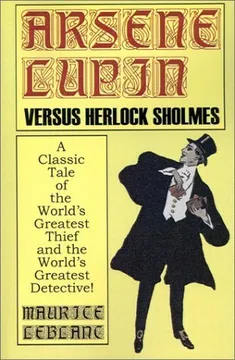
Arsène Lupin versus Herlock Sholmes features two interconnected stories pitting the gentleman thief against a thinly-veiled Sherlock Holmes. Readers generally found it entertaining, praising Lupin's charm and wit, though some felt the portrayal of Holmes was overly satirical. The clever banter and battle of wits between the two protagonists were highlights for many. Some readers noted the stories weren't as strong as other Lupin tales, but most still enjoyed the lighthearted adventure and Lupin's charismatic personality.
Characters
Arsène Lupin
The theatrical master thiefLupin is a brilliant burglar, strategist, and performer who treats danger as both occupation and entertainment. Disguise lets him move through social roles as easily as secret passages let him move through buildings. He challenges the police not only to evade them but to make their certainty look foolish. Yet he is not driven solely by profit: he can return property, protect people, and honor attachments, even while bending others to his plans. His charm and generosity complicate the harm he causes rather than canceling it. At his center is a need for freedom and intensity, paired with a pronounced code of loyalty toward those who trust him.
Herlock Sholmes
The relentless English detectiveSholmes is a methodical investigator whose close observation and disciplined memory allow him to turn scraps of evidence into patterns. He is proud of his reasoning, but not immune to frustration when Lupin controls the setting and the information. His rivalry with Lupin brings out both his competitive vanity and his genuine admiration for a worthy opponent. Sholmes tends to value truth as an end in itself, even when uncovering it threatens the people involved. His precision is formidable, though the story repeatedly tests whether deduction alone can account for loyalty, coercion, or a deliberate false confession.
Wilson
Sholmes’s devoted assistantWilson accompanies Sholmes as friend, assistant, and often unwilling partner in danger. He is eager to contribute, but his confidence regularly outruns his deductions, making him a source of comedy as well as practical support. Lupin’s schemes repeatedly turn Wilson’s trust and loyalty into vulnerabilities. Even when injured, Wilson remains attached to Sholmes and committed to the work, giving the detective’s solitary brilliance a human counterweight.
Ganimard
Lupin’s tenacious pursuerGanimard is a veteran Paris detective with patience, practical intelligence, and a long-standing fixation on Lupin. He can read a crime scene well, but Lupin’s talent for planting evidence repeatedly turns his confidence against him. Ganimard is not a fool; his persistence earns him a place in the contest, even when he admits that he cannot win it alone. His professional pride is tested by public embarrassment, yet he continues to cooperate with Sholmes and to pursue the cases.
Suzanne Gerbois
The professor’s determined daughterSuzanne is affectionate toward her father and warm in manner, but her future matters deeply to her. Her love for her cousin Philippe remains private because she doubts that Gerbois will approve. She is not simply a passive beneficiary of her father’s ambitions: when the lottery dispute threatens the marriage she wants, she acts to influence the outcome. Suzanne’s story exposes the distance between a parent’s idea of security and a daughter’s own measure of happiness.
Professor Gerbois
Suzanne’s anxious fatherGerbois is a mathematics professor of modest means, quick-tempered and protective of his daughter. The unexpected lottery fortune makes him imagine a secure marriage for Suzanne, though he initially overlooks what she wants for herself. He is easily drawn into public argument and believes that legal entitlement should settle the dispute. His love is real, but anxiety and pride make him vulnerable to Lupin’s pressure.
Clotilde Destange
The architect’s secluded daughterClotilde lives quietly in her father Lucien’s house, distant from ordinary social life and guarded in her manner. Her restraint conceals strong feeling and a capacity to make decisions under pressure. She is closely connected to the world of architecture that surrounds her family, and her relationship with Maxime Bermond brings warmth into an otherwise withdrawn existence. Clotilde’s loyalty is intense, but it does not make her emotionally simple: she feels the weight of her choices even when she stands by them.
Lucien Destange
The architect of hidden routesLucien Destange is a respected, retired architect devoted to his books, plans, and former work. His buildings share a distinctive ingenuity that makes his professional legacy central to the mysteries. He lives with his daughter Clotilde and trusts the people he admits into his home. Destange represents how technical craft can outlast its maker and acquire uses he did not intend.
Alice Demun
The watchful governessAlice is the d’Imblevalle children’s governess, observant, self-possessed, and deeply attached to the household. She has a quiet courage that allows her to withstand suspicion without betraying the person she means to protect. Her work caring for Wilson also shows her practical tenderness, while her skill at making messages from cut-out words suggests a resourceful mind. Alice’s loyalty is chosen rather than imposed, and it gives her a moral independence that others may mistake for passivity.
Baron d’Imblevalle
The owner of the stolen lampThe Baron d’Imblevalle is a wealthy collector who shares a cultivated domestic life with his wife and children. His attachment to the objects in his home is matched by trust in the people who care for it. He seeks Sholmes’s help when a treasured ornament disappears, expecting the detective to restore both property and order. The case tests how well he knows the people closest to him.
Baroness d’Imblevalle
The collector’s devoted wifeThe baroness shares her husband’s sheltered household and takes part in its daily care, including the education of their children. She is affectionate and socially composed, but her calm life depends on trust and on keeping private matters from becoming public. Her relationship with Alice is marked by deep mutual attachment. The threat of scandal makes her more vulnerable than her position and wealth suggest.
Bresson
The blackmailing lodgerBresson is a secretive man who rents rooms under an assumed name and keeps his movements difficult to track. His connection to the household is rooted in coercion and private leverage. He turns concealed information into a weapon, placing others in danger.
Countess de Crozon
The diamond’s determined ownerThe Countess de Crozon is a wealthy collector who pursues the blue diamond at auction and later seeks a reliable explanation for its disappearance. She is decisive when faced with uncertainty and willing to call on experts when local investigation stalls. Her desire to recover the jewel keeps the diamond mystery in motion.
Herschmann
The outbid financierHerschmann is a wealthy financier who competes for the blue diamond at auction. A veiled woman’s intervention distracts him at the decisive moment, showing how even immense wealth cannot protect a bidder from a carefully timed deception.
Sister Auguste
The baron’s caretakerSister Auguste cares for Baron d’Hautrec and knows the routines and vulnerabilities of his household. Her observations help investigators reconstruct who had access to the baron and when. She offers a practical, compassionate presence amid the case’s suspicions.
Henriette
The observant younger childHenriette is one of the d’Imblevalle children. Curious and eager to share her small discoveries, she unintentionally gives Sholmes a useful lead by describing the governess’s paper games. Her candor contrasts with the adults’ guarded explanations.
Detinan
Lupin’s discreet lawyerDetinan is the lawyer who represents Lupin during the lottery dispute and helps arrange the meeting with Gerbois. He is professional, curious, and willing to deal with an unconventional client without abandoning his legal role.
Plot Devices
Destange’s secret passages
Architecture as escapeThe buildings designed or altered by Lucien Destange contain concealed routes between rooms, houses, and streets. Lupin uses these passages to enter guarded homes, remove people or objects, and escape searches that appear airtight. Their repeated appearance links otherwise separate crimes and gives Sholmes a material clue where Ganimard sees only impossible disappearances. The passages make architecture part of the plot’s strategy: walls and stairways encode a hidden map that rewards the investigator who asks how a person could move, not merely who had a motive. They also explain why Lupin’s knowledge of a place can outweigh the number of police surrounding it.
The blue diamond
A jewel that misleadsThe blue diamond changes hands, locations, and apparent ownership across the first mystery. Its value gives the police a plausible motive, but its retention on the murdered baron, its placement in Bleichen’s luggage, and the use of a manufactured copy confuse rather than clarify the case. Sholmes recognizes that the ring found by the police is not genuine, while Lupin keeps the original concealed in his cane. The jewel functions as a test of inference: possession, theft, and motive do not align in the obvious way. Each person who follows the diamond must decide whether the object is evidence, bait, or both.
Coded newspaper messages
Clues inside ordinary printThe second mystery uses two modest forms of coded communication. Alice assembles words from cut-out newspaper text and letters removed from a child’s alphabet book, while brief personal advertisements in Lupin’s newspaper carry messages between correspondent and recipient. Sholmes pieces together the fragments by comparing missing letters, dates, addresses, and a cab number. The method makes routine objects serve as a private channel, but it also creates room for mistaken conclusions: a code can identify contact without fully explaining motive. Its solution advances the case while exposing the danger of treating a decoded message as a complete moral account.
Disguise and false evidence
Appearances turned into trapsLupin and his associates use disguises, borrowed names, forged notes, and planted physical traces to direct investigators toward the wrong person or place. The police encounter a false Blonde Lady, an invented chauffeur, and misleading signs of an outside burglary. Sholmes also adopts disguises to enter protected spaces and observe Lupin’s network. These tactics make identity a practical mystery rather than a matter of appearance: witnesses may be sincere and still wrong, while convincing evidence may have been arranged for them. The device sustains the rivalry by forcing each detective to question not only what a clue means, but who wanted it found.

Download PDF
Download EPUB
.epub digital book format is ideal for reading ebooks on phones, tablets, and e-readers.








