

Key Takeaways
Treat making as a way of knowing, not merely a way to produce.
Creation is a practice. Fujimura describes feeling an intense charge as a child when he painted. As an adult, he finds that preparing pigments, mixing glue, and waiting for paper to dry become forms of attention, prayer, and learning. He calls this approach the Theology of Making: understanding God and human life through the purposeful practice of creating, not only through abstract ideas.
Skill carries understanding. Biblical artisans Bezalel and Oholiab are described as filled with the Spirit for their craft. Fujimura sees their work as evidence that making can serve worship and community. Human creativity does not equal God’s, he argues, but can reflect the Creator’s generosity and take part in the work of a renewed world.
The account resonates with embodied learning: some knowledge develops through repeated action and attention, not through verbal instruction alone. A cook can read a recipe without acquiring a practiced sense of heat; a painter learns materials through the hand as well as the eye. This helps explain why art can communicate meanings that argument misses. The theological claim that creative experience reveals God, however, is a faith interpretation, not a conclusion that every maker must share. Its broader invitation is still valuable: treat skilled attention as a genuine form of inquiry.
Protect what looks useless; culture needs more than efficient fixes.
Usefulness has blind spots. Fujimura argues that modern institutions often judge work by efficiency, measurable results, and immediate utility. That standard can dismiss art, contemplation, and grief as wasted time, even though these may carry what people value most. He calls a narrow version of Christian teaching plumbing theology: it emphasizes repairing the damage of human brokenness but says too little about what life and creation are for.
Repair is not the whole story. Emily Dickinson’s poem about death uses the language of industry to show how even mourning can be treated as a task to complete. Fujimura does not dismiss practical service or repair. He argues that care also needs beauty, imagination, and a vision of a world worth building, rather than treating people and culture as problems to manage.
The critique is sharp because institutions often reward what they can count, while trust, belonging, and imagination are harder to measure. In education and public life, this can make creative work seem optional even when it helps people interpret experience. Yet usefulness is not inherently dehumanizing: reliable health care, shelter, and repair matter profoundly. The stronger distinction is between usefulness as one human good and usefulness as the sole test of value. Art is not automatically free of markets or vanity, either. Its potential depends on how it is made, shared, and received.
Repair the fracture without pretending the old shape is enough.
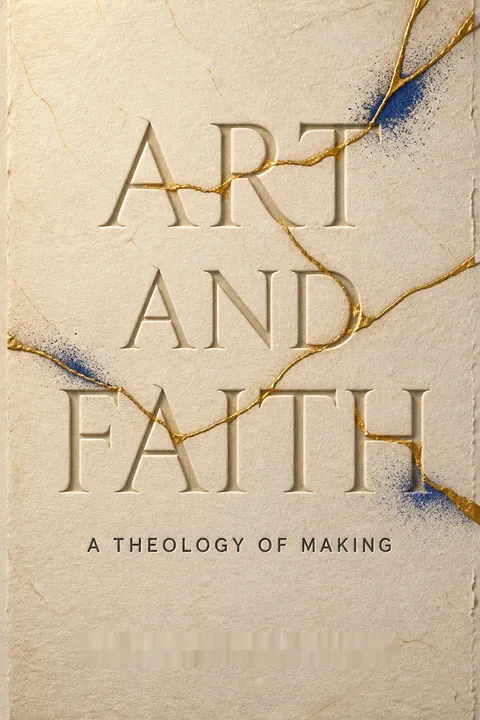
Mending can transform. Kintsugi is a Japanese method of repairing broken pottery with lacquer and gold, making the joined cracks visible rather than disguising them. Fujimura recounts a story of tea master Yusai Hosokawa protecting a young attendant who had broken a treasured bowl. Hosokawa accepted blame, then arranged for the pieces to be rejoined with gold. The act combined mercy toward a person with renewed beauty in the object.
A theological image. Fujimura uses Kintsugi to distinguish restoration from New Creation. In his Christian interpretation, redemption does not simply return people to an untouched past. It makes something new through what has been broken, as the risen Christ still bears the wounds of crucifixion. The cracks matter, but they are not the whole story.
The image connects naturally to restorative approaches that seek repair without erasing the record of harm. It suggests that healing may include changed relationships and visible acknowledgment, not a return to an imagined pristine state. But the metaphor needs care: suffering does not automatically produce beauty, and people should not be pressured to display or redeem their wounds for others. Real repair takes consent, time, and material support. Kintsugi is most persuasive as a picture of what compassionate attention may do, not as a promise that every painful experience will resolve into an elegant design.
Let compassion sit beside grief before reaching for a solution.
Presence before explanation. In John’s Gospel, Jesus arrives after Lazarus has died. He speaks with Martha about resurrection, then sees Mary weeping and weeps with her before calling Lazarus from the tomb. Fujimura focuses on this pause. Jesus could have gone directly to the miracle, but instead shares the sisters’ grief. The tears do not solve death; they show that care is not reducible to solving a problem.
Two forms of faith. Martha responds with direct belief and practical action. Mary responds through grief and an intimate gesture of devotion. Fujimura resists reducing either sister to a type of person who has got faith right or wrong. Their different responses belong together, as analysis and intuition, action and listening, each helping make room for the other.
This emphasis resembles trauma-informed care, where listening and restoring a person’s sense of safety can matter before advice or intervention. The distinction is practical: a grieving person may need company before an explanation, even when concrete help is also necessary. Fujimura’s reading makes emotional presence central rather than sentimental. Still, presence cannot be the only response to preventable harm. Compassion should support practical action, not excuse its absence. The scene is strongest when tears and action remain connected, rather than being treated as competing choices.
Spend extravagantly on what love asks you to honor.
A costly act of devotion. After Lazarus returns to life, Mary anoints Jesus with expensive perfume. In one Gospel account, its value is described as roughly a year’s wages. Some present object that it could have been sold and the money given to the poor. Jesus defends Mary’s act and recognizes it as beautiful, connected to his coming death. For Fujimura, the scene shows that love sometimes gives without reducing its value to a calculation.
Art as a gift. The story shapes Fujimura’s view of creative work. Art can be an offering that carries memory, attention, and care, not merely a commodity or an efficient message. Its value may lie in what it honors and makes possible, even when its immediate practical return is hard to measure.
The contrast between Mary’s gift and the demand for measurable benefit illuminates how communities value symbolic acts, from memorials to rituals of mourning. Such gestures can express regard that money alone cannot. But extravagance is not a universal defense of expensive projects. A community still has obligations to people in need, and a lavish gesture can serve vanity as easily as love. The relevant question is not simply whether something costs a lot, but what it honors, who bears the cost, and whether generosity also appears in ordinary, material care.
Cultivate cultural soil before expecting good ideas to take root.
Prepare the ground. Fujimura rereads Jesus’s Parable of the Sower as a story about the condition of the soil as much as the seed. Farmers amend soil before planting, sometimes growing cover crops that enrich it while the field appears dormant. He uses this as an image for culture care: nurturing the conditions that let people and ideas grow, rather than simply broadcasting messages or fighting to control cultural territory.
Make a wider ecosystem. Fujimura points to Nihonga, a Japanese painting tradition supported by generations of paper makers, brush makers, and artists. Its techniques depend on relationships and craft knowledge, not just recipes. He argues that churches and cultural institutions can similarly support makers, cultivate imagination, and make beauty and mercy part of public life.
The soil metaphor usefully shifts attention from individual messages to the environments that shape whether people can learn and participate. Schools, studios, and community institutions all depend on time, tools, trust, and mentorship. This is close to ecological thinking: outcomes depend on relationships among many conditions, not on a single input. Yet soils and societies are not interchangeable, and the metaphor can obscure power. Some people face barriers that cultivation alone cannot remove. Cultural care therefore needs both patient support and direct efforts to change unjust conditions.
Practice hope as patient craft, not optimism or control.
Hope has a tempo. Fujimura’s paintings can require many layers and long pauses while the materials dry. In one triptych, he had applied more than a hundred layers when he learned that his mother had died. At the beach, he began to see the horizon and a distant Japanese coastline through memories of childhood with her. He understood the painting as an elegy already in progress, before he knew what loss it would hold.
The future is renewal. In Fujimura’s Christian account, the end of history is not the destruction of the world but its renewal through the New Creation. This hope gives present work weight: acts of care, art, and faithful labor may belong to a future beyond what people can see. Waiting is not passivity, but a discipline that makes room for work whose outcome cannot be controlled.
The account joins patience to a form of attention that artists and mourners often recognize: meaning can become visible only after experience has unfolded. This is different from optimism, which can rush to reassure or promise a good outcome. The theological claim that present work carries into an eternal future is not empirically verifiable, and the distinction matters. Even without sharing that belief, readers can value a future-oriented ethic that treats current acts as consequential. Patience should not become an excuse to delay urgent help; it is most useful when paired with action.
Make small signs of resurrection where grief has not disappeared.
Lazarus culture begins nearby. Fujimura uses this term for a way of living shaped by the resurrection story: relaxed in the presence of Jesus, confident without denying danger, and faithful in ordinary acts. He describes an improvised performance in a Tokyo taxi. After learning that the driver’s wife, a drummer, had died, the musicians riding with Fujimura began making rhythms on a tap board. The driver joined in, remembering his wife. No one offered advice or made his loss vanish.
A moment of shared life. Fujimura sees the encounter as a small sign of New Creation: a brief act of beauty and attention inside grief. The example captures his wider call to carry compassion into wounded places, not by pretending pain is solved, but by making room for connection, memory, and hope.
The taxi story shows how a shared ritual can create connection without demanding that grief be explained or cured. Music gives the driver a way to participate, rather than making him a passive recipient of consolation. This resembles the social role of communal rituals, which can help people mark loss and remain connected to others. Still, one moving encounter cannot stand in for sustained care, and a spiritual interpretation is not the only possible one. Its value lies partly in that openness: people can experience the kindness of the moment without agreeing on its ultimate meaning.
Analysis
Art and Faith is a theological argument told through studio practice, biblical interpretation, Japanese craft, and personal memory. Its central move is to shift the meaning of creativity from decoration or communication tool to a way of knowing and participating in a renewed world. That move gives the book a distinctive strength: material processes become intellectually serious. Pigment, paper, waiting, fracture, and repair are not illustrations added after the theology. They are how the author thinks.
The book also reframes cultural engagement. Rather than treating art as either a threat to faith or a tool for evangelism, Fujimura asks religious communities to sustain the conditions in which beauty, mercy, and creative work can flourish. His examples make this concrete, from the interdependent craft ecosystem of Nihonga to the impromptu music shared with a bereaved taxi driver. The broadest contribution is an account of culture as something cultivated through relationships and gifts, not simply won in ideological contests.
The argument is most compelling when it distinguishes healing from mere repair and when it insists that grief deserves presence rather than quick explanation. Kintsugi and the Lazarus story give these ideas memorable form. They also introduce a risk: brokenness can be aestheticized, as if pain naturally becomes a beautiful contribution to a future. Fujimura resists easy optimism, but readers should still distinguish the hope that suffering can be met with care from the claim that suffering itself is necessary or beneficial.
The book’s theological claims remain explicitly Christian. Its account of resurrection and enduring creative work asks readers to enter a particular faith, not to accept a neutral theory of art. Yet many of its practices travel beyond that boundary: attend closely, learn through making, nurture shared creative life, and do not confuse efficiency with human worth. The result is less a manual for producing art than a challenge to build communities where attention, skill, generosity, and lament are treated as essential forms of life.
Review Summary
Reviewers broadly praise Art and Faith as a thought-provoking, inspiring exploration of creativity and Christian faith. Many highlight Fujimura's use of Japanese art, particularly Kintsugi, as a powerful metaphor for redemption and brokenness. Readers appreciate his "Theology of Making" and its encouragement for creatives. Some note theological reservations, particularly around N.T. Wright's influence and notions of participation. A few found portions repetitive or disorganized. Overall, most consider it essential reading for Christian artists and non-artists alike, with many expressing intent to revisit it.
People Also Read



Glossary
Theology of Making
Faith learned through creatingFujimura’s approach to knowing God and human life through creative practice, material attention, and skilled work. It treats making as more than production or illustration: the act of creating can become a form of learning, worship, and participation in God’s renewal of the world. Human making remains distinct from God’s creation, even as it may reflect divine creativity.
New Creation
Renewed world and lifeFujimura’s Christian understanding of the future begun in Jesus’s resurrection. It is not simply a return to an earlier, unbroken state or an escape from earthly life. God renews creation, and present acts of beauty, mercy, and care can be understood as signs of that future already entering the present.
Kintsugi
Gold-accented ceramic repairA Japanese practice of rejoining broken ceramics with lacquer and highlighting the joins with gold. Rather than hiding damage, the repair makes the history of the object visible and can give it renewed beauty and value. Fujimura uses Kintsugi as an image for mending that acknowledges brokenness while making something more than a return to the original condition.
plumbing theology
Faith reduced to fixingFujimura’s term for a limited account of Christianity that focuses on repairing the damage caused by sin but neglects the larger purpose of creation and redemption. He does not reject practical repair or social action. He argues that they are incomplete without a vision of the renewed world toward which Christian life and work are directed.
Lazarus culture
Community shaped by resurrectionFujimura’s name for a culture formed by the story of Lazarus’s return to life and Jesus’s grief with Lazarus’s sisters. It describes a way of living with relaxed confidence and faithfulness while recognizing suffering, and of making beauty and offering care in places marked by death or loss.
kainos
A radically new kindA Greek word translated as new in the biblical phrase new creation. Fujimura distinguishes it from neos, which he uses for recent or improved newness, such as a newly released product. He interprets kainos as a deeper kind of renewal or transformation, not simply a better version of what already exists.
Nihonga
Japanese painting traditionA Japanese tradition of painting that relies on particular materials and generations of specialized craft, including paper making and brush making. Fujimura applies its materials and techniques in contemporary art. He emphasizes that Nihonga is not merely a set of tools or recipes, but an ecosystem of training, trust, and relationships.
culture care
Nurturing creative cultureFujimura’s alternative to culture-war approaches that treat cultural influence as territory to capture. Culture care means cultivating the conditions in which beauty, creativity, and human flourishing can grow. In this book, it is grounded in a Christian vision of making, mercy, and the fruit of the Spirit, while addressing culture inside and outside the church.
wabi-sabi
Beauty in age and imperfectionA Japanese aesthetic sensibility Fujimura associates with what is worn, transient, or imperfect. A well-used object can carry the traces of human touch and attachment, making it meaningful in ways a pristine object may not be. The concept supports his reflection on aging, grief, and the value of visible marks left by life.
Yobi-tsugi
Mending with called-in fragmentsA ceramic repair practice discussed by Fujimura in which fragments from another object are fitted into a damaged vessel. The resulting joins create a collage-like pattern rather than simply restoring the original design. He presents the technique as an image for making connections across differences, including cultural or national divisions.
connaturality
Knowing through lived affinityA form of knowledge discussed by philosopher Jacques Maritain and used by Fujimura to describe understanding gained through practiced participation, desire, and embodied experience. It differs from knowledge acquired only through concepts and arguments. In the book, artistic practice offers an example: years of attentive making can develop understanding that a verbal explanation alone cannot provide.
gift economy
Value circulated through givingA way of understanding creative work in which its value depends on generosity, exchange, and the circulation of gifts, not solely on market price. Drawing on Lewis Hyde, Fujimura argues that art can exist within a market while also depending on a gift dimension. He applies this idea to the church’s communication of faith and its relationship to consumer culture.
About the Author
Download PDF
Download EPUB
.epub digital book format is ideal for reading ebooks on phones, tablets, and e-readers.








