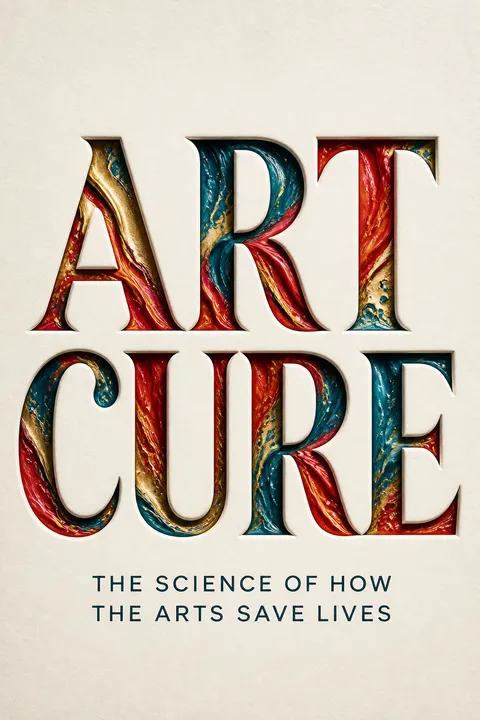


Key Takeaways
Treat art as a health behavior, not a luxury or a cure-all
A life redirected. After a stroke, Russell Haines was depressed, in pain, out of work, and taking many medications. His doctor referred him to an eight-week art class. At first he only watched. Then he began drawing, painted portraits of his classmates, and organized an exhibition. He later reported better mood, less pain, improved blood pressure and sleep, and fewer medications. His story makes the book’s central argument tangible: arts can support health, but they are not a universal cure.
A broad evidence base. The author draws on more than 30,000 empirical papers, including clinical trials, laboratory studies, interviews, and population research. The claim is not that art replaces medicine, but that it can add useful tools to care and everyday life. The same activities can also cause harm when they are coercive, unsafe, exclusionary, or poorly designed.
Russell’s story gives the science a human scale, while the distinction between benefit and cure keeps the account credible. His recovery cannot prove that art caused every improvement: health, relationships, treatment, and time may also matter. That limitation does not erase the value of his experience; it clarifies why the book pairs personal testimony with experiments and population data. The deeper reframing is that health is shaped not only by clinical treatment but by meaningful activities, relationships, and agency. Art belongs in that wider picture without being asked to perform miracles.
Match an art experience to the change you need
Think in ingredients. The book uses “active ingredients” for the parts of an arts experience that can affect health: sensory stimulation, imagination, emotional expression, physical movement, social contact, skilled facilitation, and setting. A dance class can address mobility because it involves movement; a supportive group may also ease isolation. A familiar song may calm one person and unsettle another, depending on memory and association.
Trace the process. “Causal mechanisms” are the processes connecting an experience to an outcome. For example, singing encourages controlled breathing, which can exercise respiratory muscles. Joining a choir adds social contact, potentially supporting confidence and connection. People sense an artwork through the body, then interpret it through memory, emotion, and expectation. So the useful question is not simply “Which art is best?” but “Which combination of activity, people, place, and dose fits this goal?”
This framework resists the false simplicity of a single artistic remedy. It also makes the advice more usable: someone can adjust the social setting, challenge level, sensory intensity, or degree of participation rather than abandon art after one poor fit. The approach resembles systems thinking, where outcomes emerge from interacting conditions rather than one isolated cause. Its main difficulty is measurement. A choir is not one standardized exposure, and tailoring can make findings harder to generalize. That is a reason for careful evaluation, not for pretending that every person responds to the same prescription.
Use creative practice to supply control, mastery, and purpose
More than pleasure. Shai became a lawyer partly through family expectations, but the work left her feeling constrained. After her mother urged her to reconsider her life, Shai returned to music, taking a course at Berklee and later writing songs alongside her legal career. Creating music gave her control over a part of life she could shape, while learning new skills offered mastery and performing for her mother gave the work purpose.
Fill specific gaps. The book distinguishes pleasure and happiness from broader well-being, which also includes autonomy, coherence, accomplishment, purpose, and meaning. An activity need not become a career to help. Arranging flowers, learning an instrument, making a card, or writing can create small experiences of choice and progress. A useful starting point is to notice which need feels neglected, then choose a creative activity that gives it room to be met.
Shai’s story suggests that an activity can restore balance without requiring a dramatic career exit. That is a valuable counterweight to the idea that fulfillment demands abandoning stability for passion. Creative practice can instead become a second domain in which a person experiences choice and growth. The distinction between happiness and meaning also matters: a difficult lesson may not feel pleasurable every minute, yet progress can still be deeply satisfying. The caution is that art cannot compensate indefinitely for harmful working conditions or unmet material needs. It can help people flourish, but it cannot make structural problems disappear.
Engage regularly in art to support mood and mental health
Prevention and treatment. In a Finnish trial, adults with depression received standard care, with some also receiving music therapy twice weekly. After three months, the music group had nearly twice the improvement in depression and anxiety scores and was three times as likely to show a marked improvement. In a study of mothers with postpartum depression, a weekly singing group reduced symptoms faster than a closely matched play group; about two-thirds of participants were no longer classified as depressed after six weeks.
A population signal. In a decade-long English study of adults initially without depression, monthly cultural attendance was associated with 48% lower odds of developing depression than no attendance, after statistical adjustment for other factors. Because this was observational, it cannot establish cause on its own. Still, together with trials, it suggests that sustained participation can support both treatment and prevention.
The matched play group is especially informative because it helps separate artistic activity from routine, companionship, and time outside the home. The comparison does not isolate every artistic ingredient, but it strengthens the case that art contributes something beyond generic social activity. The population result adds a different kind of evidence: long time horizons and large groups, at the cost of less certainty about causation. Together, the studies support art as a complement to established care, not a reason to stop medication or therapy. Regular participation and personal fit are practical conditions, not decorative details.
Train the brain through art, but do not expect every skill to transfer
A whole-brain activity. Music engages networks involved in hearing, memory, movement, language, attention, and emotion. Repeated experience can change brain connections through neuroplasticity, the brain’s capacity to adapt. In one stroke study, people who listened to music daily for two months improved verbal memory and attention more than people receiving usual care or audiobooks. Music training can also support aspects of children’s speech processing, while drama can help children understand stories and language.
Reserve is not a shield. Cognitive reserve means the brain’s capacity to cope with damage or aging by using its resources flexibly. Regular cultural engagement was associated with better preserved cognition and lower dementia risk in population studies. But the author rejects inflated claims that art automatically raises IQ or grades: musical training may help with related language skills, while learning an instrument does not substitute for mathematics instruction. Art may support brain health without making every kind of thinking better.
The distinction between near and distant transfer is a useful antidote to attractive but exaggerated claims. Training sound discrimination may plausibly support speech processing because the abilities overlap; a general leap from music lessons to higher mathematics is much less persuasive. The cognitive-reserve idea also shifts attention from a simplistic promise to prevent dementia toward a more measured aim: sustaining function and coping capacity. Population associations remain vulnerable to reverse causality, since early cognitive change could reduce participation. The strongest case comes from combining that long-term evidence with controlled interventions and plausible biological mechanisms.
Put rhythm and play inside movement practice
Rehabilitation with a goal. Josh had cerebral palsy after brain surgery and struggled to use his left hand. At a summer camp, occupational therapists turned hand exercises into magic tricks. After two weeks, participants improved their use of the affected hand by about 30%, completed timed tasks faster, and performed 93% of daily tasks with both hands. The gains were still evident three months later. The tricks gave the children a reason to repeat movements that might otherwise have felt like tedious therapy.
A beat as a guide. Entrainment is the body’s tendency to synchronize movement with an external rhythm. Music can act as a timing cue, improving coordination and walking in rehabilitation. Dance programs for Parkinson’s disease have improved movement and balance, while music can make exercise feel more motivating and less tiring. For movement goals, choose an enjoyable rhythm that suits the task, and seek clinical guidance when adapting therapy to an injury or condition.
Josh’s progress shows why a rehabilitation activity’s design matters. The movement practice is still present, but a meaningful goal and performance context change how it feels to repeat it. Rhythm offers another advantage: it provides an external timing signal when the body’s own timing is unreliable. The broader lesson is that enjoyment can be functional, helping people stay with a demanding program. Yet enthusiasm is not a substitute for safe adaptation. A compelling activity can still be the wrong activity if it is not matched to someone’s abilities or medical needs.
Use chosen art to ease stress and pain alongside medical care
The body responds. Stress activates linked nervous and hormonal systems, raising arousal and releasing hormones such as cortisol. Calming music can influence heart rate, breathing, and stress markers. In neonatal intensive care, studies found that music and caregivers’ voices could calm premature infants, support feeding, and in some trials shorten hospital stays. The author describes singing to her critically ill newborn daughter and observing calmer vital signs, while recognizing that one family’s experience is not a controlled experiment.
A useful adjunct. Across surgical studies, music and other arts activities have reduced anxiety and postoperative pain, sometimes lowering the need for sedatives or opioids. Art may help through distraction, relaxation, emotional reward, and the body’s own pain-regulation systems. The findings support having personally acceptable creative options available during difficult procedures or chronic pain care. They do not show that art can treat the underlying cause of illness or replace prescribed treatment.
This section is strongest when it links subjective relief to measurable bodily processes without implying that music directly cures disease. Calmer patients may need less medication in some settings, which can matter because medications have risks as well as benefits. But reduced medication use is not inherently a success unless clinicians judge it safe for that patient. The neonatal story also highlights a distinct benefit: a parent can take part in care even when touch is restricted. Art can restore a sense of agency in an otherwise powerless setting, while remaining one element of a properly supervised treatment plan.
Tell health stories that let people rehearse choices safely
Stories can teach without lecturing. East Los High was a drama about Latinx teenagers that addressed pregnancy, contraception, relationships, and health services through ongoing storylines, social media, videos, and other online material. Viewers discussed the show, sought out partner resources, and reported learning practical information. In a controlled experiment, the group that watched a scene and explored its connected online content improved its knowledge of condom use more than groups given text or the scene alone.
Connection changes behavior. Stories invite audiences to imagine decisions from a character’s perspective; group arts can also create belonging and social support. Arts projects have been used in health campaigns, including community-made radio and video during the Ebola crisis. But art is not inherently beneficial: messages can become propaganda, harmful stories require care, and poorly designed programs can reproduce exclusion. Local relevance, trustworthy information, and participant agency are essential.
East Los High illustrates how narrative can turn abstract advice into decisions with recognizable consequences. Its connected resources also make a crucial bridge from emotional engagement to practical action. That design is more respectful than assuming audiences will accept a lecture simply because it is medically accurate. The same persuasive power demands ethical safeguards: compelling stories can inform, but they can also manipulate or normalize harmful behavior. Community involvement and transparent aims help distinguish public-health communication from covert persuasion. Evaluation should ask not just whether viewers remember a message, but whether the intervention supports informed choice.
Make arts engagement sustainable, varied, and accessible
A health habit, not a binge. Arts benefits are described as perishable: a short burst may help in the moment, but ongoing benefits call for continued participation. The book suggests starting with a small daily creative practice and adding a regular class, event, or shared activity. Variety exposes people to different sensory, social, and cognitive ingredients, while focused attention helps them savor the experience instead of treating it as background noise.
Health depends on access. In one older-adult cohort, regular arts engagement was associated with a 31% lower risk of death during follow-up, after adjustment for measured confounders. This remains an association, not proof that art extends life. Access is unequal, shaped by money, location, education, school opportunities, and support for artists and venues. The author’s larger proposal is to treat cultural participation as part of public health infrastructure, not an optional luxury reserved for people with time and resources.
The habit framing is practical, but the access argument prevents the book from making health sound like a private consumer choice. A person cannot attend a class that does not exist nearby, afford a ticket, or feel welcome in a cultural space that seems designed for someone else. That makes funding and inclusive design part of the health question. The longevity finding is striking, but observational studies cannot rule out every difference between frequent participants and nonparticipants. The more defensible conclusion is that arts engagement joins a cluster of behaviors and social conditions associated with healthier, more connected lives.
Analysis
The book’s central achievement is to recast art from a discretionary pleasure into a plausible health behavior, then explain why that claim does not reduce to “music is medicine.” Its most useful intellectual structure links the features of an experience to psychological, biological, social, and behavioral processes, and those processes to outcomes. This lets the argument accommodate radically different activities, from a hospital music session to a community dance class, without pretending they share one mechanism.
The evidence is intentionally plural. Randomized trials can test whether a designed activity changes a measured outcome, while cohort studies reveal long-term patterns across larger populations. Interviews show what a change means to participants, and biological measures probe possible pathways. Their convergence makes the overall case more persuasive than any single headline finding. Yet the evidentiary strength varies by outcome. Some claims rest on controlled trials; others, especially disease prevention and longevity, remain vulnerable to selection effects and unmeasured differences. The book generally acknowledges this distinction, and readers should preserve it when repeating its strongest numbers.
A second strength is its refusal to equate art with universal benefit. Preference, memories, disability, culture, setting, and facilitator skill all shape responses. This is scientifically realistic, although it complicates simple policy prescriptions. Programs need enough flexibility to fit participants, but enough evaluation to establish what works, for whom, and at what cost. Art also has intrinsic value. If institutions defend it only by showing health returns, they risk treating artists and audiences as instruments of policy rather than people making and encountering culture.
The final argument is therefore both personal and civic. Individuals can build sustainable creative routines, but equal access depends on schools, venues, community programs, healthcare systems, and fair conditions for artists. That distinction prevents a familiar error: asking people to overcome barriers that institutions created. The strongest version of the book’s proposal is not to medicalize every painting or song. It is to recognize that creative participation is a human resource with meaningful health effects, and to make room for it without promising more than the evidence can support.
People Also Read



Glossary
Active ingredients
Health-relevant parts of artThe features of an arts experience that may contribute to a health outcome. These can include sensory stimulation, creativity, emotional expression, movement, social interaction, the facilitator, and the setting. The idea helps explain why two activities both called “art” can have different effects, and why a particular activity may suit one health goal better than another.
Causal mechanisms
Processes linking art to healthThe psychological, biological, social, or behavioral processes through which an arts experience may influence health. For example, singing involves controlled breathing, which can exercise respiratory muscles. A group activity may also encourage social connection. The book treats mechanisms as the explanatory link between the ingredients of an experience and its outcomes.
Predictive coding
The brain’s expectation processA process in which the brain uses learned patterns and expectations to anticipate what will happen next, then updates those expectations as new sensory information arrives. In an arts experience, familiarity can make a coming resolution pleasurable, while a surprise can create tension and heightened attention. Personal history helps shape the predictions each listener or viewer makes.
Cognitive reserve
Flexible coping capacity in the brainThe brain’s ability to use its resources flexibly and efficiently, helping it cope with aging, disease, or damage. It is distinct from brain reserve, which refers more directly to physical structures such as brain tissue and neural connections. Education, social activity, and cognitively stimulating leisure, including arts engagement, are associated with greater reserve, though they do not guarantee protection from dementia.
Entrainment
Movement synchronized to rhythmThe tendency of bodily movement and timing to synchronize with an external rhythm, such as music. A beat can provide a timing cue that supports coordination, walking, and exercise. In rehabilitation, music matched to a person’s movement can help improve timing and fluency, particularly when a neurological condition disrupts the body’s internal rhythm.
Entertainment-education
Health learning through storiesAn approach that embeds educational information in engaging entertainment, such as a television drama, rather than presenting advice only as instruction. Characters and plotlines model choices and consequences, while connected resources can direct audiences to services or further information. The approach works best when the story is credible, culturally relevant, transparent, and designed with appropriate expertise.
Social prescribing
Referral to community activitiesA form of nonclinical support in which a healthcare worker or community link worker connects someone with local activities and services that may support health. Referrals can include arts classes, choirs, or cultural events, alongside other community resources. It is intended to complement medical care by addressing social, emotional, and practical needs that a clinical appointment may not meet.
Download PDF
Download EPUB
.epub digital book format is ideal for reading ebooks on phones, tablets, and e-readers.








