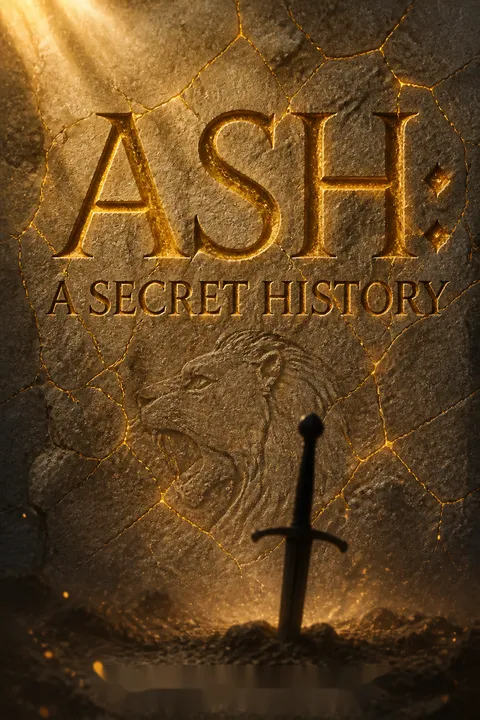


Plot Summary
Prologue
Ash grows up nameless among mercenaries, learning to steal food, handle weapons, and survive without anyone claiming her. At eight, two soldiers rape and scar her; she kills both with a crossbow and a knife, then takes the company’s whipping without crying. Later, hiding in a ruined chapel, she encounters a lion that emerges from an altar, licks her injured face, and vanishes.
The company treats the encounter as a sign, while Ash begins hearing a voice that offers battlefield advice. A nun eventually takes her to sanctuary, but the camps have already taught her the lesson that will shape her life: safety belongs to whoever can defend it.
The childhood account establishes Ash’s central contradiction early: she is forced into vulnerability, then survives by becoming formidable, while the people around her turn that survival into legend. Her scars are both evidence of violence and the mark by which others interpret her. The lion and the tactical voice remain genuinely ambiguous, allowing religious belief, childhood memory, and something stranger to coexist. Ash’s refusal to cry is not emotional invulnerability; it is a survival technique learned in a world where suffering earns no protection.
Ash Charges at Neuss
At the siege of Neuss, Ash commands the Company of the Lion, a mercenary force she has built and kept together through hard campaigning. Seeing a small Burgundian escort exposed on open ground, she ignores her employer’s caution and launches a cavalry charge. The attack nearly reaches Duke Charles of Burgundy before reinforcements force her to withdraw.
Emperor Frederick punishes neither her recklessness nor her success: unable to knight a woman or give her estates outright, he orders Ash to marry the nobleman Fernando del Guiz, with land as the reward. Ash has spent years winning property for other people. Now the prize may give her company a permanent home, but it also makes her future a matter of imperial policy.
Ash’s charge shows that her authority is earned through action but never secure. She can make an independent military decision, yet the Emperor translates her success into a marriage arranged without her consent. The conflict is not simply between a woman and a patriarchal court: Ash herself understands power as the ability to control armed people and secure resources. Frederick recognizes that competence while refusing to recognize her as its rightful owner. The marriage therefore begins as both opportunity and trap.
A Wedding Under Orders
In Cologne, Ash presses to return to the company while Constanza del Guiz prepares her for a wedding at court. Father Godfrey and surgeon Florian finally explain why Fernando’s name unsettles them: seven years earlier in Genoa, he and his friends humiliated Ash when she was twelve. Ash still chooses not to refuse the Emperor’s order, hoping marriage will secure land for her soldiers.
The wedding instead begins with Fernando insulting her and asserting control over her. On their first night, Ash considers killing him, then cannot bring herself to do it; his later, gentler touch confuses her further. Frederick assigns Fernando part of Ash’s company, making the husband she distrusts a rival commander over the people she has led.
The marriage binds together desire, humiliation, property, and command. Ash’s decision to proceed is not romantic surrender: she is trying to convert a dynastic arrangement into security for her troops. Yet the court assumes that a husband will absorb her authority along with her property. Fernando’s mixture of cruelty and unexpected tenderness prevents Ash from reducing him to a simple enemy. Her emotional confusion becomes dangerous because it interferes with the clear calculations on which she normally relies.
Genoa Goes Dark
While escorting the Visigoth ambassadors toward Genoa, Ash notices warships in the bay and smoke rising from the city. She counts a vast invasion force and orders the baggage train to abandon its wagons, then organizes archers, cavalry, and foot soldiers to cover the retreat.
A forest ambush nearly destroys the column, so Ash orders pitch-torches dragged along the slopes and the trees set alight, driving the attackers back long enough for her people to escape. Golems stride away carrying messages, revealing that the landing is part of a wider invasion. Soon the sun disappears over the northern lands. Ash has not merely found another employer’s war: she has stumbled into a campaign capable of overturning the whole world she knows.
Ash’s battlefield competence is practical rather than glorious: she abandons supplies, uses fire, and sacrifices the landscape to keep her people moving. The invasion first appears as an enemy army, but the tireless messenger-golems show it has an infrastructure and reach beyond any single battlefield. When the sun goes out, political crisis becomes physical and cosmic. Ash’s habit of treating danger as a tactical problem helps her act, but cannot explain what has changed.
The Faris Mirrors Ash
At Guizburg, Ash besieges the castle tied to her marriage while the Visigoth army approaches. She meets its Faris, the young woman directing the invasion, and is stunned by their near-identical faces. The Faris says she was born among slaves bred by the House of Leofric to produce a commander who could hear a distant tactical machine.
Ash recognizes the same kind of voice in her own mind, but hides that fact. Soon, at Basle, Visigoth forces seize Ash and imprison her. A company assault breaks through the residence with cannon, and Ash is carried out gravely injured. She is not free of the invaders, but she has learned that her supposed saint may be connected to the Faris’s machine.
The Faris turns Ash’s private sense of being anomalous into a question of manufacture and kinship. Both women command armies, yet one was deliberately cultivated for the role while Ash grew up amid violence and improvisation. Their resemblance promises recognition but also threatens Ash’s sense that her identity belongs to her. Concealing her own voice is an act of tactical self-protection. The first captivity shows how quickly a commander’s independence can vanish when she loses her people and weapons.
A Wall Breaks Open
Inside the Basle prison, Ash refuses to give up her identity or her command. Her company brings light cannon to the city and blows through the fortified rear of the building where she is held. The rescue succeeds, but Ash is caught in the fighting without armour and is badly injured, including a head wound.
The company carries her north toward Burgundy, where the sun returns as they cross the border, though darkness still covers the lands farther south. Ash wakes in a convent outside Dijon, learns that Robert Anselm and the others have survived, and discovers that former whore Margaret Schmidt has entered religious life. Their relief at Ash’s return becomes the company’s first new source of strength.
The cannon breach makes the company’s loyalty material: its members risk themselves and destroy a city structure to recover their captain. Ash survives, but the head wound exposes the limit of her own toughness and leaves her dependent on others. The return of sunlight only over Burgundy turns geography into an unresolved mystery. Her reunion with the company restores the bond that distinguishes her from the Faris: Ash is not merely obeyed; people have chosen to come back for her.
The Duke Refuses Her
Recovering in Dijon, Ash finds her company reunited and meets the exiled Earl of Oxford, who hires her because he needs her knowledge of the Visigoth army. At Duke Charles’s court, the Visigoth delegation claims Ash as a slave, arguing that her birth prevents her from signing a valid contract. Charles refuses to surrender her, despite acknowledging that the claim may be legal, and insists that protecting her is the honourable choice.
The same court learns that Fernando has defected to the Visigoths, leaving Ash exposed to both political manipulation and personal betrayal. Charles then chooses to fight rather than fund Ash’s proposed raid on Carthage, pulling her back toward the battlefield she knows and the larger war she cannot control.
Charles’s decision gives Ash temporary protection without pretending that law is neutral: the legal system can define her as property, while the Duke chooses to resist that definition at political cost. His action contrasts with Frederick’s expedient marriage bargain. Yet protection is not freedom. Ash still depends on rulers, contracts, and armed followers, and the Duke’s coming battle may decide more than her legal status. The section shifts the question from whether she belongs to someone toward who is willing to risk something to defend her.
The Surgeon Is Exposed
In Dijon, Floria del Guiz’s aunt Jeanne confronts her in front of the Company of the Lion and reveals that the surgeon Ash has known as Florian is a woman who loves women. Several soldiers attack the surgeon’s tent and try to drag Floria out. Ash releases her mastiffs to break up the mob, then kills Josse when he raises a sword against her.
The riot ends, but it exposes how fragile Ash’s command can be when the company’s prejudices are stirred. She separates Joscelyn van Mander’s Flemish lances rather than let them form a company within the company. At the same time, Floria refuses to leave Ash, even after the soldiers learn her secret.
The riot turns private identity into a direct test of command. Ash cannot preserve Floria through persuasion alone: she must use the dogs and kill a soldier to stop immediate violence. That choice saves her friend but makes the company’s violence impossible to romanticize. Ash’s decision to split van Mander’s faction is also an act of organizational surgery. She treats dissent not as an abstract debate but as a structure that could fracture the unit during battle.
A Child Before Battle
On the eve of battle, Ash realizes she is pregnant by Fernando and asks Floria to end the pregnancy. Floria refuses, both because she has sworn not to perform abortions and because she fears the procedure could kill Ash. Their argument exposes how little control Ash has over a body shaped by assault, military life, and now pregnancy.
Ash considers carrying the child, then recoils from the risks of childbirth, the possibility of deformity, and the prospect that Fernando might claim it. With the Visigoth army near and Burgundy preparing to fight, she cannot resolve the choice. She leaves for the field still pregnant, carrying a private fear that no tactical plan can settle.
The pregnancy makes the body, usually Ash’s instrument of command, a site of competing claims: her own survival, Floria’s medical oath, Fernando’s possible paternity, and the imagined child’s future. Ash does not arrive at a clean moral resolution, because the alternatives are genuinely dangerous. Her insistence that she will fight anyway reflects both courage and a learned inability to treat her own life as something worth protecting. The conflict anticipates the bodily cost of captivity without reducing it to a lesson.
Snow at Auxonne
At Auxonne, Ash helps Duke Charles’s army prepare for a battle against the Faris. She argues that the Burgundians should exploit the cold, dark conditions rather than meet the Visigoths on their terms. Snow and a hard wind spoil the enemy archers’ aim, allowing the Burgundian lines to return fire.
Then the Visigoths reveal armoured war-wagons, golem loaders, and weapons that throw fire. The Burgundian attack falters under boulders and flames. Duke Charles is wounded, and a Visigoth snatch-squad strikes Ash’s horse, breaks her knee, and knocks her unconscious. When she wakes, she is being carried south by ship, a prisoner again and separated from her company.
The battle rewards Ash’s ability to read terrain, weather, and enemy formations, but it also shows that tactical brilliance cannot neutralize a technological advantage she has not understood. Snow briefly levels the battlefield; golems and fire restore the imbalance. The contrast complicates chivalric ideals: the decisive weapons are not a knight’s lance but machines that load and burn without fatigue. Ash’s capture also reverses her usual position. She is now the vulnerable body being transported, rather than the commander deciding where others move.
Carthage Takes Her Blood
In Carthage, Ash is delivered to the House of Leofric and interrogated by the sick King-Caliph Theodoric and his advisers. They demonstrate their power by crippling another prisoner, then demand to know whether Ash can hear the Stone Golem. Amir Leofric confirms that his family has spent generations breeding enslaved people to produce a commander who can communicate with the machine.
Ash learns that the Faris is the successful result of this project and that she herself may be another of its descendants. While confined, beaten, and denied warmth, Ash miscarries the child she had hoped, feared, and refused to bear. The loss leaves her with no easy story about what she wanted or what was taken from her.
Leofric’s household converts lineage into an engineering project: bodies are bred, assessed, and discarded according to usefulness. Ash’s resemblance to the Faris is not a romantic revelation but evidence of a system that has treated generations as material. The miscarriage intensifies the same conflict at an intimate scale. Her earlier ambivalence does not cancel her grief; grief does not mean the pregnancy was freely chosen. The book refuses to make either feeling morally tidy.
The Stone Golem Speaks
To prove she can hear the machine, Ash asks questions Leofric cannot answer from family records. The voice identifies the Stone Golem’s location and recounts the lineage of the Rabbi, Ildico, Radegunde, and the generations bred to create a second listener. Ash learns that her tactical voice is not simply a saintly apparition: it comes from the same machine that guides the Faris.
Theodoric dies before Ash can be vivisected, but Leofric still intends to investigate her body. A later earthquake and the company’s efforts create an opening for Ash to escape Carthage and return to Burgundy. She has gained knowledge, but not safety, and the Wild Machines remain beyond her understanding.
The machine answers questions by treating history as stored and searchable information, while Ash experiences its voice as intimate and spiritual. Her discovery does not resolve the sacred; it destabilizes the categories she used to survive. The origin story is simultaneously technological, dynastic, and mythic, with the Rabbi’s creation of the Golem becoming the beginning of a long experiment in human control. Ash’s survival leaves her with a deeper danger: the voice is not only a tool she uses, but a channel through which others may reach her.
Dijon Takes Her Back
Ash eventually returns to Dijon injured and exhausted, where the Lion receives her as its commander rather than as a presumed casualty. She finds that Geraint has kept the company together and Robert Anselm has slept outside her convent while she recovered. The reunion restores her authority, but not her peace: Godfrey is missing, the countryside is dark or frozen, and the company’s supplies are nearly gone.
Ash learns that the Faris has moved against Burgundy and that Duke Charles must choose between political submission and battle. The company debates whether it can afford another contract, while Ash’s return makes clear that the choice cannot be made without her.
The company’s reunion is a recognition scene built from practical care: Anselm waits, Geraint manages, and the rank and file crowd around Ash. It restores her public identity while exposing the private cost of command. She can still gather people, but cannot make food appear or reverse the weather. The contrast between belonging and dependence sharpens the book’s central tension: a mercenary company is a chosen family, yet it can survive only through contracts, supplies, and the continued trust of its members.
Floria Claims the Hart
As the siege deepens, the Duke of Burgundy dies and the succession turns to an old ritual: the hunt for the white Hart. Floria, revealed to have her own connection to Burgundy’s inheritance, kills the Hart and thereby becomes Duchess in the eyes of the assembled court. She does not feel prepared for the office, but nobles and soldiers accept her authority because the ritual has named her.
The change gives Ash’s closest friend command of the principality whose survival the Wild Machines have targeted. Meanwhile, the Faris surrenders herself during the chaos, and Ash faces the woman who resembles her, now without the protection of a battlefield or a royal court.
The Hart ritual converts a living act into political legitimacy, making authority appear to arrive from beyond human bargaining. Floria’s accession is not a reward for ambition; it is an obligation imposed by inheritance and public recognition. This parallels Ash’s own command, which she never received through conventional inheritance but sustains through performance and consent. The ritual also places the two women at the centre of the coming crisis: one embodies Burgundy’s continuity, the other the force trying to erase it.
The Wild Machines Choose
After the Faris is taken at Dijon, the Wild Machines finally speak to Ash as a chorus. They explain that their aim is not merely conquest: they intend to use the Faris’s inherited miracle-working power to erase Burgundy and alter reality so humanity never existed. Ash rejects their attempt to make her a channel for that change.
When they overwhelm her body and compel her to move toward them, her comrades restrain her. She understands that she can still reach the machines, but only by calling upon the power she once feared. As Burgundy’s last defence collapses and Floria is mortally threatened, Ash decides she would rather risk a miracle than let the machines dictate the world’s past.
The revelation recasts the conflict from imperial expansion into a struggle over who may determine reality. The Wild Machines present their plan as a correction of human violence, but their solution is total erasure, imposed without consent. Ash’s resistance is not a claim that humanity is innocent; she knows exactly what humans do in war. It is a refusal to let any power, human or machine, make that judgment irreversible. Her decision carries the weight of her earlier survival: she acts, at last, without outsourcing responsibility to the voice.
Burgundy Becomes a Refuge
When the Wild Machines continue to press for their miracle, Ash recognizes that Floria’s existence is the counterweight holding Burgundy in the real. She refuses to let the Duchess die, even though the machines have made her body into the instrument of their plan.
The battle’s violence closes around them: the wounded are carried, the company’s formations break and reform, and Ash’s old instinct to treat every loss as a necessary cost gives way to a different obligation. She keeps Floria alive long enough to reach the point where the machines can be challenged on their own terms. The choice is not a clean victory; it is a desperate attempt to preserve a world by preserving the person who anchors it.
Ash’s deepest change is not from cowardice to courage, but from treating people as resources to accepting dependence and attachment as facts she must defend. Her bond with Floria becomes politically consequential without becoming possessive: the Duchess is not merely Ash’s friend but the living condition of Burgundy’s continuity. The story insists that this responsibility is compromised and frightening. Saving one person may preserve a whole order, but it does not erase the deaths and coercions that brought them to this point.
The Hart’s Last Miracle
In the final crisis, Ash invokes the Wild Machines’ power rather than letting them use the Faris. She asks for Burgundy to endure and for humanity to remain capable of choosing its future, even after everything she has seen of its cruelty. The later account does not present this as a simple triumph: the battle reaches its historical end at Nancy, and Burgundy disappears from the records of the world that follows.
In Ratcliff’s framing, Ash’s history becomes the lost first history, surviving only in legends, fragments, and impossible documents. Her final act preserves the possibility of human choice, but the cost is that the world she fought for can no longer remember her.
The conclusion turns history itself into the last battlefield. The Wild Machines want to make their preferred future absolute; Ash’s answer is to preserve contingency, even at the cost of her own world’s continuity. The paradox is deliberate: the act that saves human freedom also removes its witnesses. The novel’s frame refuses a neat distinction between fact and myth. Burgundy’s disappearance becomes both catastrophe and protection, leaving readers with a present that may be less miraculous but remains open to moral choice.
Epilogue
The modern frame follows historian Pierce Ratcliff as publisher Anna Longman challenges his translations: the Ash texts have been reclassified as fiction, and his claims about Visigoth Carthage seem impossible.
Archaeologist Isobel Napier-Grant finds articulated stone-and-bronze figures beneath the Tunisian coast, apparently confirming the manuscripts, but early tests suggest some metal is modern. Later seabed work reveals the submerged city and the Stone Golem.
Ratcliff and Vaughan Davies conclude that the documents record a first history, in which Ash’s Burgundy vanished after 1477 and became the source of scattered legends. In 2009, Ratcliff returns to the work, arguing that the project is not to restore Ash’s world but to preserve a reality in which people can still choose.
The frame makes scholarship part of the story’s danger. Ratcliff wants evidence, Longman wants a publishable account, and Napier-Grant wants to protect a site that could rewrite accepted history. Their changing classifications show that truth is not only discovered; it is institutionally managed. The final evidence does not settle the past so much as widen the uncertainty around it. By ending with a warning about reality’s instability, the novel implicates its readers: Ash’s history may be fiction to us, but the act of dismissing it is itself part of the frame’s moral problem.
Analysis
Ash: A Secret History makes history itself part of the action. The story first presents Ash’s violence as personal survival, then turns it into command, political power, and finally an ability to affect the boundaries of reality. That progression does not make her a conventional chosen hero: she remains practical, profane, and uncertain, and her most consequential choices arise from obligations to particular people rather than faith in a grand destiny.
The novel’s recurring conflict is over who gets to define a person’s use. Leofric breeds slaves for a military function; rulers marry and claim Ash to acquire property or troops; the Wild Machines seek a human instrument for an alteration of the world. Against these systems, Ash and Floria build relationships through care, work, and mutual dependence. Their choices do not erase the brutality around them, but they refuse to let usefulness become the only measure of a life.
The frame complicates any easy distinction between fact and fiction. Manuscripts are reclassified, archaeological evidence appears and disappears, and scholars debate whether a history can be lost without becoming unreal. The final implication is not that one world is simply true and another false. It is that memory, institutions, and collective belief help stabilize what counts as reality. Ash’s fight therefore concerns not only Burgundy’s survival, but the right of people to remain imperfect, morally accountable, and capable of choosing their own future.
Review Summary
Ash: A Secret History is a massive, genre-bending novel that polarizes readers. Many praise its intricate plot, detailed worldbuilding, and complex characters, particularly the protagonist Ash. The book combines historical fiction, fantasy, and science fiction elements, creating a unique and immersive experience. Critics appreciate Gentle's meticulous research and vivid depictions of medieval warfare. However, some readers find the length overwhelming and the graphic violence off-putting. Despite its divisive nature, the novel is often hailed as a groundbreaking work in the fantasy genre.
Characters
Ash
The scarred mercenary captainA camp-raised fighter who becomes captain by making herself useful, Ash measures danger in supplies, terrain, weapons, and the people who depend on her. Her blunt humour protects her from shame and fear, but does not make her indifferent: she remembers the faces of the wounded and takes responsibility for the company’s women, children, and soldiers. She distrusts titles, ceremonies, and abstractions, yet understands that reputation and loyalty can decide whether an army holds together. Ash is drawn toward risk because action is the one language in which she has always been allowed authority.
The Faris
The other voice of warThe commander of the Visigoth armies, the Faris is Ash’s counterpart: disciplined, highly capable, and accustomed to carrying the fate of a state on her decisions. She has been raised in a culture that treats command as an inherited function and regards military success as proof of divine favour. Her composure hides the strain of being both a symbol and a working commander. She is not simply Ash’s enemy; she faces the same questions of obedience, identity, and responsibility from the opposite side of the battlefield.
Floria del Guiz
The company’s surgeonKnown in the company as Florian, Floria is a skilled, unsentimental surgeon who has built a life in male disguise because formal medical training excludes women. She values competence over ceremony and responds to Ash with a mixture of loyalty, exasperation, and deep affection. Her professional discipline is not emotional distance: she takes patients’ suffering seriously and knows how dangerous the company’s habits can be. Floria’s private life and family history make her especially alert to the costs of being forced into a role someone else has chosen.
Fernando del Guiz
Ash’s unsettled husbandA young nobleman trained for tournaments and courtly status, Fernando is far less prepared for actual war than his armour suggests. He is charming, privileged, and often selfish, yet capable of honesty that unsettles Ash more than a polished lie would. He fears death and dislikes the machinery of politics, even as his choices draw him deeper into both. His relationship with Ash is shaped by desire, humiliation, resentment, and intermittent tenderness, none of which easily cancels the others.
Godfrey Maximillian
The company’s priestGodfrey is Ash’s oldest confidant, company priest, and keeper of its practical and spiritual affairs. He is a large, plainspoken man whose faith coexists with worldly knowledge of soldiers, hunger, and political danger. He believes Ash can be more than her weapons, even when she cannot imagine herself outside command. His affection for her is complicated by vows and by the years they have spent depending on one another. Godfrey offers a kind of care that is steady, imperfect, and difficult for Ash to accept.
Robert Anselm
Ash’s steadfast lieutenantAnselm is Ash’s second-in-command, an experienced English soldier who helped her build the Company of the Lion. He knows the practical burdens of command: discipline, supplies, recruitment, and the cost of keeping a unit alive. His dry humour often punctures Ash’s bravado, while his loyalty gives her a dependable counterweight in battle. He is not fearless; age and responsibility make him question how long he can remain in the trade. His competence is matched by a rare willingness to admit when he is shaken.
John de Vere
The exiled English earlThe Earl of Oxford is a seasoned commander and dispossessed Lancastrian nobleman who hires Ash because he needs her knowledge of the southern invasion. He is politically ambitious but capable of setting personal claims aside when a larger danger threatens. De Vere understands that military leadership depends on more than rank, yet he also knows how rank can unlock resources and obedience. His brisk confidence masks a history of failed campaigns, imprisonment, and survival by audacity.
Charles of Burgundy
The embattled dukeCharles is a young, intensely proud ruler who loves military action and the rituals of chivalry, yet is more politically perceptive than Ash first assumes. He sees the value of an experienced mercenary commander while remaining constrained by law, dynastic duty, and the expectations of his court. His decisions reveal a belief that power should be answerable to honour, even when that belief makes him vulnerable. Burgundy’s fate rests heavily on his capacity to unite people who do not naturally trust one another.
Amir Leofric
The breeder of commandersLeofric is a powerful Visigoth amir, a scholar of military systems, and a man who treats breeding and political power as related forms of engineering. His rat-breeding hobby reflects his patience for minute hereditary variation, while his experiments with enslaved families expose a far more brutal form of control. He is intelligent, curious, and capable of kindness, but does not naturally recognize the moral boundary between studying a person and using one.
King-Caliph Gelimer
The ambitious new rulerGelimer is a calculating Visigoth ruler who needs the conquest of Burgundy to prove his authority and secure the empire he has inherited. He understands the political uses of ceremony, fear, and public claims, and he is willing to sacrifice individual lives to preserve his position. His ambition makes him dangerous, but he is not omniscient: he must rely on advisers, military reports, and the machine that has guided the campaign.
Antonio Angelotti
The master gunnerAngelotti is a brilliant Italian gunner whose knowledge of mathematics and artillery was shaped by time in Carthage. Beautiful, polished, and quick-witted, he stands out in the mud and grime of mercenary life. He treats cannon as both craft and language, understanding that a shot’s angle can alter the whole shape of a battle. His loyalty to Ash is practical but deep, and his experience of enslavement gives him a personal understanding of the power structures she encounters.
Geraint ab Morgan
The volatile archer captainGeraint is a gifted Welsh archer and a capable field leader whose drinking, violence, and weak discipline make him a persistent problem for Ash. He understands soldiers because he has lived among them, but he is less comfortable with the administrative work that keeps a company intact. His ambition and resentment can make him test Ash’s authority, yet he also knows how much of the company’s survival depends on her judgment.
Rickard
Ash’s growing squireRickard begins as a handsome, sharp-eyed page who moves easily through the company’s world of weapons, horses, and adult danger. He admires Ash and wants to earn a place beside her, but his eagerness sometimes exceeds his experience. He learns by watching how she gives orders, handles fear, and weighs loyalty against risk. His youth brings warmth and humour to a brutal environment, while his ambition forces Ash to consider what it means to train someone who may one day follow her into battle.
Euen Huw
The Welsh lance-leaderEuen Huw is a wiry, foul-mouthed Welsh soldier who leads archers and can turn a rough band into a functioning unit. He is blunt about fear, food, and the absurdity of military life, and his humour often steadies men who would rather admit no weakness. He knows Ash’s command style well enough to challenge it without mistaking that challenge for disloyalty. His practical competence makes him valuable in the field and difficult to replace.
Margaret Schmidt
The penitent former whoreMargaret moves from a Basle house of prostitution toward religious life, carrying experience of poverty, sexual exploitation, and the narrow choices available to women without protection. She is observant and self-possessed, and her decisions are not presented as simple repentance or escape. Her brief closeness with Floria reveals a gentler possibility within a life built around transaction, while her presence reminds Ash that the company’s followers have inner lives beyond their service to soldiers.
Onorata Rodiani
The veteran woman fighterOnorata Rodiani is a seasoned Italian mercenary who once worked as a painter and now commands troops of her own. Gunfire has damaged her hearing, and repeated injuries have bent her fingers, but she remains technically curious about weapons and armour. Her meeting with Ash offers a rare conversation between women who have made fighting into a profession. She treats combat as skilled labour rather than spectacle, and understands the practical cost of surviving it.
Olivier de la Marche
Burgundy’s battle championDe la Marche is a powerful Burgundian commander whose loyalty is tested by the collapse of his duke’s authority and the encroaching Visigoth armies. He understands the military value of discipline and reputation, and he sees that Ash’s company can serve a purpose larger than any single contract. His blunt manner and willingness to act make him an effective counterpart to Ash, though his confidence in noble order cannot prevent the crisis from deepening.
Amir Alderic
The Visigoth field officerAlderic is a disciplined Visigoth commander who has served in campaigns from Iberia to the north. He knows the machinery of war and the hierarchy of his empire, yet carries private memories of duties he finds difficult to justify. His conduct toward Ash is shaped by conflicting forces: orders, military respect, and a recognition of what soldiers on opposing sides share.
Pierce Ratcliff
The historian of AshRatcliff is the modern scholar who translates the documents about Ash and argues that they preserve a history erased from conventional records. He is meticulous and ambitious, but his commitment to evidence is tested when manuscripts shift classification and archaeological discoveries seem to contradict one another. Ratcliff wants a rational explanation for what he finds, even as his research forces him to entertain possibilities that exceed ordinary historical method.
Anna Longman
The skeptical editorLongman is Ratcliff’s publisher and editorial partner, responsible for testing his claims against libraries, scholarship, and commercial reality. She is skeptical without being dismissive, and her persistence forces Ratcliff to confront the gaps between an exciting theory and verifiable evidence. As the modern frame becomes stranger, she serves as the reader’s practical counterweight: she asks what can be proved, what can be published, and what the discovery might cost.
Isobel Napier-Grant
The Carthage archaeologistNapier-Grant leads the archaeological work that uncovers the submerged site associated with Carthage and the stone machines described in Ash’s records. She is disciplined, protective of her team, and wary of publicity that might damage the excavation or its evidence. Her scientific habits keep Ratcliff’s historical claims under pressure, even when the discoveries seem to support them. She is drawn to what can be measured, recorded, and preserved.
Soeur Simeon
The convent’s stern protectorSoeur Simeon oversees the convent where Ash recovers. She is strict about its rules and initially insists that Ash remain in bed, but she understands the discipline required to keep a vulnerable community safe. Her manner is unsentimental, practical, and difficult to charm.
Jeanne Châlon
Floria’s bitter auntJeanne is Floria’s powerful, disapproving aunt, shaped by family reputation and rigid expectations about gender, religion, and social rank. She raised Floria but also helped drive her from home when Floria’s life violated those expectations. Her authority comes from status and money, not from military skill, and her presence exposes the compromises families make to protect their names.
Plot Devices
The Stone Golem
A distant tactical voiceThe Stone Golem is an ancient machine in Carthage that answers military questions and advises the Faris from far away. Ash hears a voice that seems to offer tactics, and for years she interprets it as a saint or miracle. The device links battlefield decisions to the political authority of House Leofric and the Visigoth Empire. It is both a practical advantage and a source of uncertainty: Ash cannot initially tell whether she is consulting a tool, a spirit, or something beyond either category.
The Wild Machines
Voices behind the campaignThe Wild Machines are a chorus of ancient, stone-bound intelligences that communicate through the Stone Golem. They seek to use a human wonder-worker to alter reality and erase Burgundy, believing humanity will eventually destroy the coherent world. Their influence helps turn an invasion into an existential threat. They can advise and compel through a channel, but cannot act freely in the physical world. Ash’s ability to hear them makes her both a threat to their plans and a possible instrument of those plans.
The Eternal Twilight
A world losing its sunThe sun abruptly vanishes over the lands invaded by the Visigoths, bringing darkness, cold, crop failure, and famine. Burgundy remains lit for a time, making it both refuge and strategic prize. The changing light is not merely atmosphere: it shapes travel, battle tactics, food supplies, and political belief. People interpret it as punishment, prophecy, or miracle, while Ash tries to read it as a military condition. Its spread signals that the conflict is reaching beyond ordinary conquest.
The Condotta
A contract that binds armiesMercenary service is governed by contracts that specify payment, command, and obligations. Ash’s company survives because she treats the condotta as more than a fee: it is the fragile legal structure that keeps armed strangers from becoming a mob. Marriage, land, and feudal claims repeatedly threaten that structure. The device drives Ash’s choices from Neuss through Dijon and makes betrayal a concrete danger, not merely a moral accusation. Every new employer offers survival, but also the possibility of losing control over her own company.
The Hart and the Bloodline
A ritual that names a rulerThe white Hart is both a Burgundian emblem and the focus of a ritual that determines who may rule. Floria’s act of killing it makes her Duchess, translating an ancient ceremony into political authority at a moment when the old order is collapsing. The Hart also binds the book’s two kinds of power: inherited blood and public recognition. Ash’s own scars and the Faris’s resemblance complicate that inheritance, while the ritual offers a counterweight to the Wild Machines’ attempt to make one future inevitable.
Download PDF
Download EPUB
.epub digital book format is ideal for reading ebooks on phones, tablets, and e-readers.








