

Key Takeaways
Donnelly makes Atlantis the missing center of world history
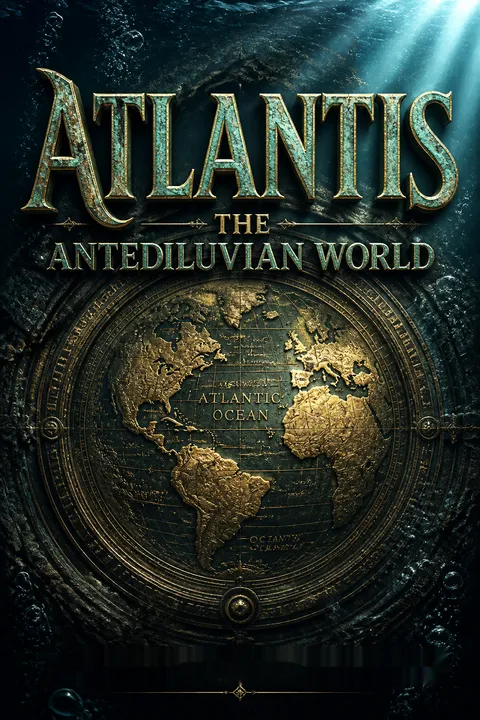
A sweeping central claim. In this 1882 book, Ignatius Donnelly argues that Atlantis was a real island in the Atlantic, opposite the Mediterranean, and the birthplace of civilization. He treats Plato’s account as history: an island empire extended into parts of Europe, Africa, and the Americas, then vanished in a catastrophic upheaval. Plato’s story reaches us through a chain of reports, from Egyptian priests to Solon and, generations later, to Plato’s family. Donnelly accepts the reported date of about 9,000 years before Solon as literal and uses Atlantis to explain ancient civilizations, myths, floods, and shared customs across continents.
The book’s organizing wager. If those many similarities all descend from one lost center, Atlantis could explain the scattered origins of civilization. Donnelly therefore asks readers to see the evidence as converging rather than isolated. But a powerful organizing idea is not itself proof: his case depends on whether each resemblance genuinely supports contact and whether alternative explanations have been ruled out.
What's compelling is the scale of the question: how can distant societies share striking motifs, technologies, or stories? Donnelly offers a single answer with enormous explanatory reach, a quality that makes the book memorable even when its conclusions fail. Modern historical method asks a harder question: what evidence would distinguish a real migration from literary invention or parallel development? A hypothesis gains strength not merely by connecting many facts, but by making predictions that could prove it wrong. Atlantis is the book's explanatory engine, but its very versatility makes careful testing essential.
Treat flood traditions as clues, not proof of one worldwide catastrophe
A recurring catastrophe. Donnelly compares the flood story in Genesis with the Babylonian account of Xisuthros, Indian stories of Manu, Greek versions involving Deucalion, and accounts from Central America and Indigenous North America. Some share details such as a warned survivor, a vessel, animals, and birds sent to find dry land. Others emphasize earthquakes, sudden inundation, or a world transformed by water. Donnelly argues that these are memories of Atlantis’s destruction, carried outward by people who escaped the disaster.
One cause, many versions. The variety of legends becomes evidence for a shared event in his account. He also treats differences in details as changes introduced by later tellers. Yet the stories are not equally independent or alike, and several were recorded after contact with Christian traditions. Their resemblance invites comparison, but it cannot by itself identify Atlantis as their source.
Flood traditions are valuable evidence about what communities feared, remembered, and considered morally significant. They can preserve the experience of devastating local events, including river floods and coastal inundations, without describing one global event. Comparative folklore works best when it tracks how a story changes across time and contact, rather than treating every version as an untouched record. Donnelly is right to take these narratives seriously as cultural evidence. The interpretive limit is that a shared plot is not a shared eyewitness account, especially when stories can travel through trade, religion, and later retelling.
Accept geological upheaval without mistaking it for proof of Atlantis
Real changes, real examples. Donnelly assembles reports of earthquakes, volcanic eruptions, rising islands, and land swallowed by water. He cites Icelandic eruptions, Java’s 1822 disaster, the short-lived island of Graham’s Island near Sicily, and the 1755 Lisbon earthquake. These cases show that coastlines and volcanic islands can change dramatically. He also points to deep-sea ridges and volcanic deposits in the Atlantic, interpreting them as the remains of a submerged continent.
A gap in the argument. Donnelly moves from the established fact that land can rise and sink to the much larger claim that a great Atlantic island sank during human history. The first does not establish the second. His examples demonstrate local geological catastrophe, while the soundings available to him could not verify the size, age, or disappearance of an inhabited continent.
This section shows both the strength and the danger of analogy. Documented disasters make sudden geological change imaginable, an important correction to the assumption that the Earth is fixed. But a small volcanic island appearing or vanishing does not establish that a continent-sized landmass did the same. Modern geology explains ocean ridges through plate tectonics and does not support a recently submerged Atlantic continent of Donnelly’s scale. The useful distinction is between possibility and evidence: natural processes can produce dramatic change, but a specific historical claim still needs geological traces that match its proposed scale and timing.
Similar customs invite comparison, but resemblance alone cannot prove contact
A catalogue of parallels. Donnelly compares architecture, pyramids, mummification, religious crosses, priesthoods, calendars, games, and burial practices in the Americas and the Old World. He gives special weight to customs such as the couvade, in which a father takes to bed after a child’s birth, and to the preservation of the dead in Egypt and Peru. To him, so many parallels are unlikely to have arisen independently and point to a shared Atlantean source.
What comparison can show. These examples help readers notice both genuine similarities and the questions they raise. But the book often treats resemblance as if it established a historical link, without demonstrating a route, date, or sequence of borrowing. Some comparisons are broad, others depend on selective examples, and a practice can acquire different meanings in different societies.
Cross-cultural comparison is most informative when it includes differences as well as likenesses. A shared tool shape, for instance, becomes stronger evidence of contact if its materials, manufacturing process, and archaeological dating also align. Human societies often face similar practical problems, so some customs can arise independently; other motifs spread readily through exchange. Donnelly’s wide-ranging comparisons are a useful prompt for inquiry, not a reliable shortcut to a common origin. The key question is not simply whether two practices look alike, but whether the evidence shows how, when, and through whom one could have reached the other.
Map crops and animals before assigning them to a lost empire
Biology as a bridge. Donnelly argues that similarities in plants and animals between the Old and New Worlds point to former land connections. He discusses horses, camels, and other animals, as well as the banana, whose seedless cultivated form he considers evidence of ancient human transport. He also emphasizes that the origins of major cereals such as wheat, barley, oats, and rye were obscure to the scholars he cites. He proposes Atlantis as the missing place where useful plants were domesticated and then distributed by colonists.
Distribution needs more than resemblance. The argument depends on nineteenth-century accounts of species and plant origins, several of which were mistaken or incomplete. Similar species may reflect ancient evolutionary history, while cultivated crops can spread through human exchange without a vanished continent. Donnelly’s observations about domestication raise worthwhile questions, but unknown origins do not identify Atlantis as the answer.
The movement of crops and animals is powerful evidence about human history, but it requires careful separation of biological ancestry from human transport. A plant’s current range does not reveal by itself where it was first cultivated, and the absence of a known wild ancestor may reflect extinction or gaps in research. Modern archaeology, genetics, and botany can test these histories using evidence Donnelly did not have. His strongest instinct is to treat food as a record of migration and exchange. His weaker step is to make missing information support one preferred explanation rather than leaving the question open.
Read Olympus, Eden, and ancient gods as Donnelly’s Atlantean geography
Myths become history. Donnelly interprets Greek gods as memories of human rulers from Atlantis. In this reading, Poseidon represents the island’s founder, Atlas its royal line, and Zeus a later king; their rivalries preserve distorted political events. He links Atlantis to the Greeks’ western paradise, the Hesperides and Elysian Fields, and to the Garden of Eden. The cross, which appears in many religious traditions, becomes a symbol of four rivers flowing from a central mountain in the lost homeland.
A striking reinterpretation. This approach turns myth into a map of migration and cultural memory, rather than a collection of supernatural tales. Donnelly sees similar sun worship and sacred geography in Egypt and Peru. But myths can combine political memory, natural imagery, ritual, and literary invention. A god’s resemblance to a king, or a paradise’s resemblance to an island, does not establish that the story records Atlantis.
Myth can preserve fragments of social memory, but it is rarely a transparent chronicle. Deities change as communities reinterpret them, and landscapes become sacred through ritual as well as through remembered events. Donnelly’s reading is imaginative because it treats myths from distant societies as parts of a single historical archive. A more cautious approach asks what each story meant in its own culture before looking for parallels elsewhere. This does not make comparison pointless. It makes comparison more precise, and protects against turning every shared symbol into evidence for the same lost place.
Trace the proposed migrations from Aztlan to Egypt, Ireland, and Peru
A world of colonies. Donnelly pictures Atlantean settlers moving toward Egypt and the Mediterranean, into Ireland and western Europe, and across the ocean to the Americas. He treats Aztlan, the ancestral homeland in Mexican traditions, as a memory of Atlantis. The builders known as the Mound Builders, whose earthworks occur across the Mississippi Valley, become another branch of this expansion. In Peru, he sees shared architecture, sun worship, mummification, and public works as evidence of an Atlantean colony.
A migration story assembled from clues. The proposed routes give the book a narrative arc: a central civilization expands, leaves cultural traces, and disappears while its settlements survive. Donnelly draws on traditions of eastern origins and on striking monuments, including Peruvian roads and enormous earthworks in North America. Yet the book’s parallels do not establish these migrations. Similar buildings or origin stories need independent chronological, linguistic, and archaeological support.
Migration is a strong historical explanation when it can be followed through multiple kinds of evidence, such as changing material culture, ancient DNA, and dated settlements. Donnelly’s map is unusually ambitious, connecting regions usually studied separately. Its breadth also means that each proposed link needs its own proof; a route cannot be confirmed simply because the destination has impressive monuments. The comparison between the Mississippi earthworks, Mesoamerican centers, and Andean states remains useful as a question about regional histories. Treating those societies as colonies of one Atlantic empire, however, erases the possibility of distinct local development.
Civilization is inherited, yet its origins require evidence, not analogy
A civilization passed down. Donnelly argues that major inventions and institutions were developed in Atlantis and transmitted to later peoples. He attributes agriculture, animal domestication, metalworking, the alphabet, navigation, the compass, and even gunpowder to this lost civilization or its colonies. His case draws on the sudden sophistication of early Egyptian records, Bronze Age artifacts found across Europe, and similarities between Maya signs and Old World alphabets.
An important distinction. Donnelly is right that knowledge accumulates through exchange and inheritance, and that societies rarely begin from nothing. But he often treats a resemblance, or the earliest surviving example, as proof of a single source. An alphabet’s development requires a dated chain of forms; a metal object requires evidence of its manufacture and movement. The book’s inventive proposals are not equivalent to demonstrated histories of these technologies.
Donnelly’s emphasis on cultural inheritance anticipates a durable insight: technologies rarely appear in a vacuum, and knowledge travels with people, trade, and institutions. Yet the history of invention is often branching rather than a single chain from one civilizational center. Similar tools can be devised independently, while a shared technology can be adapted beyond recognition. Archaeological context matters as much as resemblance: where an object was found, what lies with it, and how it is dated. This is where Donnelly’s argument is least secure, because he treats scattered artifacts as a connected record without establishing that sequence.
Treat gold’s sacred origins as a theory, not a settled economic history
From worship to money. Donnelly proposes that gold and silver first became valuable because they were sacred: gold represented the sun, silver the moon. He points to Peru, where gold was devoted to the sun and used lavishly in temples, and to similar celestial associations in other ancient cultures. In his account, Atlantis spread these beliefs and metals through its colonies, helping establish their later role as standards of value.
A memorable but incomplete explanation. The theory links religious symbolism to economic custom, giving a vivid account of why precious metals might have attracted attention. But Donnelly moves from sacred use to worldwide monetary value without tracing the intervening histories of exchange, scarcity, political control, and coinage. The idea is best read as one possible cultural influence, not as a complete explanation of how gold and silver became money.
The proposal usefully reminds readers that economic value is not purely a matter of physical utility. Symbols, ritual, status, and political authority can shape what societies treat as precious. But monetary history also depends on properties such as durability, divisibility, scarcity, and ease of exchange, as well as institutions that recognize particular standards. Those factors need not have one origin or remain constant across cultures. Donnelly’s account is vivid because it connects the sun, temples, and markets. Its limitation is the leap from a religious association in some societies to a universal explanation for precious-metal currency.
Analysis
Atlantis: The Antediluvian World is an ambitious work of nineteenth-century diffusionism. Donnelly begins with a real interpretive puzzle: ancient societies across the world share some stories, symbols, and technologies, while the beginnings of agriculture and civilization are difficult to reconstruct. He answers by making Atlantis the common source. His method is cumulative. A flood story, a pyramid, a shared ritual, or a similar word is presented as another ray pointing toward the same vanished center.
That method gives the book much of its narrative force, but weakens its historical case. The examples vary greatly in quality, and resemblance is frequently treated as evidence of descent without establishing dates, routes, or intermediate forms. Inconvenient differences can be explained as later corruption, which makes the theory difficult to falsify. The flood accounts, for example, are not all independent records of one event, and common motifs do not establish a single historical catastrophe.
Modern geology does not support Donnelly’s proposed recently submerged Atlantic continent. The ocean floor’s structure is explained through plate tectonics, and evidence for ancient contact between Atlantean colonies and pre-Columbian American civilizations is absent. The book’s claims about shared alphabets, animal distributions, and migrations also rely on outdated scholarship. Those corrections matter: the summary should preserve Donnelly’s case as an argument, not present it as established history.
The book remains valuable as a revealing exercise in how people build grand explanations from incomplete evidence. It gathers mythology, geology, archaeology, language, and natural history into one sweeping story, and repeatedly asks whether cultural memory can outlast the societies that produced it. Its most durable lesson is methodological. Cross-cultural comparison can generate fruitful questions, but a pattern becomes historical evidence only when chronology, context, and plausible transmission support it. Donnelly’s Atlantis is therefore more persuasive as a map of nineteenth-century intellectual ambition than as a reconstruction of humanity’s actual past.
Review Summary
Atlantis: The Antediluvian World receives mixed reviews. Some readers find it fascinating, praising Donnelly's extensive research and compelling arguments for Atlantis as the origin of ancient civilizations. Others criticize its outdated science, racist undertones, and far-fetched conclusions. The book is noted for its historical significance in popularizing Atlantis theories and influencing later works. While some appreciate its comparative mythology and cultural insights, others find it tedious and pseudoscientific. Overall, it remains a controversial but influential work in the realm of alternative history.
People Also Read


Glossary
Atlantis
Donnelly’s lost civilizationIn Plato’s dialogues, Atlantis is an island power said to have fought ancient Athens before disappearing in a catastrophe. Donnelly interprets the account literally and makes the island the source of civilization, global migrations, and many shared traditions. His book’s central claims are speculative and are not supported by modern geological or archaeological evidence.
Aztlan
Ancestral homeland in Mexican traditionsAztlan is the homeland from which several Indigenous Mexican peoples, including the Aztecs in some traditions, were said to have migrated. Donnelly interprets it as a memory of Atlantis because it lies in the east, across the sea, in accounts of ancestral origins. That interpretation is his theory, not an established identification.
Mound Builders
Builders of ancient North American earthworksMound Builders is a historical label Donnelly uses for the ancient peoples who constructed earthworks and enclosures across parts of eastern North America, especially the Mississippi and Ohio valleys. He argues that they were related to civilizations farther south and ultimately descended from Atlantis. The label does not identify a single people or prove such a migration.
Couvade
Father’s post-birth bed customCouvade refers to customs in which a father takes to bed or follows ritual restrictions around the birth of a child. Donnelly cites similar practices in parts of Europe and the Americas as evidence of shared ancestry. The term describes a varied set of customs, not one uniform rite or proof of historical contact.
FAQ
1. What is "Atlantis: The Antediluvian World" by Ignatius L. Donnelly about?
- Exploration of Atlantis: The book investigates the existence, civilization, and influence of the lost continent of Atlantis, arguing it was a real place described by Plato and the origin of many ancient cultures.
- Comparative analysis: Donnelly compares myths, religions, languages, and artifacts from both the Old and New Worlds to support his theory of a shared Atlantean heritage.
- Historical reconstruction: The work attempts to reconstruct Atlantis’s geography, society, and legacy using evidence from geology, archaeology, and ancient texts.
- Connection to global myths: Donnelly links Atlantis to stories like the Garden of Eden, the Golden Age, and worldwide flood legends.
2. Why should I read "Atlantis: The Antediluvian World" by Ignatius L. Donnelly?
- Challenging mainstream history: The book offers a provocative alternative to conventional views on the origins of civilization, suggesting a single, advanced source for global culture.
- Interdisciplinary approach: Donnelly blends geology, mythology, linguistics, and archaeology, making it a fascinating read for those interested in lost civilizations and ancient mysteries.
- Influence on later thought: The book has inspired generations of writers, researchers, and enthusiasts in the fields of alternative history and pseudoarchaeology.
- Rich in comparative detail: Readers gain insight into the similarities between ancient societies and the enduring power of myth.
3. What are the key takeaways from "Atlantis: The Antediluvian World" by Ignatius L. Donnelly?
- Atlantis as civilization’s cradle: Donnelly argues that Atlantis was the original source of arts, sciences, religion, and social organization for both the Old and New Worlds.
- Mythology as history: He interprets ancient myths, especially flood legends, as distorted memories of real events surrounding Atlantis’s destruction.
- Cultural diffusion: The book claims that similarities in pyramids, writing, metallurgy, and religious symbols worldwide are due to Atlantean colonization and influence.
- Call for further research: Donnelly encourages scientific investigation into Atlantis, believing future discoveries could revolutionize our understanding of human history.
4. How does Ignatius L. Donnelly use Plato’s account in "Atlantis: The Antediluvian World"?
- Historical record, not fable: Donnelly treats Plato’s dialogues "Critias" and "Timaeus" as accurate historical sources describing a real empire.
- Detailed descriptions: He highlights Plato’s specifics about Atlantis’s size, location, government by ten kings, and advanced architecture.
- Destruction narrative: Donnelly emphasizes Plato’s account of Atlantis’s sudden destruction by earthquake and flood, which he links to global flood myths.
- Geographical clues: The book uses Plato’s placement of Atlantis in the Atlantic Ocean as a basis for identifying its possible remains.
5. What geological and archaeological evidence does Donnelly present in "Atlantis: The Antediluvian World"?
- Submerged landmasses: Donnelly cites deep-sea soundings and the presence of islands like the Azores as remnants of a sunken continent.
- Volcanic activity: He points to volcanic deposits and active or extinct volcanoes in the Atlantic as evidence of catastrophic destruction.
- Land rising and sinking: The book references geological studies showing continents can rise and fall, paralleling the Atlantis story.
- Artifacts and architecture: Donnelly draws on similarities in pyramids, mounds, and other structures across continents as evidence of a shared origin.
6. How does "Atlantis: The Antediluvian World" by Donnelly connect global flood legends to Atlantis?
- Universal flood traditions: Donnelly notes that flood myths appear in nearly every culture, from the Hebrews and Greeks to American Indians.
- Shared narrative elements: Many legends involve a righteous survivor, a catastrophic deluge, and the repopulation of the earth, echoing Plato’s Atlantis story.
- Historical memory: He argues these myths are not mere stories but collective memories of Atlantis’s destruction.
- Comparative analysis: The book draws detailed parallels between the biblical Deluge, Chaldean, Hindu, and American flood stories.
7. What similarities between Old World and New World civilizations does Donnelly highlight in "Atlantis: The Antediluvian World"?
- Architecture and engineering: Both hemispheres built pyramids, mounds, aqueducts, and roads, with comparable sophistication.
- Metallurgy and crafts: The use of copper, bronze, gold, and iron, as well as pottery and textile arts, is found on both sides of the Atlantic.
- Religious practices: Sun worship, priesthoods, mummification, and flood myths are common to both Old and New World societies.
- Social customs: Marriage rites, music, writing systems, and symbols like the trident or serpent appear in both, suggesting a shared origin.
8. How does Donnelly explain the transmission of civilization and culture from Atlantis in "Atlantis: The Antediluvian World"?
- Colonial expansion: Donnelly claims Atlantis established colonies in Egypt, the Mediterranean, Europe, Africa, and the Americas.
- Cultural diffusion: He argues that key inventions, religious practices, and the alphabet spread from Atlantis to descendant nations.
- Mythological reinterpretation: Ancient gods and heroes are seen as Atlantean rulers whose deeds became mythologized.
- Survivors’ influence: After Atlantis’s destruction, survivors carried knowledge and traditions to new lands, shaping later civilizations.
9. What is the significance of the alphabet and writing systems in Donnelly’s "Atlantis: The Antediluvian World"?
- Origin in Atlantis: Donnelly claims the Phoenician and Maya alphabets derive from an original Atlantean writing system.
- Cultural transmission: The spread of phonetic alphabets and hieroglyphs is presented as evidence of Atlantean influence.
- Preservation of knowledge: Atlanteans are said to have inscribed laws and records on orichalcum columns, some of which may have survived the Flood.
- Link to civilization: The development and spread of writing is a key marker of Atlantean legacy in both the Old and New Worlds.
10. How does Donnelly interpret the role of sun-worship and mythology in "Atlantis: The Antediluvian World"?
- Original Atlantean religion: Sun-worship is described as the oldest religion of Atlantis, influencing Egyptian, Peruvian, and other mythologies.
- Gods as historical rulers: Donnelly suggests that many ancient gods were actually Atlantean kings and heroes, later deified in myth.
- Symbolism and rituals: Religious symbols like the trident and cross, and practices such as sacrifices and festivals, are traced to Atlantean origins.
- Mythology as history: Myths about floods, paradise, and divine punishment are seen as distorted memories of real events in Atlantis.
11. What does "Atlantis: The Antediluvian World" by Donnelly say about the social structure and civilization of Atlantis?
- Organized government: Atlantis was ruled by ten kings, each governing a portion of the island and subject territories.
- Social classes: The society included priests, artificers, shepherds, hunters, husbandmen, and warriors, each with defined roles.
- Advanced laws and customs: Laws were inscribed on orichalcum columns, and kings swore oaths to govern justly and peacefully.
- Wealth and culture: Atlantis was described as immensely wealthy, with magnificent temples, palaces, and a high standard of arts and agriculture.
12. What are the main colonies and descendants of Atlantis according to Donnelly in "Atlantis: The Antediluvian World"?
- Central American and Mexican civilizations: The Maya, Toltecs, and Aztecs are linked to Atlantean colonists from “Aztlan.”
- Egypt and the Old World: Egypt is presented as an Atlantean colony, inheriting its religion, pyramids, and knowledge.
- Mississippi Valley and Europe: The Mound Builders, Iberians, and early Irish are traced back to Atlantis through cultural and linguistic evidence.
- Peru and the Aryans: The Incas and Quichua peoples, as well as the Aryan race, are connected to Atlantean migrations and influence.
Download PDF
Download EPUB
.epub digital book format is ideal for reading ebooks on phones, tablets, and e-readers.








