

Key Takeaways
Your attitude is a chosen skill, not inherited DNA
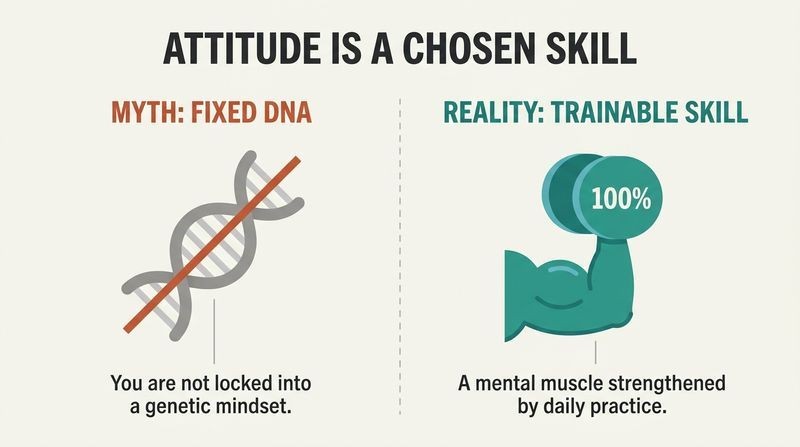
Keith Harrell's central claim is that attitude functions like a muscle you develop, not a trait you're born with. He cites psychologist Martin Seligman's research showing optimists can be trained, and that attitudes shift from negative to positive by coaching your inner dialogue.
Harrell offers a playful proof: assign each letter a number (A=1 through Z=26), and the word ATTITUDE sums to exactly 100. His point is that attitude is the one variable that gets you to 100 percent regardless of circumstances. He distinguishes two camps: people controlled by attitude (who believe hardship is permanent and personal) and people with attitude under control (who treat setbacks as temporary interruptions). The difference is not talent or luck, but the decision to manage your own mental state.
The nature-versus-nurture claim is broadly supported by modern research on learned optimism and neuroplasticity, though Harrell overstates it. Behavioral genetics suggests roughly 40 to 50 percent of dispositional happiness has a heritable set point (Lyubomirsky's work). The honest framing is that attitude is highly trainable within genetic bounds, not infinitely malleable. The ATTITUDE=100 gimmick is numerology, not evidence, and a skeptical reader should treat it as a mnemonic rather than a proof. Still, the actionable core holds: agency over interpretation is real, and Seligman's explanatory-style research genuinely shows that how people narrate setbacks predicts resilience and performance.
Guard the three gates feeding your mind: ears, eyes, mouth

Harrell treats the mind like a computer programmed through what he calls the ear-gate (what you hear), eye-gate (what you see), and mouth-gate (what you say). Whatever passes through gets recorded in the heart and shapes your attitude. His warning: the usual computing rule is garbage in, garbage out, but for the human mind it's worse, garbage in, garbage stays.
To defend the gates he offers concrete tools. A Personal Attitude Interrupt (PAI) is a physical gesture, like raising your hand, that stops negative input from lodging in your subconscious. Take Trash Out (TTO) is wiping away accumulated mental garbage. He advises avoiding late-night news since the subconscious is most receptive in the five minutes before sleep, and finishing any newspaper on a positive story.
The gate metaphor maps neatly onto cognitive behavioral therapy, which similarly treats inputs and self-talk as modifiable drivers of mood. The claim about pre-sleep suggestibility has real grounding: the hypnagogic state shows heightened memory consolidation, and studies link doomscrolling before bed to worse sleep and mood. Where Harrell risks oversimplifying is the implication that filtering negativity is always healthy. Suppressing or avoiding difficult information can shade into denial. A more robust practice pairs input hygiene with active processing, deciding what deserves attention rather than reflexively blocking anything unpleasant. The physical-gesture interrupts are clever, exploiting embodied cognition to disrupt rumination loops.
Between event and response sits your freedom to choose

Harrell's airport parable makes the point vivid. Facing a two-hour flight delay, one furious executive argued with a supervisor for 35 minutes and accomplished nothing; the plane still left late. Harrell instead ate, read a chapter of a book, bought popcorn, and called his grandmother, and forgot the delay entirely. Same circumstance, opposite experience, decided by choice.
He frames choice as the master key: the paths our lives take are set by the choices we make daily, and choosing nothing is itself a costly choice. His retail-manager example, Melissa, wakes each morning and consciously selects a good mood, treating every complaint as a chance to point out the positive. After a near-fatal car accident she credits choosing to live. Circumstances supply the raw material; you assign the meaning.
This echoes Viktor Frankl's insight from the concentration camps that the last human freedom is choosing one's attitude in any given set of circumstances, and Stephen Covey's stimulus-response gap. The psychological mechanism is cognitive reappraisal, one of the most empirically validated emotion-regulation strategies. A fair critique: the choice framing can curdle into victim-blaming, implying that anyone suffering simply chose poorly. Structural constraints, trauma, and clinical depression are not dissolved by deciding to be cheerful, and Harrell's own nod to chemical imbalance concedes this. The strongest reading is narrower and defensible: within whatever latitude circumstances allow, interpretation is a lever, and most people underuse it.
Turn painful turning points into learning points
Harrell's origin story anchors this lesson. An All-American college captain, he expected an NBA draft call in 1979 that never came. Devastated, he drifted to Alaska as a paint-prepper until a stranger scolded him for giving up. That jolt sent him home to reinvent himself, eventually reframing NBA as Natural-Born Abilities.
The framework: convert turning points (major life events) into learning points by extracting the lesson instead of hauling the wound forward. He names three types of emotional baggage that sabotage attitude:
1. If-only baggage (regret anchored in the past)
2. What-now baggage (stress under present pressure)
3. What-if baggage (worry about the future)
Self-awareness, the ability to notice feelings as they arise, is the tool for spotting which bag you're carrying so you can set it down rather than repack it.
The baggage taxonomy is a tidy diagnostic that mirrors clinical distinctions: If-only maps onto rumination, What-if onto anticipatory anxiety, both robust predictors of depression and generalized anxiety. Harrell's reframing instinct anticipates post-traumatic growth research (Tedeschi and Calhoun), which finds that many people report meaning, strength, and new priorities after adversity, not despite it. One caution worth adding: premature reframing can bypass necessary grief. Naming a loss a blessing too fast is what therapists call spiritual bypassing. The healthier sequence is to feel the loss fully, then mine it for learning. Harrell's own months-long struggle after the draft actually models this slower arc.
Swap anger and regret for gratitude and forgiveness
Harrell calls gratitude and forgiveness the two antidotes to a negative attitude, because they return responsibility to you and dissolve the fuel of resentment. He illustrates with a father who raged daily at his kids' toys blocking the driveway until a lonely neighbor, whose own daughter had grown and gone, said to enjoy it while it lasts. Nothing changed but perspective; the toys stayed, the anger vanished.
He insists forgiveness need not restore a harmful relationship, you can love from a distance, and that self-forgiveness matters as much as forgiving others. He shares repairing his own relationship with a distant father by simply calling on his birthday to say I love you, three of the most powerful and least-used words. His practice: count roughly a hundred things you're grateful for each day.
The neuroscience has caught up to Harrell's intuition. Gratitude journaling reliably raises well-being in controlled trials (Emmons and McCullough), and forgiveness interventions lower blood pressure, anxiety, and depression (Worthington's REACH model). His framing of ego as Edging God Out is a memorable device, but the deeper mechanism is that forgiveness relocates the locus of control from perpetrator to self, ending the rent-free occupation of the mind. The one hundred items a day target may be excessive to the point of rote; research suggests savoring a few things deeply beats mechanically listing many. Quality of attention, not quantity of items, drives the benefit.
A job without passion or purpose breeds a bad attitude
For seven years at IBM Harrell was frustrated and resentful, blaming his territory and bosses. The real problem was internal: he'd chased the job purely for security and prestige, setting a goal with no passion or purpose behind it. His attitude only transformed when, pushed out of his comfort zone into a training role in Atlanta, he discovered he loved teaching and public speaking.
His prescription is to build a game plan with dated mini-goals and a written affirmation for each. He distinguishes purpose (the goals you pursue) from passion (doing what you love), arguing the happiest, most energized people combine both. His mantra, borrowed from Yogi Berra: if you don't know where you're going, you might wind up someplace else. Goals are tools for focus, responsibility, and action.
Harrell's purpose-plus-passion pairing prefigures the Japanese concept of ikigai, the intersection of what you love, what you're good at, and what the world values. Self-determination theory (Deci and Ryan) supports his diagnosis: intrinsic motivation, autonomy, and mastery predict engagement far better than extrinsic rewards like security or prestige, which explains his IBM malaise despite a stable paycheck. A useful nuance he underplays: passion is often cultivated, not discovered. Cal Newport argues that skill and mastery frequently precede passion rather than following it, which fits Harrell's own arc, where competence at training sparked the love, not the reverse. Purpose can be built through doing.
Respond deliberately instead of reacting emotionally to setbacks
Harrell distinguishes response from reaction: a response is a constructive mental adjustment with the long view engaged; a reaction is raw emotion that usually worsens things. He notes we have Emergency Response Teams, not Reaction Teams, and that a doctor wants your body responding to treatment, not reacting.
Central to this is being pre-active, planning your reply before trouble strikes. When a hurricane cancelled his flight, other travelers slept on airport floors while Harrell, anticipating the mess, booked a hotel and arrived rested. His hazard toolkit: expect problems (the problem is not the problem, it's a marker of where you are), remember aftershocks follow every quake and divorce, and keep faith that victory lies on the other side of the challenge. He cites the claim that people waste up to 92 percent of worry on things that never matter.
The response-reaction distinction is essentially the difference between the prefrontal cortex and the amygdala, deliberate executive function versus fast threat-driven impulse. Pre-activity resembles what psychologist Peter Gollwitzer calls implementation intentions, if-then plans that dramatically raise follow-through by pre-deciding behavior before the emotional moment arrives. The 92 percent worry statistic is folklore with no solid source, though the underlying pattern is real: studies by Borkovec found roughly 85 percent of worried-about outcomes never materialized, and people coped fine with the rest. Harrell's hurricane example is the strongest teaching here, showing that foresight, not positivity alone, converts a shared crisis into a private advantage.
Reprogram yourself with affirmations, visualization, and attitude talk
Harrell's Attitude Tool Kit is a set of self-motivation techniques. Affirmations are positive statements spoken aloud in present or future tense, avoiding weak words like try or hope; as a stuttering schoolboy he repeated I don't stutter anymore so intensely he read aloud flawlessly to his class for the first time. Visualization is mental rehearsal: he cites Maxwell Maltz's experiment where players who only imagined free throws improved nearly as much as those who physically practiced, and Nelson Mandela picturing freedom through 27 years of prison.
Attitude talk is silent positive inner dialogue that overwrites old programming. Rounding out the kit: enthusiasm (from Greek roots meaning God within), humor (15 minutes of belly laughter rivals moderate jogging), spiritual empowerment, exercise, and positive greetings, his own being super-fantastic.
Mental rehearsal is well validated: neuroimaging shows imagined movement activates overlapping motor cortex regions with real movement, and Olympic training programs build visualization in deliberately. Affirmations are more conditional. Research by Joanne Wood found that positive self-statements can backfire for people with low self-esteem, widening the gap between belief and reality. The fix, which Harrell intuits by pairing affirmations with action plans, is process affirmation (I am preparing) over grandiose outcome affirmation. His enthusiasm etymology is genuine and evocative. The laughter-as-exercise claim overstates the physiology, but the endorphin and stress-reduction benefits of laughter are real and increasingly documented in psychoneuroimmunology.
Nobody succeeds alone; recruit an A-Team and evict toxic people
Harrell rejects the self-made myth: no one makes it alone, and the people you allow close have the greatest impact on your attitude. He calls his inner circle an A-Team (Attitude Team) built on shared vision, shared values, and mutual benefit, populated through networking rooted in a service attitude. After a self-indulgent speech to peers, one honest colleague scored it and told him he'd missed the mark; that painful feedback served him better than the standing ovation.
Just as important is removing toxic influences, since pessimism is contagious. He profiles four types to limit exposure to:
1. Judges and critics
2. Professional victims who blame everyone
3. Soap opera stars addicted to drama
4. The bitter-to-the-core who resent others' success
The contagion claim is now hard science. The Framingham study by Christakis and Fowler found happiness spreads through social networks up to three degrees of separation, and emotions transmit through unconscious mimicry (Hatfield's emotional contagion research). Harrell's service-first networking anticipates Adam Grant's finding in Give and Take that generous givers, not takers, ultimately build the most valuable networks. The toxic-people typology is useful but risks caricature; real relationships are rarely so cleanly villainous, and cutting people off can be an avoidance tactic dressed as boundary-setting. The wiser reading of his advice is to manage exposure and influence deliberately, reserving full eviction for the genuinely corrosive.
Meet every change with a Whatever-It-Takes attitude
When Harrell told his security-loving father he was leaving IBM to speak professionally with no clients lined up, his father fired questions: Get a roommate? Sell your car? Move home? Harrell answered each Whatever it takes, and his father blessed him: you've got WIT, a Whatever-It-Takes attitude.
He argues resisting change causes changecosis, a self-inflicted ailment marked by rigidity, denial, and blame. Change unfolds in four stages: doubting whether you have what it takes, the disorienting free-fall after leaping, gaining confidence as action produces results, and finally embracing the new you. He backs risk-taking with a roll call of ignored naysayers: Fred Smith got a C for the FedEx concept, Parker Brothers rejected Monopoly for 52 reasons, and Decca passed on the Beatles for disliking their sound.
The four-stage model closely tracks established change psychology, from the Kubler-Ross curve to Prochaska's transtheoretical stages of change, and the free-fall stage matches what William Bridges called the neutral zone, the disorienting gap between letting go and the new beginning. The naysayer highlight reel is motivating but suffers survivorship bias: for every ignored expert who was wrong about the Beatles, thousands of stubborn dreamers ignored correct warnings and failed. WIT is a virtue only when paired with the judgment to know which risks are worth taking. Harrell's own contingency planning, the roommate and the sold car, quietly shows that smart risk hedges even as it commits.
Plant seeds in others to leave a mark that can't be erased
Harrell closes with the parable of a young Ghanaian who left his village for seven years and returned with only three cocoa seeds, planting what became one of his nation's primary crops. The lesson: small positive acts compound across lives you'll never see. Exhausted and slipping toward depression on a road trip, he heard Pastor Creflo Dollar preach on making a mark that cannot be erased, and shifted from asking what's in this for me to what can I do for others.
He illustrates with examples: Janelle Hail turning breast cancer into a national foundation, and coaches Rutledge and Parker who moved players from the weight room to character classes, invoking the Stanford figure that success is 8 percent ability and 92 percent attitude, and won a state championship.
The closing pivot from self-improvement to service reflects a robust finding in well-being research: prosocial spending and volunteering boost happiness more reliably than self-focused consumption (Dunn, Aknin, and Norton). Adam Grant's work reinforces that contribution, not accumulation, sustains long-term motivation and buffers burnout, which is precisely the road-weariness Harrell describes. The 8-percent-ability, 92-percent-attitude statistic attributed to Stanford is apocryphal and appears in no verifiable study, so treat it as rhetoric, not data. The seed metaphor's real strength is its humility about invisibility: it reframes impact as something you trust rather than measure, which is psychologically healthier than chasing visible credit.
Analysis
Attitude Is Everything is a framework-driven self-help book built on ten sequential steps, structured around Keith Harrell's own arc from undrafted basketball hopeful to IBM trainer to America's Attitude Coach. Its genre is classic American motivational literature, sitting in the lineage of Norman Vincent Peale, Zig Ziglar, and Dale Carnegie, and it is unabashedly Christian in its later chapters. The audience is working professionals navigating corporate uncertainty, downsizing, and career reinvention, which dates and grounds it in the post-9/11, merger-and-acquisition anxiety of the early 2000s.
The book's genuine strength is its toolkit: memorable, actionable devices (PAI, TTO, WIT, the three gates, turning points to learning points) that give abstract advice concrete handles. Harrell is a gifted storyteller, and his personal vulnerability, particularly the childhood stutter, lends credibility that pure exhortation lacks. The four-stage change model and the emotional-baggage taxonomy are legitimately useful diagnostics that align with established psychology.
The weaknesses are equally clear. The book leans heavily on unverifiable statistics (92 percent of worry, 8 percent ability versus 92 percent attitude, ATTITUDE equals 100) presented as evidence when they function as rhetoric. Its relentless positivity risks minimizing structural barriers, clinical illness, and legitimate grief, occasionally sliding toward the toxic-positivity critique that later scholarship has leveled at the whole genre. The choice-is-everything thesis, taken literally, cannot survive contact with poverty, trauma, or depression, though it holds well within the latitude of ordinary professional life.
Where it endures is as practical cognitive training. Stripped of the numerology and the survivorship-biased success stories, Harrell's core is defensible modern psychology: interpretation is a lever, self-talk is trainable, environments and relationships shape mood contagiously, and service outperforms accumulation for durable well-being. Read as a disciplined practice rather than a magic formula, it delivers real value.
Review Summary
Attitude is Everything receives mostly positive reviews, with readers praising its motivational content and practical strategies for developing a positive mindset. Many found the book inspiring and life-changing, appreciating the author's personal anecdotes and step-by-step guidance. Some critics felt the book lacked depth or contained repetitive information. Overall, readers commend the book for its emphasis on the power of attitude in shaping one's life and success, though opinions vary on its effectiveness and originality.
People Also Read










FAQ
1. What is Attitude is Everything by Keith Harrell about?
- Core message: The book teaches that attitude is the foundation of personal and professional success, influencing every aspect of life from relationships to career achievements.
- Practical roadmap: Keith Harrell provides 10 actionable steps to help readers develop and maintain a positive attitude, even during challenging times.
- Blend of inspiration and action: The book combines motivational insights with practical tools, real-life examples, and daily exercises for attitude improvement.
- Focus on transformation: Readers are guided to turn positive thinking into positive action, making attitude a driving force for lasting change.
2. Why should I read Attitude is Everything by Keith Harrell?
- Attitude’s impact on life: Harrell demonstrates that attitude determines your experiences, opportunities, and overall happiness, making it essential for anyone seeking growth.
- Empowerment and control: The book empowers readers to take responsibility for their mindset, showing that attitude is a choice, not a fixed trait.
- Comprehensive toolkit: Readers gain access to practical strategies, such as the Attitude Tool Kit and Personal Attitude Interrupts (PAIs), to overcome negativity and setbacks.
- Support for uncertain times: The advice is especially valuable during periods of change or instability, helping readers stay resilient and focused.
3. What are the key takeaways from Attitude is Everything by Keith Harrell?
- Attitude controls outcomes: Your attitude is the controlling force behind your actions and results, making it crucial to success.
- Be pre-active, not reactive: Planning and preparing for challenges before they arise helps reduce stress and improve responses to adversity.
- Faith and perseverance: Maintaining faith and a positive outlook, especially during tough times, is essential for overcoming obstacles.
- Remove negativity: Identifying and eliminating negative inputs is necessary to keep your mind clear and focused on your goals.
4. What are the 10 life-changing steps in Attitude is Everything by Keith Harrell?
- Step-by-step guide: The steps include understanding attitude’s power, choosing your attitude, identifying and reframing bad attitudes, and finding purpose and passion.
- Proactive mindset: Steps like being pre-active, motivating yourself, and building supportive relationships help you anticipate and overcome challenges.
- Embracing change: Adopting a “whatever-it-takes” attitude and leaving a legacy are key to long-term fulfillment and impact.
- Practical application: Each step is supported by real-life examples, exercises, and tools for daily practice.
5. How does Keith Harrell define "attitude" in Attitude is Everything?
- Attitude as life: Harrell defines attitude as a state of mind or feeling that reflects what resides in your heart, essentially equating attitude with life itself.
- Control center concept: The heart is described as the control center for attitude, meaning that changing your attitude requires changing your inner beliefs and feelings.
- Programming analogy: The mind is likened to a computer, programmed by what you hear, see, and say, emphasizing the importance of controlling these inputs.
- Attitude is a choice: Harrell stresses that external circumstances do not have to dictate your attitude; you have the power to choose your response.
6. What is the significance of the "ear-gate, eye-gate, and mouth-gate" concept in Attitude is Everything?
- Input channels: These gates represent how you receive information—ear-gate (hearing), eye-gate (seeing), and mouth-gate (speaking)—which all influence your attitude.
- Programming your mind: Just as a computer is programmed, your mind is shaped by these inputs, making it crucial to filter out negativity.
- Personal Attitude Interrupt (PAI): Harrell recommends using PAIs to block negative programming, such as physically signaling to stop negative talk.
- Conscious filtering: Protecting these gates helps maintain a positive internal dialogue and prevents harmful attitudes from taking root.
7. What is the "Take Trash Out" (TTO) method in Attitude is Everything by Keith Harrell?
- Mental garbage removal: TTO is a metaphor for consciously discarding negative thoughts and influences from your mind, similar to taking out physical trash.
- Physical ritual: Harrell suggests a physical gesture—wiping your forehead and making a "whoosh" sound—to reinforce the act of removing negativity.
- Protecting your mind: The method includes guarding your ear-gate from negative comments and using PAIs to filter out harmful inputs.
- Daily practice: TTO is presented as a foundational step for maintaining a clear, positive mindset every day.
8. How does Keith Harrell define and use affirmations in Attitude is Everything?
- Affirmations as self-coaching: Affirmations are positive statements repeated daily to reprogram your subconscious with empowering beliefs.
- Attributes of effective affirmations: They should be personal, uplifting, vivid, emotionally resonant, and use strong, definitive language.
- Practical examples: Harrell provides affirmations tailored to specific challenges, such as job loss or health issues, to inspire action and positivity.
- Integration with other tools: Affirmations are most effective when combined with visualization and consistent repetition as part of the Attitude Tool Kit.
9. What is the difference between responding and reacting according to Attitude is Everything by Keith Harrell?
- Response vs. reaction: A response is a thoughtful, constructive adjustment, while a reaction is an impulsive, emotional action that can worsen situations.
- Long-term perspective: Responding keeps the big picture in mind and helps you stay in control of your attitude and decisions.
- Pre-active mindset: Being pre-active—planning ahead—supports responding rather than reacting, empowering you to handle challenges effectively.
- Practical examples: Harrell illustrates this with scenarios like job loss, showing the benefits of responding with action over reacting with panic.
10. How does Attitude is Everything by Keith Harrell address fear and its impact on attitude?
- Fear as a barrier: Fear is identified as a major obstacle that can paralyze action and foster negative attitudes.
- Conquering fear: The book encourages facing fears through faith, seeking support, and monitoring internal dialogue to transform fear into motivation.
- Spiritual empowerment: Harrell emphasizes the role of faith and prayer in overcoming fear and maintaining a positive outlook.
- Real-life stories: Examples, such as overcoming a fear of flying, illustrate practical steps for managing and defeating fear.
11. What is the "Attitude Tool Kit" in Attitude is Everything by Keith Harrell and what does it include?
- Purpose of the toolkit: The Attitude Tool Kit offers practical methods to motivate yourself and sustain a positive attitude.
- Key tools: It includes affirmations, visualization, attitude talk (positive self-talk), watching your words, positive greetings, enthusiasm, spiritual empowerment, humor, and exercise.
- Daily integration: Harrell recommends using these tools together and practicing them daily for maximum effectiveness.
- Personal story: He shares his own journey, such as overcoming a stutter, to demonstrate the power of these tools in real life.
12. How does Keith Harrell suggest building and maintaining supportive relationships in Attitude is Everything?
- Building your A-Team: Surround yourself with supportive people who share your values and vision, providing encouragement and honest feedback.
- Attitude for relationships: Approach relationships with service, humility, and unconditional acceptance, focusing on trust and mutual benefit.
- Managing toxic influences: Limit exposure to negative individuals and create a nontoxic environment to protect your attitude.
- Practical strategies: Harrell offers tips for disarming negativity, setting boundaries, and fostering positive connections for sustained growth.
Download PDF
Download EPUB
.epub digital book format is ideal for reading ebooks on phones, tablets, and e-readers.








