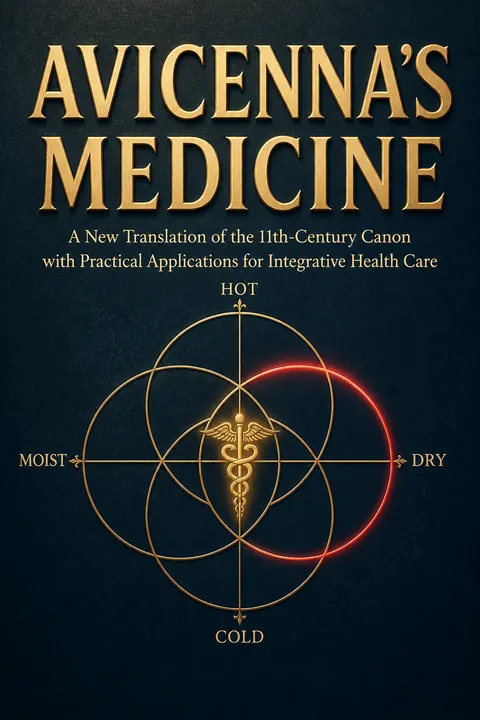


Key Takeaways
Read Avicenna as a clinician testing inherited knowledge, not merely preserving it.
A book built from practice. Avicenna did not simply compile ancient authorities. He studied their texts and commentaries, treated patients, and compared inherited explanations with what he observed. According to the book's account, he began studying medicine at thirteen and was treating patients by sixteen. At seventeen, he was summoned to care for the seriously ill ruler of Bukhara after other physicians had given up. His reported success earned him access to a major library and a post as court physician.
Knowledge kept moving. His Canon gathered ideas from Greek, Persian, Indian, and other traditions, then examined them through clinical experience. It became a standard university text in Europe for centuries. This edition translates only Book I, which focuses on general principles, health preservation, and disease.
What's valuable here is the model of scholarship: inherit knowledge, test it against experience, and revise without treating age or prestige as proof. That approach resembles modern evidence-based practice at its best, where clinical observation can challenge a theory and theory can sharpen observation. The story of Avicenna's rise also reminds readers that medical knowledge travelled across languages and institutions, rather than developing within a single cultural lineage. The book's admiration is warranted, but reports of a dramatic cure cannot establish the accuracy of an entire medical system. The stronger case rests on his method of critical synthesis.
Track functional change before symptoms harden into visible tissue damage.
Disease as a process. Avicenna defines illness by abnormal function, not merely by a symptom or a damaged-looking organ. His first broad category is dystemperament, a departure from an individual's healthy balance of warmth, coldness, moisture, or dryness. He also classifies structural disorders and discontinuities, such as breaks or wounds. More than one type can contribute to a single illness.
Illness has a timeline. Many diseases, in his account, pass through four phases: onset, worsening, a peak or plateau, and decline. The point is practical: a finding means different things at different stages, and treatment should change accordingly. The translators connect early functional disruption to modern homeostasis, the body's regulation of its internal conditions, but that comparison does not prove the medieval account describes the same mechanisms.
This framework's enduring strength is its insistence that disease unfolds, rather than appearing all at once when a test crosses a threshold. Contemporary clinical reasoning also distinguishes risk, early dysfunction, established pathology, and recovery. That makes the book's emphasis on timing a useful corrective to snapshots of illness. Still, the historical categories cannot substitute for current diagnostic criteria: vague changes in function can have many causes, and early intervention is not automatically beneficial. A useful modern reading keeps the process-oriented question, what is changing and when, while using validated tools to determine what the change means.
Define health against a person's own baseline, not a universal ideal.
Balance is relative. Temperament, or mizaj, is the book's way of describing a person's or organ's characteristic balance of warmth, coldness, moisture, and dryness. Avicenna argues that healthy balance is not one fixed point for everyone. It varies with the body, age, organ, and environment, and should be judged against an appropriate baseline.
Variation matters clinically. A quality that is normal for one person or organ might be abnormal for another. This idea anticipates the importance of individual differences in diagnosis and treatment. The book also divides people by race and geography, including judgments about which populations are more balanced. Those claims reflect historical assumptions, not sound contemporary biology, and should not be carried forward as medical facts.
The strongest insight is not the old temperature-and-moisture scale, but the refusal to confuse population averages with individual health. Modern medicine faces the same problem when reference ranges or treatment responses differ across age, physiology, and context. A baseline can make a change more meaningful than a universal cutoff. Yet individualized care needs safeguards: personal history should enrich, not replace, reliable evidence, and social labels must not be mistaken for biological destiny. The book's historical ranking of populations is a clear example of why its adaptable principle deserves more attention than every claim built upon it.
Treat the four humors as a historical model, not modern blood chemistry.
A food-to-body theory. In Avicenna's account, humors are mixtures produced as food is digested and transformed, then used to nourish the body. The four primary humors are blood, phlegm, yellow bile, and black bile. Each can be normal or abnormal, and illness may involve a change in its quantity, quality, or both. Water is not itself a humor in this model because it helps transport and process nourishment rather than nourishing tissue directly.
A modern reinterpretation. The translators propose that the categories roughly correspond to biochemical groups such as proteins, fats, and organic acids. They use examples such as abnormal aggregation of a blood protein to make the analogy vivid. But the proposed matches are interpretations, not established biochemical identifications, and the ancient categories do not map neatly onto present-day molecules.
The humoral idea is more sophisticated than the familiar caricature of four literal liquids sloshing around the body. It is a functional account linking diet, digestion, circulation, and illness, which helps explain why it remained useful to practitioners. The translators' attempt to connect it to biochemistry is an invitation to compare models, not a discovery that the categories have been scientifically verified. Similarity of purpose does not establish identity of mechanism. Readers can preserve the systems-level question, how food and metabolism shape health, while rejecting an unsupported one-to-one equivalence between medieval terms and modern molecules.
Protect health through ordinary routines before reaching for interventions.
Health is managed daily. Avicenna gives prevention a central place, organizing health around six necessary influences: surrounding air; food and drink; movement and rest; psychological activity; sleep and wakefulness; and eating and elimination. The translators' practical summary also stresses maintaining balance, choosing suitable food, clearing waste, preserving the body's structure, and attending to environment and habits.
Small choices accumulate. Exercise is valued partly because Avicenna believes digestion leaves residual material that can build up. Moderate movement, he argues, helps the body process it without relying continually on strong drugs or purges. He also adapts food, rest, and activity to a person's condition. These are historical recommendations, not a modern treatment plan, and the book includes interventions that should not be attempted without qualified care.
This approach gives health a wider frame than the clinic visit: air quality, daily movement, food, rest, and emotional strain all belong in the picture. Contemporary public health likewise recognizes that health is shaped by routines and surroundings, not only by treatment after diagnosis. The useful lesson is to notice modifiable conditions before seeking a dramatic fix. But prevention can become blame if structural constraints are ignored. Clean air, safe places to exercise, and nourishing food are not equally available. Individual habits matter, while the conditions that enable them matter too.
Use energy and hydration as questions, not proof of Avicenna's biology.
A unifying biological idea. The book repeatedly links life to heat and moisture. Avicenna's “innate heat” describes the body's sustaining capacity; its decline is associated with weakness, aging, and ultimately death. He also treats digestion as a sequence that turns food into usable nourishment, with incomplete or excessive processing producing harmful material.
A modern analogy, not a translation. The translators connect innate heat to cellular energy production, especially mitochondrial activity and ATP, and connect moisture to hydration and water produced during metabolism. These comparisons make the old framework easier to discuss alongside biology, but Avicenna did not know about mitochondria or ATP. The parallels are retrospective interpretations, not proof that his concepts anticipated modern cell biology in precise terms.
Energy is a productive lens because cells need energy to maintain specialized functions, and hydration affects many physiological processes. Thinking across levels, from cell to organ to whole body, can make biological explanations more coherent. The caution is equally important: heat in a medieval medical theory is not automatically equivalent to ATP production, and moisture is not a complete account of tissue hydration. Modern terms can illuminate an analogy while also making it sound more conclusive than it is. The best use of this comparison is to generate questions that can be tested, not to certify the historical model.
Interpret signs together, in context, rather than trusting one reading.
Observation was systematic. Avicenna treats the pulse, urine, stool, pain, movement, appearance, and function as clues to what is happening inside the body. A sign might indicate a location, a cause, or a stage of illness. He advises examining urine under consistent conditions, since food, drink, exercise, and time can alter its appearance. He also warns that a symptom can have several meanings depending on the patient and situation.
Patterns over isolated clues. The goal is to combine observations and compare them with the person's usual condition. The translators connect this habit to the limits of relying on a single laboratory marker. Yet the detailed pulse and urine interpretations in the Canon are historical diagnostic claims, not validated alternatives to modern tests or professional medical assessment.
The book makes a persuasive case for clinical attention that does not outsource all judgment to a number on a report. Context matters: a measurement is shaped by timing, behavior, and the person being measured. Modern diagnostics also work best when findings are interpreted with symptoms, history, and other evidence. The needed nuance is that pattern recognition can mislead, especially when many ambiguous signs are combined without validation. Avicenna's observational discipline is worth recovering; the specific interpretations require independent testing and should not displace established diagnosis.
Match intervention to cause, phase, and the patient's remaining strength.
Treatment requires a sequence. Avicenna distinguishes illness without a harmful humor, which calls for changing the imbalance, from illness with a harmful humor, which may also require removing it. He describes direct treatment, gradual efforts to prevent deterioration, and preventive action before illness takes hold. He advises judging an intervention by the affected organ, disease stage, severity, and the patient's strength, rather than applying one remedy to everyone.
Do not confuse history with instruction. The Canon discusses purging, emesis, bloodletting, and other procedures in detail. These methods can cause serious harm and are not recommendations for self-treatment. The broader principle is more safely applied through modern care: identify the likely cause, weigh benefits and harms, and avoid treating a symptom in ways that worsen the underlying problem.
The insistence on matching treatment to cause and patient capacity is a durable principle of clinical decision-making. It also anticipates a central challenge in pharmacology: the same intervention can help one person and harm another. The book's own procedures show why good intentions are not enough. Purging or bloodletting may appear logically consistent within a system and still be dangerous. Modern medicine adds trials, safety monitoring, and formal contraindications to address that risk. A thoughtful reading separates the useful decision rule from therapies whose safety and effectiveness have not been established.
Adjust daily care to season, place, and the body's changing demands.
Context changes the regimen. Avicenna considers climate, air, water, terrain, travel, and seasonal transitions part of health. He describes spring as a period for lighter food and less fullness, summer as a time to limit heat and exertion, and winter as a time for more warming food and movement. For travelers, he emphasizes planning around fatigue, unfamiliar food, thirst, and water quality.
A useful idea with limits. The specific seasonal disease predictions reflect medieval theory and should not be treated as medical fact. The lasting practical point is that routines may need to change when temperature, activity, diet, and access to familiar resources change. The book's focus on clean air and safe water also places individual health within the conditions of a person's surroundings.
Seasonal thinking encourages people to treat the body as responsive to its surroundings rather than sealed off from them. Modern clinical practice also accounts for heat, cold, travel, and environmental exposure, especially when these alter risk or access to care. The book's attention to preparation is particularly practical: a traveler who anticipates fatigue and unfamiliar water is less likely to be caught unready. Its explanations of which winds or seasons cause particular humoral disorders are not reliable contemporary science. Keep the context-sensitive habit, and test specific causal claims against current evidence.
Analysis
This book is both a translation project and an argument about how medicine should think. The first Book of Avicenna's Canon supplies the historical architecture: health and illness are states of a changing whole, shaped by digestion, environment, activity, sleep, and individual constitution. Avicenna's clinical reputation and the Canon's centuries of influence give that architecture a compelling story. The work also shows a physician distinguishing theoretical principles from practical reasoning, then organizing diagnosis and treatment with unusual breadth.
The modern authors add a second layer. They translate specialized Arabic terms and interpret them through contemporary biology, especially cellular energy, mitochondria, hydration, and biochemical classes. This makes the text accessible and raises valuable questions about where reductionist measurement misses interactions among bodily systems. But their strongest claims are also the least secure. Equating humors with modern molecular classes, or innate heat with mitochondrial activity, is not demonstrated by historical resemblance. The book sometimes moves from analogy to validation too quickly. Its criticisms of modern medicine also overstate the case: laboratory testing and targeted therapies can be indispensable, even when they benefit from a broader clinical view.
The most defensible contribution is therefore methodological rather than biomedical. Avicenna's work rewards careful observation, attention to causal sequences, and a refusal to assume that a respected authority is beyond revision. It also exposes how translation shapes interpretation: a term rendered as spirit, humor, or heat can imply more than the original evidence supports. Readers should approach the Canon neither as obsolete superstition nor as a concealed version of modern science. It is a sophisticated historical system whose questions about context, function, prevention, and individual variation remain useful, while its specific explanations and therapies require critical evaluation. This distinction preserves the intellectual value without confusing historical importance with present-day proof.
Review Summary
Avicenna's Medicine receives high praise for its comprehensive approach to traditional medicine, merging Greek, Islamic, Indian, and Chinese concepts. Readers appreciate its timeless wisdom, detailed explanations of diseases and treatments, and insights into humoral theory. Some find it complex for non-professionals, while others note its continued relevance in modern medicine. The book's extensive coverage of topics like anatomy, pharmacology, and surgery is highlighted. A few reviewers mention challenges with translations or editions, but overall, it's regarded as a masterpiece of medical literature.
People Also Read


Glossary
Unani medicine
Greco-Arabic medical systemA medical tradition developed from Greek, Arabic, Persian, and other sources, and organized in Avicenna's Canon around health preservation, disease causes, bodily qualities, and treatment. In this book, it is presented as a holistic system that attends to the person, environment, and daily regimen. Its historical concepts should not be assumed to match modern biomedical mechanisms.
Temperament (mizaj)
Individual bodily balanceIn Unani medicine, temperament describes the balance of warmth, coldness, moisture, and dryness in a person or organ. Avicenna treats healthy temperament as relative rather than a single universal ideal, with differences according to the individual, organ, age, and environment. The translators compare it to homeostasis, but the terms are not identical scientific measures.
Dystemperament
Departure from healthy balanceA state in which a person's or organ's temperament deviates from its normal range in warmth, coldness, moisture, or dryness. In Avicenna's disease model, this deviation can impair function and may be accompanied by imbalance in the humors. The term belongs to the historical framework and does not correspond directly to a modern diagnosis.
Humors (akhlat)
Food-derived bodily mixturesAvicenna describes four primary humors: blood, phlegm, yellow bile, and black bile. They arise through the body's processing of food and contribute to nourishment and health. Each can be normal or abnormal in quality and quantity. The translators propose modern biochemical analogies for these categories, but those correspondences are interpretations, not established identifications.
Innate heat
Life-sustaining bodily capacityA central Unani concept describing the body's internal capacity that supports life, digestion, and the transformation of nourishment. Avicenna associates its decline with aging and its extinction with death. The translators interpret it through modern ideas about cellular energy and mitochondrial activity, but Avicenna's term does not name those mechanisms.
Raw humor
Insufficiently matured materialIn the Canon, a raw humor is material that has not been fully transformed through digestion and bodily processing. Avicenna treats its quality, accumulation, and location as relevant to disease, not merely its quantity in circulating fluid. The translators compare maturation to the processing or breakdown of biological material, an analogy rather than a verified biochemical equivalence.
Faculties
Organ-based capacitiesFaculties are the capacities through which organs carry out functions. Avicenna's account distinguishes psychological faculties associated with the brain, natural faculties concerned with nourishment and reproduction, and vital or animalistic faculties associated with movement and breath. These categories organize how the Canon links organs, functions, and health, but they are not modern anatomical or physiological classifications.
Phases of disease
Stages in illness progressionAvicenna describes many illnesses as moving through four phases: incipience, increment, acme, and decline. These indicate the course of the illness, not simply its severity, and the appropriate treatment may differ by phase. The framework reflects a historical model of disease progression and should not be used in place of contemporary diagnostic criteria.
Parsimony phylogenetics
Method for comparing biological profilesA data-analysis approach discussed by the modern authors for organizing complex omics measurements. They describe using it to create cladograms, or branching diagrams, that compare patterns across biological samples. In their argument, this method may help identify broader profiles when single molecular markers are inadequate. The book's discussion presents this as a research approach, not a standard clinical diagnostic method.
FAQ
What's Avicenna's Medicine about?
- Historical Medical Text: Avicenna's Medicine is a translation of the Canon of Medicine, a pivotal 11th-century text by Avicenna, which integrates ancient medical knowledge with modern integrative health care practices.
- Holistic Approach: The book emphasizes a holistic understanding of health, focusing on the balance of humors and temperaments, central to Unani medicine, and their relevance to diagnosing and treating diseases.
- Cultural Significance: Avicenna's work has influenced both Eastern and Western medical traditions, and this translation aims to make his historical insights accessible to contemporary readers.
Why should I read Avicenna's Medicine?
- Rich Historical Insight: The book offers a deep dive into the evolution of medical thought and practice over a millennium, highlighting Avicenna's contributions as the "Prince of Physicians."
- Integrative Health Applications: It provides practical applications of Avicenna's principles for modern integrative health care, encouraging a return to holistic approaches in medicine.
- Cultural Understanding: Reading it provides a broader understanding of the evolution of medical thought across cultures, reflecting the rich history of Islamic medicine.
What are the key takeaways of Avicenna's Medicine?
- Humoral Theory: Health is maintained through a balance of four humors: blood, phlegm, yellow bile, and black bile, with imbalances leading to disease.
- Temperament Importance: Each individual has a unique temperament influenced by factors like age, gender, and environment, crucial for diagnosing and treating illnesses.
- Holistic Health Management: Emphasizes the importance of diet, lifestyle, and environmental factors in maintaining health, advocating for individualized treatment.
What are the best quotes from Avicenna's Medicine and what do they mean?
- "Life is sustained by heat, and grows by moisture.": Highlights the importance of maintaining proper body temperature and hydration for health.
- "Medicine is a science through which we figure out the states of the human body.": Reflects Avicenna's view of medicine as a systematic study of health and disease.
- "Disease is treated by the opposite and health is preserved by the similar.": Emphasizes that treatments should counteract specific imbalances causing disease while maintaining health through supportive measures.
How does Avicenna define health and disease in Avicenna's Medicine?
- Health as Balance: Defined as a state of balance among the body's humors and temperaments, with harmony leading to optimal function.
- Disease as Imbalance: Arises from an imbalance in the humors or external disruptions, encouraging a holistic view focusing on prevention and balance.
- Innate Heat and Moisture: Emphasizes the roles of innate heat and moisture in maintaining health, suggesting their preservation is crucial.
What is the significance of humors in Avicenna's Medicine?
- Four Primary Humors: Blood, phlegm, yellow bile, and black bile must be balanced for optimal health, each with specific qualities and functions.
- Health and Disease Connection: Imbalances in these humors can lead to various diseases, making their understanding crucial for diagnosis and treatment.
- Modern Relevance: Encourages a holistic view of health that considers diet, lifestyle, and emotional well-being, even in contemporary practices.
How does Avicenna's Medicine approach treatment?
- Individualized Medicine: Emphasizes treatment based on a person's unique temperament and humoral balance, contrasting with one-size-fits-all models.
- Diet and Lifestyle: Advocates for dietary management and lifestyle adjustments as primary methods for restoring health.
- Holistic Methods: Includes herbal remedies, dietary changes, and lifestyle modifications aimed at restoring balance within the body.
What specific dietary recommendations does Avicenna make in Avicenna's Medicine?
- Meat and Grains: Recommends consuming meat from young animals and clean grains like wheat for nourishment and health maintenance.
- Avoiding Green Vegetables: Advises against excessive consumption of green, leafy vegetables, viewing them as medicinal rather than nutritious.
- Seasonal Eating: Emphasizes eating according to the seasons, aligning food choices with environmental conditions to support health.
How does Avicenna view the role of exercise in health?
- Essential for Health: Views exercise as fundamental for health preservation, helping maintain innate heat and prevent waste accumulation.
- Types of Exercise: Categorizes exercises into gentle and strenuous, emphasizing moderation and individual health status.
- Impact on Digestion: Believes exercise enhances digestion and waste elimination, vital for maintaining a healthy body.
How does Avicenna's Medicine explain the concept of dystemperament?
- Definition of Dystemperament: Refers to an imbalance in the body's humors, leading to various health issues.
- Types of Dystemperament: Categorized into hot, cold, dry, and moist types, each requiring specific treatment approaches.
- Management Strategies: Includes dietary adjustments, lifestyle changes, and treatments like venesection and purgation to restore balance.
What is the role of air and environment in Avicenna's Medicine?
- Essential for Life: Air is crucial for respiration and overall health, with clean, fresh air maintaining the body's innate heat.
- Environmental Impact: Seasonal changes and geographic location significantly affect health, influencing humoral balance.
- Air Quality: Linked to health outcomes, with polluted or stagnant air leading to illnesses, highlighting the relevance of environmental health.
How does Avicenna's Medicine relate to modern integrative health care?
- Holistic Framework: Provides a framework aligning with modern integrative health care practices, emphasizing interconnectedness of body, mind, and environment.
- Preventive Focus: Emphasizes prevention through diet, lifestyle, and environmental factors, resonating with contemporary preventive medicine.
- Relevance of Traditional Knowledge: Bridges ancient medical wisdom with modern practices, highlighting traditional knowledge's value in addressing contemporary health challenges.
Download PDF
Download EPUB
.epub digital book format is ideal for reading ebooks on phones, tablets, and e-readers.








